A profusion of Peake

gormenghast_box.jpg

Bellgrove, young Titus and Barquentine by Mervyn Peake. Case designed by Robert Hollingsworth.

I’d thought about posting the covers of my boxed set of Gormenghast paperbacks a couple of years back when there was a flurry of blogospheric attention being given to Penguin cover designs…thought about it then never got round to it. The reason for doing so now is twofold: firstly I’ve been re-reading the books, and secondly some Gormenghast-related news emerged this week which gives this post an additional relevance.

gormenghast1.jpg

Fuchsia by Mervyn Peake.

The set of Peake paperbacks which Penguin published in 1968 (and their subsequent reprints) were the first editions of Peake’s trilogy which I encountered so I can’t help but regard them as the ones, the only copies I could countenance reading. That may change, however (see below). I’ve no idea how scarce the boxed edition is but the books are reprintings from 1970 so I presume Penguin put out a boxed gift set to make the most of Peake’s posthumous success. I always liked the presentation which is the standard Penguin Modern Classics format of the period, it leaves to you how much you want to regard the books as works of fantasy or simply novels of a rather grotesque and highly imaginative reality. Titus Groan‘s sketch of a glowering and thoroughly unglamorous Fuchsia was a daring choice for a cover intended to lure a newer, younger audience to Peake’s work. The drawing says a great deal about the author’s unsentimental attitude towards his creations; compared to the florid and often delicate covers of the fantasy books being published by Ballantine in the late Sixties (a series which included the Gormenghast trilogy), it seems shockingly unpleasant.

Continue reading “A profusion of Peake”

Ecce homo

brabander.jpg

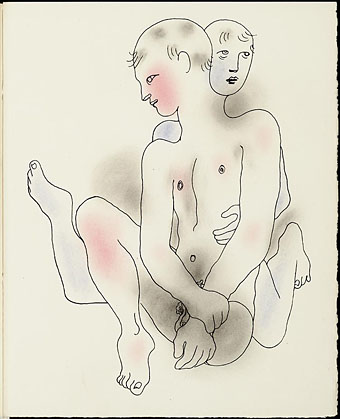
Saint Sebastian appears rather unconcerned by his wounds in this contemporary version by Yves De Brabander, part of his Ecce Homo series which reworks some recurrent themes from western art history.

Elsewhere on { feuilleton }
The gay artists archive

Previously on { feuilleton }
The art of Robert Sherer
The art of Joan Sasgar
Saint Sebastian in NYC
Guido Reni’s Saint Sebastian
The art of Takato Yamamoto
Fred Holland Day

Sinister silhouettes

ovchinnikov.jpg

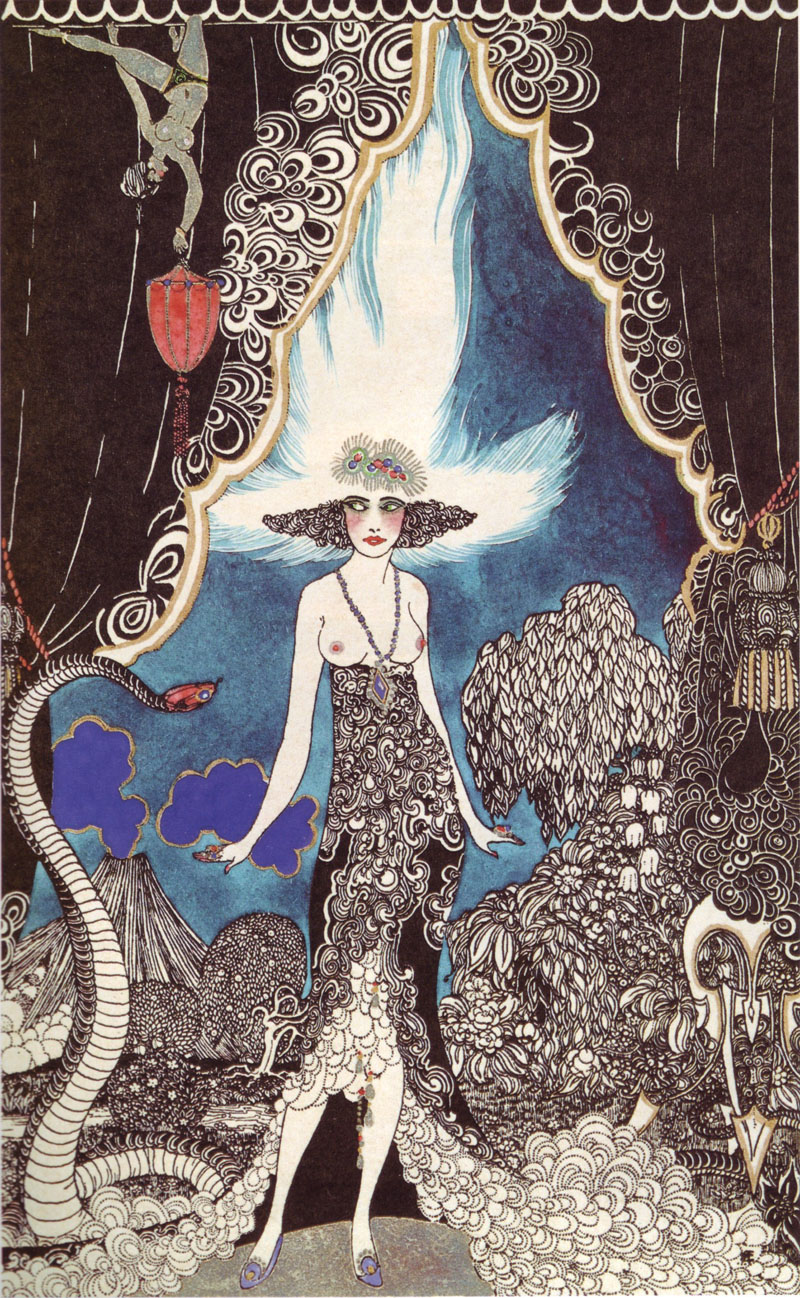
One of a series of creepy children’s illustrations by Alexander Ovchinnikov which look like the work of pioneering animator Lotte Reiniger pushed into a darker world. Ovchinnikov’s Behance portfolio has a similar set mixing silhouettes with photography.

Elsewhere on { feuilleton }
The illustrators archive

William Burroughs’s Stuff

ross.jpg

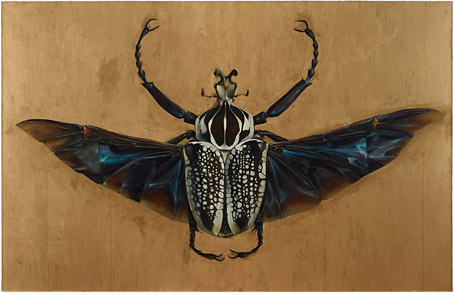
Some of it, anyway. This bullet grasshopper was owned by William Burroughs and photographed by Peter Ross as part of a series presenting some of the writer’s possessions. No clues as to who constructed this but I like the way it combines two of Burroughs’ persistent interests, insects and weapons. Via Coudal.

Previously on { feuilleton }
Jewelled butterflies and cephalopods
William S Burroughs: A Man Within
Geoffrey Haberman’s brass insects
Elizabeth Goluch’s precious metal insects
Kelly McCallum’s insect art
The art of Jo Whaley
The art of Philippe Wolfers, 1858–1929
Lalique’s dragonflies
Lucien Gaillard

Metamorphosis Victorianus

bucaille1.jpg

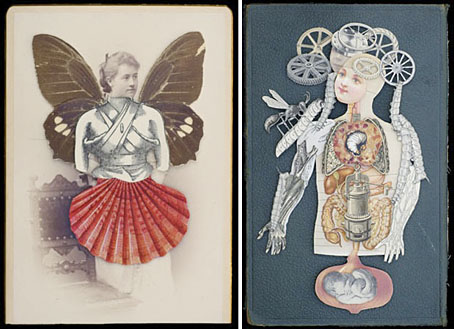
left: L’antre du magicien (1948); right: La Distribution des soleils (1945).

I’m rather late with this one, Metamorphosis Victorianus—Modern Collage, Victorian Engravings & Nostalgia is an exhibition running at the Ubu Gallery, New York until the end of the month. Lots of the names one would expect to see in a collection of engraving collagists although no Wilfried Sätty. The examples shown here are by Max Bucaille.

Max Ernst (1891–1976), with such work as his shocking and seminal illustrated collage-novel, La Femme 100 têtes (1929), influenced an entire wave of artists who looked towards the Surrealist and his use of 19th Century engravings as a point of departure within their own work in this medium. The first generation of artists were Ernst’s contemporaries, who worked primarily in the 1930s with significant connection to the Surrealists: Joseph Cornell (1903–1972), Jind?ich Štyrský (1899–1942), Otto Hofmann (1907–1994), Franz Roh (1890–1965), Max Bucaille (1906–1992), and Gerome Kamrowski (1914–2004). Those a generation later, including Ray Johnson (1927–1995), Bruce Conner (1933–2008), and Jess (1923–2004), each separately rediscovered Ernst, specifically choosing to use this type of collage as a jumping off point towards other conceptual ends.

bucaille2.jpg

Capture (1946).

Previously on { feuilleton }
Max (The Birdman) Ernst
The Robing of The Birds
Gandharva by Beaver & Krause
The art of Stephen Aldrich