The recurrent pose 47

leighton3.jpg

After subjecting Frederic Leighton to undignified speculation yesterday, his work is now ushered into the homoerotic environs of the Recurrent Pose Archive. These engravings are from a Leighton-themed edition of The Art Annual which is undated but which refers to The Sluggard as being a work in progress so that would date it to 1894 or 95. Despite throwing barbs at Leighton, I bought the bound copy of four issues mainly for the feature on the artist’s work and his extraordinary home. The three other artists represented—Millais in his horribly dull post-PRB phase, Alma-Tadema and Meissonier—can’t compete with Leighton’s academic flamboyance.

Cymon And Iphigenia (1884) can be seen in all its splendour at the Google Art Project, not the only painting of Leighton’s where the depiction of drapery seems to be the principal concern. The figure caught in the Flandrin pose is robed and tucked away in the background.

leighton4.jpg

Frederic Leighton’s sculptures

leighton1.jpg

An Athlete Wrestling with a Python (1877).

The python wrestler by Frederic Leighton (1830–1896) has appeared here before, and it’s one sculpture that always catches my eye for having appeared in my adaptation of The Call of Cthulhu in 1988. It’s now one of the Leighton works available for close viewing at the Google Art Project although only from a single angle, something that seems a flaw in web presentation of three-dimensional art.

leighton2.jpg

The Sluggard (c. 1895).

In the same collection is a copy of Leighton’s The Sluggard from the Yale Center for British Art. What’s notable about this piece is that it’s generally offered as Exhibit A for the homo-prosecution during discussion of the artist’s sexuality. The Sluggard to which most people refer is the life-size bronze which is a lot more robust and muscular than this lithe and twinky specimen. According to a note at the V&A Yale’s copy is one of many cast from the clay model for the life-size version. What was excused at the time as a late Victorian exercise in contrapossto looks even more camp—in the Philip Core definition—than the finished piece which makes me wonder whether Leighton beefed up the original to disguise something. Core defined camp as “the lie that tells the truth”; camp art always pretends to be one thing whilst simultaneously telegraphing a very different message about its creator. Leighton’s sexuality is a source of continual speculation which means it’s unlikely now to be resolved in any direction, and the artist himself would loathe our prurience, but it’s only by reappraising works in this way that we’re able to show that gay people didn’t magically erupt via some process of spontaneous generation in 1967. If Leighton had any dalliances whilst holidaying in the gay resort of Capri then he was perfectly circumspect. Back at home, as a President of the Royal Academy he had a rather pompous and remote reputation, being memorably described by Violet Paget as “something between an Olympian Jove and a head waiter.” For more camp, see The Narcissus Hall in the artist’s incredibly lavish home, Leighton House in London, where 1st Baron Leighton, PRA, lived splendidly alone.

Previously on { feuilleton }
Angelo Colarossi and son
Men with snakes

Jean de Bosschère’s Folk Tales of Flanders

bosschere01.jpg

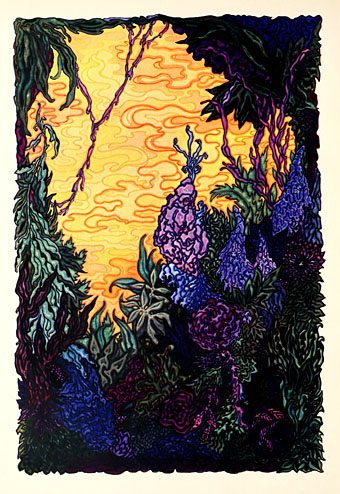
The illustrations of Belgian artist Jean de Bosschère (1878–1953) aren’t as easy to find as those of his British and American contemporaries so it’s a shame there isn’t more of his idiosyncratic work at the Internet Archive. Folk Tales of Flanders is there, however, an edition from 1918 featuring a number of colour plates and many black-and-white illustrations. For once I prefer the paintings over the line drawings, de Bosschère’s colour work perhaps owes something to Edmund Dulac’s style but it’s a lot more eccentric, especially here where he’s required to depict the activities of a host of anthropomorphic animals. The eccentricities extended to the artist’s life and the books he wrote, one of which is an autobiography entitled Satan l’Obscure (1933). A lighter work, Weird Islands (1921), was featured at BibliOdyssey a couple of years ago.

bosschere02.jpg

bosschere03.jpg

Continue reading “Jean de Bosschère’s Folk Tales of Flanders”

Weekend links 103

fripp.jpg

Robert Fripp photographed by Chris Stein. Video posterization by Michael Schiess.

Scans of Synapse, “The electronic music magazine”, are posted here. Issues range from 1976 to 1979, and include interviews with the more notable synthesists of the period, Kraftwerk included. Brian Eno was regularly interviewed by synth mags despite always being reluctant to talk about what equipment he might be using; sure enough he’s featured here. Far more interesting is a longer interview with Robert Fripp that catches the guitarist as he emerged from his self-imposed retirement in the mid-70s with the extraordinary Exposure album. (See a 1979 promo video for that here.) Related: TR-808 drum sequences in poster form by Rob Ricketts.

• More electronic music from the 1970s: “[Don Buchla] showed me that the idea of playing a black-and-white keyboard with one of these instruments was completely ridiculous. It was inappropriate and had nothing to do with the way you would use an electronic instrument.” Suzanne Ciani talks to John Doran about electronic music composition. A collection of her early recordings, Lixiviation, is released by Finders Keepers. Related: The Attack of the Radiophonic Women: How synthesizers cracked music’s glass ceiling.

• “Her writing—full of immigrants, circus animals, freaks, socialists, hipsters, servants, and suffragettes—revels in the atmosphere of the ‘Yellow Nineties,’ a period characterized by Wildean decadence and art for art’s sake.” Jenny Hendrix on Djuna Barnes.

brunovsky.jpg

More etchings by Albin Brunovsky at But Does It Float.

• More scanned magazines: the Fuck You Press archive at Reality Studio. A trove of rare publications produced by Ed Sanders in the 1960s with contributions from world-class writers, William Burroughs included.

• “[My parents] were horrified by what I did, but they encouraged me to keep doing it because I was obsessed, and what else could I do?” John Waters writing in (of all places) the Wall Street Journal.

• A time-lapse assembly of Alfred Hitchcock’s Rear Window (1954) by Jeff Desom who explains how he did it here.

The Occult Experience: a 95-minute documentary on the international occult scene, filmed in 1984–85.

• Compost and Height re-post A Gold Thunder, a song by Julia Holter first sent to them in 2010.

• Drawings by Bette Burgoyne.

Schroeter’s Salomés

Cats are liquids

Fade Away And Radiate (1978) by Blondie (featuring Robert Fripp) | Exposure (1978) by Peter Gabriel (produced by and featuring Robert Fripp) | Exposure (1979) by Robert Fripp | Babs And Babs (1980) by Daryl Hall (produced by and featuring Robert Fripp) | Losing True (1982) by The Roches (produced by and featuring Robert Fripp).

Gerald Scarfe’s Long Drawn-Out Trip

scarfe.jpg

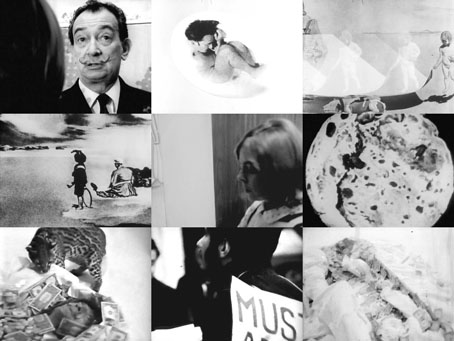
Yet more animation. Long Drawn-Out Trip was Gerald Scarfe‘s first foray into the medium, produced in 1972 at the request of the BBC who sent the artist to Los Angeles to try out the new De Joux animation system. The process needed only six or eight drawings per second of film thus reducing the usual amount of labour. Scarfe says in the first book collection of his work, Gerald Scarfe (1982), that the 16-minute film was still very labour intensive.

The subject of Long Drawn-Out Trip is Los Angeles and America itself, the concerns being the same ones that Ralph Steadman was depicting the same year in his illustrations for Hunter S. Thompson’s Fear and Loathing on the Campaign Trail ’72: venality, violence, vulgarity and the omnipresent spectre of Richard Nixon, a president who had the good fortune to be drawn many times by two of Britain’s greatest living satirists although he wouldn’t have thanked them for it. In Scarfe’s film we also find Mickey Mouse being reduced to his constituent lines and colours after smoking a joint. In the 1980s Scarfe regularly drew Ronald Reagan wearing the famous mouse ears, something that nearly got him fired from his post at the Sunday Times after Rupert Murdoch saw one of the cartoons. Long Drawn-Out Trip had a more favourable effect when it was seen by Roger Waters who asked Scarfe to create some animations for Pink Floyd’s Wish You Were Here tour. The animated sequences for The Wall have their origin in this short film. Watch it here.