Le horreur cosmique

hpllibrio.jpgI’ll be in Paris this week so some French-related postings are in order.

Michel Houellebecq’s HP Lovecraft: Against the World, Against Life (which I still haven’t read) has been in the news again recently, with a number of reviews appearing in UK newspapers and magazines, most of which present the by-now rather tired spectacle of reviewers who normally wouldn’t give any of this nasty pulp stuff a second thought having to take Lovecraft seriously because Houellebecq is a serious author. (“He’s a bad writer!” they bleat. And Lou Reed is a bad singer; you’re missing the point, you fools.) The Observer last week had one of the better ones. Last year the Guardian published an extract from Houellebecq’s book.

Curious how often it requires the French to make the Anglophone world look anew at marginalised elements of its own culture; Baudelaire championed Edgar Allan Poe, it was French film critics who gave us the term “film noir” when they identified a new strain of American cinema and the Nouvelle Vague writers and filmmakers were the first to treat Hitchcock as anything other than a superior entertainer. The French have always liked Lovecraft so it was no surprise to me at least when Houellebecq’s book appeared.

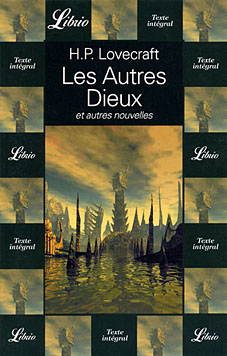
Oddly enough, the only association I’ve had so far with French publishing is the use of my 1999 picture of Cthulhu’s city, R’lyeh, on the cover of a reprint of HPL stories from Houellebecq’s publishing house (above). Something I’ll be looking for in Paris if I have the time will be more of Philippe Druillet‘s Lovecraft-inflected work. Druillet has been working with the imagery of cosmic horror since the late 60s and even illustrated the work of William Hope Hodgson, one of HPL’s influences and an English writer the broadsheet critics have yet to hear about. Take a look at these pictures for stories written before the First World War then go and look at some stills from the latest Pirates of the Caribbean movie. What was once the preserve of Weird Tales and other pulp magazines is now mainstream culture.

Previously on { feuilleton }
• Davy Jones
• Charles Méryon’s Paris
The art of Jessica Joslin

diminuto.jpg

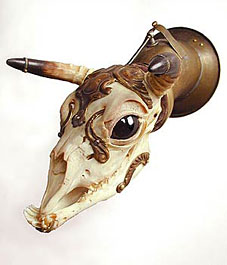
Diminuto, 7″x5″x6″ (2004)
Antique hardware, bone, leather, cast painted glass eyes.

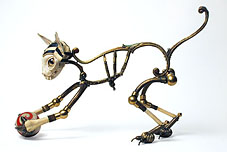
lupe.jpg

Lupe, 11″x6″x16″ (2005)
Antique hardware, brass, bone, glove leather, painted wood ball, glass eyes.

Gorgeous stuff, reminds me of some of Jan Švankmajer‘s sculptural works (which are possibly an inspiration) but with an added dimension of Victorian playfulness.

Via Boing Boing.

Rembrandt’s vision

rembrandt.jpg

The Netherlands celebrate four hundred years of Rembrandt’s genius.

While looking around for links I noticed this story for the first time:

Margaret S. Livingstone and Bevil R. Conway, neurobiologists at Harvard Medical School, say Rembrandt’s many self-portraits reveal that his eyes are focused in slightly different directions, depriving him of the “stereo” effect that makes vision three-dimensional. As a result, they argue, Rembrandt would have struggled with depth perception – though he may never have known he had a vision defect.

Rembrandt’s flat world view may have helped him more precisely capture reality on a flat canvas, where painters create the illusion of three-dimensions through techniques such as shading. In fact, Livingstone and Conway say that visual artists are far more likely to be “stereoblind” than the general public, suggesting that limited depth perception may actually be an advantage over normal sight.

“Art teachers often instruct students to close one eye in order to flatten what they see,” the researchers write in today’s New England Journal of Medicine, explaining their theory about Rembrandt. “Stereoblindness might not be a handicap – and might even be an asset – for some artists.”

Similar assertions from doctors about conveniently dead artists surface from time to time; we had Michelangelo suffering from Asperger’s recently and I recall a story about Shakespeare having a brain tumour based solely on scrutiny of very vague portraits. The Rembrandt story is significant for me because my eyes have always been mis-aligned and I don’t see stereoscopically. I have permanent double-vision as a result, something people are always surprised to hear, although I only notice this when I think about it. My brain treats the mis-aligned (and weaker) data from my right eye as redundant information and so ignores it.

The point is, whether Rembrandt had a similar defect or not (and I’m sceptical; how can you be so sure by looking at a few paintings?), it’s very difficult, if not impossible, to judge what effect this has on artistic ability without conducting a mass survey. Even then I doubt that you’d discover much. The doctors in this case want to imply that Rembrandt’s damaged eyesight gave him an extra edge with regard to depth perception but I find this incredibly difficult to demonstrate with any degree of certainty. What gives Rembrandt more of an edge (and keeps us looking at his work) is his exceptional drawing skill and peerless mastery of the oil medium, something that’s partly innate talent but mostly prodigious ability and the result of years of labour. Whatever assistance stereoblindness might lend him would be a very small thing next to this combination of natural gifts and hard work.

Previously on { feuilleton }
• “One measures a circle, beginning anywhere?”