Weekend links 214

/sfsound.jpg

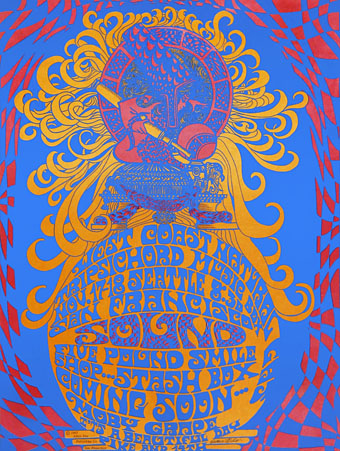
San Francisco Sound (1967). Art by Wallace Studio, Seattle.

• RIP gay porn pioneer Peter de Rome. BUTT posted de Rome’s surprisingly daring Underground (1972), a film in which two men have an unfaked sexual encounter on a New York subway train. That film and others are available on the BFI’s DVD collection. Related: Brian Robinson remembers a director of films whose supporters included Andy Warhol, William Burroughs and John Gielgud.

• “My stuff is implicitly critical of television as it is now,” explains Jonathan [Meades], “Television used not to be as openly moronic as it has become…” A lengthy and typically pugnacious Meades interview with Remy Dean.

Thurston Moore remembers the Burroughs-themed Nova Convention staged in New York in 1978. William Burroughs 100—Nova Convention is a retrospective exhibition running at Red Gallery, London, next month.

How are we expected to take seriously…any work which appears to have engaged less than the whole passionate attention of its author? To be fobbed off, at the last, with something which we feel to be less true than the author knew it to be, challenges the importance of the whole art of writing, and instead of enlarging the bounds of our experience, it leaves them where they are.

Katherine Mansfield was also a book reviewer.

• JG Ballard’s Crash is reissued in August by Fourth Estate with an introduction by Zadie Smith. There’s a tantalising extract from the intro at the NYRB or you can read the whole thing if you’re a subscriber.

• “Between 1959 & 1980 Shirley Collins changed the course of folk music in England & America. Thirty years after disappearing, she’s back.”

Photos by Anne Billson of one of the more attractive Parisian arcades. Related (in a flâneur sense): Christina Scholz‘s Vancouver dérive.

• “Why did Borges hate soccer?” asks Shaj Matthew. Related: George Orwell on the same subject.

• Mixes of the week: FACT mix 447 by Forest Swords, and Programme 13 from Radio Belbury.

• At Dangerous Minds: Roland Topor’s cheerfully violent illustrations from Les Masochistes.

• Rainy Day Psychedelia: Ben Marks on Seattle’s neglected 1960s poster scene.

• Strange Flowers looks at Oskar Schlemmer‘s Triadic Ballet designs.

• A Journey to Avebury: Stewart Lee interviews Julian Cope.

It’s All Over Now (1963) by The Valentinos featuring Bobby Womack | It’s All Over Now (1964) by The Rolling Stones | It’s All Over Now (1974) by Ry Cooder
Weekend links 213

munro.jpg

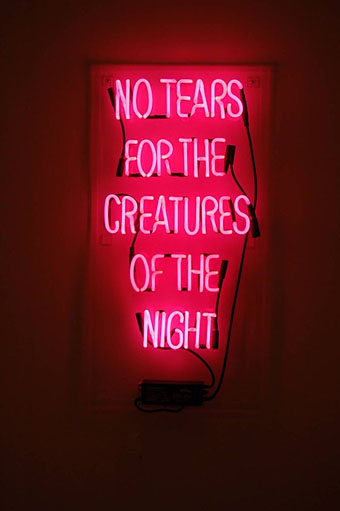
No Tears for the Creatures of the Night (2005) by Will Munro.

• Steve Barker’s On The Wire show on BBC Radio Lancashire is one of the longest-running music shows on British radio but it’s not broadcast in London so you seldom hear it mentioned at all. (It’s also the only radio show I’ve appeared on, oddly enough.) Some of Barker’s shows, which predominantly feature dub and reggae artists, can now be heard at Mixcloud.

• “As protagonist after protagonist is undone by temptation and lust, one can’t help but divine a sinister double entendre in the book’s title – something nocturnal and obscene.” James Lovegrove on the reissue of Robert Aickman’s 1964 collection of “strange stories”, Dark Entries.

Coil vs. Kenny Loggins sounds like no contest, and so it proved in 1988 at the Mike Tyson/Michael Spinks fight. There’s another surprising connection between Tyson and Industrial culture with the poster that Neville Brody designed for the boxer’s Tokyo bout.

Ventriloquism: Unheimlich manoeuvres: Sarah Angliss (who performs as Spacedog) on the history of ventriloquist dummies. With a bonus appearance from the great Ray Alan and Lord Charles. Related: the Vent Haven Museum.

• I’ve been wanting to read Proust’s À la recherche du temps perdu for years but always hesitate over which translation to choose. As Leland de la Durantaye shows, the arguments about translating Proust into English are still unresolved.

Music For A Good Home 3: a collection of 31 rare or unique tracks by a variety of artists including Belbury Poly, Pye Corner Audio, and Grumbling Fur. All proceeds go to Shelter.

David Cronenberg – The Exhibition is running throughout the summer at the EYE Film Institute in Amsterdam showing props and other materials from the director’s films.

• “’I’m in pictures,’ John Wayne explained when Nabokov cordially inquired about his line of work.” Blake Bailey on Vladimir Nabokov’s unpublished Lolita screenplay notes.

• Original artwork for the Linweave Tarot (1967) at Sweet Jane’s Pop Boutique. As noted before, the full set of cards is probably the grooviest ever created.

• Mixes of the week: Secret Thirteen Mix 118 by Ensemble Economique, and a Wyrd Daze Solstice mix from The Ephemeral Man.

• At One With Chaos & Abandonment: The Irrepressibles’ Jamie McDermott talks to Joseph Burnett about his music.

From the Zodiacal Light, a new track from Earth with vocals by Rabia Shaheen Qazi.

• The Ultimate Chinatown Filming Location Map of Los Angeles.

Tuxedomoon at Pinterest.

Dark Companion (1980) by Tuxedomoon | Dark River (1990) by Coil | Dark Turn Of Mind (2011) by Gillian Welch

Midsummer

midsummer8.jpg

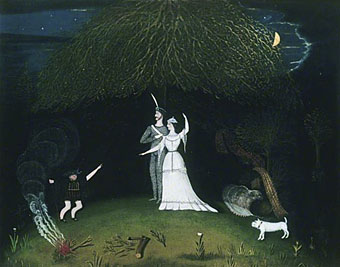
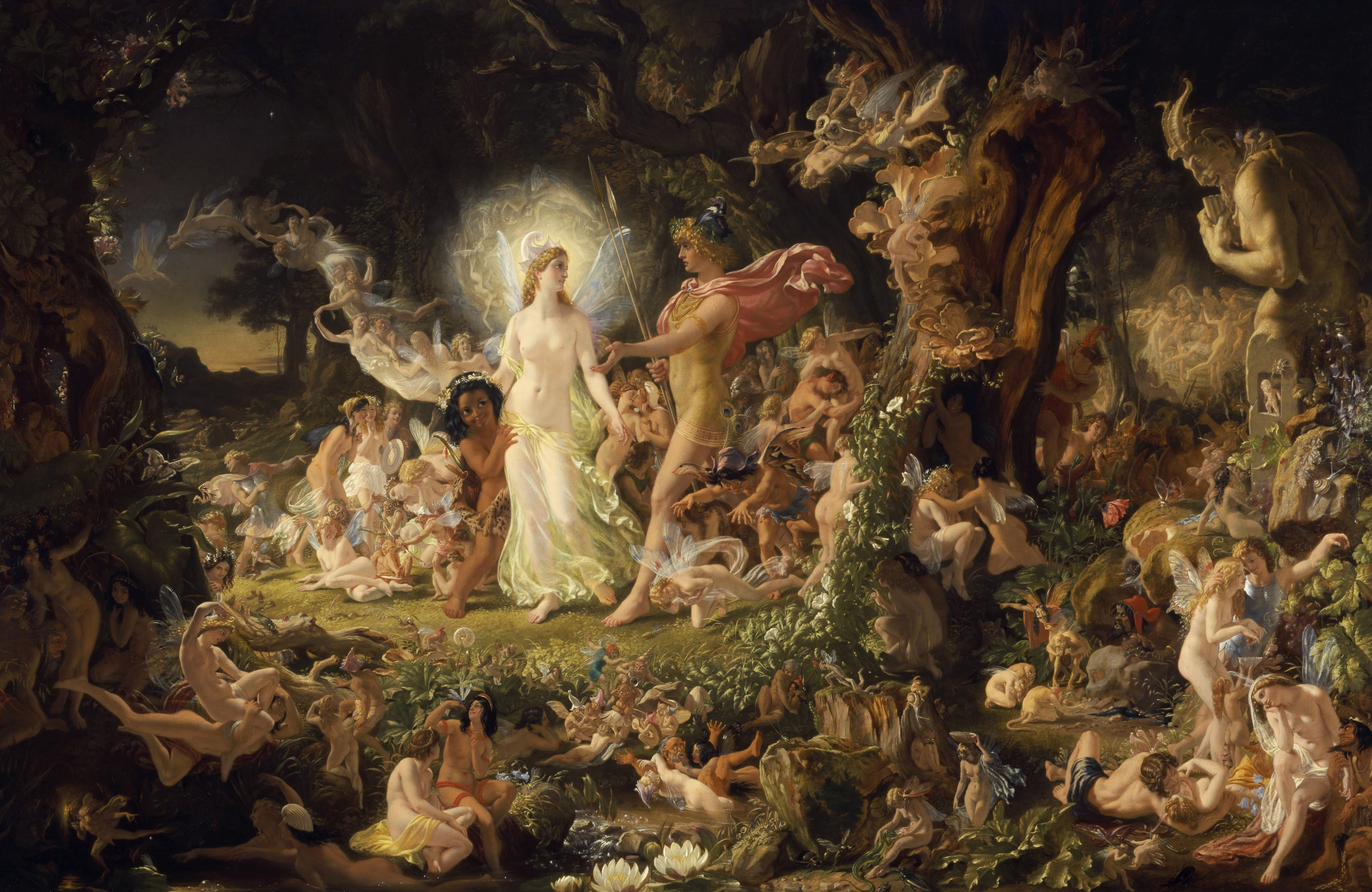
A statue of the Great God Pan looks down on the teeming chaos of Joseph Noel Paton’s The Quarrel of Oberon and Titania (1849), one of many 19th-century paintings based on A Midsummer Night’s Dream. Paton’s canvas gives Richard Dadd a run for his money in its wealth of incident and grotesque detail (see the big version at Wikipedia), and the artist returned to the theme a few years later with the equally excessive Fairy Raid (below). The later painting presumably depicts the kidnapping of the Changeling which Oberon and Titania quarrel over.

While we’re on the subject, a couple of years ago I wanted to link to the amazing fairy scene in William Dieterle’s 1935 film (which supposedly features Kenneth Anger as the Changeling) but it wasn’t on YouTube. Now you can watch it here.

midsummer7.jpg

The Midsummer Night’s Fairies (detail, 1847) by Robert Huskisson.

midsummer1.jpg

The Quarrel of Oberon and Titania (1849) by Joseph Noel Paton.

midsummer4.jpg

A Midsummer Night’s Dream (c. 1860) by W. Balls.

midsummer2.jpg

The Fairy Raid: Carrying Off a Changeling, Midsummer Eve (1867) by Joseph Noel Paton.

midsummer5.jpg

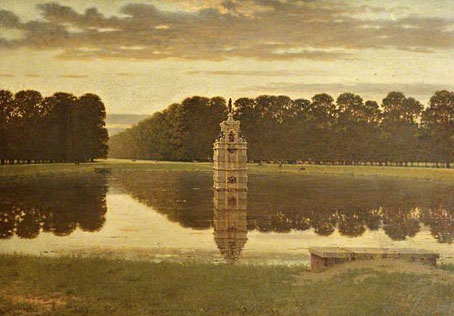
Midsummer Morn, Bushy Park (1905) by George Dunlop Leslie.

midsummer3.jpg

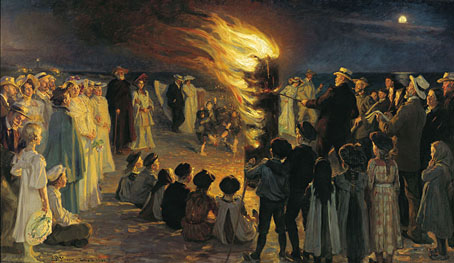
Midsummer’s Eve Bonfire on Skagen’s Beach (1906) by PS Krøyer.

midsummer6.jpg

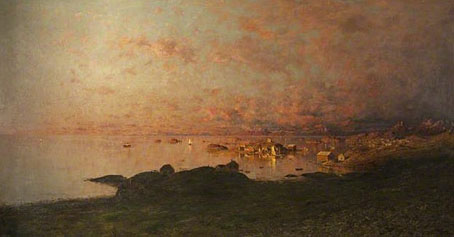
Midsummer Night, Lofoten, Norway (no date) by Adelsteen Normann.

Previously on { feuilleton }
Max Reinhardt’s Dream
The Midsummer Chronophage
Another Midsummer Night
A Midsummer Night’s Dadd
William Heath Robinson’s Midsummer Night’s Dream

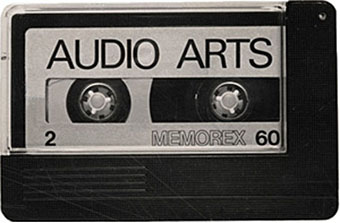
Audio Arts

audioarts.jpg

Audio Arts was a British audio magazine established by Bill Furlong which appeared on vinyl LP, cassette tape and CD from 1973 to 2006. The Tate website has an archive section devoted to the magazine which allows you to listen to each of the tapes, surprisingly when much of the content on the Tate sites is fenced about with copyright restrictions. The contents are as varied as any regular arts magazine: reviews, interviews and so on. An interview with Marcel Duchamp from 1959 is one of the featured highlights. Of greater interest to this listener is an interview from 1981 with Laurie Anderson discussing her epic stage work, United States Parts 1–4. This would have been around the time that one of the songs from that show, O Superman, turned her into a UK pop star for a few weeks.

In addition to a great deal of talk some of the tapes contain recordings of sound pieces or performances. One tape from 1985 features nine works by the Bow Gamelan Ensemble: Ann Bean, Richard Wilson and PD Burwell. The Bow Gamelan Ensemble were at the arty British end of the 1980s’ vogue for making music with industrial detritus, a trend developed and popularised by Z’EV, Einstürzende Neubauten, Test Department and others. I never got to see the ensemble but their pyrotechnic live performances always looked like fun. The tape gives an idea of their uncompromising sound. (Tip via The Wire.)

Previously on { feuilleton }
ICA talks archived

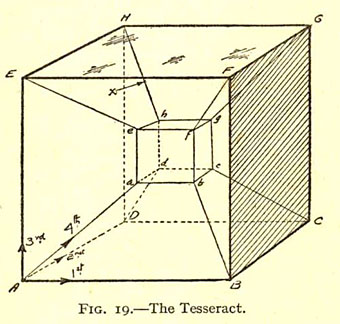
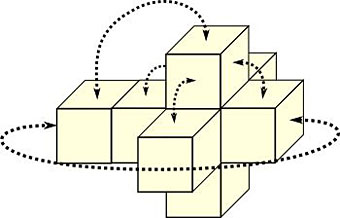
More hypercubes

hypercube1.jpg

A few more extensions of the idea, not all of which have much to do with Hinton’s concepts beyond the name.

hypercube2.jpg

hypercube3.jpg

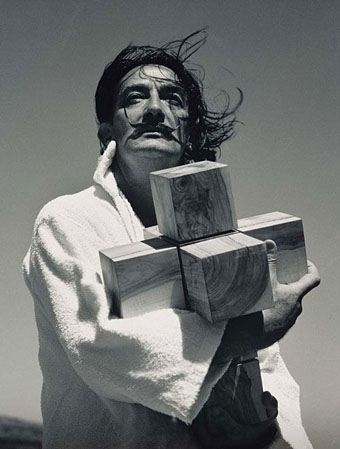
Salvador Dalí with hypercube (1952). Photo by Francesc Català-Roca.

hypercube4.jpg

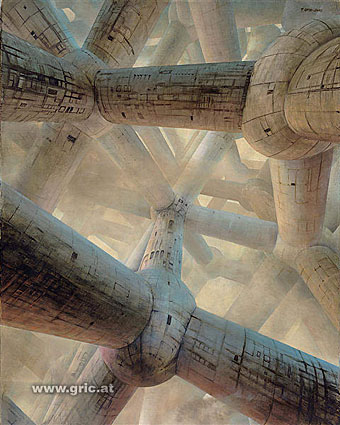
Hypercubic Metropolis (2002) by Peter Gric.

hypercube5.jpg

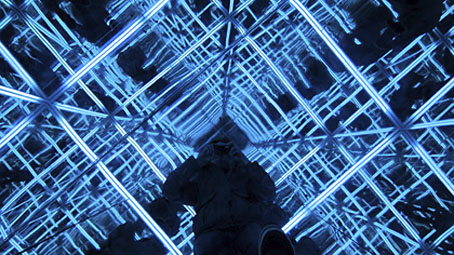
HyperCube (2012) is an installation by artist Jaap van den Elzen and sound composer Augusto Meijer which combines the mirror room familiar from the work of Yayoi Kusama with changeable lighting and sound effects. See also Cube 2: Hypercube (2002) which concerns a group of people imprisoned in a tesseract.

Previously on { feuilleton }
Hinton’s hypercubes
Infinite reflections