Eugène Grasset’s calendar

grasset01.jpg

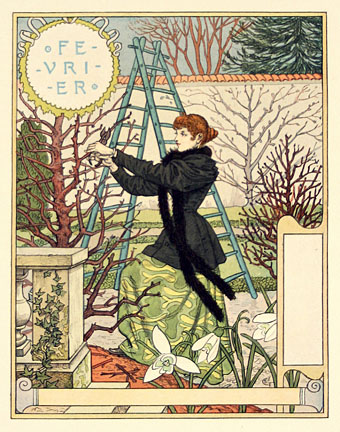
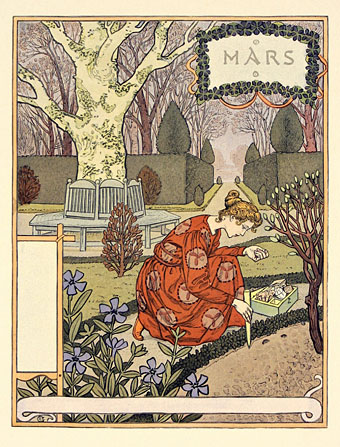
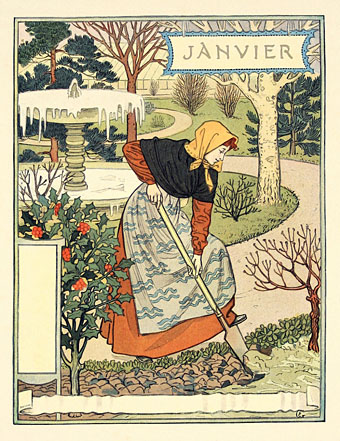
I was going to post a few more paintings depicting the month of February but now I’ve circled the calendar with the monthly theme suitable candidates are harder to find. Searching wasn’t a waste of time, however, since I turned up a complete set of the prints by Art Nouveau designer Eugène Grasset (1845—1917) that depict the months of the year. Some of these have appeared here before but I’d not seen a complete set until now. Grasset was commissioned by the Parisian department store La Belle Jardinière in 1894 to produced twelve artworks to be used as a calendar. The portfolio was published as The Months in 1896. The prints also serve as zodiac when you notice that each woman has an astrological symbol on her clothing. See them at larger size here.

grasset02.jpg

grasset03.jpg

Continue reading “Eugène Grasset’s calendar”

Weekend links 245

htbag.jpg

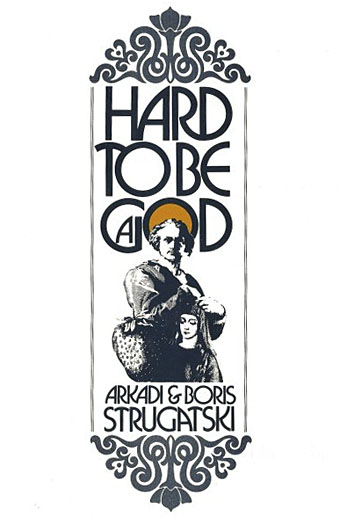
First English-language edition of Hard to Be a God, 1973. Cover design by Alan Peckolick.

A group of scientists is sent to the planet Arkanar to help the local civilization, which is in the Medieval phase of its own history, to find the right path to progress. Their task is a difficult one: they cannot interfere violently and in no case can they kill. The scientist Rumata tries to save the local intellectuals from their punishment and cannot avoid taking a position. As if the question were: what would you do in God’s place?

Hard to Be a God is a 170-minute Russian science-fiction film based on a novel by Arkady & Boris Strugatsky, the authors of Roadside Picnic. The film was the magnum opus of director Aleksey German (1938–2013) who died shortly before post-production was complete. German’s wife and son finished the film.

“…the wonder about this exhausting, astonishing film is not that it took so long to make, it’s that it got made at all,” says Gabriel Winslow-Yost; “one of the most consistently disgusting films ever made,” says Glenn Kenny, “…not only an unforgettable individual masterpiece but probably one of the capital-G Great Films.”; “There are no bones to be made about it, Hard to Be a God is a modern masterpiece,” says Matt Thrift.

This pushes all of my cinematic buttons, of course, so now I’m itching to see it. YouTube has trailers, and (if you must) you can also find the entire film without subtitles. I’d rather wait for a disc version. Meanwhile, Chicago Review Press have republished the novel with a new translation by Olena Blumberg and a foreword by Hari Kunzru.

• At the Guardian John Doran recommends new Middle Eastern and North African music; the playlist includes a song from the forthcoming album by Melechesh which features my cover art. At the Quietus this week Doran explored Manchester’s urban wastelands with local musician Julie Campbell aka Lonelady.

• “Research into psychedelics, shut down for decades, is now yielding exciting results,” says Michael Pollan. Related: Ryan Cooper on why the [US] government should be funding mass scientific studies of Ecstasy, magic mushrooms, and LSD, and “Early humans used magic mushrooms, opium“.

Dad combined porn with all manner of genre fiction. He wrote pirate porn, ghost porn, science-fiction porn, vampire porn, historical porn, time-travel porn, secret-agent porn, thriller porn, zombie porn and Atlantis porn. An unpublished Old West novel opens with sex in a barn, featuring a gunslinger called Quiet Smith, without doubt Dad’s greatest character name. By the end of the decade, Dad claimed to have single-handedly raised the quality of American pornography.

Chris Offutt on the prolific writing career of his father, Andrew Jefferson Offutt V

The Sound Repository 2 by Wizards Tell Lies, a free collection of “rare tracks, demos, early and alternative versions” at Bandcamp.

Jennifer Rothwell‘s new fashion collection uses prints based on Harry Clarke’s stained-glass windows.

• Mix of the week: My Body Full Of Stars, an Afrofuturism mix by Oyinboy.

Terry Gilliam’s title sequence for Cry of the Banshee (1970).

Endless Endless: Kraftwerk at Tumblr.

Sehr Kosmisch (1974) by Harmonia | Walky-Talky (1975) by Harmonia | Sometimes In Autumn (1976) by Harmonia 76
John Austen’s Tales of Passed Times

austen01.jpg

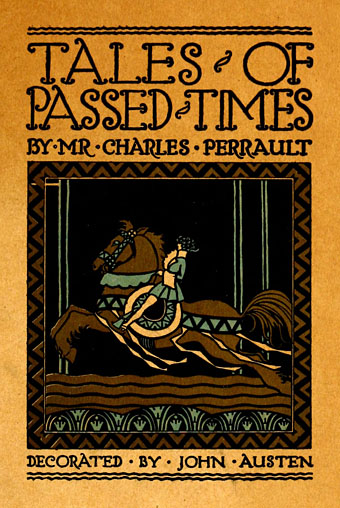
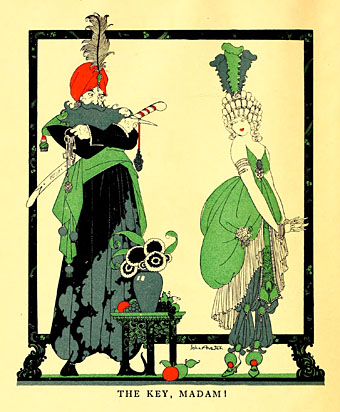
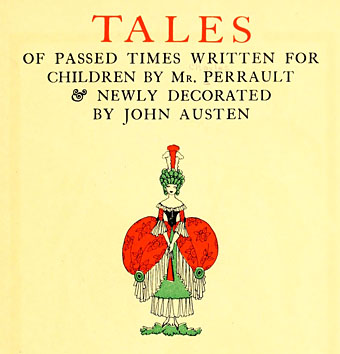
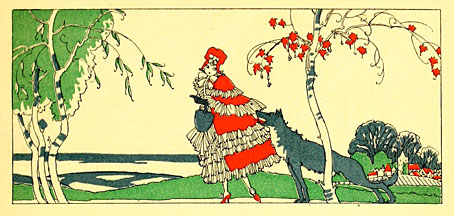
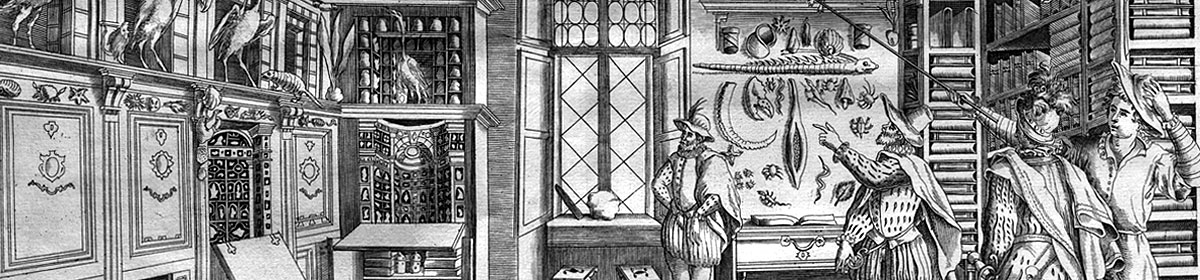
The retellings of old folk tales by Charles Perrault (1628–1703) became the earliest examples of what we now call fairy tales, but Perrault’s versions of Little Red Riding Hood, Puss in Boots, Sleeping Beauty, Cinderella et al have tended to be overshadowed by the more copious works of the Brothers Grimm and their followers. Perrault has attracted illustrators, however, including major figures such as Gustave Doré and Harry Clarke. This edition by John Austen is one of the artist’s earliest books dating from 1922. Perrault collections are often short; this one is only 74 pages but Austen fills the book with many small illustrations and vignettes. It’s a surprise seeing his work in colour when the more familiar drawings are all striking black-and-white. Spot colours help highlight Little Red Riding Hood’s outfit and Bluebeard’s beard. See the rest of the book here or download it here. (Thanks again to Nick for the tip!)

austen02.jpg

austen03.jpg

austen04.jpg

Continue reading “John Austen’s Tales of Passed Times”

Birth of a Zimbu

zimbu1.jpg

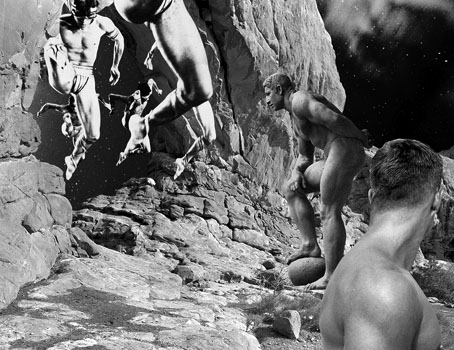
Birth of a Zimbu by Christopher Schulz is another addition to the growing collection of artworks based on William Burroughs’ The Wild Boys (1971), in this case a 52-page collection of “visual reveries made from collaged parts of dated gay porn, ancient ruins, and other various unrelated sources.” The book costs $10 and may be previewed and ordered here.

zimbu2.jpg

The Zimbus are Burroughs’ solution to the problem of reproduction (or regeneration) among the Wild Boys, his army of eternal teenage boys at war with the world at large in a dystopian 1988. Warfare means casualties so in order to maintain their homosocial, homoerotic tribal existence they gather at special times to perform sex-magic rituals that summon the “Zimbu” spirit forms of dead Wild Boys. The Zimbus are incarnated as new Wild Boys after being inseminated and fully materialised.

Burroughs wasn’t short on fantastic concepts but his ideas are often delivered and dismissed in a few lines. By contrast, the creation of the Zimbus is given pages of detailed description, the separatist, semi-human world of the Wild Boys being one to which he devoted a great deal of imaginative attention. I’ve linked before to Phil Hine’s essay, Zimbu Xototl Time, which examines the Zimbu idea at some length, drawing comparisons to similar ideas in anthropology and other fiction. If I ever get round to finished the long-gestating Wild Boys portfolio I may be able to show some Zimbu manifestations of my own.

Elsewhere on { feuilleton }
The William Burroughs archive

Weekend links 244

scarpulla.jpg

MMOB :: Far West (2013) by Alison Scarpulla.

• “…although same-sex love is as old as love itself, the public discourse around it, and the political movement to win rights for it, arose in Germany in the late nineteenth and early twentieth centuries. This message may surprise those who believe that gay identity came of age in London and New York, sometime between the Oscar Wilde trials and the Stonewall riots.” Alex Ross reviewing Robert Beachy’s Gay Berlin: Birthplace of a Modern Identity. Beachy talks about his book here.

• “I was in a room with tube synthesizers, where you had to tune them up to play them. It was unbelievable.” John Carpenter talking to Joseph Stannard about composing with electronics. Carpenter’s album of new music, Lost Themes, may be previewed here.

• From 2010: John Ridpath on Mervyn Peake’s illustrations for Lewis Carroll’s Alice Through the Looking Glass and Alice in Wonderland. Related: “The most twisted version of Alice in Wonderland you’ll ever see.”

I was brought up in a world where art was something owned and insured—usually inherited: but seldom if ever made by anyone one I knew.

I had an early inkling that there was fun to be had over the hill, like the feeling when faced with a sunset that someone’s throwing a mega awesome party just beyond the nearest cloud, and I set off to join the caravan. Let’s just say I was in search of company, headed towards the glow, and I found it.

Tilda Swinton‘s speech at the Rothko Chapel

• “Her art often touches on alchemy and magic; and in her memoir of insanity she writes of misreading an Imperial Chemicals sign as ‘chemistry and alchemy’.” Charlotte Higgins on Leonora Carrington.

Shadows Over Main Street, an anthology of small-town Lovecraftian terror, is out this week from Hazardous Press. 20 stories and poems plus interior illustrations including a contribution of my own.

• “With Fantastic Planet, I felt torn about using it, because it’s…the title of an animated film.” Guitarist Sarah Lipstate, aka Noveller, talks to Ned Raggett about her new album.

Jim Jupp of Belbury Poly and the Ghost Box record label answers 15 questions.

• A DeLorean driving through a Tron cityscape: Retrowave by Florian Renner.

• Powell & Pressburger’s Tales of Hoffmann (1951) has been restored.

Music from Forbidden Planet (1956) by Louis & Bebe Barron | The Four Horsemen (1972) by Aphrodite’s Child | Assault on Precinct 13 (Main Theme) (1976) by John Carpenter