Weekend links 516

correa.jpg

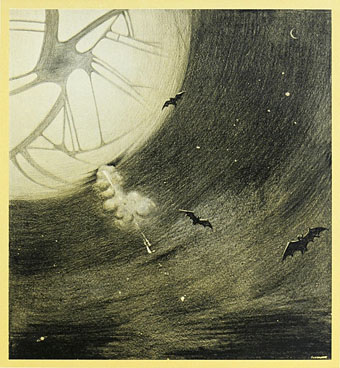
Bats in space: an illustration by Henrique Alvim Corrêa from a 1906 edition of The War of the Worlds.

• Auf wiedersehen to Florian Schneider. Until he left Kraftwerk in 2009 (or 2006 or whenever it was), Schneider had been the group’s longest-serving member, keeping things running for the few months in 1971 when Ralf Hütter was absent. The brief period when Kraftwerk was Schneider plus soon-to-be-Neu! (Michael Rother, guitar, and Klaus Dinger, drums) fascinates aficionados over-familiar with the later albums. The music they produced was a wild and aggressive take on the rock idiom but Scheider maintained the link with Kraftwerk before and after, not only instrumentally but with his ubiquitous traffic cones, as noted in this post. There’s no need for me to praise Kraftwerk any more than usual, this blog has featured at least one dedicated post about them for every year of its existence, and besides which, the group itself is still active. Elsewhere: Simon Reynolds on how Florian Schneider and Kraftwerk created pop’s future; A Kraftwerk Baker’s Dozen Special; Dave Simpson attempts to rank 30 Kraftwerk songs (good luck getting anyone to agree with this); Jude Rogers with ten things you (possibly) don’t know about Kraftwerk; Dancing to Numbers by Owen Hatherley; Pocket Calculator in five languages; Florian Schneider talks about Stop Plastic Pollution.

Intermission is a new digital compilation from Ghost Box records featuring “preview tracks from forthcoming releases and material especially recorded for the compilation during the global lockdown”. In a choice of two editions, one of which helps fund Médecins Sans Frontières.

• How groundbreaking design weirdness transformed record label United Artists, against all odds. By Jeremy Allan.

Sex in an American suburb is not quite the same phenomenon as sex in, say, an eastern European apartment block, and sex scenes can do a great deal to illuminate the social and historical forces that make the difference. All of which is to say that sex is a kind of crucible of humanness, and so the question isn’t so much why one would write about sex, as why one would write about anything else.

And yet, of course, we are asked why we write about sex. The biggest surprise of publishing my first novel, What Belongs to You was how much people wanted to talk about the sex in a book that, by any reasonable standard, has very little sex in it. That two or three short scenes of sex between men was the occasion of so much comment said more about mainstream publishing in 2016, I think, than it did about my book. In fact, in terms of exploring the potential for sex in fiction, I felt that I hadn’t gone nearly far enough. I’ve tried to go much further in my second novel, Cleanness. In two of its chapters, I wanted to push explicitness as far as I could; I wanted to see if I could write something that could be 100% pornographic and 100% high art.

Garth Greenwell on sex in literature

James Balmont’s guide to Shinya Tsukamoto, “Japan’s Greatest Cult Filmmaker”.

• A Dandy’s Guide to Decadent Self-Isolation by Samuel Rutter.

Maya-Roisin Slater on where to begin with Laurie Anderson.

• The Count of 13: Ramsey Campbell’s Weird Selection.

Adam Scovell on where to begin with Nigel Kneale.

When John Waters met Little Richard (RIP).

RB Russell on collecting Robert Aickman.

Weird writers recommend weird films.

Campo Grafico 1933/1939.

Ruckzuck (1970) by Kraftwerk | V-2 Schneider (1977) by David Bowie | V-2 Schneider (1997) by Philip Glass

Tom’s World

tom01.jpg

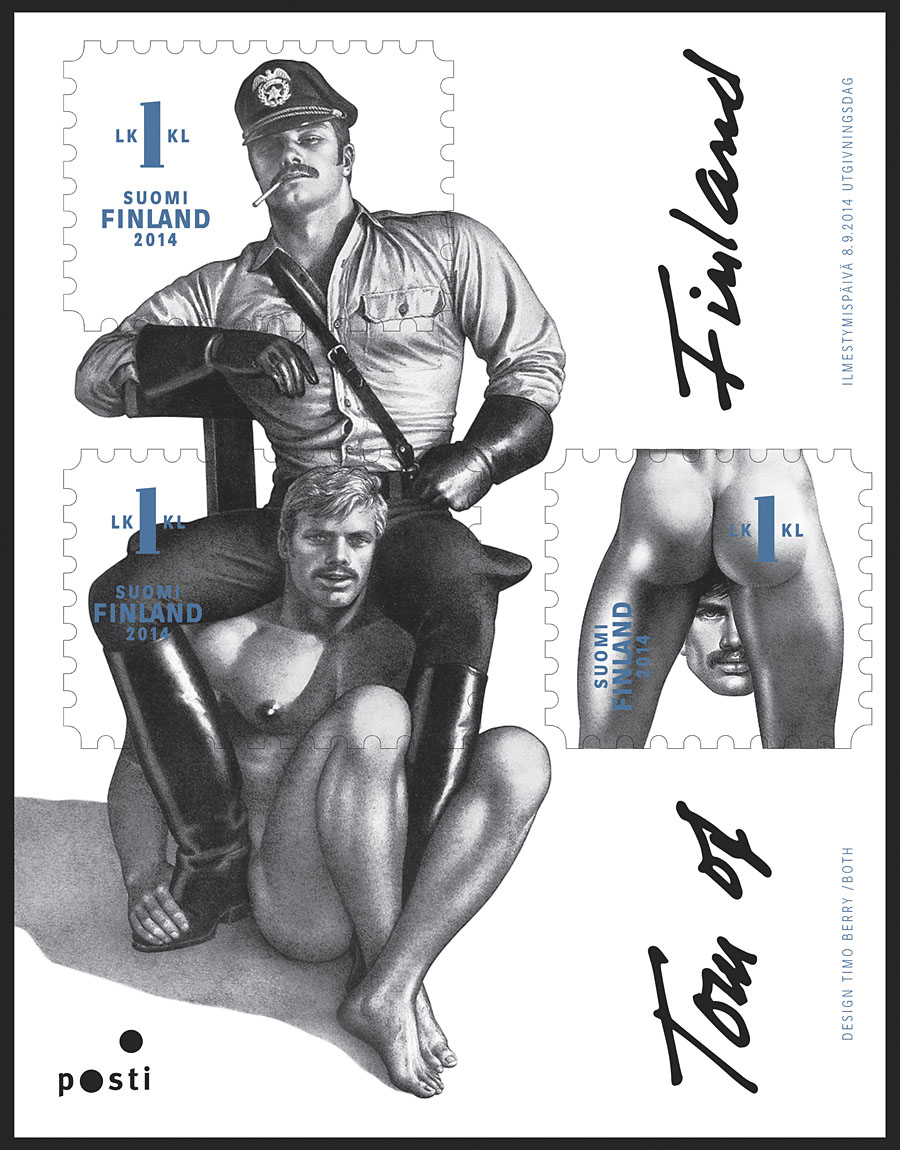
The celebratory stamps produced by the Finnish postal service in 2014.

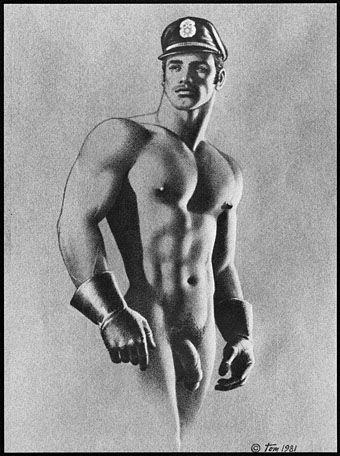
A post for Touko Valio Laaksonen, the man known to the world as Tom of Finland, born 100 years ago today. Back in March I finally acquired Tom of Finland XXL, a gorgeous, heavyweight Taschen volume edited by Dian Hanson, as a result of which Tom and his leather-clad muscle-men have been in my thoughts even without his anniversary. The thick-necked hunks that populate Tom’s drawings have never been my ideal of masculine beauty but I admire his dedication to erotic obsession as well as his draughtsmanship, the latter even more so after seeing the high-quality reproductions in Hanson’s collection. The drawings from the 1970s and 80s are especially impressive, when success had given the artist more time to spend perfecting his figures and capturing all the ways that leather apparel folds itself and reflects the light. His beautiful pencil renderings of jackets, trousers and boots treat their subjects to the careful scrutiny that Dutch still-life painters used to devote to pheasants and apples; this is a fetishist’s infatuation raised to the status of art.

tom07.jpg

Leather duo (1963).

Tom of Finland’s progress from amateur pornographer to gallery artist and national institution is a very unlikely career path, especially when he wasn’t dependent on the support of the art market. Tom’s earliest drawings and comic strips were relatively simple things but still explicit enough for the Finnish authorities in the 1940s to find them obscene. Many erotic artists have been subject to similar opprobrium but none of them have achieved posthumous fame as the most internationally visible male artist from the nation that once proscribed their work, and all this without toning down that work in any way. Tom shares his celebrity with Moomin creator Tove Jansson, which means that Finland is now the only nation in the world whose art is represented internationally by a gay man and a lesbian. Their work, needless to say, could hardly be more different, despite both artists being adept at black-and-white illustration and the creation of sequential narratives. Jansson’s Moomins have been universally popular for many years but Tom of Finland’s art, which has never been anything other than gay pornography, is inevitably limited in its appeal. The lavish depictions of cock-sucking and anal sex are so profuse and unrelenting that whatever is shown of his drawings in the general media is always carefully selective, shunning the enormous penises in favour of a moustached face or a pair of embracing clones.

tom04.jpg

I’m amused by this and also reassured that there are still a few aspects of human life that are too anarchic for exploitation by mass media. The global domination of American culture and American technology has rendered everything grist to its all-devouring mill, everything, that is, except for explicit sex. Pornography is also a part of the US cultural behemoth but it’s like the bastard child that everybody pretends doesn’t exist and wishes would go away. America’s gay publications gave Tom of Finland his nom de plume and made him famous, but porn, for a variety of reasons, resists universal acceptance and approval. Tom’s art is so single-minded in its representation of gay men gleefully fucking each other that there’s little about it that can be exploited by cultural products intended to appeal to the widest audience, or sold to nations with repressive attitudes to gay sex and sexuality. Tom’s libidinous leather-clad hero, Kake, ejaculates his way through multiple penetrations and gang bangs the likes of which you’ll never see in a big-budget franchise, no matter how much Hollywood teases audiences with more polite same-sex scenarios. How many erections are a paying audience prepared to swallow?

Continue reading “Tom’s World”

Weekend links 515

huysmans.jpg

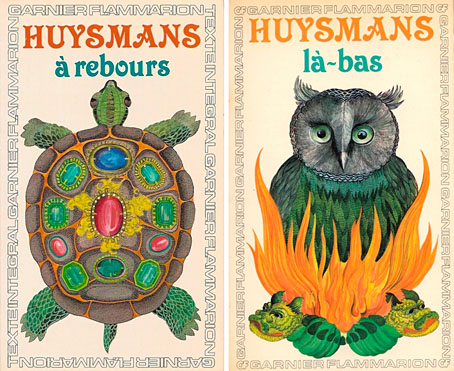
A pair of Huysmans covers from 1978 designed by Gérard Deshayes.

• Friends of the great composer/musician Jon Hassell set up a GoFundMe account a few days ago to help raise money for Jon’s medical costs. It’s always dispiriting having to link to these fund-generators when they shouldn’t be required at all but until America sorts out its health situation this is how things are. For those who’d prefer to help Jon by buying his music, there’s a Bandcamp page with a handful of releases, and more available at Bleep, the online distributor of Warp Records who helped produce his last release, Listening To Pictures (Pentimento Volume One). Related: Words With The Shaman: Jon Hassell interviewed by Chris May.

• Every time I think I must have heard all the best of the early Kraftwerk concerts another one turns up. This new posting at YouTube is taken from a recent file upload at the concert-swapping site Dimedozen, and is believed to be a radio recording of the group playing in Vancouver, Canada, in 1975. It’s very good quality (some slight bleed from other stations) and features excellent versions of their concert repertoire at that time. The version of Autobahn is especially good.

• in 2009 Dana Mattocks built a machine he called Steampunk Frankenstein, a construction which was attended by a frame containing my first piece of steampunk art. Dana’s latest creation is TILT, the Robot with Rocket Jet-Pack.

• RIP Tony Allen, the drummer about whom Fela Kuti said “without Tony Allen, there would be no Afrobeat”. Allen was interviewed by John Doran in 2012. Related: Tony Allen: the Afrobeat pioneer’s 10 finest recordings.

• “Robert Fripp’s ‘Music for Quiet Moments’ series. We will be releasing an ambient instrumental soundscape online every week for 50 weeks. Something to nourish us, and help us through these Uncertain Times.”

• How to avoid Amazon: the definitive guide to online shopping – without the retail titan; Hilary Osborne & Poppy Noor have some suggestions. I favour eBay for many of my purchases, large or small.

Adam Scovell on A Cinematic Lockdown: Confinement in the films of Alfred Hitchcock.

Liberty Realm, a book of art by Cathy Ward, is coming soon from Strange Attractor.

• One Great Reader: Luc Sante talks to Wes del Val about his favourite books.

• Oscar Wilde and the mystery of the scarab ring by Eleanor Fitzsimons.

Unica Zürn at Musée D’art Et D’histoire De L’hôpital Sainte-Anne.

• Mix of the week: Secret Thirteen Mix 302 by Avizohar.

• Another concert: Tuxedomoon live in Rome in 1988.

Rarefilmm | The Cave of Forgotten Films.

• At Dennis Cooper’s: Ghosts.

Ghost Song (1978) by Jim Morrison & The Doors | Ghost Song (2000) by Air | Ghost Song (2005) by Patrick Wolf

Cornell’s Constellations

cornell05.jpg

Untitled (Die Sternen-Welt), c.1950.

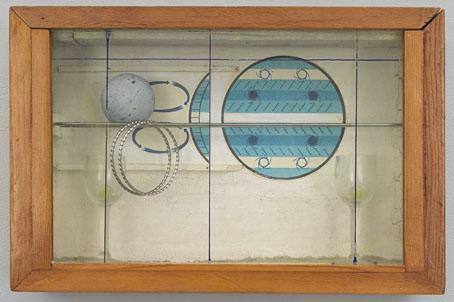
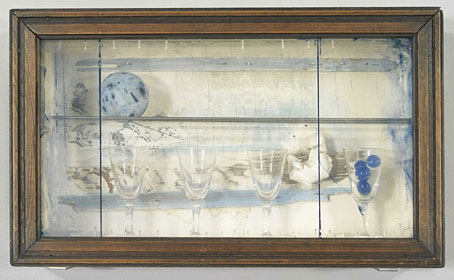
Among my current reading is Utopia Parkway (1997), Deborah Solomon’s biography of American artist Joseph Cornell (1903–1972). The book is very good for the factual data but I’ve been less enamoured by Solomon’s attempts to dredge biographical significance from Cornell’s hermetic and allusive work, or by her dismissive comments about other artists. Her account is most valuable when showing the evolution of Cornell’s art, the way he developed his often erratic and hesitant working methods. Most of Cornell’s works that I’ve seen in the past have been solitary examples, usually in books about Surrealism, so I wasn’t aware that so many of his celebrated and influential box assemblages were produced as themed series: Aviaries, Dovecotes, Hotels, and so on.

cornell01.jpg

Planet Set, Tête Etoilée, Giuditta Pasta (dédicace), 1950.

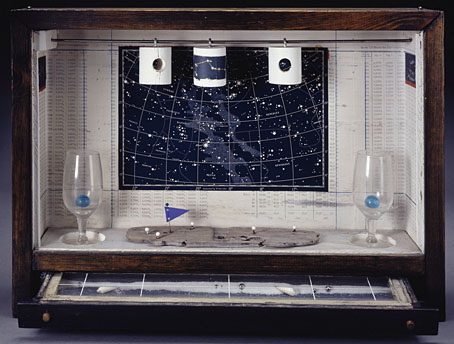
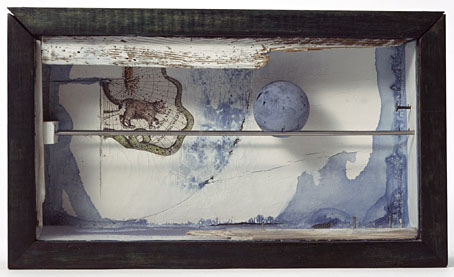
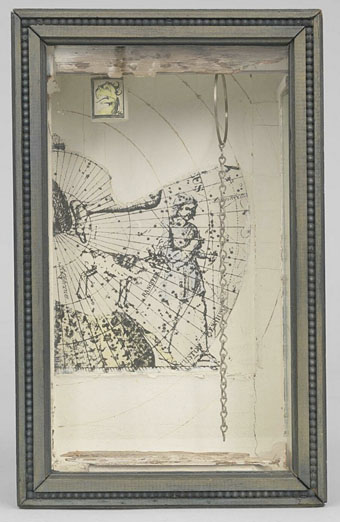
Astronomy was a Cornell passion which also provided the subject for another themed series, Observatories, a collection of boxes begun later in his career for which star maps and heavenly bodies were the dominant concern. By the 1950s his creations were much more refined than some of his earlier constructions, although the box contents include many familiar Cornell ingredients: antique maps and diagrams, glassware, spherical objects, etc. The examples here are a small selection of those to be found scattered around various websites. Another consequence of reading Solomon’s book is realising that I could do with a companion volume filled with Cornell’s artwork. There doesn’t seem to be a decent monograph as yet; if anyone has any suggestions (preferably with colour plates) then please leave a comment.

cornell02.jpg

Sun Box (1950). [Not a constellation, obviously, but from the same astronomical series.]

cornell07.jpg

Untitled (Celestial Navigation), 1956–58.

cornell03.jpg

Celestial Navigation (c.1958).

cornell06.jpg

Untitled (Canis Major Constellation), c.1960.

cornell04.jpg

Custodian—M.M. (1962).

Previously on { feuilleton }
Joseph Cornell: Worlds in a Box
Joseph Cornell, 1967
Rose Hobart by Joseph Cornell
View: The Modern Magazine

Weekend links 514

kircher.jpg

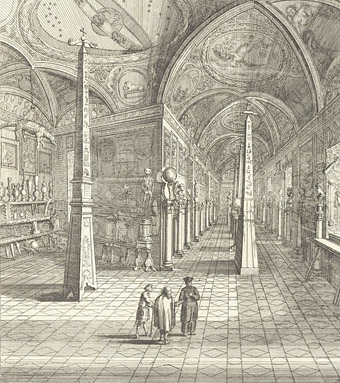
Athanasius Kircher welcoming two guests to the Collegio Romano, a detail from the frontispiece to his Romani Collegii Societatis Jesu Musaeum celeberrimum (1678).

Opium (1919) by Robert Reinert: “A Chinese opium dealer takes revenge on Westerners who have corrupted his wife.” With Werner Krauss and Conrad Veidt a year before their pairing in The Cabinet of Doctor Caligari.

Aubrey Beardsley at Tate Britain: in which the gallery thinks that 7 minutes is enough to give us a taste of a major exhibition that we can’t otherwise see.

Joe Pulver (RIP): His Highness in Yellow. A memorial piece that includes artist Michael Hutter talking about his paintings of Carcosa.

Court Mann on the strange history of Robert Smithson’s Spiral Jetty, 50 years old this month.

• “Invisible Little Worms”: Athanasius Kircher’s Study of the Plague by John Glassie.

Sophie Monks Kaufman on why literary lesbians are having a moment on screen.

• Photographer Ryan McGinley: “I was taught to believe in Satan. It scared me.”

• At Dennis Cooper’s: Ellen Burstyn Day, and the ghostly novels of WG Sebald.

Dorian Lynskey on where to start with Nina Simone’s back catalogue.

• Wie funktioniert ein Synthesizer? (1972). Bruno Spoerri explains.

• Banham avec Ballard: On style and violence by Mark Dorrian.

John Boardley on the most dangerous book in the world.

Improvisation for Sonic Cure by Ryuichi Sakamoto.

• The Strange World of…JG Thirlwell.

Diet Of Worms (1979) by This Heat | Stomach Worm (1992) by Stereolab | Heartworms (1998) by Coil