Alex Steinweiss: creator of the album cover

steinweiss2.jpg

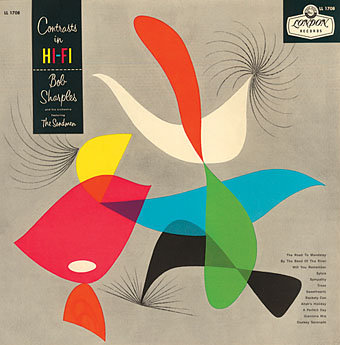
Contrasts in Hi-Fi by Bob Sharples.

A Tribute to Alex Steinweiss
The Creator of the Album Cover

Robert Berman Gallery announces an exhibition of Alex Steinwiss. Original album covers, paintings, and collages by Steinweiss, and special tribute by selected artists. Co-curated by Kevin Reagan and Greg Escalante.

In 1939, a 23 year-old graphic designer revolutionized the music industry. No longer would records come in plain brown wrappers. As Art Director at Columbia Records, Steinweiss created the ‘album package.’ His idea was to create a visual to complement the musical. It was an instant success, and spawned an entire new field of illustration and design: Album Cover Art. Steinweiss was the king of the genre; his covers are still regarded as icons.In his four decade career, Steinweiss created album covers for musical luminaries such as Louis Armstrong, Duke Ellington, Igor Stravinsky and Benny Goodman.
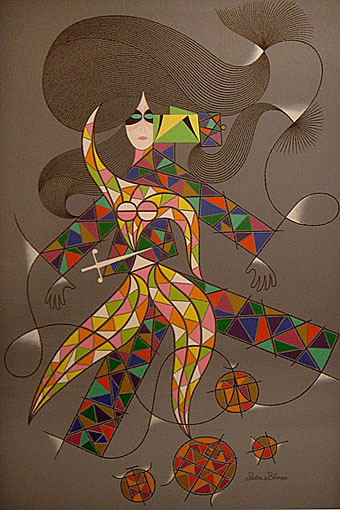
steinweiss1.jpg

The Miraculous Mandarin (circa 1977).

The Steinweiss exhibition will feature 50 of his original cover designs, plus 50 original ‘tribute’ works, created specifically for this show. Artists that are honoring Steinweiss in the show include: Clive Barker, Bill Barminski, Ron English, Mick Haggerty, Raymond Pettibon, Shag, and Glenn Wexler. The featured artists have created album covers for a wide range of musicians, including Black Flag, Dixie Chicks, Goo Goo Dolls, Supertramp, and Rob Zombie.

“Steinweiss is 90 years old this year; this tribute is long over-due. The art community is excited to have a chance to pay homage to Alex’s unprecedented contribution to album cover art,” says Kevin Reagan, three time GRAMMY winning Art Director.

“It’s amazing to discover this one man, this un-sung hero, who is responsible for inventing the album. Steinweiss should be a household name,” says Greg Escalante, curator of Juxtapoz, and co-founder of Copro-Nason Gallery.

“The opportunity to highlight ‘the art of music’ is exciting. You have the energy of two different genres, and their combination is explosive,” says gallery owner Robert Berman. “Just plain design didn’t mean a damn thing,” Steinweiss says. You had to know music. I had to find a way to bring out the beauty of the music and the story.” (dwell, 10/07)

Alex Steinweiss lives in Sarasota, Florida, where he continues to design and paint.

A Tribute to Alex Steinweiss
Gala Opening: January 19th
Show runs through February 12th, 2008

Robert Berman Gallery
Bergamot Station Arts Center
2525 Michigan Avenue, C2
Santa Monica, CA 90404

• Alex Steinweiss at the Art Director’s Club Hall of Fame
• For the Record: The Life and Work of Alex Steinweiss at Amazon
• Alex Steinweiss at Soundfountain

Elsewhere on { feuilleton }
• The album covers archive
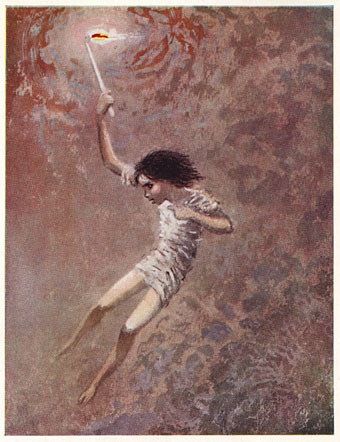
Mervyn Peake in Lilliput

This month I’ve been redesigning the Savoy Books edition of The Exploits of Engelbrecht by Maurice Richardson, in preparation for a reprint. This has involved scanning the covers of the issues of Lilliput, the magazine where Richardson’s tales of the dwarf surrealist sportsman first appeared, and one number of these, from May 1950, also includes a feature about nursery rhymes illustrated by Mervyn Peake. The paintings were reprinted in Mervyn Peake: The Man and his Art in 2006 but shrunk onto a single page so this is a chance to see them at a larger size. Also reproduced below is the accompanying article by Leslie Daiken and the Arcimboldo-style cover by Ronald Ferris. Some of the earlier covers by Walter Trier—all of which featured a man, a woman and a dog in a variety of guises—can be seen at VTS.

Update: For more about Mervyn Peake, see also Peake Studies.

peake1.jpg

“How many miles to Babylon?”
“Three score miles and ten.”
“Can I get there by candle-light?”
“Yes, and back again.
If your heels are nimble and light
You may get there by candle-light.”

Continue reading “Mervyn Peake in Lilliput”

Beardsley’s Salomé

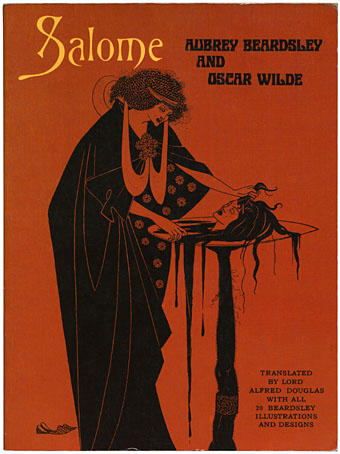
salome1.jpg

So the first book purchase of the year turns out to be the original Dover edition of Beardsley and Wilde’s Salomé. This appeared in 1967, a year after the major V&A exhibition which introduced Beardsley’s work to a new generation and commenced the Beardsley craze that lasted into the Seventies. Not that I’m in desperate need of these drawings, having most of them several times already in different Beardsley books, but this volume is worth having since the reproductions are large size, very sharp and they took enough care to ensure that the uncensored versions of the drawings were used. The book also includes the complete text of Wilde’s play and Robert Ross’s Note on Salomé from 1930 which I don’t have elsewhere.

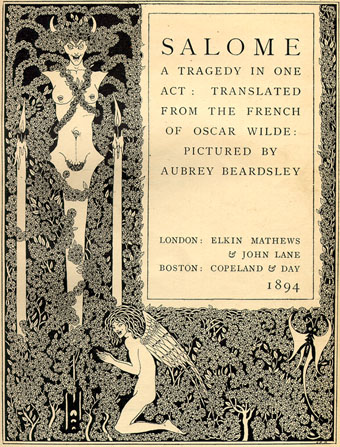
salome2.jpg

Beardsley’s work was subject to many censorship actions during his career but the Salomé book caused the most trouble (his later erotic works were private editions so don’t really count). The original title page shown here had the semi-erect penis of the winged boy and the pendulous genitals of the herma removed while one drawing, The Toilette of Salomé, was deemed too much and had to be redrawn entirely. That picture did contain a masturbating page boy so it’s perhaps not so surprising. There was such a lot to offend Victorian sensibilities in Beardsley’s work at this time, whether overt or surreptitious, that it’s remarkable the book was printed at all. His art was so radically different from anything else being done in 1894 that many people had difficulty accepting these pictures as illustrations at all, regardless of the content. As a result they missed salacious details that would have finished the career of a lesser artist. Wilde’s play was equally scandalous and could only be performed in France, having been banished from the London stage. As Robert Ross says in his Note:

Wilde used to say that Salomé was a mirror in which everyone could see himself. The artist, art; the dull, dullness; the vulgar, vulgarity.

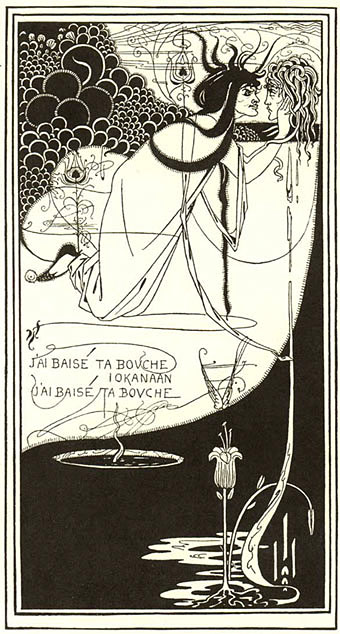
salome3.jpg

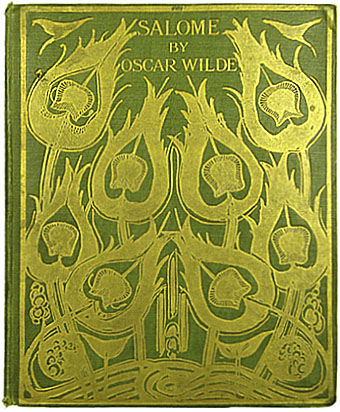
The sense of shock extended back to Beardley’s original Salomé drawing (also included in the Dover volume) which appeared in the first number of The Studio in 1893, some of the readers of that magazine finding the detail of the spilled blood nourishing a phallic lily a grotesque detail too far. The Studio drawing was reworked and simplified as The Climax for Salomé. You can see the complete set of illustrations here. Neither that collection nor the Dover book include a picture of the original cover, however, whose splendid gold-on-green peacock feathers look a lot more impressive than Beardley’s rough design. So here it is.

salome4.jpg

• Download the 1906 US edition of Salomé free at the Internet Archive

Elsewhere on { feuilleton }
• The book covers archive
• The illustrators archive
• The Salomé archive

Clark Ashton Smith book covers

smith1.jpg

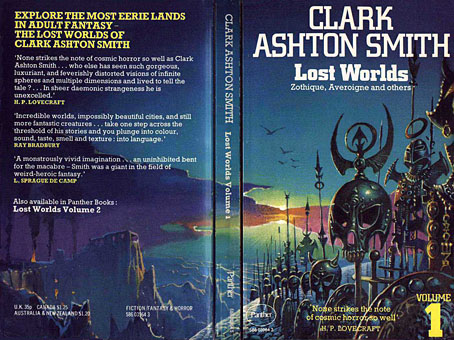
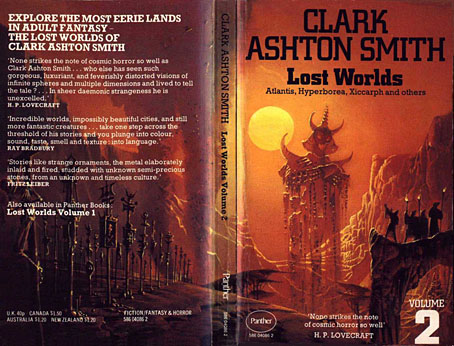
I hadn’t looked at Eldritch Dark, the premier Clark Ashton Smith site, for a while so it’s good to see they now have a substantial collection of CAS covers from books, magazines and fanzines. The ones shown here are further examples of my Panther Books fetishism and were the first CAS titles I came across in the mid-Seventies. The artist is Bruce Pennington who produced much fine sf and fantasy art during this period and whose spiky, bone-strewn paintings are especially suited to cosmic horror vistas or the more apocalyptic end of the fantasy spectrum. He also painted a couple of Lovecraft-related covers for Panther, hence his inclusion in the forthcoming Lovecraft art book from Centipede Press.

smith2.jpg

• Bruce Pennington at ImageNETion: I | II | III | IV

Elsewhere on { feuilleton }
• The book covers archive
• The illustrators archive

Previously on { feuilleton }
• Witness my hand and official seal

The Evanescent City

panama1.jpg

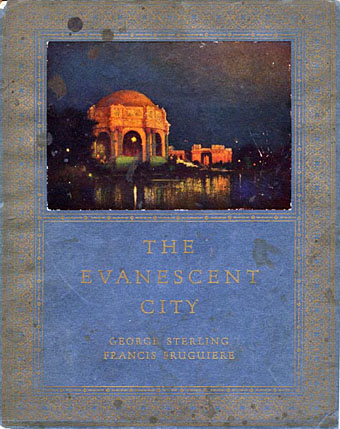
The cover of The Evanescent City shows a night view of Bernard Maybeck’s Palace of Fine Arts, one of the few remaining structures from the Panama-Pacific International Exposition that was held in San Francisco in 1915. After earlier posts about ephemeral architecture and the futuristic visions of Hugh Ferriss, I stumbled across the Books about California site which features a wealth of scanned volumes, including a number of books and pamphlets devoted to the Panama-Pacific Exposition. Expositions and World’s Fairs hold a particular attraction for enthusiasts of architectural invention, not least for the way they allow architects the opportunity to create structures that would otherwise never be built.

panama5.jpg

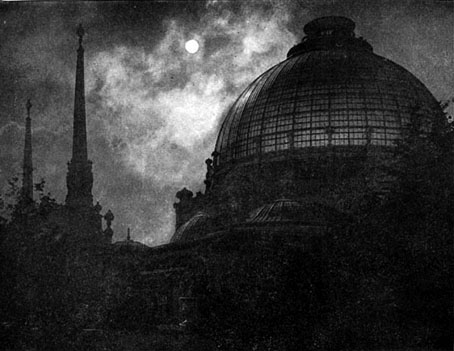
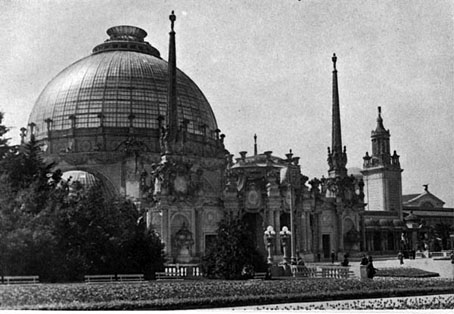
Palace of Horticulture—Dome and Spires by Night from The Architecture and Landscape Gardening of the Exposition.

At night, when the powerful searchlights within the dome are played upon the translucent glass, the effect is magical, the reflections weirdly changing in color and shape. The rich details of the decorations are softened in the night light.

The Panama-Pacific Exposition and the 1893 World’s Columbian Exposition in Chicago fascinate owing to the insight they give into the 19th- and early-20th century architectural imagination. This invariably meant huge towers, enormous domes and everything ladled with elaborate decoration, the Panama-Pacific Exposition being especially decadent in this respect, numbering a jewel-spangled tower among its attractions. With the Bauhaus innovations a few years away this was the last time the world would be offered a reflection of itself that was so excessively indebted to the past. If Hugh Ferriss shows us a vision of the world like that in Fritz Lang’s Metropolis, the Panama-Pacific architects invite us to imagine a world like the Slumberland that Winsor McCay created for Little Nemo.

The Internet Archive has a number of short films showing views of the exposition. Most interesting, if rather crudely made, is The Story of the Jewel City, a brief fantasy about two children exploring the exposition grounds.

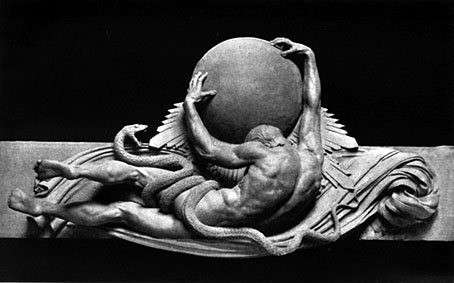
The following pictures are a small sample of the amount of material at Books about California. The snake-entwined figure of Helios would have made a good addition to the Men with snakes post while it’s difficult not to smile at the suggestion that the figure of a naked man should be preserved for America’s future gay capital.

panama2.jpg

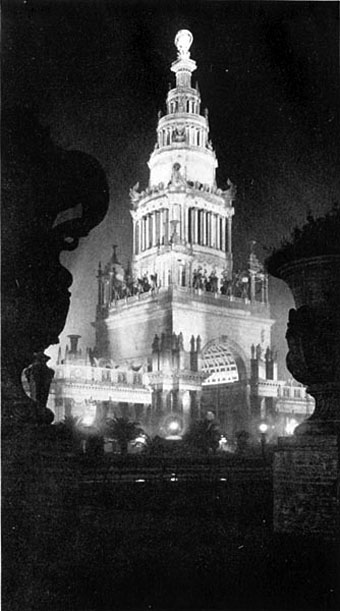
Tower of Jewels—the Illumination by Night from The Architecture and Landscape Gardening of the Exposition.

The Tower takes its name from the thousands of many-colored jewels so cut, polished and suspended that they reflect the sunshine with dazzling brilliancy by day and at night, under the white radiance of the searchlights, clothe the whole structure with shimmering splendor.

panama3.jpg

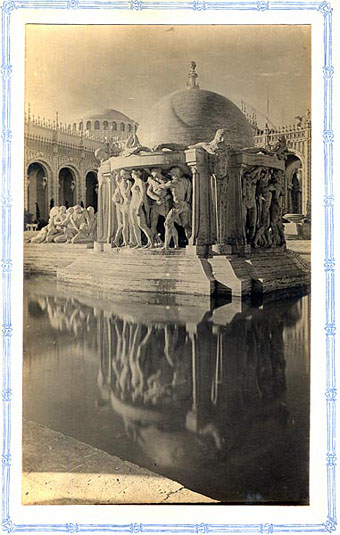
The Fountain of Earth from The Court of Ages by Beatrice Wright.

panama9.jpg

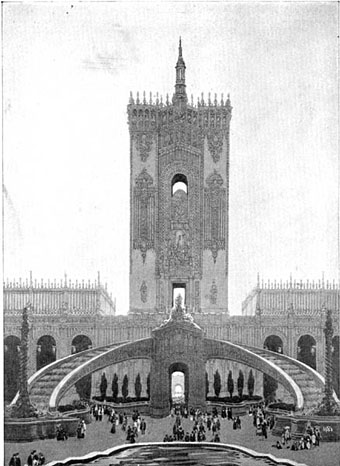
Part of Education Building and Court of Palms looking towards Horticultural Building from Panama-Pacific International Exposition—Popular Information.

panama4.jpg

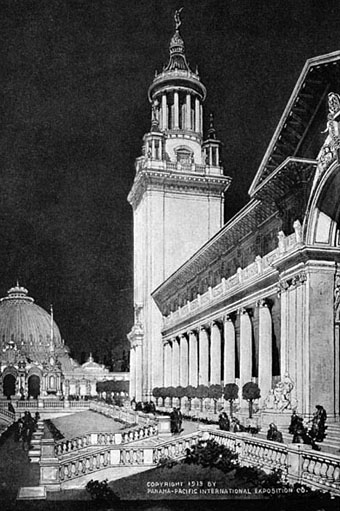
Tower and Cascade in Court of Abundance from the Official View Book of the Panama-Pacific International Exposition.

Dedicated to Music and Pageantry. Water in the cascade flows over a scheme of brilliant illumination. Designed by Louis Christian Mullgardt.

panama6.jpg

Palace of Horticulture—The Dome and East Entrance from The Architecture and Landscape Gardening of the Exposition.

panama7.jpg

Helios by Robert I Aitken from The Sculpture and Mural Decorations of the Exposition.

panama8.jpg

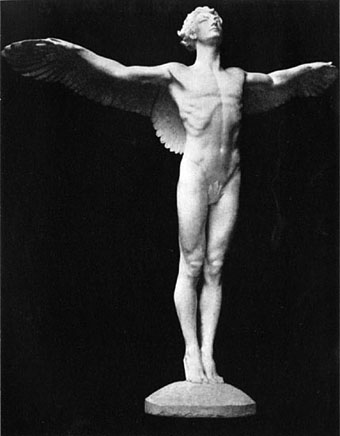
The Rising Sun by Adolph Alexander Weinman from Sculpture of the Exposition Palaces and Courts by Juliet Helena Lumbard James.

This fresh, strong young Sun is about to start on his journey – dawn is soon to break upon the world. With muscles stretched, the wind blowing through his hair, the heavenly joy of the first move expressed upon his face, the vigor of young life pulsating through his body, he will start the chest forward and move those outstretched wings. Let us preserve this glorious figure for our western city. It would so admirably suggest the new light that has been shed upon San Francisco by the Exposition of nineteen hundred and fifteen, as well as the new light occasioned by the opening of the Panama Canal.

Elsewhere on { feuilleton }
• The illustrators archive

Previously on { feuilleton }
• Ephemeral architecture
• Hugh Ferriss and The Metropolis of Tomorrow
• Winsor McCay’s Hippodrome souvenirs
• The World in 2030
• Metropolis posters
• Frank Lloyd Wright’s future city