Wildeana 4

hichens.jpg

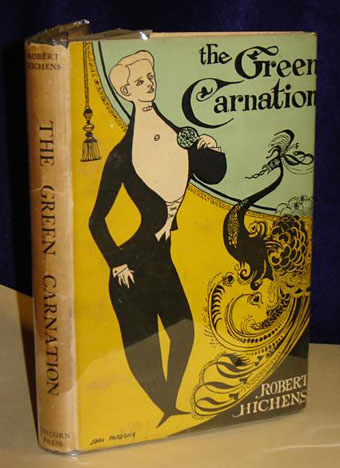
I could make these posts a lot more often since there’s seldom a week goes by when Oscar Wilde’s work or something from his life isn’t making the news somewhere. I forget now how I came across the Robert Hichens book but the Beardsley-derived cover design is the best I’ve seen for this title. The Green Carnation was first published in 1894 and is the notorious roman à clef whose lead characters, Esmé Amarinth and Lord Reginald Hastings, are based on Wilde and Lord Alfred Douglas. Hichens paints the pair as very obvious inverts with none of the “is he or isn’t he?” subtlety that Wilde managed to sustain in public. For a scandalised London the book seemed to confirm what was already suspected about Wilde and Bosie’s relationship.

The cover art is credited to one John Parsons, an illustrator whose other work, if there is any, eludes the world’s search engines. This edition was published in 1949 by Unicorn Press and it’s something I’m tempted to buy as a companion for my Unicorn Press edition of Dorian Gray.

The following links are to recent articles spotted whilst looking for other things:

Oscar Wilde, Classics Scholar. A review of The Women of Homer by Oscar Wilde, edited by Thomas Wright and Donald Mead.
• A new Broadway production of The Importance of Being Earnest has actor Brian Bedford playing Lady Bracknell.
Buyers go Wilde for Oscar as short note to his friend sells for €1,500.
Outsmarted: What Oscar Wilde could teach us about art criticism.

Elsewhere on { feuilleton }
The Oscar Wilde archive
The book covers archive

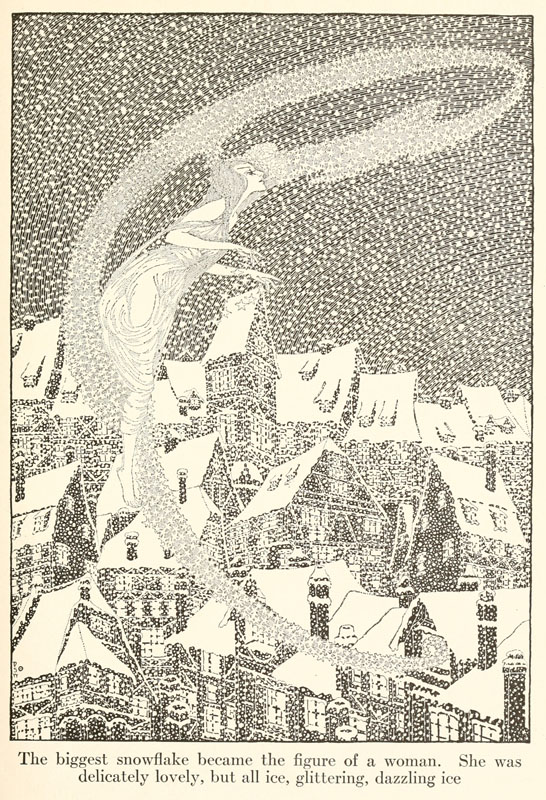
The Snow Queen

dulac1.jpg

Edmund Dulac.

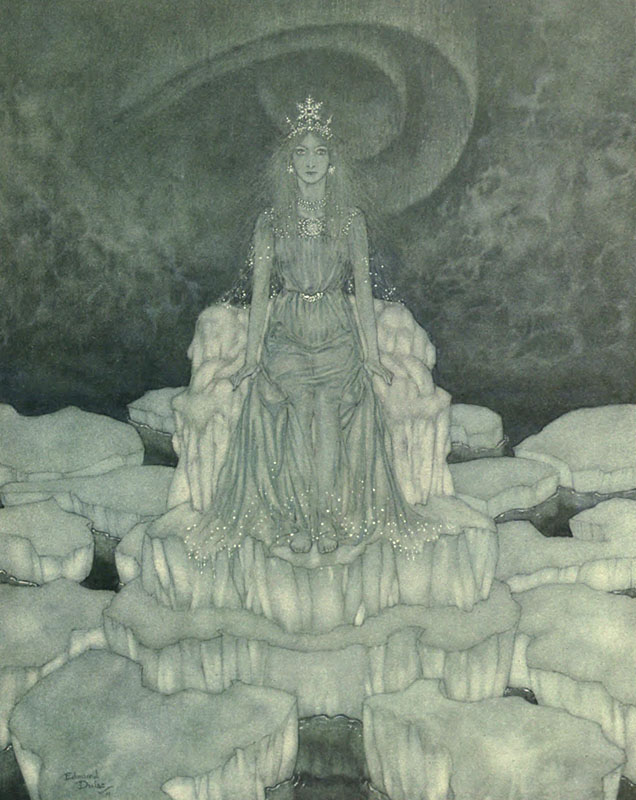
Empty, vast, and cold were the halls of the Snow Queen. The flickering flame of the northern lights could be plainly seen, whether they rose high or low in the heavens, from every part of the castle. In the midst of its empty, endless hall of snow was a frozen lake, broken on its surface into a thousand forms; each piece resembled another, from being in itself perfect as a work of art, and in the centre of this lake sat the Snow Queen, when she was at home. She called the lake “The Mirror of Reason,” and said that it was the best, and indeed the only one in the world.

Here in Britain it may not be quite as cold as it was earlier in the month but the Snow Queen still has us in her thrall. Hans Christian Andersen’s fairy tale was published in 1845 and, like many of the writer’s stories, is a blend of the beguiling and irritating: beguiling for the traces of older folk tales in its trolls, their magic mirror, and the Snow Queen as an embodiment of the season; irritating for the Christian gloss which is layered over everything like a sugar-coating. In this respect it’s a lot like Christmas; religiose sentimentality papered over winter rituals that are older and darker than the celebrations we’re supposed to acknowledge.

dulac2.jpg

Edmund Dulac.

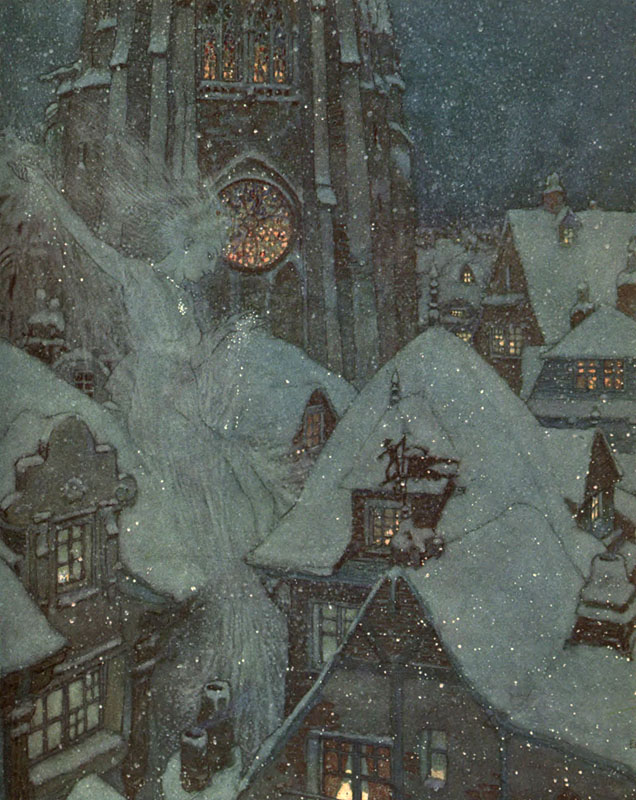
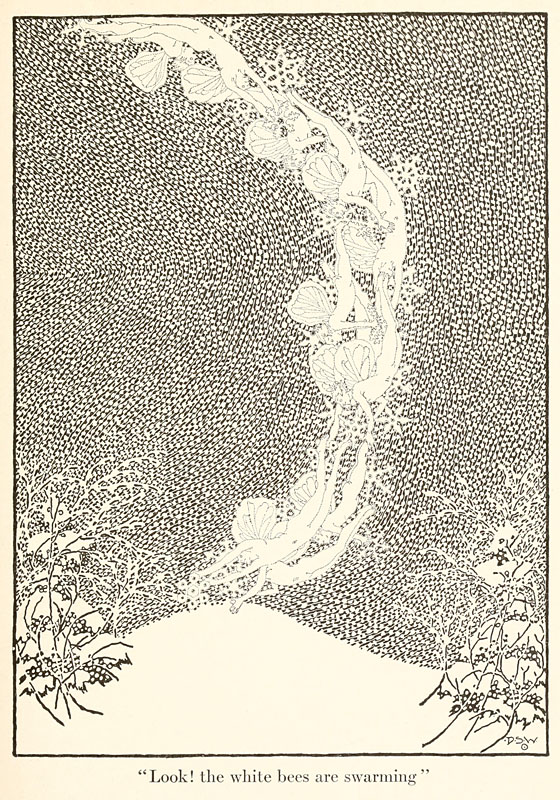
Andersen’s story has been illustrated and filmed many times with varying success. The Internet Archive has several illustrated editions, the selections here being from two of the better ones. Edmund Dulac’s Stories from Hans Andersen (1911) is one of the shorter collections and features predominantly colour pictures while Dugald Stewart Walker’s Fairy Tales from Hans Christian Andersen (1914) is one of the most heavily illustrated as well as having finer renderings of many stories. But not of the Snow Queen in her palace, Dulac beats everyone there.

walker2.jpg

Dugald Stewart Walker.

This description stood out from the second part of Andersen’s tale:

In winter all this pleasure came to an end, for the windows were sometimes quite frozen over. But then they would warm copper pennies on the stove, and hold the warm pennies against the frozen pane; there would be very soon a little round hole through which they could peep…

My sister and I had been reminiscing recently about growing up in the 1960s when central heating and double-glazing were a lot less common than they are today. This meant little or no heating in bedrooms, so very cold weather often meant the same frozen windows which Andersen describes. People in rural places will be familiar with this but it’s something I haven’t seen for years. When you’re a child it’s quite an excitement waking up to find that Jack Frost has paid a visit but these days I prefer a warm house.

As usual I’ll be away for a few days so the archive feature will be activated to summon posts from the past. Have a good one. And Gruß vom Krampus!

walker1.jpg

Dugald Stewart Walker.

Elsewhere on { feuilleton }
The illustrators archive

Previously on { feuilleton }
Dugald Stewart Walker revisited
More Arabian Nights
The art of Dugald Stewart Walker, 1883–1937

Cardwell Higgins versus Harry Clarke

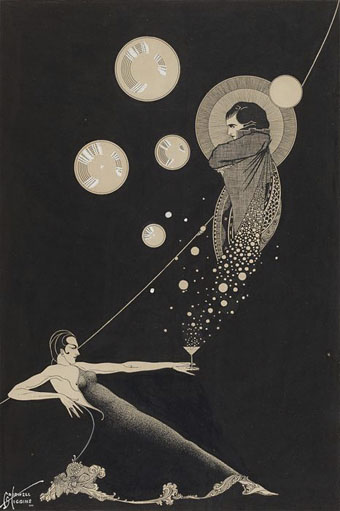
higgins1.jpg

A Delightful Page in the Record of My Existence.

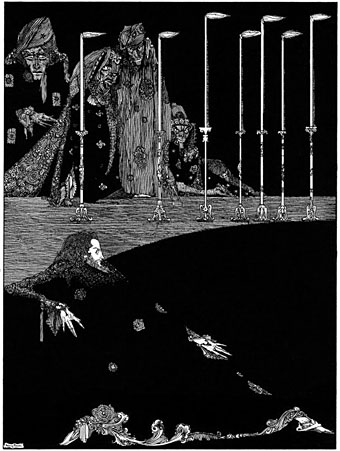
This picture popped up at Chateau Thombeau a few days ago and it’s also been circulating in Tumblr’s recursive labyrinth. The very obvious debt to Harry Clarke’s black-and-white style caught my attention, especially to the artist’s Poe illustrations with the reclining woman being a blatant swipe from one of the Pit and the Pendulum drawings.

clarke.jpg

The Pit and the Pendulum (1919) by Harry Clarke.

Searching around revealed that the artist responsible, Cardwell Higgins, produced a small series of similar pieces in the late 1920s. He then settled into a career as an illustrator for American magazines and advertising, working in a far more commercial style which isn’t really the kind of thing I get very excited over. Six drawings from the black-and-white series were published as a lthograph set in 1979. Some of the originals came up for sale recently which accounts for the surfacing of these copies.

Continue reading “Cardwell Higgins versus Harry Clarke”

Le Baiser de Narcisse

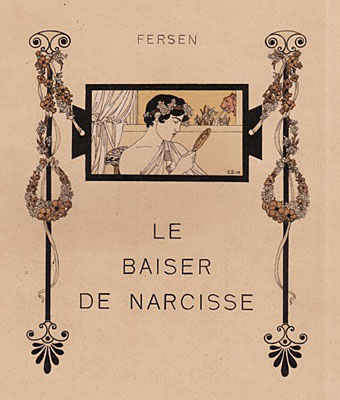
brisset1.jpg

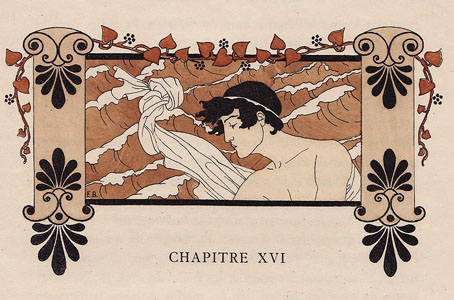
We have the French gay culture site Bibliothèque Gay to thank for posting illustrations by Ernest Brisset from Jacques d’Adelswärd-Fersen’s rare volume of homoerotic fiction, Le baiser de Narcisse (The Kiss of Narcissus). The book was originally published in 1907 but it was a new edition in 1912 which came embellished with Brisset’s Classical drawings and decorations. If these lack a degree of eros it should be noted that the text would have been condemned as outright pornography in the Britain of 1912, a paean to youthful male beauty which lingers over details of a boy’s “polished hips” and his “round and firm sex like a fruit”. As is usual with homoerotics of this period, the Classical setting and allusion to Greek myth provides the vaguest excuse for the subtext even though prudes of the time weren’t remotely fooled by this, as Oscar Wilde discovered.

brisset2.jpg

Among other works by Fersen there’s a decadent roman à clef, Lord Lyllian: Black Masses (1905), which I’ve been intent on reading since it was translated into English a couple of years ago. Here Fersen provides us with yet another fictional extrapolation of Oscar Wilde who the author gifts with some of his own scandalous history. Fersen had been driven from France following a public outrage involving the “Black Masses” of the novel’s title, and the alleged debauching of Parisian schoolboys.

hocker.jpg

Nino Cesarini by Paul Höcker (1904).

Fersen settled in Capri with his partner Nino Cesarini where they spent some years reinforcing the reputation of that island (not for nothing is Noël Coward’s camp and catty character in Boom! named “the Witch of Capri”), and proselytising for the Uranian cause with a literary journal, Akademos, modelled on Adolf Brand’s Der Eigene. Fersen’s later life is reminiscent of that of Elisar von Kupffer, a wealthy contemporary who created a secluded homoerotic paradise of his own, the Sanctuarium Artis Elisarion. Unlike Kupffer, however, Fersen ended his days prematurely in a haze of opium and cocaine. As for Ernest Brisset, if anyone finds other work of his online, please leave a comment.

Elsewhere on { feuilleton }
The gay artists archive

Previously on { feuilleton }
Reflections of Narcissus
Narcissus

Weekend links 41

2001.jpg

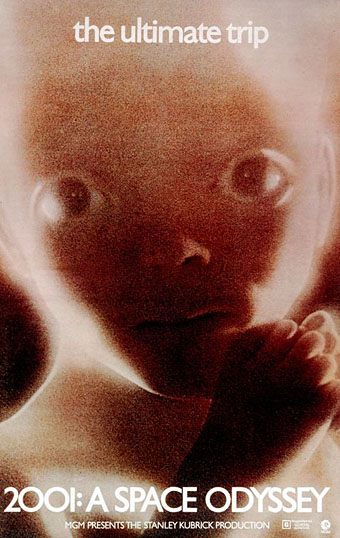
Being an inveterate Kubrickphile I was naturally pleased to hear that some of the excised scenes from 2001: A Space Odyssey have survived in a watchable form, even though I’m often ambivalent about the restoration of such material. While it was good to see at last the missing French compound sequence of Apocalypse Now, for example, that sequence added nothing to the film as a whole and its inclusion was spoiled by music which Coppola used for sentimental reasons. In Kubrick’s case, there’s a longer version of The Shining which the director allowed to be screened on UK TV in the 1980s but, again, most of the unseen material was incidental and added nothing to the film.

• Related: Roger Ebert’s review of 2001 from 1968; Olivier Mourgue, designer of the Djinn chairs seen in the film’s space Hilton scenes; Magnificent obsession, a Vanity Fair piece from 2002 about the search for the missing scenes from The Magnificent Ambersons. Meanwhile, the trailer for Terrence Malick’s new film, The Tree of Life, features some surprising cosmic moments among its scenes of family life.

The separate history [of gay and lesbian artists] has been kind of edited out of art history but in fact art history is very much interwoven with gay or queer history. In a way the two can’t be separated. America doesn’t like anything uncomfortable. I find in my dealings with museums that if I ask a question and the answer is ‘no,’ they don’t answer. If the answer is ‘yes,’ I get these amazingly enthusiastic responses. I find it sort of strange sometimes, not being American myself. In a way what they’re doing is editing out the uncomfortable. David Wojnarowicz’s work can make you uncomfortable — and they’ve edited out that possibility in the show.

Canadian artist AA Bronson (see below).

• More on the Smithsonian versus David Wojnarowicz affair: Frank Rich examined the train of events in a comment piece, Gay Bashing at the Smithsonian, for the NYT; the Andy Warhol Foundation threatened to withdraw their funding for future Smithsonian events unless the work is reinstated, the Robert Mapplethorpe Foundation will be doing the same; another artist featured in the National Portrait Gallery exhibition, AA Bronson, requested that the gallery withdraw his work from the show in protest; the NPG refused, citing a contractual arrangement; among the increasing number of galleries showing support for Wojnarowicz, Tate Modern, London, will host an event in January which will feature a screening of the contentious video; lastly, there’s a protest event in New York City today (Sunday, December 19th) at 1.00pm, details here.

• More censorship in America: Jeffrey Deitch Censors Blu’s Political Street Art Mural. In the book world, writer Selena Kitt finds her erotic incest stories removed from Amazon’s Kindle store. Other authors, Jess C Scott and Esmerelda Green, have had their erotic titles removed from the store. Selena Kitt says:

When some of my readers began checking their Kindle archives for books of mine they’d purchased on Amazon, they found them missing from their archives. When one reader called to get a refund for the book she no longer had access to, she was chastised by the Amazon customer service representative about the “severity” of the book she’d chosen to purchase.

Can you imagine buying a paper book and the bookstore then paying you a visit to forcibly reclaim it? To date no adequate explanation from Amazon has been forthcoming but they’ll be happy to sell you a Kindle edition of the Marquis de Sade’s The 120 Days of Sodom.
m51.jpg

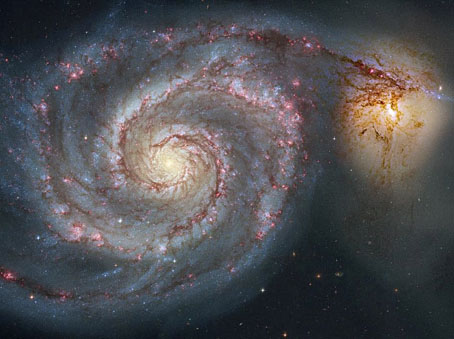
Galaxy M51 aka The Whirlpool. One of the Top Astronomy Pictures of the Year from a selection by Bad Astronomy. Photo by the Hubble Heritage Team & Robert Gendler.

• More cosmic events: there’ll be a total lunar eclipse this coming Monday, visible in much of the Northern Hemisphere.

• “Heterosexuality is the opiate of the masses!” The Raspberry Reich (2004), a film by Bruce LaBruce.

New editions of Borges poetry. Fine so long as you accept that the translations can never truly satisfy.

• Just the thing for the winter weather, illustrations for Pushkin’s Queen of Spades from 1966.

• Another Ghost Box download: Radio Belbury Programme 1: “Holidays & Hintermass”.

Monsters, Inc: Arcimboldo and the Wunderkammer of Rudolf II.

• Silent Porn Star found some burlesque lamps.

Giant airship powered by algae.

Space Oddity (1969) by David Bowie.