Weekend links 426

slinger.jpg

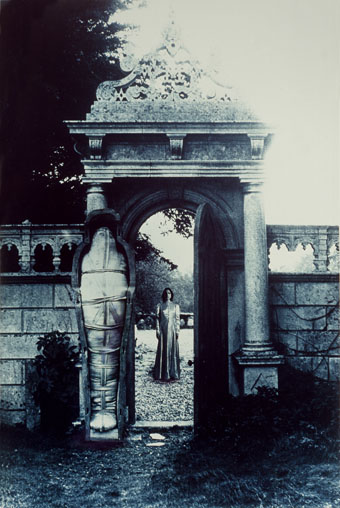
Self Preservation (1970–77), a collage by Penny Slinger from the series An Exorcism.

• RIP John Calder, one of the most important British publishers of the last century whose death was acknowledged in the Washington Post (and in the Telegraph, a paper that would have given him no support during his censorship battles) but at the time of writing hasn’t been mentioned at all in the increasingly useless Guardian. The omission in the latter seems even more surprising when Calder himself wrote obituaries for the paper, and they ran an archive piece two weeks ago for the 50th anniversary of Calder & Boyars’ successful court defence of Last Exit to Brooklyn. “Publishing is an industry run by capitalists now.

• Another 50th anniversary: David Bushman asked Alan Moore for his memories of Patrick McGoohan’s superb TV series The Prisoner.

Michael Moorcock in conversation with Hari Kunzru at Shakespeare and Company, Paris.

Stephen O’Malley presents Acid Quarry Paris – In Session with Richard Pinhas (Heldon).

• When a rock is a stone: Louise Steinman on finding Robert Smithson’s Spiral Jetty.

• Victorians, Vaults, and Violet Water: a profusion of links at Greydogtales.

• Mix of the week: FACT mix 666 by Róisín Murphy.

• The amazing adventures of Melinda Gebbie.

Starbirthed

Exorcism (1971) by Lucifer | The Final Calling (Physical Exorcism) (1984) by CTI | Exorcism Of The Hippies (2010) by Mater Suspiria Vision

Illustrating Frankenstein

holst.jpg

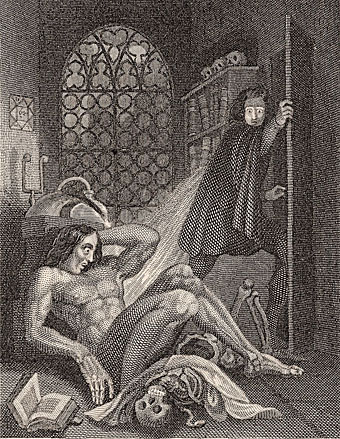
Frontispiece by Theodore Von Holst of the 1831 edition of Frankenstein. The monster in this illustration, which Mary Shelley would no doubt have seen, is closer to the description in the text than the myriad shambling figures that came later.

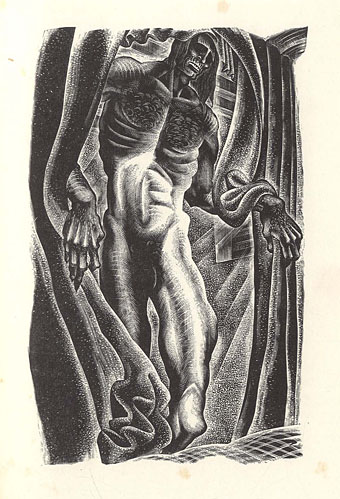
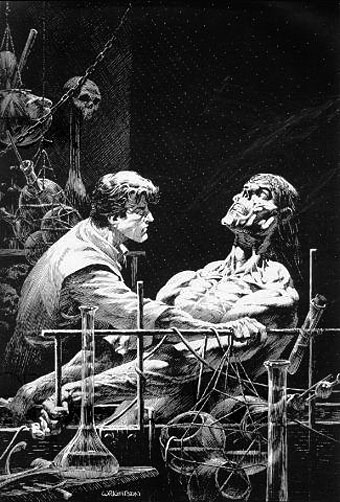
It’s a recurrent feature of commissioned work that you sometimes find yourself illustrating novels or stories you might otherwise have never attempted. Spanish publisher Editorial Alma have just added a new edition of Mary Shelley’s Frankenstein to their series of illustrated classics, convenient timing with this year being the bicentenary of the book’s first publication. Last year I produced 33 illustrations for Alma’s collection of Poe stories, as well as 3 new illustrations for a small Lovecraft collection. For their edition of Frankenstein I’ve created 24 full-page pictures, one for each chapter. (I produced 25 in total, 24 for the chapters and one for the letters at the front, but the Spanish translation is arranged slightly differently so one of the drawings has been omitted.) In the past I’ve given little consideration to illustrating classic books, preferring to look for subjects which were less familiar. Frankenstein is a book that isn’t illustrated as much as some but Lynd Ward in 1934, and Berni Wrightson in 1977/78 both produced sufficiently exceptional sets of drawings for me to regard the novel as almost unassailable. Until last year, that is.
ward1.jpg

Frankenstein by Lynd Ward (1934).

Despite such formidable predecessors, I felt that with this book at least I might be able to offer something new using the blend of collage and drawing that I’ve been evolving recently. There was additional promise in that the story as it’s written is less familiar than the Poe stories, and much less familiar than its fellow horror classic, Dracula. People think they know Frankenstein but what they often know is the manglings the novel has received in various film and TV adaptations. The Ward and Wrightson illustrations stay close to the text, the latter being replete with period detail, and rendered in a style reminiscent of 19th-century wood engravings. Wrightson even copied two of Gustave Dore’s pictures from The Rime of the Ancient Mariner for the opening scenes on the ship, one of which went unused. But Wrightson’s drawings are closer still to Franklin Booth‘s pen-and-ink style which was also derived from wood engraving yet which achieves its effects in a different manner to the engraving process.
frankenstein2.jpg

Frankenstein by Berni Wrightson (1977/78).

Even when artists follow the text of Frankenstein more closely than the screenplay adapters, personal tastes can’t help manifest themselves. So Ward’s drawings reflect the angular and stylised compositions of his “novels in woodcuts”, while Wrightson’s work still shows evidence of his earlier career as a comic artist. With my illustrations I wanted to reflect the artistic spirit that gave birth to the novel, namely Romanticism. Frankenstein is very much a Romantic tragedy with violent passions set against the overwhelming landscapes of the Swiss Alps, the Rhine valley and the Arctic seas. Three of the illustrations below allude to Caspar David Friedrich’s paintings, while many of the others have had their mundane cloudscapes exchanged for gloom and tumult.

I’ve said before that one of the things I enjoy about the collage technique is being able to use engravings and other graphics from the same period (give or take a few decades) as the story itself. The disadvantage of relying on pre-existing sources is that you’re always limited by the available material, so recently I’ve been pushing the technique further to achieve a hybrid style, something midway between the Ernst/Sätty engraving-collage technique and the very laborious, heavily-shaded pen-and-ink style I used when I was drawing comics. The approach isn’t so different to the one I used in my Lovecraft comics many of whose backgrounds and other details were copied from photographs. The difference is that where I used to spend several days working on a single panel (and two weeks working on a page) I can now create an entire picture in half the time. In these new illustrations I feel the hybrid style is working as I intended, allowing me greater freedom to create the picture I have in mind rather than a picture dictated by the source material. Without incorporating original figures and other drawn elements into the compositions it would have been difficult to illustrate a story with the same characters in so many scenes, a problem I encountered when I was illustrating Lewis Carroll’s Alice books and ran out of pictures of Victorian girls.

The full run of pictures follows below, including the one which was omitted from the print edition. All may be seen at a larger size here. Since the scenes aren’t always self-explanatory I’ve included fragments of text from each chapter.
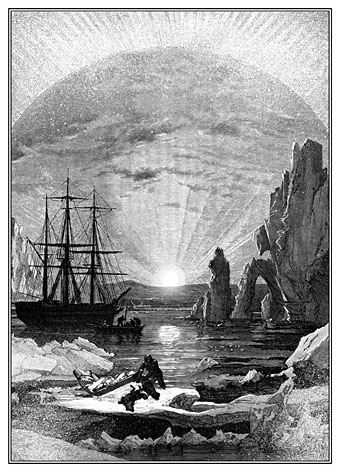
frankenstein00.jpg

“In the morning, however, as soon as it was light, I went upon deck and found all the sailors busy on one side of the vessel, apparently talking to someone in the sea. It was, in fact, a sledge, like that we had seen before, which had drifted towards us in the night on a large fragment of ice.”
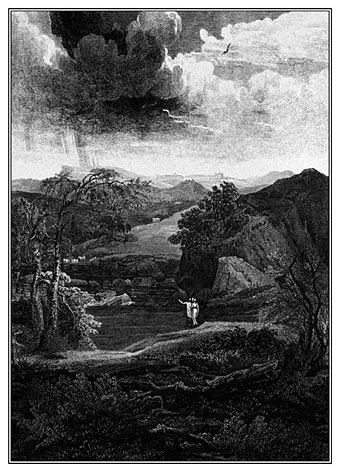
frankenstein01.jpg

“During one of their walks a poor cot in the foldings of a vale attracted their notice as being singularly disconsolate, while the number of half-clothed children gathered about it spoke of penury in its worst shape.”

This one was omitted from the Alma edition. No loss, really, since the scene doesn’t add much to the story.
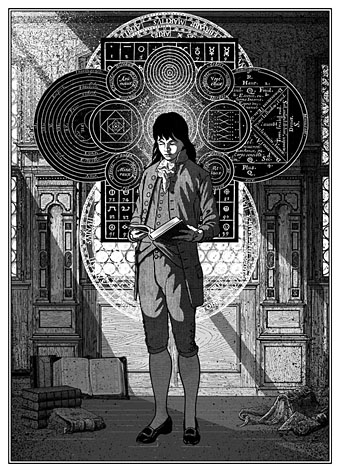
frankenstein02.jpg

“When I returned home my first care was to procure the whole works of this author, and afterwards of Paracelsus and Albertus Magnus. I read and studied the wild fancies of these writers with delight; they appeared to me treasures known to few besides myself.”

The diagrams here are taken from some of the books the young Victor Frankenstein is reading. There’s an allusion to this in the magic square on the wall in the back of Theodore Von Holst’s frontispiece, the square being the kind of thing seen in books like this one by Cornelius Agrippa, one of the occult philosophers mentioned in the novel.

Continue reading “Illustrating Frankenstein”

The weekend artists, 2017

images.jpg

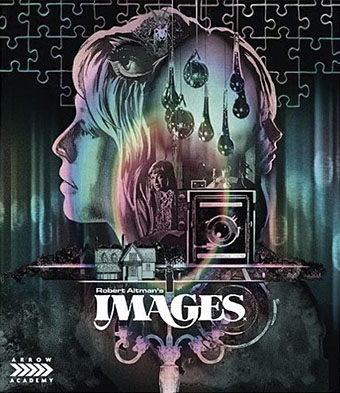
Art by Twins of Evil for the forthcoming blu-ray from Arrow Academy.

The laziest post of the year is invariably a review of the artists/designers/photographers featured on the weekend posts, so here’s another end-of-year list for you. Scroll down to see what caught my attention over the past twelve months.

mueck.jpg

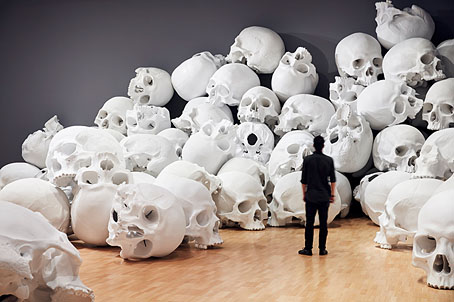
Mass by Ron Mueck at the National Gallery of Victoria Triennial. Photo by Tom Ross.

possession.jpg

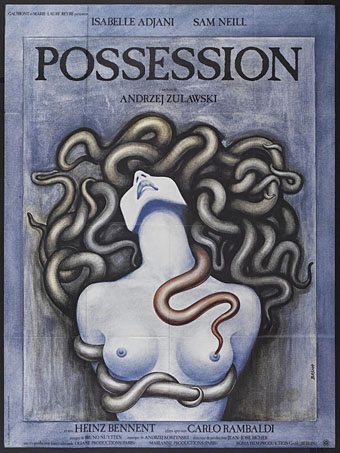
French poster by Basha (Barbara Baranowska) for Andrzej Żuławski’s extraordinary Possession (1981).

adam.jpg

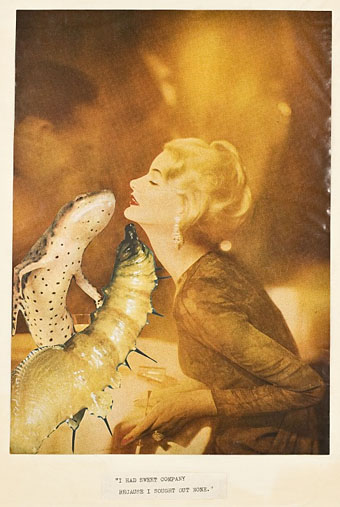
I Had Sweet Company Because I Sought Out None. Collage by Helen Adam.

nakayama.jpg

Still of an Alive Painting by Akiko Nakayama.

Continue reading “The weekend artists, 2017”

Weekend links 389

adam.jpg

I Had Sweet Company Because I Sought Out None. Collage by Helen Adam.

• Readers of The Library of Babel by Jorge Luis Borges continue to be compelled to either illustrate the impossible archive or create virtual equivalents. The Library of Blabber by nothke is a procedural version for home computers in which each volume on the shelves contains randomly-generated content.

• The Japanese American Toy Theatre of London presents: James Bonk in Matt Blackfinger (1987). Directed by Akiko Hada, with music by David Toop, and a song from Frank Chickens’ Kazuko Hohki (who also co-wrote the script).

• Music, Time and Long-Term Thinking—The Long Now Foundation (and a fair amount of Brian Eno) by Austin Brown, Alex Mensing and Ahmed Kabil.

• A Return to Normilcy: Bernie Brooks talks to post-punk group Normil Hawaiians about their 1982 album More Wealth Than Money which has just been reissued.

• Sound artist and theremin player Sarah Angliss has reworked music by Bernard Herrmann for an upcoming stage adaptation of The Twilight Zone.

• Does the world need another reissue of A Secret Wish by Propaganda? Not really but there’s a “deluxe” vinyl and CD edition on the way.

• “What Would [Bernard] Wolpe Do?” Talking Wolpe, Albertus and book cover design with the Faber & Faber Art Department.

• Mixes of the week: FACT mix 629 by Idle Hands/Chris Farrell, and XLR8R Podcast 518 by Cassy.

• At Phantasmaphile: Neglected collage artist Helen Adam (1909–1993).

Collectors’ corner: photos of book and music libraries

• The Black Meat (Deconstruction Of The Babel-Tower of Reason) (1994) by Automaton | Babel (2010) by Massive Attack feat. Martina Topley-Bird | Branching (2016) by The Library of Babel

Narraciones extraordinarias by Edgar Allan Poe

poe01.jpg

Berenice.

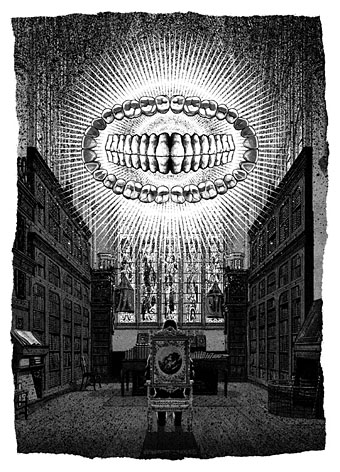
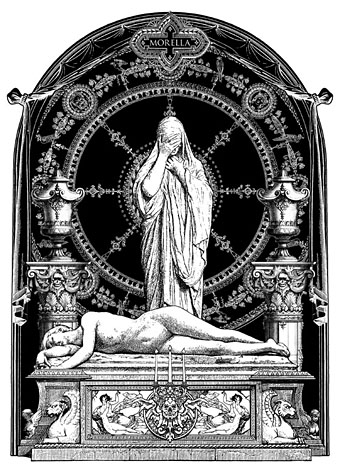
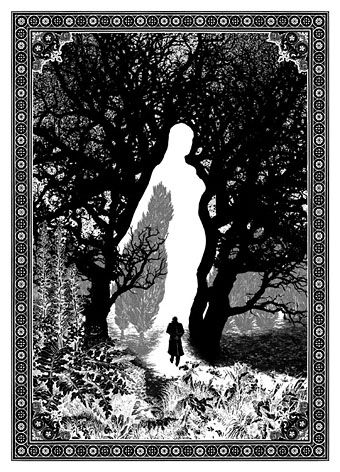
Narraciones extraordinarias was the first commission that arrived from Spanish publisher Editorial Alma earlier this year but it’s the second one to be revealed here. (Copies of the pictures at a larger size may be seen on the main website.) I confess I was rather dismayed when the request came through for this. I was pleased to have the opportunity to illustrate so many stories but Edgar Allan Poe is a tough brief when Harry Clarke has already created the definitive set of illustrations. The challenge, then, became one of trying to successfully illustrate the stories without repeating anything by Clarke or the many other illustrators who’ve tackled Poe, not least my favourite collagist, Wilfried Sätty.

poe02.jpg

Morella.

One advantage of the collection was the inclusion of several pieces that you seldom find in the common English reprints of Poe, stories such as A Tale of the Ragged Mountains. The style is Sätty-esque, of course, although less surreal in approach thanks to the flexibility of digital tools. I’ve been developing this engraving collage style over the past year or so to create a hybrid that blends drawn and collaged material into a seamless whole. When this works, as with The Man in the Crowd (below), you shouldn’t be able to easily tell which elements are drawn and which collaged. (And more importantly, it shouldn’t really matter.) This technique has been developed further in the most recent work I’ve done for Editorial Alma but you’ll have to wait a while to see the results.

poe03.jpg

Ligeia.

Despite my initial misgivings, this job worked out better than I expected, not least because the deadline was so tight. Several of these pictures were created in a day, a work-rate common to many comic artists but not one that I’m used to (or happy with) at all. I’m still unhappy with MS. Found in a Bottle which lazily swiped a chunk of a Gustave Doré illustration; if I’d had the time I would have changed it, and if this series of pictures is ever reprinted that’s one I’ll be reworking.

As before, this is a Spanish-language hardback, and the only purchase link I have is an Amazon one. My next contribution to this series should be out early next year.

poe04.jpg

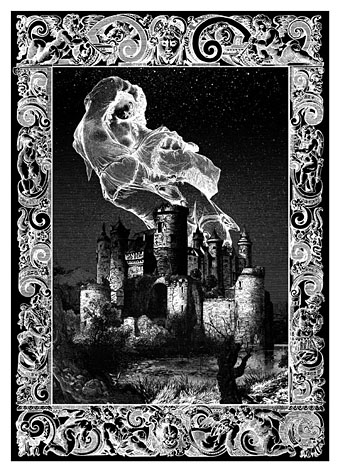
The Fall of the House of Usher.

Continue reading “Narraciones extraordinarias by Edgar Allan Poe”