Weekend links 96

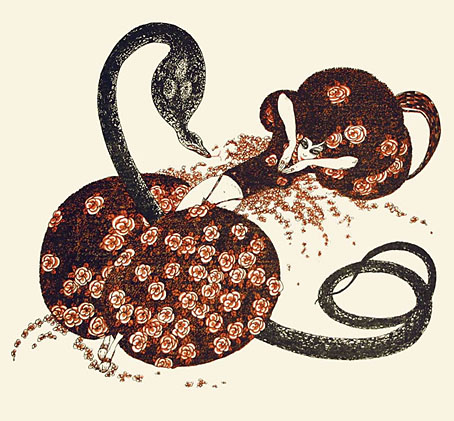
nunez.jpg

Sin título (monstruas) (2008) by Marina Núñez.   

• Salon asks Christopher Bram “Is gay literature over?” Bram’s new book, Eminent Outlaws: The Gay Writers Who Changed America, is reviewed here.

• Robert Montgomery is profiled at the Independent as “The artist vandalising advertising with poetry.”

In addition to aesthetics, McCarthy noted a deeper link between great science and great writing. “Both involve curiosity, taking risks, thinking in an adventurous manner, and being willing to say something 9/10ths of people will say is wrong.” Profound insights in both domains also tend arise from a source beyond the limits of analytic reason. “Major insights in science come from the subconscious, from staring at your shoes. They’re not just analytical.”

Nick Romeo meets Cormac McCarthy at the Santa Fe Institute.

• For FACT mix 316 Julia Holter mixes radio broadcasts, street recordings and music.

• This week in the Tumblr labyrinth: fin de siècle art and graphics from Nocnitsa.

“There’s a widespread cultural barrenness across art and political culture. But there are some pockets of resistance on the extreme margins, like the techno-savvy protest movements, small press, the creator-owned comics, that seem to be getting some signs of hope for the future,” he says. “All of the genuinely interesting work is being done on the margins, with independent companies, self-producing, and alternative distribution networks.”

Alan Moore on Watchmen’s “toxic cloud” and creativity v. big business.

• Stone Tape Shuffle, a 12” LP of readings by Iain Sinclair. Limited to 400 copies.

• Monolake on how we cope with death: mythologies, rituals, drugs and Ghosts.

• Kraftwerk perform at New York’s Museum of Modern Art in April.

• Kathy Acker (in 1988?) interviewing William Burroughs.
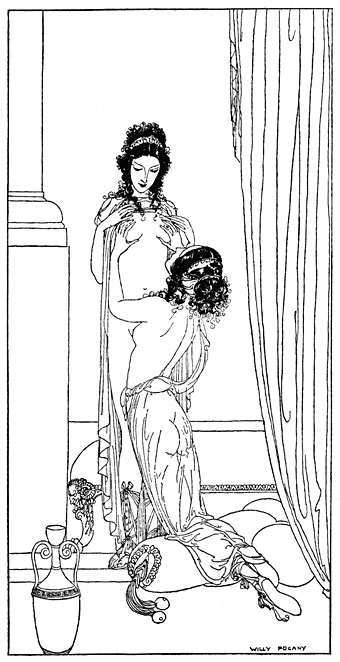
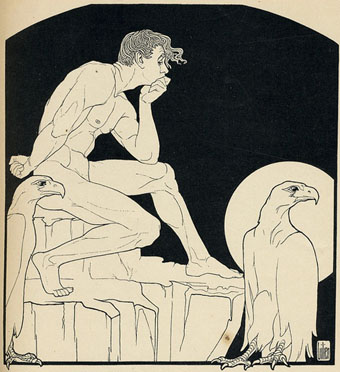
pogany.jpg

Willy Pogány’s erotica: illustrations for a 1926 edition of The Songs of Bilitis by Pierre Louÿs.

• Nicholas Lezard on David Lynch: director of dreams.

• Did otherworldly music inspire Stonehenge?

• Coilhouse has an Eyepatch Party.

• Tanzmusik (1973) by Kraftwerk | The Model (1992) by the Balanescu Quartet | Trans Europe Express (2003) by the Wiener Sinfonie Orchestra & Arnold Schönberg Choir.
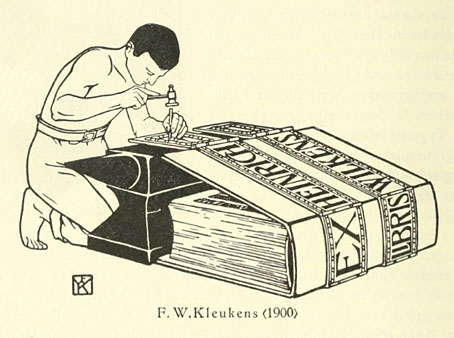
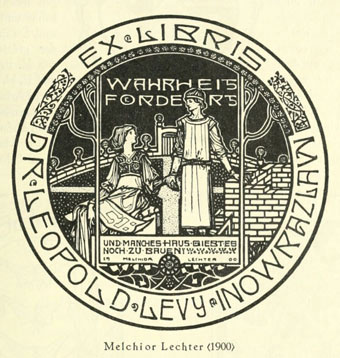
German bookplates

exlibris08.jpg

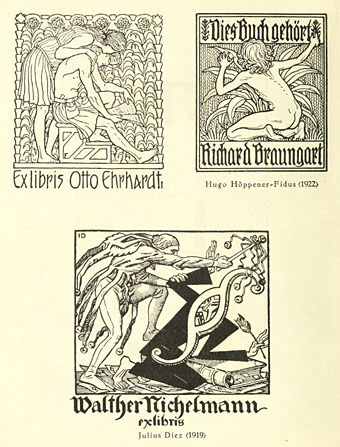
A selection from Das Moderne Deutsche Gebrauchs-Exlibris (1922) edited by Richard Braungart, an overview of the practioners of the bookplate form in Germany and Austria during the first decades of the 20th century. Some of the German and Austrian art magazines featured here over the past couple of years included bookplate designs, and Braungart’s collection includes many artists from those magazines: Melchior Lechter, Hugo Höppener (aka Fidus), Julius Diez, Heinrich Vogeler, Marcus Behmer, Franz von Bayros, Koloman Moser, Carl Otto Czeschka, Ephraim Moses Lilien, Franz Stassen and others. 400 examples in all.

exlibris01.jpg

exlibris02.jpg

Continue reading “German bookplates”

Vaslav Nijinsky by Paul Iribe

iribe1.jpg

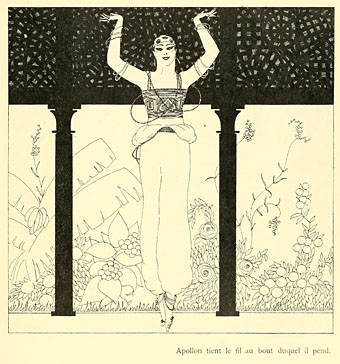
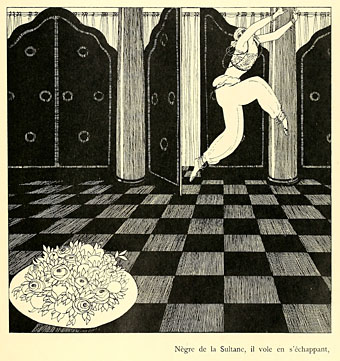
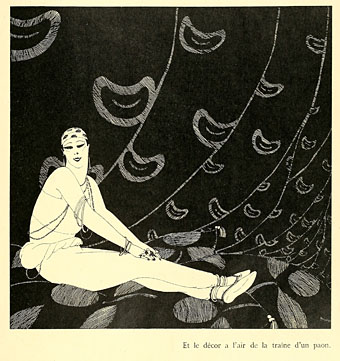
Another small and obscure volume hiding in the Internet Archive, Vaslav Nijinsky is a portfolio of six ink drawings by Paul Iribe (1883–1935) with a few lines of appended verse by Jean Cocteau. Iribe was a French designer and fashion illustrator who for a while was a member of the Ballets Russes circle, hence these depictions of the troupe’s most celebrated dancer. As post-Beardsley black-and-whites go these are pretty good although Iribe’s figures lack the requisite grace for their subject. If they were the only drawings of their kind that wouldn’t be so bad but one of Iribe’s contemporaries, George Barbier, produced his own superb series of Nijinsky drawings most of which can be seen here.

Note: the date given for this book at the Internet Archive is 1900 which seems quite wrong given that Nijinsky was still a young dancer in Russia at that time. Iribe’s drawings must date at least from 1910, maybe later.

iribe2.jpg

iribe3.jpg

Continue reading “Vaslav Nijinsky by Paul Iribe”

Weekend links 86

alastair.jpg

Salammbô by Alastair (Hans Henning Voigt) from Harry Crosby‘s Red Skeletons (1927). Dover published a new collection of Alastair’s drawings in September.

“A Taste of Honey showed working-class women from a working-class woman’s point of view, had a gay man as a central and sympathetic figure, and a black character who was neither idealised nor a racial stereotype.” RIP Shelagh Delaney. Related: Shelagh Delaney’s Salford (1960), directed by Ken Russell, and all 47 minutes (!) of The White Bus (1967), Lindsay Anderson’s strange, pre-If…. short, written by Shelagh Delaney, filmed in and around Manchester.

Since birth I’ve craved all things psychedelic, the energy and beauty of it. The pleasure… […] But in the US the exploration of consciousness and its powers—or really any curiosity about anything at all—is actively discouraged, because the system is so corrupt that it depends on people being virtually unconscious all the time. Burroughs cracked that code long ago. Spirituality here equals money; no one seems to be able to think, never mind explore their own consciousness.

Laurie Weeks: Making Magic Out of the Real

• Ian Albinson shows us The Title Design of Saul Bass while Ace Jet 170 has a copy of the new Bass monograph.

• Kris Kool (1970) at 50 Watts, Philip Caza’s lurid, erotic, psychedelic comic strip.

lilien.jpg

Götz Krafft by EM Lilien from a collection at Flickr.

• Serious Listeners: The Strange and Frightening World of Coil.

• The Octopus Chronicles, a new blog at Scientific American.

• We now live in a world where there are Ghost Box badges.

• Kilian Eng interviewed at Sci-Fi-O-Rama.

• Dalí Planet

• Bedabbled!

• A Taste of Honey (1962) by Acker Bilk | A Taste of Honey (1965) by Herb Alpert’s Tijuana Brass | A Taste of Honey (Moog version) (1969) by Martin Denny.

Japanese gay art

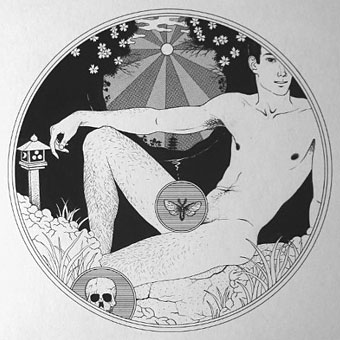
hasegawa.jpg

An untitled drawing by Sadao Hasegawa from Japanese Gay Art, an English-language site with a substantial collection of works by Hasegawa and others, all of which are for sale. Examples run the spectrum from Gengoroh Tagame‘s beefcake S&M to Hideki Koh‘s delicate geisha boys. Something for everyone, in other words. There are also artist interviews, and a handful of articles about this area of the Japanese art world.

Elsewhere on { feuilleton }
• The gay artists archive

Previously on { feuilleton }
• Gekko Hayashi: homoerotics and monsters
• The art of Ben Kimura
• The art of Goh Mishima, 1924–1989
• The art of Hideki Koh
• Secret Lives of the Samurai
• The art of Sadao Hasegawa, 1945–1999
• The art of Takato Yamamoto