The Smoke

smoke01.jpg

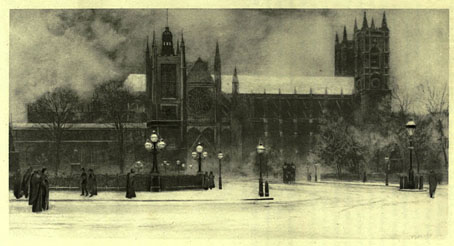
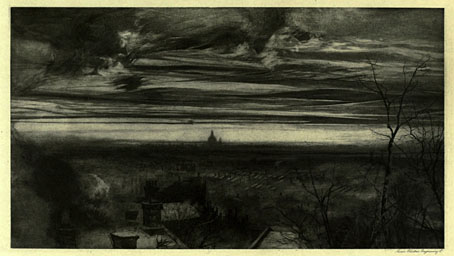
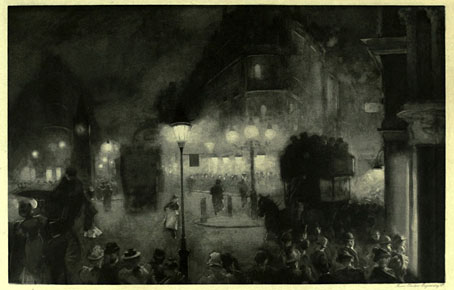
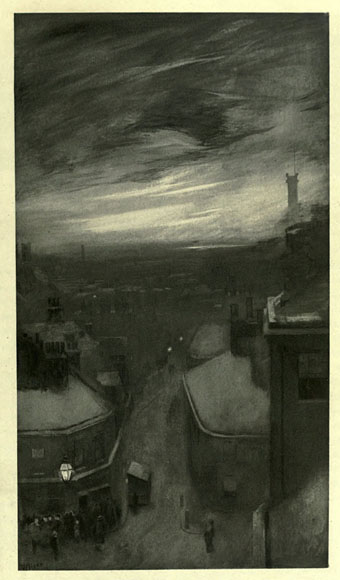
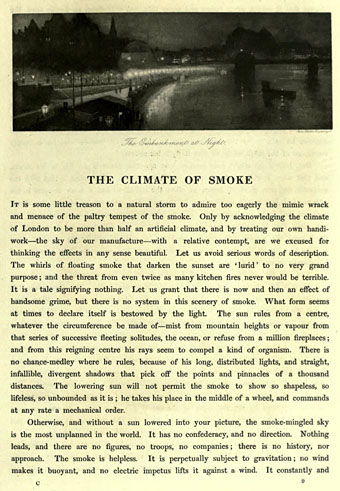
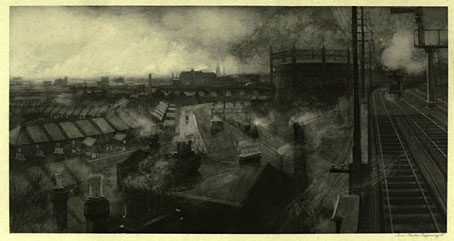
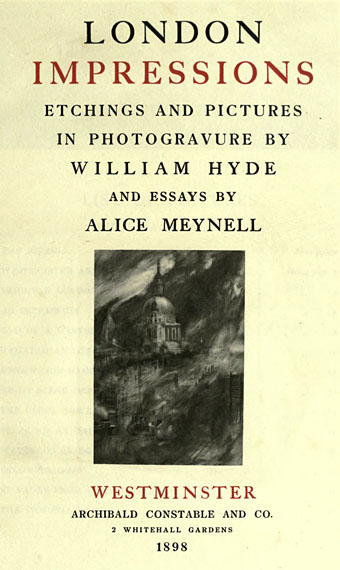
London in 1898 was the most populous city in the world, a metropolis of “four million souls” as Arthur Conan Doyle continually reminds us in the Sherlock Holmes stories. The stereotypical representation of London in the 19th century is of a city wreathed in fog but the reality was closer to the dense smogs that plague Chinese cities today. The four million souls heated themselves by burning wood and coal, and the resulting smoke (and a fair amount of steam, no doubt) combined with the British climate to create the noxious, tinted “fogs” that fill the streets of Victorian fiction.

smoke02.jpg

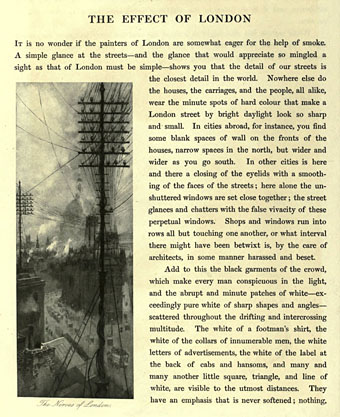
Whatever the health hazards, the vaporous atmosphere had its champions in artists such as Claude Monet and James Whistler, both of whom relished the way the smoky air softened the silhouettes of the city. William Hyde may be added to the list for this superb series of etchings showing London at its most tenebrous, another chance discovery at the Internet Archive. London Impressions is an ambivalent celebration of the capital as a city of shadows, smoke and fog, the essays by Alice Meynell ruefully admitting that while the industrial cities of the north may rival London for their polluted atmosphere, their smaller size means that blue sky is never far away, something the Londoner of 1898 couldn’t take for granted. This is a marvellous book, and one I’d love to own if it wasn’t so rare; there’s a copy on eBay at the moment for $1,640. At least we can read it (and download the pages) here.

smoke03.jpg

smoke04.jpg

smoke05.jpg

smoke06.jpg

smoke07.jpg

smoke08.jpg

Continue reading “The Smoke”

Weekend links 405

expo70.jpg

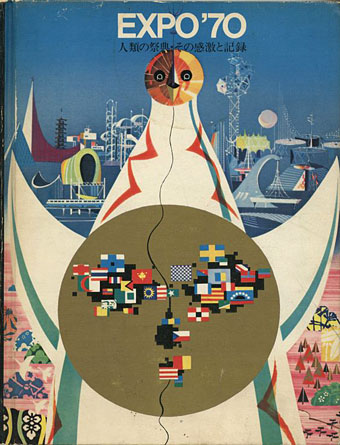
Taro Okamoto’s Tower of the Sun on the cover of an Expo ’70 guide.

• Last week I was watching the restored print of Howard Brookner’s excellent William Burroughs documentary, Burroughs. Among the later scenes are shots of the writer visiting Britain in the autumn of 1982 for the Final Academy events, a visit also recorded on Super-8 by Derek Jarman, and by the video cameras of the Haçienda nightclub at a reading I was fortunate to attend. Included in the Brookner film are brief snatches of an interview with Burroughs for BBC Radio 1 by John Peel’s producer, John Walters, something I missed when it was first broadcast.

• Taro Okamoto’s Tower of the Sun was built in Osaka for Expo ’70, and unlike many one-off expo buildings has managed to survive years of neglect and threats of demolition. Visitors to the Tower may now explore the restored “Tree of Life” interior, although places are limited so it’s necessary to book in advance. Related: Expo ’70 at ExpoMuseum, and Tower Of The Sun (1997) by Shonen Knife.

• Also at Dangerous Minds this week: a 1969 TV recording of Krzysztof Penderecki’s notorious The Devils of Loudon, an opera based on the same Aldous Huxley book as Ken Russell’s The Devils, and which includes (among other things) a singing nun enduring a forced enema.

• The new Cavern Of Anti-Matter album, Hormone Lemonade, is released this week. XLR8R has a preview. Related: an old/undated mix by Tim Gane for The Brain radio show here.

Milton Glaser on some of his favourite posters. Milton Glaser Posters, a book collecting 427 poster designs, is published this week by Abrams.

• The Ghosts of Empty Moments: Christopher Burke reviews M. John Harrison’s You Should Come with Me Now.

• Mixes of the week: FACT mix 644 by Susanna, and XLR8R Podcast 534 by Pär Grindvik.

Emily Temple found 25 of the most expensive books you can buy on the internet.

Towers Of Dub (1992) The Orb | Tower Of Our Tuning (2001) by Broadcast | Television Tower (2001) by Monolake

Weekend links 401

time.jpg

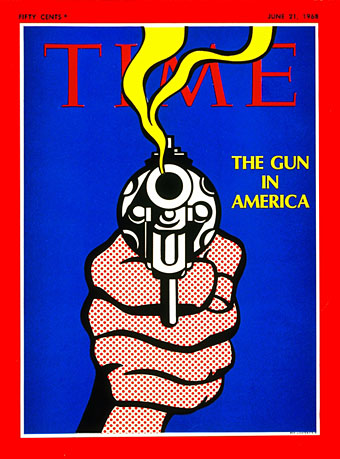
TIME, June 21st 1968. Cover by Roy Lichtenstein.

• “Forget the democratic processes, the judicial system and the talent for organization that have long been the distinctive marks of the US. Forget, too, the affluence (vast, if still not general enough) and the fundamental respect for law by most Americans. Remember, instead, the Gun. That is how much of the world beyond its borders feels about the US today. All too widely, the country is regarded as a blood-drenched, continent-wide shooting range where toddlers blast off with real rifles, housewives pack pearl-handled revolvers, and political assassins stalk their victims at will.” The TIME magazine feature with the famous Roy Lichtenstein cover (prompted by the assassination of Robert Kennedy) will be fifty years old in June.

• “Where do we feel at home? What do our cities look like? How do we see? In 1908, architect and theorist August Endell set out to answer these deceptively simple questions.” Endell’s The Beauty of the Metropolis is coming from Rixdorf Editions in May.

Beardsley 120: The Death of Pierrot is a series of events in Aubrey Beardsley’s birthplace, Brighton, taking place throughout the month of March.

Like the Bloomsbury Group and the Beats, the Surrealists could be incestuous, choosing lovers from inside the circle and often remaining close to their exes. When [Max] Ernst and [Leonora] Carrington reached Paris, he introduced her to Leonor Fini, his friend and former lover. Tall, dazzling, and bejeweled, Fini cultivated a baroque theatricality; every day with her was a masked ball. Recognizing Carrington as “a revolutionary,” she claimed her as an astrological twin—a feat possible only because Fini lied about her age. “This chronological charade, combined with later cosmetic surgeries, sustained the image of youth and beauty that remained vital to Leonor’s self-image, the sexuality and her sense of her place in the world,” writes Chadwick:

Imperious and mercurial, she was also generous, loving and happy to share her rich intellectual life with the younger woman she considered her double. Like Leonora, she believed that cats possessed highly developed psychic powers, that horses had mythological powers that identified them with the feminine, and that painting was an alchemical process.

Regina Marler reviewing three new books about Leonora Carrington and the women artists of the Surrealist movement

As Serious As Your Life: Black Music and the Free Jazz Revolution, 1957–1977 by Val Wilmer receives a welcome republication next month.

• At Dangerous Minds: Occultism, cinema and architecture: How a ouija board built the Bradbury Building.

• When Books Read You, a Defence of Bibliomancy by Ed Simon.

• Ä Brïëf Hïstöry Öf Mëtäl Umläüts by Mike Rampton.

Joey Zone Illustration – Art from The joey Zone.

• At Dennis Cooper’s: Brad Dourif Day.

Alva Noto‘s favourite albums.

Eddie Campbell, Dammit!

• Metropolis (1978) by Edgar Froese | Metropolis (1979) by Motörhead | Under The Gun (Metropolis Mix) (1993) by The Sisters Of Mercy

Weekend links 400

bernard.jpg

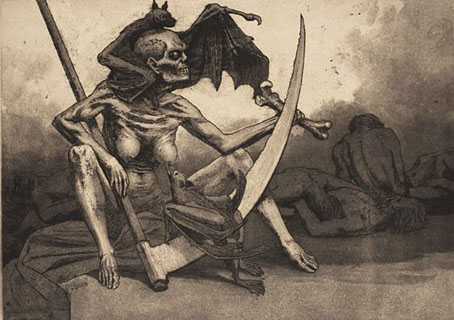
Le Répit (La Mort allaitant une chauve-souris) (1895) by Valère Bernard.

Playhouse 90 presents Heart of Darkness by Joseph Conrad. An American TV production from 1957 starring Boris Karloff, Roddy McDowall, Eartha Kitt and others; introduced by Sterling Hayden. It’s bizarre. Acidemic goes into the detail.

• Erik Davis talks to occult writer and drug geek Julian Vayne about Baphomet, the (sur)reality of spirits, evolution, ritualizing entheogens, and his new book Getting Higher: The Manual of Psychedelic Ceremony.

• “Unsurprisingly, 1. Outside was the record that the #BowieBookClub readers most readily associated with Hawksmoor.” Anna Aslanyan revisits Peter Ackroyd’s architectural mystery.

The Flowers of Dorian Gray: part one of a series of posts examining one of Oscar Wilde’s favourite symbols.

• At Haute Macabre, an interview with Michael Locascio & Heather Jean Skawold of Dellamorte & Co.

One Minute Art History, an animated film by Cao Shu.

Film posters at the Harry Ransom Center, UT-Austin.

• Mix of the week: FACT mix 639 by Black Milk.

Susanna‘s favourite albums.

• Welcome to The Spoodoir.

• Flowers Of Evil (1983) by Cortex | Baphomet (1989) by Foetus Inc. | Heart Of Darkness (1989) by Syd Straw

Weekend links 399

quays.jpg

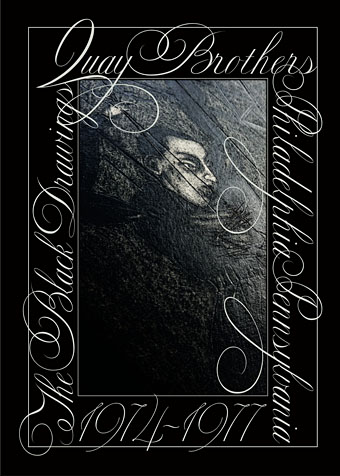
• “In the mid-Seventies the influential stop-motion animators, Stephen and Timothy Quay, embarked on a series of dark graphite drawings, conceived as imaginary film posters. They kept their first autonomous art project hidden for decades, allowing only a few glimpses to transpire in some of their animation classics such as Noctura Artificialia and Street of Crocodiles. In hindsight, the Black Drawings can be considered as a blueprint for their future work. This book offers a first in-depth exploration of this important graphic series that reveals many of the themes and techniques that would come to life in their celebrated animation films.” Quay Brothers: The Black Drawings 1974—1977 is a book by Edwin Carels and Tommy Simoens.

• The first of the BFI’s forthcoming blu-ray boxes of Derek Jarman films is now available for preorder. In addition to what I presume will be an uncensored presentation of Sebastiane (1976) the set also includes the digital premiere of In the Shadow of the Sun (1980) an “alchemical” blending/transmutation of Jarman’s early Super-8 films with a score by Throbbing Gristle. Related: Adam Scovell on another of the films in the set, Jubilee (1978), and one that Jarman disliked even though it incorporates many of his obsessions, especially in the punk-baiting sequences derived from Shakespeare and Elizabethan metaphysics.

• Mixes of the week: FACT mix 638: Circuit des Yeux, XLR8R Podcast 528 by Huxley Anne, Secret Thirteen Mix 246 by Hiro Kone, and drone works from Abby Drohne. And since the untimely death of composer Jóhann Jóhannsson was announced a few hours ago, a return to his sombre mix for FACT from 2015.

Nabokov’s ambitions weren’t interpretive. He “held nothing but contempt for Freud’s crude oneirology,” Barabtarlo explains, and in tracking his dreams he wasn’t turning his gaze inward. For him, the mystery was outside—far outside. Nabokov had been reading deeply into serialism, a philosophy positing that time is reversible. The theory came from JW Dunne, a British engineer and armchair philosopher who, in 1927, published An Experiment with Time, arguing, in part, that our dreams afforded us rare access to a higher order of time. Was it possible that we were glimpsing snatches of the future in our dreams—that what we wrote off as déjà vu was actually a leap into the metaphysical ether? Dunne himself claimed to have had no fewer than eight precognitive dreams, including one in which he foresaw a headline about a volcanic eruption.

Daniel Piepenbring reviewing Insomniac Dreams by Gennady Barabtarlo

• Gavin Stamp 1948—2017: a eulogy to the late architectural writer by Jonathan Meades. One of Stamp’s more offbeat assignments was providing illustrations for the George Hay Necronomicon in 1978.

Embassy of the Free Mind is the name of the new online library whose digitisation of rare occult volumes was financed by author Dan Brown.

• At Dangerous Minds: Meet Princess Tinymeat, the obscure genderbending trashglam post-punk goth offshoot of Virgin Prunes.

• “Why are film-makers obsessed with the story of doomed British sailor Donald Crowhurst?” asks Jonathan Coe.

• “Asian music influenced Debussy who influenced me—it’s all a huge circle,” says Ryuichi Sakamoto.

• At Spoon & Tamago: The birds of Tokyo beautifully illustrated by Ryo Takemasa.

Mark Pilkington is In Wild Air

Professor Yaffle

The Sun’s Gone Dim And The Sky’s Turned Black (2006) by Jóhann Jóhannsson | The Great God Pan is Dead (2008) by Jóhann Jóhannsson | A Pile of Dust (2016) by Jóhann Jóhannsson