Weekend links 23

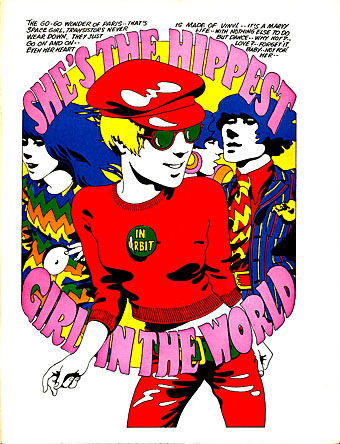
groovy.jpg

“The Go-Go wonder of Paris — That’s space girl. Transistors never wear down, they just go on and on — Even her heart is made of vinyl — It’s a marvy life — With nothing else to do but dance — Why not? – Love? — Forget it, baby — Not for her —” From Mod Love (1967) by Michael Lutin and Michel Quarez.

• “Gay people are not advancing themselves in the (publishing) industry, they’re just regurgitating familiar territory. Of course, artists are always ahead of gatekeepers. That’s the way it works—artists innovate. But in order to fulfill your promise as an editor, agent, publisher or reviewer, you have to be a person who’s embracing the new and looking to elevate what is not yet known. And unfortunately, there’s not a discussion among publishing professionals about enhancing this aspect of people’s responsibilities. In fact, it goes the other way. So there needs to be a psychological revolution on behalf of the people who are controlling what information is allowed to be seen.” From an interview with Sarah Schulman at Lambda Literary.

Jonathan Ross meets Jim Steranko. Also at the Guardian: Unearthing the truth about Alan Moore.

• Photographing an abandoned Art Deco skyscraper. From the people who photographed Neverland at night.

Powers: “aural sculptures” by Andy Partridge inspired by the strange science fiction art of Richard M Powers.

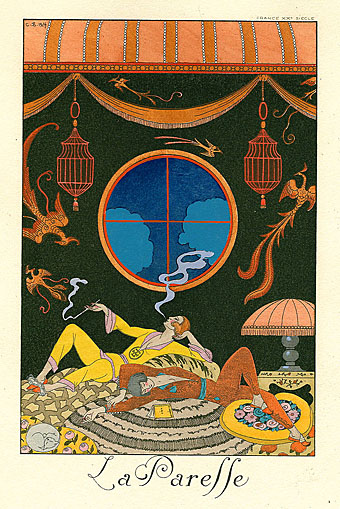
barbier.jpg

La Paresse (Laziness) (1924) by George Barbier.

Lautréamont’s poison-drenched pages. Roger Cardinal reviews a new edition of Les Chants de Maldoror and Poésies.

The Wire‘s Top 50 Rhythms of All Time, a list from 1992. Some great recommendations but it’s impossible to imagine that being written now without a mention of Klaus Dinger. And where’s Fela Kuti?

• The Wire Salon at Cafe Oto, London, on August 5th presents Rob Young discussing his forthcoming book, Electric Eden: Unearthing Britain’s Visionary Music.

American Pictorial Photography, 1912–1955. Another astonishing picture set at Golden Age Comic Book Stories.

The Beats: Pictures of a Legend. Edmund White on a new exhibition of Allen Ginsberg’s photographs. Related: the trailer for Howl.

The Dream Machine is a point-and-click adventure game made using hand-crafted animation.

Fuck yeah Francisco Lachowski: Brazilian model cutie has many Tumblr fans.

Polly Morgan’s wings of desire. The taxidermy artist interviewed.

Thomas Dolby’s solar-powered boat studio.

Rückstoss Gondoliere (1971) by Kraftwerk: pt. 1 | pt. 2

Weekend links 21

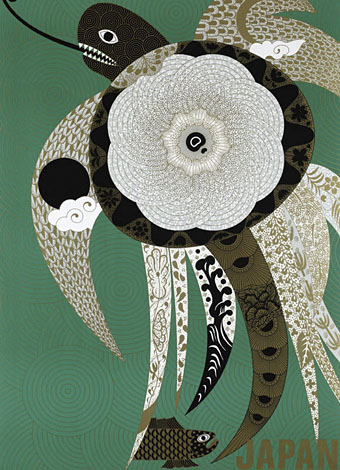
nagai.jpg

A poster by Kazumasa Nagai.

• Franco Maria Ricci creates the world’s largest maze. “The former publisher said he first confided his ambition to Jorge Luis Borges, who characteristically told him the world’s largest maze already existed and was called a desert.” Related: Mirror, Mask, Labyrinth, a review of two new collections of Borges’ poetry.

FACT mix 164 is a dubstep collection by Pinch and a promotion for the Dark Matter compilation which I designed earlier this year.

• One of the monuments of 20th century music, Bitches Brew by Miles Davis, is released in another new (and expensive) edition next month by Sony. Nice packaging, and there’s a vinyl edition included, but these things always come across as a cyncial attempt to milk the hardcore fans one more time. And have you noticed how all vinyl releases are now described as “audiophile”? If the big record companies had shown this much dedication to quality in the 1980s when they were jobbing out sub-standard vinyl pressings their reputation might be slightly higher today.

• More Gysin: Brion Gysin, William Burroughs, and the secret life of a building on the Bowery. And Ubuweb’s page of Gysin sound works and recordings.

Michael Moorcock: “I think I preferred my own imagination”. A two-part interview about the cover designs for Moorcock books.

The Pansy Project: “Artist Paul Harfleet plants pansies at the site of homophobic abuse, he finds the nearest source of soil to where the incident occurred and generally without civic permission plants one unmarked pansy. The flower is then photographed in its location and posted on his website, the image is entitled after the abuse … The Pansy Project also marks locations where people have been killed as a result of homophobic attack”

This Gaming Life: Travels in Three Cities. Jim Rossignol’s book is available as a free download.

Lost London. Also, the Victorian Catacombs of South London.

Dedalus Books had its Arts Council grant reinstated.

’Zine Lutefisk: fashion/art/escape.

Time Will Show The Wiser (1968) by Fairport Convention | She Moves Through The Fair (1969) by Fairport Convention | She Moved Through The Fair (1994) by Jam Nation.

Marsi Paribatra: the Royal Surrealist

marsi1.jpg

La Menace (1994).

Two paintings by Princess Marsi Paribatra, a member of the royal family of Thailand who lists Dalí, Arcimboldo and Titian among her artistic influences. If it seems surprising that a princess should not only be an accomplished painter but also be possessed of a distinctly vivid imagination we might ask why this is the case. There’s no reason why a member of a royal family shouldn’t be as good a painter as anyone else although it’s the case that here in Britain our views of royalty are inevitably tainted by the uninspiring members of the current House of Windsor. Prince Charles in particular is a singularly dreary and frequently philistine figure, and also a painter whose daubs would never have received any attention at all were it not for his being born into the right family.

This hasn’t always been the case. It used to be that being an aristocrat gave you the free time and the wealth to indulge no end of manias and eccentricities. The British Isles are littered with architectural follies of various kinds built to appease the whims of rich landowners; William Beckford (1760–1844) is renowned for having written the Gothic melodrama Vathek and also for having built the lavish (and unfortunately short-lived) pile of Fonthill Abbey. In the 20th century we had Edward James (1907–1984), a lifelong champion of Surrealism who spent much of his later life building Las Pozas in the Mexican jungle at Xilitla, a concrete fantasia which looks like something dreamed up by Antonio Gaudí and JG Ballard. James collected the work of Leonora Carrington and Dorothea Tanning and I’d imagine him being equally entranced by some of Marsi Paribatra’s paintings. The recurrence of skeletal figures in her work invokes the Mexican Day of the Dead traditions which always excited the Surrealists.

marsi2.jpg

No title or date available.

Dali House has more about Marsi Paribatra’s life and art while further examples of her paintings can be found here and here. Thanks again to Monsieur Thombeau for pointing the way!

Elsewhere on { feuilleton }
The fantastic art archive

Previously on { feuilleton }
Angels of Anarchy: Women Artists and Surrealism
Return to Las Pozas
The art of Leonor Fini, 1907–1996
Surrealist women
Las Pozas and Edward James

Edinburgh, 1929

edinburgh1.jpg

2A Arthur Street.

Samples from a collection of photographs by Alfred Henry Rushbrook at the National Library of Scotland’s Flickr pages showing the St Leonards area of Edinburgh. These were taken in 1929 but the age of the buildings and the curiously fogged appearance of the prints makes them seem a lot older. The City of Edinburgh Improvement Trust commissioned Rushbrook to record views of the area before slum clearances took place. In that respect his photos are like a Scots equivalent of the famous views of Paris taken by Atget before Hausmann’s demolition teams set to work.

edinburgh2.jpg

2–4 Lothian Street and 3–5–7 Potterow.

Previously on { feuilleton }
Old Bunker Hill
Inondations 1910
Berenice Abbott
Jessie M King’s Grey City of the North
Eugene de Salignac
Luther Gerlach’s Los Angeles
The temples of Angkor
The Bradbury Building: Looking Backward from the Future
Edward Steichen
Karel Plicka’s views of Prague
Atget’s Paris
Downtown LA by Ansel Adams

Stonehenge panorama

stonehenge.jpg

I would have posted this for the Solstice yesterday had it not been for the Chronophage. The panorama is at a BBC page since the corporation is one of the few organisations with the weight to gain permission to photograph the stones up close. Unless you’re an archaeologist or an English Heritage official your view is restricted to the path which surrounds the monument, something you can experience via Google Maps. There did used to be exceptions to this. I was fortunate to be at the Stonehenge Festival in 1982 which took place for a few days over Midsummer in one of the fields a short distance away. On Solstice Day the people from English Heritage let everyone—festival-goers and bemused tourists alike—wander inside the circle where a couple of pagan weddings took place. A couple of years later further festivals were prevented with heavy police action so I feel privileged to have been there on that day.

There was more Stonehenge recently at Bldg Blog with a post about Harold Egerton’s stunning photograph of the stones at night. And while we’re on the subject, let’s not forget Woodhenge, Seahenge , Timisoara’s Stonehedge, and the Ballardesque Carhenge.

Elsewhere on { feuilleton }
The panoramas archive