Weekend links 33

andrews1.jpg

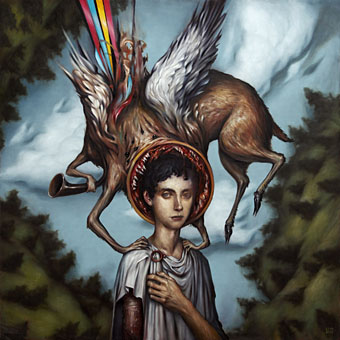
Blue Sky Noise (2010) by Esao Andrews.

Franz Xaver Messerschmidt is the first exhibition in the United States devoted exclusively to the 18th-century sculptor. Related: an earlier post about the artist’s work.

• How are the team behind War Horse planning to follow up their smash hit? With a gay love story performed by puppets. Related: Achilles (1995) by Barry JC Purves.

• More great posts at A Journey Round My Skull: Czechoslovakian Expose VI and Black Cradle of Bright Life, fifteen works by the Macedonian artist Vangel Naumovski (1924–2006).

Top 10 Anti-Gay Activists Caught Being Gay. Related: “Fuck your feelings,” in which columnist Dan Savage gets righteously impatient when a correspondent complains. As Savage says, people who use their faith as a stick to beat gay people contribute to an atmosphere of intolerance in which kids are bullied for being gay (or appearing to be), or transgender, or merely different, and kill themselves as a result. Over the past couple of weeks there’s been an upsurge of US media attention to the most recent suicides; Savage inaugurated the It Gets Better project in order to help. Also related: God Loves Poetry.

andrews2.jpg

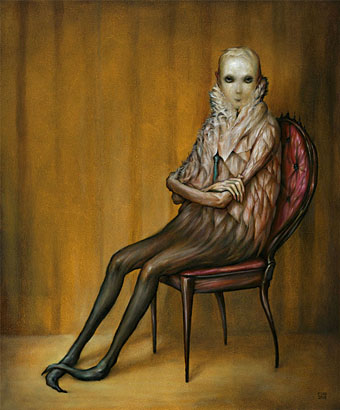
Meigh (2010) by Esao Andrews.

Antony Hegarty enthuses about Shoot Yer Load, one of the scurrilous 12″ singles released by my Savoy colleagues in the 1980s. Antony and the Johnsons have a new album out, Swanlights, on Secretly Canadian.

When the future of music was a rainbow hued parabola: book designer John Gall collects old synthesizer manuals.

Fantastic Memories (1944) by Maurice Sandoz, illustrated by Salvador Dalí.

Urban optometry: life as a London crane operator at BLDGBLOG.

• Today is 10/10/10 which means it’s Powers of Ten Day.

These New Puritans: a band like no other.

Art Nouveau: a virtual exhibition.

Diaghilev: Lord of the dance.

Flaming Telepaths (1974) by Blue Öyster Cult; Flaming Telepaths (2005) by Espers.

Carceri, thermae and candelabra

piranesi_tivoli.jpg

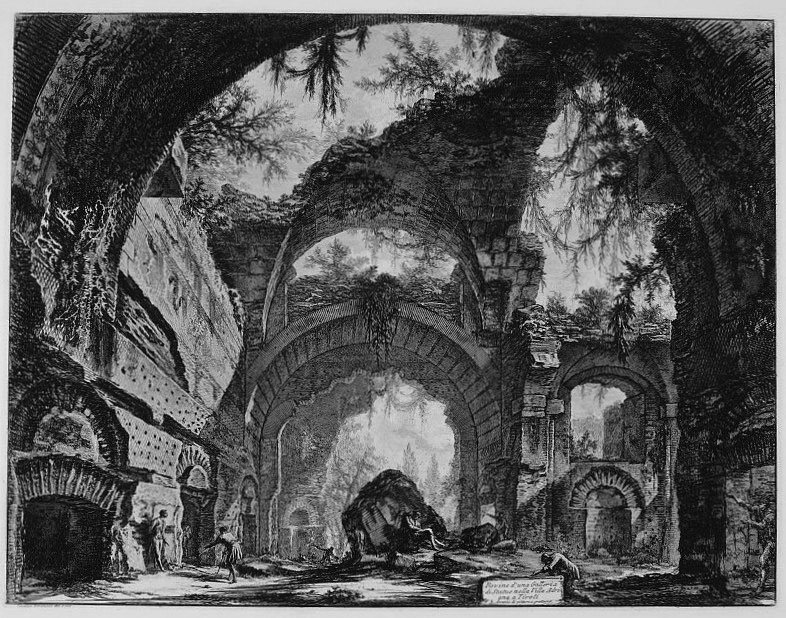
Piranesi’s etching which purports to show a statue gallery at Hadrian’s Villa was published in 1770 as part of the artist’s Vedute di Roma series, and conveniently provides a themed link for a pair of new exhibitions. The artist’s attribution of statue gallery was a mistaken one, the structure is actually the remains of Hadrian’s thermae, or baths, but archaeology was still in its infancy in the 18th century so mistakes were inevitable. If you’re fortunate enough to be in Venice during the next two months the Fondazione Cini has a major exhibition of Piranesi’s work, The Art of Piranesi: architect, engraver, antiquarian, vedutista, designer. On display are over three hundred prints which no doubt include many of the Vedute di Roma.

piranesi.jpg

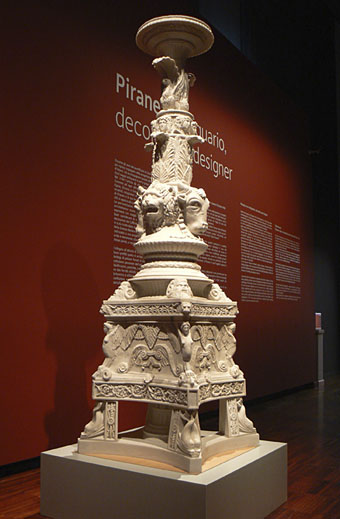
Ornamental candelabrum created by Factum Arte from a design by Piranesi.

Good as that sounds, what’s especially notable about this exhibition is a presentation of three-dimensional works specially created from Piranesi’s designs for candelabra, fireplaces, and other objects based on his studies of artefacts from the ancient world. These pieces have been produced by Factum Arte who have a great website showing the finished pieces and also a page detailing the production of the objects. Also on that page is one of the exhibition’s other features, a 10-minute video by Gregoire Dupond which cleverly joins together and animates a journey through several of Piranesi’s Carceri d’invenzione (Imaginary Prisons). The music accompaniment is Bach’s Cello Suite 2 which happens to be the piece played by Yo-Yo Ma in an earlier animation of the Carceri, so it’s a reasonable guess that the earlier film was an inspiration for this new work. The exhibition runs to November 21, 2010.

jauregui.jpg

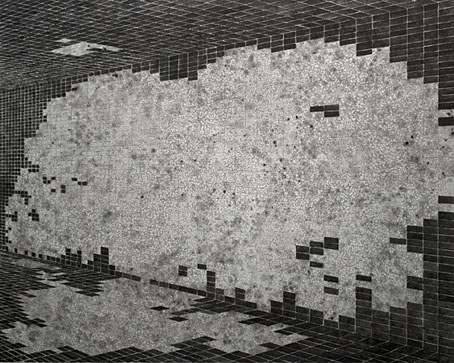
Jack’s Bath (2010) by Danny Jauregui. Gouache on canvas.

Hadrian’s obsession with his doomed lover Antinous makes the Emperor a gay icon which explains the connection between Piranesi’s view of the ruined baths and an exhibition of work by American artist Danny Jauregui. There Goes the Neighborhood is at the Leslie Tonkonow Gallery, New York, and features a selection of Jauregui’s paintings of tiles from the bathhouses which were a feature of gay life in the days before AIDS.

I make paintings of bathhouses in ruin. Moldy, disheveled and abandoned, the paintings are memorials to the absence of memorials – indexes of the traumatic erasure inflicted on the radical gay sexuality of the past. They are paintings of what I imagine those spaces to look like, had they not been disguised and hidden from sight. (More.)

The exhibition runs until October 30, 2010. By coincidence gay news blog Towleroad had a post yesterday about New York’s first anti-gay police raid on the Ariston Baths in 1903.

time-bandits.jpg

Time Bandits.

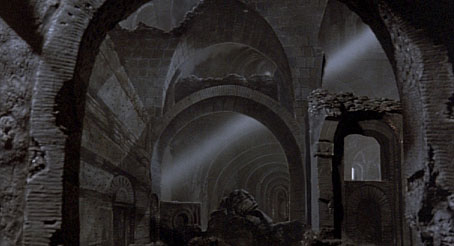
Seeing as I posted the picture of Hadrian’s baths I have to also post this shot from Terry Gilliam’s Time Bandits (1981) showing the interior of the Fortress of Ultimate Darkness. Here we see the Piranesi’s ruined baths incorporated into a vast and gloomy space which must surely be inspired by the Carceri, the views of Rome being absorbed by the artist’s darker imaginings. And for a final piece of trivia, writer Marguerite Yourcenar is not only the author of Memoirs of Hadrian (1951), a novel about the Emperor’s passion for Antinous, but also penned an essay about the Carceri. I haven’t read either of those works so I think it’s time to add them to the shopping list.

Update: For those in the UK, there’s also Piranesi’s Prisons, an exhibition at the Mead Gallery, Warwick, from now until December.

Elsewhere on { feuilleton }
The etching and engraving archive

Previously on { feuilleton }
La Tour by Schuiten & Peeters
Set in Stone
Hadrian and Greek love
Piranesi as designer
Vedute di Roma
Aldous Huxley on Piranesi’s Prisons
The Cult of Antinous

Infernal entrances

atget.jpg

L’Enfer, Boulevard de Clichy (1911).

A recent posting at The Haunted Lamp showed the interior of L’Enfer, a Montmartre cabaret which described itself as “unique au monde”, pictured here in a memorable photo by Eugène Atget. The interior and portions of the exterior were certainly unique enough, and look like they were created by the same people who designed the carnival show for Harry Lachman’s film Dante’s Inferno (1935), but the yawning mouth as an entrance isn’t without precedent. Some prior examples follow.

zuccari.jpg

Palazzo Zuccari.

L’Enfer is long gone, unfortunately, but the entrance to the Palazzo Zuccari in the Via Gregoriana, Rome, is still extant despite being hundreds of years older. I was hoping that Google’s Street View would have some good pictures but they managed to capture the building in the midst of renovation. A friend of mine was working at an office in this street when I was in Rome in 1993 and the yawning mouths and windows are a very curious sight in a narrow road near the Spanish Steps. Flickr has better views, here, here and here.

bomarzo.jpg

Ogre, Parco dei Mostri.

The Rome palazzo is named after the Mannerist artist who lived there, Federico Zuccari (c. 1542/1543–1609), and Zuccari’s inspiration for his doorway came from another Mannerist creation, the Parco dei Mostri at Bomarzo. The mouth in this case isn’t an entrance to the underworld but a devouring ogre, and one of the park’s many grotesque attractions. I wonder if this was also an inspiration for the giant floating head in John Boorman’s ludicrous science fiction film, Zardoz (1974).

moulin.jpg

Moulin Rouge!

And speaking of films, Baz Luhrmann used the L’Enfer entrance as a gateway to Montmartre itself in the zooming shot which opens Moulin Rouge!. I like that idea, as though it’s an iniquitous equivalent of the old Temple Bar gateway to the City of London. For more pictures of L’Enfer, and details of its history, see here and here. If anyone knows of any other notable doorways like these, please leave a comment.

Update: Nathalie found another Bomarzo influence while Jescie on Twitter drew my attention to a set from this German film.

Previously on { feuilleton }
Villa d’Este
Harry Lachman’s Inferno
Atget’s Paris

Weekend links 32

ji1.jpg

Red Quechquemitls (2010) by Sylvia Ji.

• The Blackout Mix, a pay-what-thou-wilt 49-minute mixtape, “specially designed to accompany (or simulate) a human-plant interaction”. Art by Arik Roper, music selection by Jay Babcock.

An ode to the many evolved virtues of human semen: “the penis is capable of dispensing a sort of natural Prozac” says Jesse Bering.

• The new John Foxx CD & DVD release, D.N.A., has a Jonathan Barnbrook cover, a new collaboration with Harold Budd and a disc of short films.

• “I have been copying Margaret Hamilton my whole life, and I am proud to admit it. The Wicked Witch of the West, the jolie laide heroine of every bad little boy’s and girl’s dream of notoriety and style, whose twelve minutes of screen time in The Wizard of Oz can never be topped … I’m a big butch-lesbian hag. I love the ones with chips on their shoulders and heavy attitude. They’re my real favorites.” John Waters always gives great interviews.

• Listen to a track from the forthcoming Brian Eno album while you’re reading Kristine McKenna’s interview with the man himself at Arthur mag. Includes an appreciation by Alan Moore.

ji2.jpg

Atropa Bella Donna (2009) by Sylvia Ji.

• Steven Severin is touring the UK this month, performing a live accompaniment to screenings of Jean Cocteau’s The Blood of a Poet. He’s at the Tyneside Cinema this Tuesday. Other dates can be found on his website.

• “I know it’s a very emotive subject and you’re either for it or against it but for a jobbing self-employed musician such as me – bootlegging (CD copying) is just killing us.” Finding The Spaces Between: musician Chris Carter (Throbbing Gristle, Chris & Cosey, et al) interviewed.

Mile End Pugatorio (1991), a one-minute film-poem by Guy Sherwin and Martin Doyle. Related: four one-minute movies by The Residents.

• Gijs Van Vaerenbergh installed an Upside Dome at the St. Michiel Church in Leuven, Belgium.

• Sidney Sime illustrates Lord Dunsany at Golden Age Comic Book Stories.

Europe according to gay men. There’s more at Mapping Stereotypes.

• There’s never a dull moment in the High Desert.

• Generative art by Leonardo Solas.

Alhambra cyanotypes

alhambra1.jpg

The cyanotype process is a very old photographic printing technique and also the source of the word “blueprint”, after the process became common among builders and engineers for the printing of plans. The technique also has its enthusiasts today, some examples of which can be seen here. These views of the Alhambra Palace in Granada, Spain, were taken by Carl Curman, a Swedish scientist and photographer, in 1878. The Swedish National Heritage Board at Flickr has two sets of Curman’s travel photography which include additional views of the Alhambra as well as other cyanotypes.

alhambra2.jpg

Previously on { feuilleton }
Constantinople, 1900
Edinburgh, 1929
Old Bunker Hill
Inondations 1910
Berenice Abbott
Eugene de Salignac
Luther Gerlach’s Los Angeles
The temples of Angkor
The Bradbury Building: Looking Backward from the Future
Edward Steichen
Karel Plicka’s views of Prague
Atget’s Paris
Downtown LA by Ansel Adams