The Burroughs Century

burroughs.jpg

By the end of this year (maybe sooner) we’ll all be heartily sick of hearing about the centenary of the First World War, so it’s good to have some positive anniversaries from 1914 to celebrate. I mentioned yesterday that Sun Ra’s centenary falls this year; next month there’s a celebration in Bloomington, Indiana of the birth of William Burroughs:

In celebration of his 100th birthday this February, Bloomington has developed a festival in his honor, knowing his influence throughout America, and our own everyday lives. We are calling this event the Burroughs Century, but we are not looking backward; rather, we believe that the Burroughs Century is ongoing, that we are in the midst of it, and we intend to stage an event that indicates the full range of that continuing influence, including a film series, art and literature exhibits, speakers and panels, musical performances, and more.

Burroughs’ manuscripts, correspondence and paintings will be on display, James Ilgenfritz’s opera based on The Ticket that Exploded will be performed, and there will also be a screening of Howard Brookner’s definitive film portrait of the author, Burroughs: The Movie, which receives a long-awaited reissue later this year. For those of us who can’t make it to Bloomington it’s worth keeping an eye on the slowly expanding Burroughs pages at Ubuweb. These now include PDFs of out-of-print books, more films, and a lot more audio material. Expect more Burroughsiana on this site between now and February 5th.

Elsewhere on { feuilleton }
The William Burroughs archive

Weekend links 192

fournier.jpg

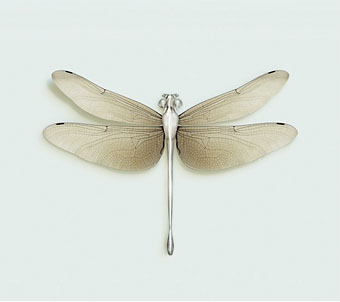
“Chloromgonfus detectis, a dragonfly that can detect volatile pollutants.” A speculative insect by artist Vincent Fournier.

• “…a modern taxonomist straddling a Wellsian time machine with the purpose of exploring the Cenozoic era…” Butterflies tied together Vladimir Nabokov’s home, science, and writing, says Mary Ellen Hannibal.

• More ghosts: Kira Cochrane on the Victorian tradition of the Christmas ghost story, and Michael Newton on why Jack Clayton’s The Innocents (1961) remains one of the very best ghost films. No argument there.

• Should you require further persuasion, Daniel Barrow reviews I Am The Center: Private Issue New Age Music In America 1950-1990, an album still receiving heavy rotation in these quarters.

Swords, daggers—weapons with a blade—retained a mysterious, talismanic significance for Borges, imbued with predetermined codes of conduct and honor. The short dagger had particular power, because it required the fighters to draw death close, in a final embrace. As a young man, in the 1920s, Borges prowled the obscure barrios of Buenos Aires, seeking the company of cuchilleros, knife fighters, who represented to him a form of authentic criollo nativism that he wished to know and absorb.

The Daggers of Jorge Luis Borges by Michael Greenberg

The Junky’s Christmas (1993): a seasonal tale from William Burroughs turned into a short animated film by Nick Donkin and Melodie McDaniel.

• Mixes of the week: Secret Thirteen Mix 101 by Jan Jelinek, and The Conjuror’s Hexmas by Seraphic Manta.

• Meet the 92-year-old Egyptian [Halim El-Dabh] who invented electronic music.

The Mysterious Lawn Home of Frohnleiten, Austria.

The Peacock Room at Sammezzano Castle in Italy.

The Quay Brothers’ Universum.

Alan Bennett‘s diary for 2013.

Butterfly (1968) by Can | Butterfly (1974) by Herbie Hancock | Butterfly (1998) by Talvin Singh

Weekend links 181

eye.jpg

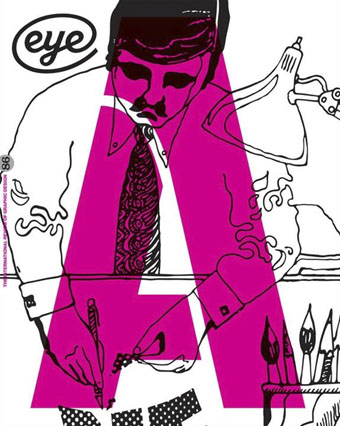
Cover of Eye no. 86 vol. 22, 2013, a type special. Detail from 1970s Letratone brochure, overprinted by character from the Marsh stencil alphabet.

The new edition of Eye magazine includes my essay on the evolution and aesthetics of steampunk. In the same issue Rick Poynor’s feature on the prints of Eduardo Paolozzi mentions a forthcoming book by David Brittain about the artist’s associations with New Worlds magazine in the 1960s. I designed the Paolozzi volume which will be published by Savoy Books in a few weeks’ time. More about that later.

Still on steampunk, KW Jeter notes its popularity among the younger crowd: “If some old fogey peering through his smudged bifocals can’t discern the cool and important stuff going on, such as the tsunami of anarchic multiculturalists using the steampunk scalpel to dissect the past and reassemble it like a two-dollar watch, that’s his loss; the readers are picking up on it.”

• Musicians interviewed: Rhys Chatham: “The reason I got into trumpet playing is because I wanted to play like [Black Sabbath guitarist] Tony Iommi.” | James Ginzburg: “One of the strongest feelings I had was that the act of sitting down and making dance music was like playing a video game…I felt disconnected from it…” | Julia Holter: “I love working with the voice, I love mystery, I love creating atmosphere.” | Roly Porter: “I sit at home and listen to folk and blues from before I was born. I listen to a lot of dub and reggae and classical music. These are all genres which to me seem really interlinked and influential.”

• At Kickstarter: From the director of Lovecraft: Fear of the Unknown, a short film entitled Do Not Disturb. “Two men are forced to share a motel room on a dark & stormy night. One man’s snoring starts to summon creatures into our world.”

The Notting Hill of the 1960s – with Moorcock’s marriage, children, celebrity, the editorship of New Worlds, the collaboration with JG Ballard, Brian Aldiss and the rest – became the proving ground for the shape-shifting Carnaby Street dandy Jerry Cornelius. But all the numerous Moorcock characters, those undying and born-again clones, have a part to play in his “multiverse”, a concept he developed alongside the earlier model suggested by John Cowper Powys. Moorcock’s astonishing catalogue of speculative fiction works to prove his key equation, which is based on meta-temporal parallel worlds drawn from HG Wells, Chaos Theory, String Theory, the Edgar Rice Burroughs of John Carter of Mars and the William Burroughs of Nova Express and the “Interzone”. Publishing all the strange rafts and pods of Moorcock’s prodigious science fiction and fantasy output, as Gollancz have done, is like assembling a ghost fleet, under the joint command of Dr John Dee and Admiral John Ford, with which to invade that uncertain continent we know as the past.

Iain Sinclair on the new series of Michael Moorcock editions from Gollancz.

• “What does science tell us about the relative dangers of drugs? Alcohol is by far the No. 1 most dangerous drug.” Some graphs from the American Enterprise Institute who no one would accuse of being a bunch of stoners.

• “I loved Eudora Welty, Flannery O’Connor, Katherine Ann Porter, Carson McCullers. There was a feeling that women could write about the freakish, the marginal.” Alice Munro at The Paris Review.

Elena Smith on Literary Parkour: @Horse_ebooks, Jonathan Franzen, and the Rise of Twitter Fiction. Related: Boris Kachka has a list of Everything Jonathan Franzen currently hates.

• Mixes of the week: Joseph Burnett compiles Adventures in Modern Jazz while Kier-La Janisse puts together a British Horror mix for Fangoria.

Explore the planet Mars, one giant image at a time.

• At BibliOdyssey: The Turner’s Manual.

A Crimson Grail (for 400 Electric Guitars) (2007) by Rhys Chatham | Arrakis (2011) by Roly Porter | City Appearing (2013) by Julia Holter | Debris (2013) by Faint Wild Light


Pay It All Back

burroughs.jpg

Two things of interest to William Burroughs aficionados are looking for funding this month. The Burroughs Century is an event being planned to celebrate the 100th anniversary of Burroughs birth next year in Bloomington, Indiana:

We are calling this event the Burroughs Century, but we are not looking backward; rather, we believe that the Burroughs Century is ongoing, that we are in the midst of it, and we intend to stage an event that indicates the full range of that continuing influence, including a film series, art and literature exhibits, speakers and panels, musical performances, and more.

There’s more detail at Indiegogo. The organiser of the event, Charles Cannon, has expressed an interest in showing some of the Wild Boys portfolio which I keep tinkering with. Having a deadline to work towards may compel me to finish some of those pieces.

tangiers.jpg

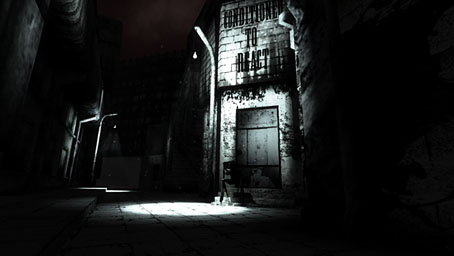
I’ve already mentioned Alex Harvey’s computer game-in-progress, Tangiers, but the game now has a Kickstarter fund which Harvey and co. are hoping will push their work to completion. The Burroughs influence here is more oblique since this is an original creation but it’s still a promising development in a medium with a tendency to rely on Hollywood and genre stereotypes for its scenarios:

You play an outsider to the world, an entity with a singular, enigmatic goal – to find and dispose of five other beings. Your arrival here has fractured the world; the city that these other beings resided in is now broken into shards across a broken, bleak landscape.

You must infiltrate these cities, searching to discover your marks – investigating both precisely who, and where. Keeping to the shadows is to be encouraged – reality here is a fragile place. Your interactions with the world cause it to fall apart. In homage to Burrough’s cut-up technique, the world collapses and rebuilds itself the more you interact with it – future areas rebuilt with the fragments and personality of places you mistreated. From this every play-through will, subtly or drastically, be unique to you.

Find out more at the game’s Kickstarter page.

Weekend links 166

foxxbelbury.jpg

The Julian House cover art for the forthcoming collaboration between John Foxx and Belbury Poly (here renamed) has been revealed. Single no. 9 in the Ghost Box Listening Centre Study Series is now available.

• In addition to new Ghost Box records there’s more Hauntological (for want of a better term) cinema on the way this summer with the DVD/BR release of Ben Wheatley’s A Field in England. The potted description at Movie Mail is “a monochrome psychedelic trip into magic and madness set during the English Civil War”. Julian House has made a trailer. Meanwhile at Fangoria, there’s a PIF mixtape from The Advisory Circle. This accompanies an interview with John Krish, director of the most bizarre of the UK’s many strange and alarming public information films from the 1970s.

• More mixes: The hour-long OH/EX/OH show for The Geography Trip on Chorlton FM. “Expect slumber / tension / euphoria in almost equal measures.” It’s marvellous. At Self-Titled mag there’s DJ Food with O Is For Orange: Boards of Canada, Broadcast, The Books, etc.

Tangiers is a computer game based on the fiction of William Burroughs. Jim Rossignol talked to Alex Harvey about the development of the project.

walpurgisnacht.jpg

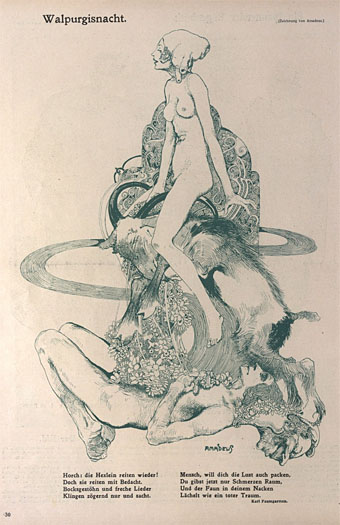
Walpurgisnacht (1917) by Amadeus. A drawing that could easily be from the late 1960s. If anyone knows the full name of the artist, please leave a comment. Via Beautiful Century.

Rebecca J. Rosen asks “What would the night sky look like if the other planets were as close as the moon?”

• The mystery of Charles Dellschau and the Sonora Aero Club.

The Surreal Cave Paintings Of Stockholm’s Metro Stations.

• At 50 Watts: More strange art from Marcus Behmer.

Ry Cooder in 1970. Directed by Van Dyke Parks!

The Post Office Tower: now you see it…

• At Little Augury: 99 Meninas.

Sartori In Tangier (1982) by King Crimson | City Of Mirage (2010) by John Foxx