Weekend links 315

knights.jpg

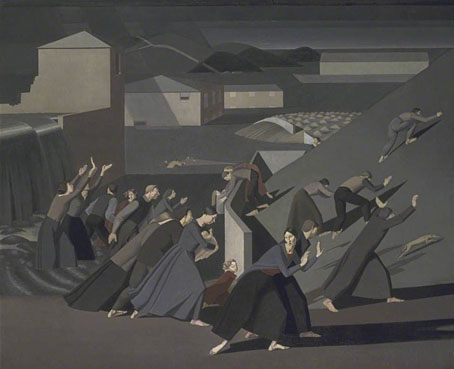
The Deluge (1920) by Winifred Knights.

Dennis Cooper‘s favourite fiction, poetry, nonfiction, film, music, art & internet of 2016 so far. (Thanks again for the nod to this blog!)

• At Literary Hub: Jonathan Russell Clark on Jorge Luis Borges, and Jon Sealy on why indie presses [in the US] are opening bookstores.

• “It’s not just about the music.” A conversation on the occult practices in the arts between poet Janaka Stucky and Peter Bebergal.

• Daisy Woodward talks to Andreas Horvath about Helmut Berger, Actor, a documentary about Visconti’s muse and lover.

• More Fritz Leiber: Brian J. Showers on his decision to republish Leiber’s horror novel, The Pale Brown Thing.

• Mixes of the week: Sextape 4 by Drixxxe, and Radio Oscillations #96 (Richard Pinhas/Heldon) by Iron Blu.

• The 5th Young One: Pay No Attention to the Girl Behind the Sofa; John Reppion on a television mystery.

• More reading suggestions: Cheerless beach reads for gloomsters and saddies by S. Elizabeth.

• Never the same film twice: Seances by Guy Maddin, Evan Johnson, Galen Johnson.

• How painter Winifred Knights became Britain’s “unknown genius”.

• The Journey & The Destination: An interview with Hawthonn.

Robert Latona goes in search of the grave of Constance Wilde.

• Invisible by Day: photos by Mikko Lagerstedt.

• A Queer Lit Q&A with Evan J. Peterson.

• RIP Michael Herr and Bernie Worrell.

Bridget Riley: The Curve Paintings.

• The typography of Blade Runner.

Japanese matchbox labels

SOS by Portishead

A Rainbow In Curved Air (1969) by Terry Riley | The Great Curve (1980) by Talking Heads | Dangerous Curves (2003) by King Crimson
Weekend links 145

brundage.jpg

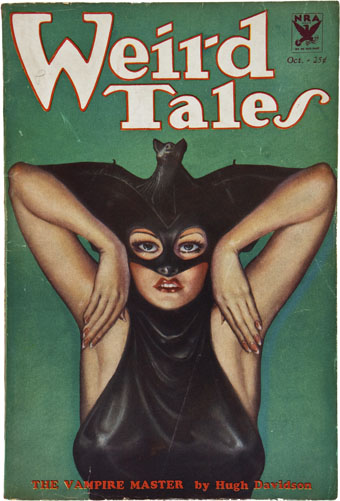
Weird Tales, October 1933. Cover art by Margaret Brundage.

• Michael Moorcock’s novels are being republished this year by Gollancz in a range of print and digital editions. Publishing Perspectives asks Is Now a Perfect Time for a Michael Moorcock Revival? • Related: Dangerous Minds posted The Chronicle of the Black Sword: A Sword & Sorcery Concert from Hawkwind and Michael Moorcock. My sleeve for that album was the last I did for the band. • Obliquely related: Kensington Roof Gardens appear as a location in several Moorcock novels, and also provided a venue for the author’s 50th birthday party. If you have a spare £200m you may be interested in buying them once Richard Branson’s lease expires.

• One of my favourite things in Mojo magazine was a list by Jon Savage of 100 great psychedelic singles (50 from the UK, 50 from the US). This week he presented a list of the 20 best glam-rock songs of all time. For the record, Blockbuster by The Sweet was the first single I bought so I’ve always favoured that song over Ballroom Blitz.

The Alluring Art of Margaret Brundage is a forthcoming book by J. David Spurlock about the Weird Tales cover artist. Steven Heller looks at her life (I’d no idea she knew Djuna Barnes) while io9 has some of her paintings. Related: Illustrations for Weird Tales by Virgil Finlay.

The masterpiece of Mann’s Hollywood period is, of course, Paracelsus (1937), with Charles Laughton. Laughton’s great bulk swims into pools of scalding light out of greater or lesser shoals of darkness like a vast monster of the deep, a great black whale. The movie haunts you like a bad dream. Mann did not try to give you a sense of the past; instead, Paracelsus looks as if it had been made in the Middle Ages – the gargoyle faces, bodies warped with ague, gaunt with famine, a claustrophobic sense of a limited world, of chronic, cramped unfreedom.

The Merchant of Shadows (1989) by Angela Carter. There’s more of her writing in the LRB Archive.

• Television essayist Jonathan Meades was back on our screens this week. The MeadesShrine at YouTube gathers some of his earlier disquisitions on culture, place, buildings and related esoterica.

• Sometimes snark is the only worthwhile response: An A-Z Guide to Music Journalist Bullshit.

• London venue the Horse Hospital celebrates 20 years of unusual events.

The Politics of Dread: An Interview with China Miéville.

How Giallo Can You Go? Antoni Maiovvi Interviewed.

A guide to Terry Riley’s music.

• Three more for the glam list: Coz I Love You (1971) by Slade | Get It On (1971) by T. Rex | Starman (40th Anniversary Mix) (1972) by David Bowie

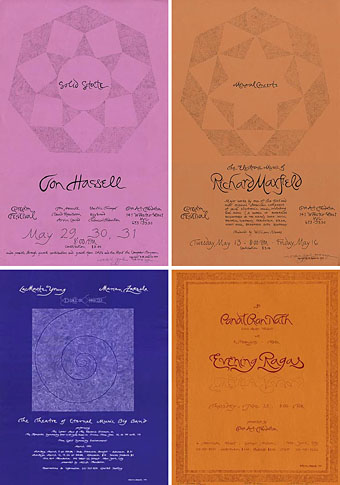
The poster art of Marian Zazeela

zazeela.jpg

top: Jon Hassell: Solid State. Richard Maxfield: Memorial Concerts.
bottom: The Theatre of Eternal Music Big Band. Pandit Pran Nath: Evening Ragas.

Artist Marian Zazeela’s beautiful hand-drawn posters can be seen (and bought) at the MELA Foundation website. Most of these were created for the Dream House productions hosted by Zazeela and partner La Monte Young. Zazeela has also used her distinctive calligraphic design on the sleeves of recordings by La Monte Young, Terry Riley and raga master Pandit Pran Nath.

A gallery of Marian Zazeela posters

Previously on { feuilleton}
The poster art of Bob Peak
Posters by Josef Müller-Brockmann
A premonition of Premonition
Perfume: the art of scent
Metropolis posters
Film noir posters

The music of Igor Wakhévitch

igor1.jpg

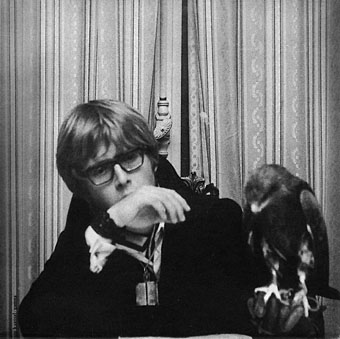
Igor Wakhévitch and feathered friend.

Continuing the Francophile theme, I felt that now was a good time to plumb the mysteries of the enigmatic Igor Wakhévitch. Who? Well… In 20th century music there’s strange and there’s weird and then there’s off-the-wall unclassifiable which is the place where we have to file Igor’s compositions. After half a lifetime spent trawling record shops for unusual music these albums had somehow managed to remain off the radar until a CD reissue set, Donc…, appeared courtesy of Fractal Records and a friend with similarly outré tastes (hi Gav!). The obscurity of these remarkable recordings can’t solely be due to Monsieur Wakhévitch being French; Richard Pinhas, Bernard Szajner and (of course) Magma, have been given enough attention over the years.

So what does this stuff sound like? Thankfully the redoubtable Alan Freeman tackled the problem of describing the albums in Audion (reproduced below), a task I would have found rather daunting. Docteur Faust is probably my favourite, a crazily eclectic and doomy album which lurches from rock freakout to contemporary orchestral/choral to electro-acoustics and back again. Imagine the witch cult from Rosemary’s Baby jamming with Alpha Centauri-era Tangerine Dream while Peter Maxwell Davies and Amon Düül 2 slug it out in the background. The clincher is a great cover by French comic artist Philippe Druillet.

One other notable album that the Donc… collection omits is the 1974 recording of Salvador Dalí’s opera, Être Dieu. Dalí wrote the libretto in 1927 with Federico Garcia Lorca but the piece wasn’t recorded until Wakhévitch provided a score. The result is pretty much the same as Wakhévitch’s other work, with the added bonus of the Surrealist master declaiming and frequently shrieking over the music.

For more information about Donc… and Igor Wakhévitch see the Fractal Records review page.

Continue reading “The music of Igor Wakhévitch”