Weekend links 801

waterhouse.jpg

The Magic Circle (1886) by John William Waterhouse.

The Moon and Serpent Bumper Book of Magic has just been published in France by Editions Delcourt. A preview here shows how carefully they’ve managed to translate and reletter my page designs.

• Among the new titles at Standard Ebooks, the home of free, high-quality, public-domain texts: Algernon Blackwood’s stories of John Silence, occult detective.

• Relevant to some of my recent reading: The Necronomicon Wars, an examination of the many attempts to give life to HP Lovecraft’s fictional grimoire.

Altered States is tremendously exciting to watch—and not only during its psychedelic interludes when goat Jesus is being crucified and writhing red figures are toppling, Hieronymus Bosch–like, into hell and abstract splotches give the impression of cells endlessly dividing or murky membranes dissolving and beautiful women stare into Magritte skies and waves of lava crash as though the molten core of humanity itself were erupting. Even in its quieter moments, it is a beautiful film, with Hurt’s every appearance shot by cinematographer Jordan Cronenweth to emphasize his character’s alien otherworldliness.

Jessica Kiang explores the creation of Ken Russell’s flawed but fascinating psychedelic feature, Altered States

• A new catalogue of lots at another After Dark: Gay Art and Culture online auction. Homoerotic art, photos, historic porn. etc.

Tarot decks through the ages: a video showing some of the cards from Victoria and Albert Museum’s collection.

• More psychedelia: Neuroscientist Grigori Guitchounts asks “What is your brain doing on psychedelics?”

• At the Daily Heller: Ryan Hughes has published a weighty collection of his typeface designs.

• Old music: Caged (25th Anniversary Edition) by Ian Boddy & Chris Carter.

• At the BFI: Rory Doherty selects 10 great Technicolor melodramas.

• At Dennis Cooper’s: The Old School Horrors of Terence Fisher.

Photographs from the 2025 Wildlife Photographer of the Year.

Ambientblog celebrates 20 years of existence.

• RIP Dave Ball.

Necronomicon (1970) by Les Baxter | Liriïk Necronomicus Kahnt (1975) by Magma | Necronomicon–The Magus (2004) by John Zorn

Weekend links 785

mabuse.jpg

A 1933 poster for the second of Fritz Lang’s Mabuse films.

• Good news for those who missed the original run (from 2002–2013), Arthur Magazine is now available for the first time as a complete set of free PDFs. I was laterally involved with the magazine from the outset, mostly as a remote supporter, but I also did several covers and interior illustrations for the early issues.

• Among the new titles at Standard Ebooks, the home of free, high-quality, public-domain texts: Dr. Mabuse, the Gambler by Norbert Jacques (translated by Lilian A. Clare); and two books by J. Sheridan Le Fanu: Short Fiction, and a novella, The Room in the Dragon Volant.

• New music: Spilla by Ensemble Nist-Nah; and Sea-swallowed Wands by Jolanda Moletta and Karen Vogt.

With his compulsions for systems and architecture, his command of shadows and symbolism-imbued sets and props, Lang is never less than arresting. Yet few of the films make complete statements; Lang’s art, in this period, is seemingly as much a fugitive as are his archetypal characters. That is, until the moment that his long journey to the direct subject matter and cultural framework of the 1950s United States, addressed in the terms and by the means available to him in Hollywood, abruptly comes to superb fruition with The Big Heat.

Jonathan Lethem on Fritz Lang in Hollywood and one of the greatest noir pictures of the 1950s

• This week in the Bumper Book of Magic: an enthusiastic review at The Joey Zone. My thanks to Mr Shea!

• Mixes of the week: A mix for The Wire by Nina Garcia; and Isolated Mix 133 by Pentagrams Of Discordia.

• At Colossal: David Romero’s digital recreations of Frank Lloyd Wright’s unrealised buildings.

• At Smithsonian magazine: John Last investigates the history of the Tarot.

• At Planet Paul: An interview with artist Malcolm Ashman.

• At the Daily Heller: A porno gag mag with attitude.

Hodgsonia

Das Testaments Des Mabuse (1984) by Propaganda | (The Ninth Life Of…) Dr Mabuse (1984) by Propaganda | Abuse (Here) (1985) by Propaganda

Nightmare Alleys

nightmare05.jpg

Undated paperback.

My reading this week has been William Lindsay Gresham’s Nightmare Alley, a novel I’d been intending to read for some time after becoming familiar with the story from the first film adaptation. (I haven’t seen the recent version.) Whenever I’m reading a novel that’s been around for a while I have to see how it was presented in the past by designers and illustrators. Nightmare Alley was published in hardback originally, and the book today is marketed as a literary classic, but Gresham’s account of cheap carnivals and fraudulent mediums is sufficiently lurid enough to warrant a variety of different treaments, including pulp excess. The paperback at the top of this post is an extreme example but the cover could easily be applied to any number of noirish thrillers, there’s nothing in the artwork to suggest the carny world or the Spiritualism that the novel’s protagonist, Stanton Carlisle, mercilessly exploits.

nightmare01.jpg

First edition, USA, 1946.

The first edition isn’t a great design but it happens to be faithful to the core storyline, more so than many of the covers that follow. In the film we’re left to guess what the “nightmare alley” of the title might be but in the novel this is a symbol that recurs throughout the story, a literal nightmare of Carlisle’s in which he dreams he’s being chased down a dark alleyway towards a light that remains continually out of reach. The dream weighs enough on Carlisle’s mind for him to regard it as a symbol of the human condition, or at least his soured perception of the same. The cover of the first edition combines this image with the Tarot trump of The Hanged Man which Carlisle turns up in a reading as a signifier of his destiny. Tarot scholars may quibble with this detail—The Hanged Man isn’t as doom-laden or negative as the novel suggests—but Gresham makes good use of Tarot as a structural element, with each chapter named after one of the trump cards, and with elements of the story reflecting the Tarot imagery. Given all this you’d expect cover artists to use Tarot symbolism much more than they do.

nightmare03.jpg

First paperback edition, USA, 1948.

Another odd omission is the colour of Carlisle’s hair which the novel repeatedly tells us is blond. When Carlisle begins his career as a phony preacher and medium his blue-eyed “golden boy” persona is one of his tools for charming and deceiving wealthy widows. Gresham reinforces this in the chapter named after The Sun trump card by having Carlisle identified with the god Apollo. The film adaptations and almost all of the book covers ignore this detail.

nightmare02.jpg

Film tie-in, USA, 1948.

The 1947 film adaptation was directed by Edmund Golding from a screenplay by Jules Furthman. The storyline is condensed and inevitably sanitised for the screen but it’s still one of the best film noir entries from the prime noir decade.

nightmare04.jpg

Art by James Avati, USA, 1949.

James Avati was one of the great paperback illustrators yet even he gives Carlisle dark hair. I suspect by this point everyone expected as much after Tyrone Power’s memorable performance.

nightmare06.jpg

USA, 1986.

And Power’s saturnine features are still providing the dominant image forty years later.

Continue reading “Nightmare Alleys”

Weekend links 760

varo.jpg

Ermitaño Meditando (1955) by Remedios Varo.

• Public Domain Review announces the Public Domain Image Archive. I’ve added it to the list. Meanwhile, the PDR regular postings include Francis Picabia’s 391 magazine (1917–1924).

• Among the new titles at Standard Ebooks, the home of free, high-quality, public-domain texts: The Well at the World’s End by William Morris.

• At Smithsonian Magazine: “See 25 incredible images from the Wildlife Photographer of the Year Contest”.

The ideas are more complex than the presentation suggests, but not vastly. Neither is it exactly breaking new ground. Art is everywhere, they say, from fingernails to fine dining; art is not a message to be decoded, but takes on new meanings in the mind of each viewer; art allows us to experience emotions in a “safe” context, like a form of affective practice; art helps us to imagine new worlds, thereby expanding the boundaries of what’s possible in the real world. The point isn’t to be original, though, but to distil a lifetime’s worth of practical wisdom and reflection. The result is a kind of joyous manifesto: just the thing to inspire a teenager (or adult) into a new creative phase. Eno and Adriaanse conclude with a “Wish”: that the book helps us understand that “what we need is already inside us”, and that “art – playing and feeling – is a way of discovering it”.

Brian Eno and Bette Adriaanse talking to David Shariatmadari about their new book, What Art Does: An Unfinished Theory

• “Crunchie: The Taste Bomb!” DJ Food unearths four psychedelic posters promoting Fry’s Crunchie bars.

• New music: Music For Alien Temples by Various Artists, and Awakening The Ancestors by Nomad Tree.

• At Wormwoodiana: Mark Valentine lays out a history of the Tarot in England.

Sun Ra & His Intergalactic Research Arkestra live on German TV, 1970.

• At Dennis Cooper’s: Chris Marker Day (restored/expanded).

• At the BFI: Anton Bitel on 10 great Mexican horror films.

Matt Berry’s favourite albums.

Tarot (Ace of Wands Theme) (1970) by Andrew Bown | Tarotplane (1971) by Captain Beefheart And His Magic Band | Tarot One (2012) by Tarot Twilight

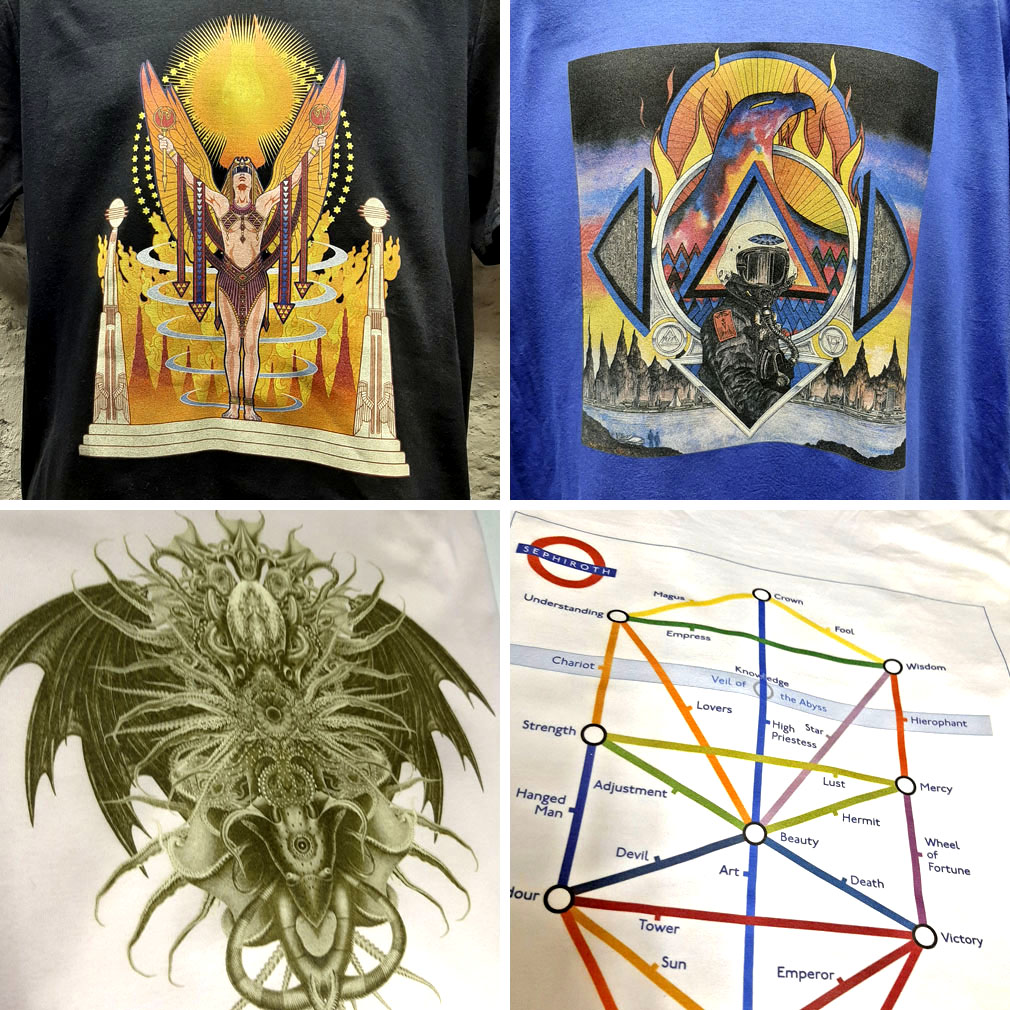
November shirts

skullprint-shirts.jpg

Skull Print shirts.

November weather isn’t exactly suitable for T-shirt wearing when you live this far north (although it’s unseasonably mild just now) but I’ve recently added four more shirt designs to my Skull Print page. As I was saying last month, now that I’ve quit CafePress all shirts featuring my art and design will be done through Skull Print, a small business who specialise in shirt-printing, and do so with very reasonable prices: £22 (inc. postage) for the UK, £32 (inc. postage) for the rest of the world. Long sleeves, sizes 3XL and over, and tie-dye colours add a little more to the cost.

skullprint-magus.jpg

It’s always the case when creating spin-off products that I’m guessing what people may want. Three of the four new designs have been extracted from popular works of the past (the Tarot designs have been given a boost now that they’re featured in the Bumper Book of Magic). I’m always open to suggestions for new designs so long as they don’t infringe on any trademarks or copyright agreements.

skullprint-priestess.jpg

skullprint-chaos.jpg

The Chaos symbol is a new creation based on a shirt I designed for Hawkwind’s Chronicle Of The Black Sword tour in 1985 (see this post). The symbol isn’t exclusive to Hawkwind, of course. Michael Moorcock invented it for the original Elric stories in the 1960s after which it was picked up by the practitioners of Chaos magic in the 1980s.

skullprint-alice.jpg

And this is one of my popular Alice in Wonderland designs which I amended for The Graphic Canon in 2012, extending the square composition into a rectangle. I may add one or two more from this series in future although this was one was easier to adapt than some of the others.