Weekend links 491

beatty.jpg

The Weirdness is Coming, an illustration by Robert Beatty for an NYMag feature about the near future.

• I’m slightly late to this news, but better late than never: The Doll’s Breath is a 22-minute animated film by the Brothers Quay, shot on 35mm film and with a soundtrack by Michèle Bokanowski. It may take a while before it’s available to view outside the festival circuit but it’s good to know it’s in the world. Related: Filip Lech on the Polish inspirations of the Brothers Quay.

• More from Swan River Press: Joseph Sheridan Le Fanu’s disturbing horror tale, Green Tea, is published in a 150th anniversary edition, with an introduction by Matthew Holness, two essays and a CD containing a theatrical adaptation of the story by the Wireless Mystery Theatre.

• Luca Guadagnino, Olivia Laing and Sandy Powell, Tilda Swinton and John Waters choose favourite pieces of writing by Derek Jarman. Related: Protest!, a Jarman exhibition at the Irish Museum of Modern Art.

Fairport [Convention]’s revolutionary impact came in doing precisely the opposite of what the folklorists had intended when they began collecting the songs. By taking the old songs and setting them down on paper, they had largely believed they were preserving them in the form in which they must remain, ignoring the fact that songs passed through generations orally will always evolve. Fairport, though, played extremely fast and loose with the source material, matching tunes from one source with lyrics from another. As Rob Young put it in his book Electric Eden: “It threw into question the spurious ‘authenticity’ of the folk versions studiously set in stone by the Victorian and Edwardian collectors. Fairport’s electrifying act preserved and restored the guts and spontaneous vigour to the folk continuum.”

Michael Hann on the 50th anniversary of Fairport Convention’s Liege & Leaf

• More Patrick Cowley: PC’s megamix of Hills Of Kat Mandu by Tantra. And the mix of the week: a Patrick Cowley tribute from 1981 by DJ Jim Hopkins.

• The seventh edition of Wyrd Daze—”The multimedia zine of speculative fiction + extra-ordinary music, art & writing”—is out now.

• 5 Mishaps: A 32-page hardbound handmade book of short stories by Tamas Dobozy, with collage illustrations by Allan Kausch.

• At Dangerous Minds: Lovely Bones: The transfixing skeletons and dreamlike nudes of Belgian painter Paul Delvaux.

• From 1979: a very early TV appearance by Virgin Prunes (their first?) on Ireland’s The Late Late Show.

• Fists of fear: Anne Billson on 10 films featuring severed (and frequently vengeful) hands.

• Adrian Curry at MUBI selects his favourite film posters of the 2010s.

• Tea For Two (1956) by Duke Ellington | Tea For One (1976) by Led Zeppelin | Tea In The Sahara (2001) by Simon Shaheen & Qantara
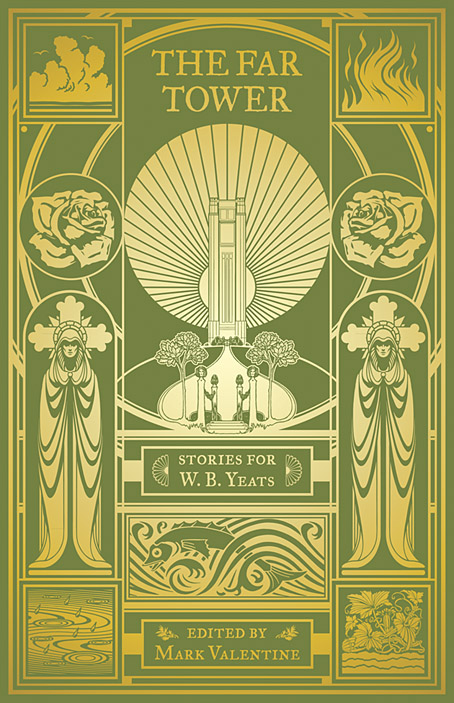
The Far Tower: Stories for WB Yeats

tower.jpg

I said a couple of weeks ago that I had more cover designs waiting to be revealed, and this was one of them, arriving two years to the week after my earlier cover for The Scarlet Soul: Stories of Dorian Gray. Both books are collections of original fiction edited by Mark Valentine for Swan River Press, and both offer variations on works by Irish authors prominent during the 1890s:

“All Art that is not mere story-telling,
or mere portraiture, is symbolic…” — WB Yeats

Stories of magic and myth, folklore and fairy traditions, the occult and the outré, inspired by the rich mystical world of Ireland’s greatest poet, WB Yeats. We invited ten contemporary writers to celebrate Yeats’s contributions to the history of the fantastic and supernatural in literature, drawing on his work for their own new and original tales. Each has chosen a phrase from his poems, plays, stories, or essays to herald their own explorations in the esoteric. Alongside their own powerful qualities, the pieces here testify to the continuing resonance of Yeats’s vision in our own time, that deep understanding of the meshing of two worlds and the talismans of old magic.

Yeats had a career that extended beyond the fin de siècle, of course, and the title of The Far Tower alludes to The Tower, a collection of poems that Yeats published in 1928. (The first poem in the book, Sailing to Byzantium, is the origin of the phrase/title “no country for old men”.) Yeats’s poetry is very different to the Modernists, however, and remained infused with mystical resonances, something I tried to reflect in the cover design. In addition to the very Yeatsian symbol of the rose there are symbols for the four elements, and a pair of robed figures who can be taken as adepts of one sort or another, either the Golden Dawn (who Yeats was involved with for a time) or the various Theosophists and Rosicrucians of the period who fed his imagination.

The green-and-gold colour scheme matches the gold on green design that Thomas Sturge Moore created for the first edition of The Tower. Sturge Moore produced covers for a number of Yeats’s books but it was his splendid design for Axel by Auguste Villiers de L’Isle-Adam that gave me the nested circles and vertical division of the board. That edition happens to have a preface by Yeats so as an influence it isn’t too remote.

The Far Tower will be published in December but is available for pre-order now.

Previously on { feuilleton }
• The Scarlet Soul: Stories for Dorian Gray
• Form and Austin Osman Spare
• Golden apples and silver apples
• A Book of Images by WT Horton
• The Savoy magazine

Weekend links 477

starling.jpg

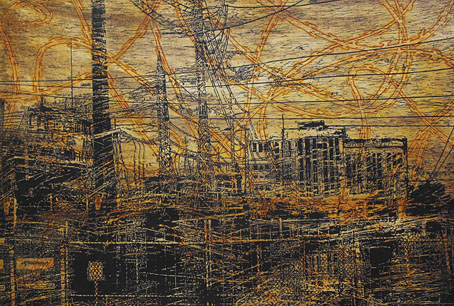
Edge of Industry (2009) by Anne Starling.

• “In her darkroom with her silver salts and gelatine plates, she experimented with the mercurial effects of light, time and temperature.” Hailey Maxwell on the photographic art of Dora Maar.

• A Visionary Work Renew’d: A conversational review of Swan River Press edition of William Hope Hodgson’s The House on the Borderland by the late Sam Gafford & The joey Zone.

• Brian Blomerth’s graphic novel Bicycle Day tells the story of the psychedelic ride made in 1943 by Swiss chemist Albert Hofmann while he was researching LSD.

• “The cinema is not the industrial cinema. The cinema is independent cinema.” Francis Ford Coppola on Apocalypse Now and related matters.

• More lunacy: “Fireworks, wild swans and super-cannons were propelling people mentally Moonwards long before 1969,” says David Seed.

• Mix of the week: Then Beautiful Swift Sparrows Led You Over the Black Earth by The Ephemeral Man.

• Working (You Are), a new recording by Stephen Mallinder, his first solo work since Pow Wow in 1982.

• Lost Proust stories of homosexual love finally published (but only in French for the moment).

• Oren Ambarchi‘s favourite albums.

• My White Bicycle (1967) by Tomorrow | Trip On An Orange Bicycle (1968) by The Orange Bicycle | Blue Bicycle (2008) by Hauschka

Weekend links 410

hog.jpg

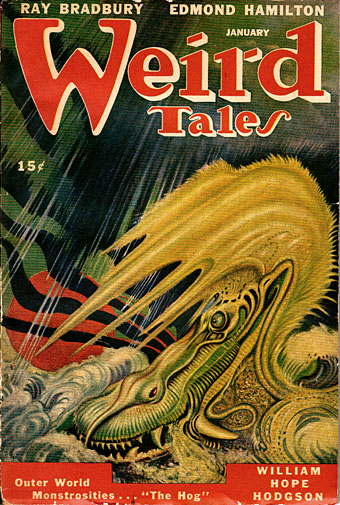
William Hope Hodgson’s final Carnacki mystery, The Hog, received its first magazine publication in January 1947. The cover art by AR Tilburne may not have been originally created for Hodgson’s tale but it complements the story’s atmosphere of febrile dread.

• It’s still April so that means it’s still the month that saw the 100th anniversary of the death of William Hope Hodgson, bodybuilder, manacler of Harry Houdini, and the author of several novels of weird fiction that continue to entrance new generations of readers. The edition of Hodgson’s The House on the Borderland that I illustrated for Swan River Press would have been on sale this month but print problems have caused delays with the run as a whole; anyone interested is advised to contact the publisher for news. • Meanwhile, Jon Mueller (composer of the book’s accompanying soundtrack CD) and myself talked to Swan River Press about the attractions of Hodgson’s novel. • More Hodgsoniana: Greydogtales acknowledged the Hodgson centenary via a discussion with Hodgson scholar Sam Gafford, while Michael Dirda reviewed the new edition of The House on the Borderland and another SRP title, The Scarlet Soul (whose cover I also designed), for The Washington Post.

• “From the ashes of countless decayed Modernities comes Neo-Decadence, a profaned cathedral whose broken stained glass windows still glitter irregularly in the harsh light of a Symbolist sun. Behind this marvellously vandalised edifice, a motley band of revellers picnic in the graveyard of the Real, leaving behind all manner of rotting delicacies and toxic baubles in their wake.” Drowning in Beauty: The Neo-Decadent Anthology edited by Daniel Corrick & Justin Isis is published this month by Snuggly Books, an imprint whose catalogue of new books and first-time translations will be of interest to anyone who comes here for Decadence, Symbolism or anything related. Related to the above: A Neo-Decadence Day at Dennis Cooper’s.

• “Witches are change-makers. They’re transgressive beings who dwell on the fringes of society, and so they’re the perfect icon for rebels, outsiders, and rabble-rousers, especially those of the female persuasion.” Pam Grossman talks to Grimoire about witchcraft and related arts.

• Mixes of the week: Resident Advisor Podcast 621 by Grouper, and Bacchus Beltane 5: The Owl Service by The Ephemeral Man.

• Back in black: Publisher/translator James Conway and designer Cara Schwartz on the cover designs of Rixdorf Editions.

• I was talking again this week at The Writer’s Corner where JKA Short asked me about working as an illustrator.

• All Gates Open: The Story of Can by Rob Young is published next week. The Wire has an extract.

• Delusional Albion: Brad Stevens on how foreign directors saw Britain in the Swinging Sixties.

• “There’s no book I love more than Derek Jarman’s Modern Nature,” says Olivia Laing.

• Eden Tizard on Soliloquy For Lilith, the drone album by Nurse With Wound.

• Owls (1969) by Ruth White | Decadent & Symmetrical (1995) by ELpH vs Coil | The Owls (2013) by Félicia Atkinson

Weekend links 402

hodgson.jpg

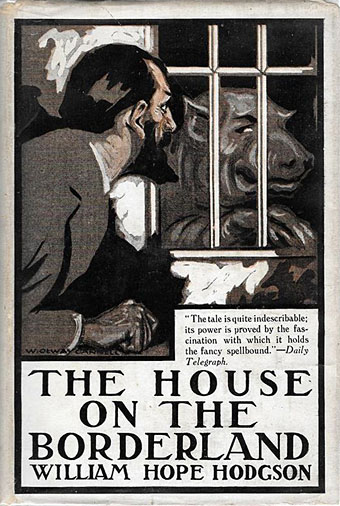
Cover art for the 1921 edition by W. Otway Cannell.

• “An exiled recluse, an ancient abode in the remote west of Ireland, nightly attacks by malevolent swine-things from a nearby pit, and cosmic vistas beyond time and space. The House on the Borderland has been praised by China Miéville, Terry Pratchett, and Clark Ashton Smith, while HP Lovecraft wrote, ‘Few can equal [Hodgson] in adumbrating the nearness of nameless forces and monstrous besieging entities through casual hints and significant details, or in conveying feelings of the spectral and abnormal.’

“‘Almost from the moment that you hear the title,’ observes Alan Moore, ‘you are infected by the novel’s weird charisma. Knock and enter at your own liability.’ The House on the Borderland remains one of Hodgson’s most celebrated works. This new edition features an introduction by Alan Moore, an afterword by Iain Sinclair, and illustrations by John Coulthart.” The long-gestating illustrated edition of William Hope Hodgson’s The House on the Borderland is now available for pre-order from Swan River Press. This is limited to 350 copies so I’d advise anyone interested to order as soon as they can; there’s been a lot of interest in the edition, and with the print run being a small one it’s liable to sell out quickly.

• “Art et Liberté was a movement that came into being in 1938 in Cairo. It was affiliated to Surrealism through contact with André Breton in Paris, and shared Surrealism’s spirit of rebellion and provocation, its desire for dream knowledge and penchant for manifestos.” Marina Warner on the neglected history of Egyptian Surrealism.

• Titan Comics follow their recent collection of Philippe Druillet’s first six Lone Sloane stories with Gail, a book which I don’t think has received an English translation until now.

• Mixes of the week: FACT mix 641 by Alva Noto, a mix by Chris Carter for Bleep/NTS, and Through A Landscape Of Mirrors Vol. I: Sweden by David Colohan.

• 200 years after the first publication of Frankenstein, the city of Bath is to unveil a plaque commemorating Mary Shelley‘s time spent there while writing the book.

• Southern Lord co-founder Gregg Anderson talks to Red Bull Radio about running a record label devoted to avant-garde metal.

• Twelve illustrated dust jackets from Martin Salisbury’s The Illustrated Dust Jacket: 1920–1970.

• At MetaFilter: Links to Hokusai’s drawing guides and similar books.

• Canada Modern

• Grief (1999) by Tactile | In The Cellar (2005) by Nostalgia | The House On The Borderland (2008) by Electric Wizard