
Weekend links 462

chanctonbury.jpg

The next release on the Ghost Box label, Chanctonbury Rings is “a blend of folk, electronic music, poetry, prose and environmental sound” by Justin Hopper & Sharron Kraus with The Belbury Poly. The album will be available in June. Design, as always, is by Julian House.

• Clumsy and insensitive translations can ruin the enjoyment of a foreign-language film. Don’t blame us, say the subtitlers pressing film-makers for more appreciation of their art. Anne Billson on the difficulties of translating for a medium of moving images.

• At Expanding Mind: Hypermedia researcher and author Konrad Becker talks with Erik Davis about algorithms from hell, the madness of rationality, media seances, and the martial art of freedom.

• The HP Lovecraft Cat Book: a limited collection of Lovecraft’s writings about cats edited by ST Joshi and illustrated by Jason C. Eckhardt.

Amacher was also inspired by a short story she found in the 1986 cyberpunk anthology Mirrorshades, edited by Bruce Sterling—a tale called Petra by Greg Bear, about a grand cathedral, possibly Notre Dame in Paris, in a ravaged, postapocalyptic landscape. Stone gargoyles and other statues mate with humans, creating new hybrids who wander the labyrinthine chambers of the battered house of worship.

Geeta Dayal on composer Maryanne Amacher

• The novel that wouldn’t leave Anthony Burgess alone: Alison Flood on the discovery of a non-fiction continuation of the themes in A Clockwork Orange.

• Kristina Foster on photographs of Central Asia’s Striking Soviet Architecture.

• Adrian Shaughnessy‘s ten favourite design and visual culture books.

• William Joel on the process behind Helvetica’s 21st century facelift.

• The Stupid Classics Book Club by Elisa Gabbert.

• The Haunted Generation by Bob Fischer.

• Haunted Cocktails (1983) by Intro | Haunted Gate (1997) by David Toop | The Universe Is A Haunted House (2002) by Coil

Weekend links 459

akira.jpg

• “Their graves were covered with cement tiles to block the radiation emanating from their corpses.” Sophie Pinkham reviews three books about the Chernobyl nuclear disaster.

• At Dangerous Minds: Julius Eastman: The resurrection of the visionary minimalist composer continues; at The Quietus: The Strange World of Julius Eastman.

• Mixes of the week: a Dune-inspired Secret Thirteen Mix 286 by Coeden, and ’94–95 Mirrorverse by The Ephemeral Man.

Nabokov had meanwhile acquired a literary agent in New York. She made no headway placing translations of his Russian novels. His latest, she informed him, was “dazzlingly brilliant” and hence wholly without promise for the American market. She suggested something more topical, an idea that left her client hyperventilating. “Nothing,” he would roar later, “bores me more than political novels and the literature of social unrest.” He was, he enlightened his representative, neither Sinclair Lewis nor Upton Sinclair. (Ultimately he tossed the two over the cliff together, as “Upton Lewis.”) Weeks later, in the bathroom of a Paris studio apartment, he began — “a champion figure skater switching to roller skates,” as he complained, speaking for whole cadres of displaced professionals — to write in English.

Stacy Schiff on Vladimir Nabokov, literary refugee

• Iain Sinclair on Ghosts of a Ghost: William Burroughs, time surgery and the death of the image.

• ST Joshi remembers Lovecraftian writer Wilum Pugmire (RIP).

• The Conspirators: A Borgean Tribute to Jorge Luis Borges.

• Jasper Sharp on where to begin with Japanese cyberpunk.

• Greg Anderson on the new Sunn O))) album, Life Metal.

• Drew Daniel of Matmos picks his Bandcamp favourites.

• The Kraken surfaces for Clive Hicks-Jenkins.

• An interview with Brian Eno by Suite (212).

• Apocalypse Now: Final Cut

• The Book of Weirdo

• Conspiracy Of Silence (1994) by Cypher 7 | The Vodun Conspiracy (1996) by The Sidewinder | Machine Conspiracy (2010) by Conforce

Leather Cthulhu unleashed

cthulhu1.jpg

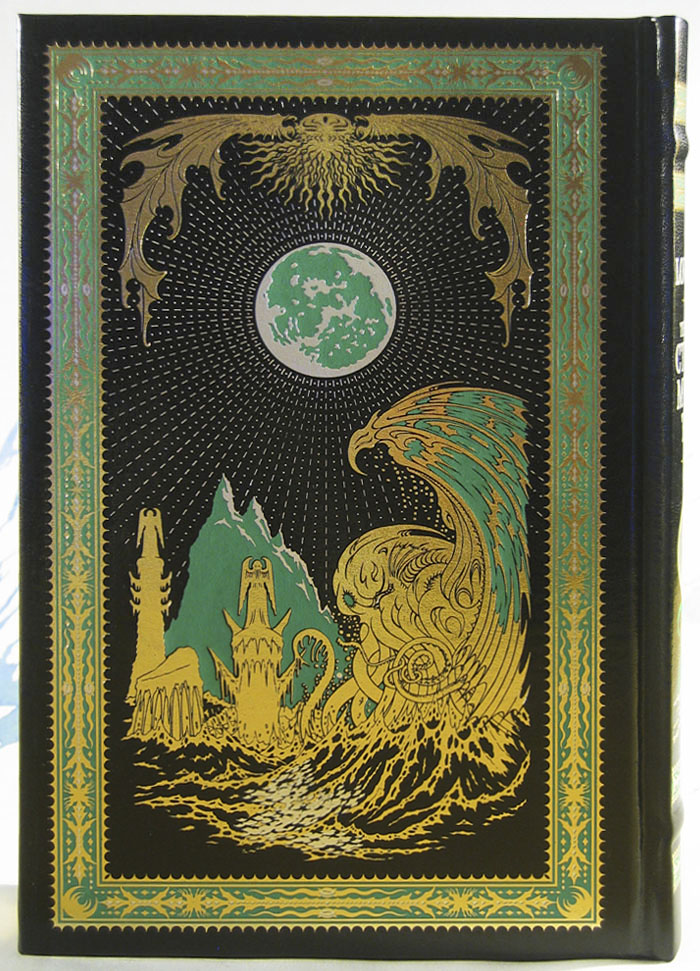
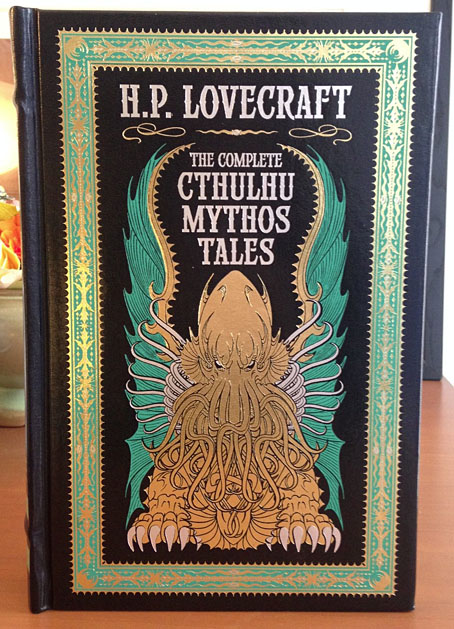
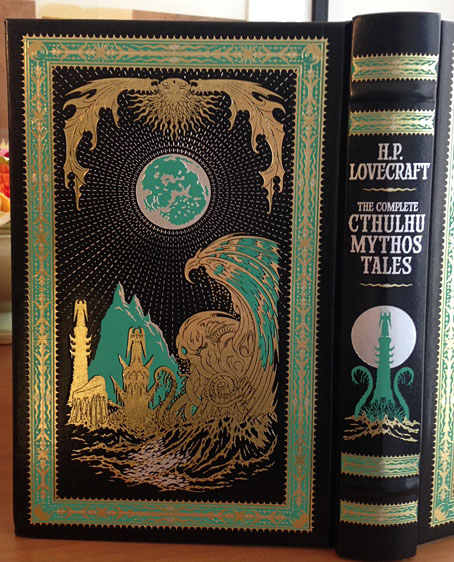
The beautiful leatherbound Complete Cthulhu Mythos Tales is officially published this Friday but the books are in Barnes & Noble stores already, and my complimentary copies arrived this week. Photos don’t do justice to the volumes in this series of classic reprints, you really need to hold one to see how well made they are. The leather is smooth and flawlessly printed—I was worried that I might have pushed the limits with some of the details in my cover design but every line and edge is where it should be. The pages of this particular volume are edged with gold, an effect applied to some of the books I’ve designed for Savoy but an uncommon thing in today’s book world.

cthulhu2.jpg

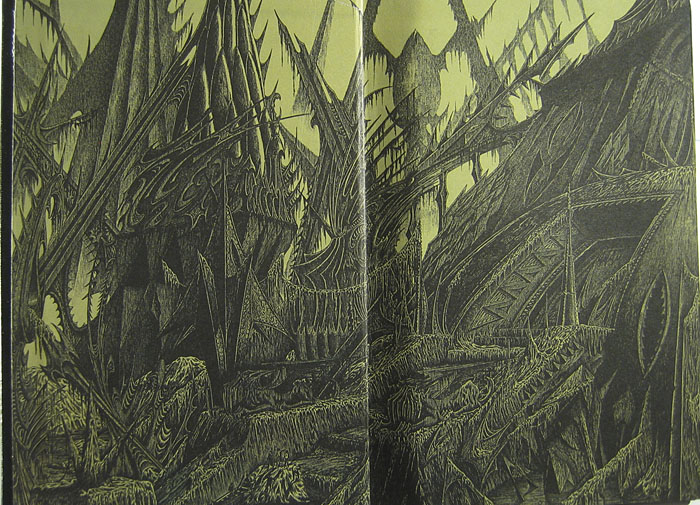
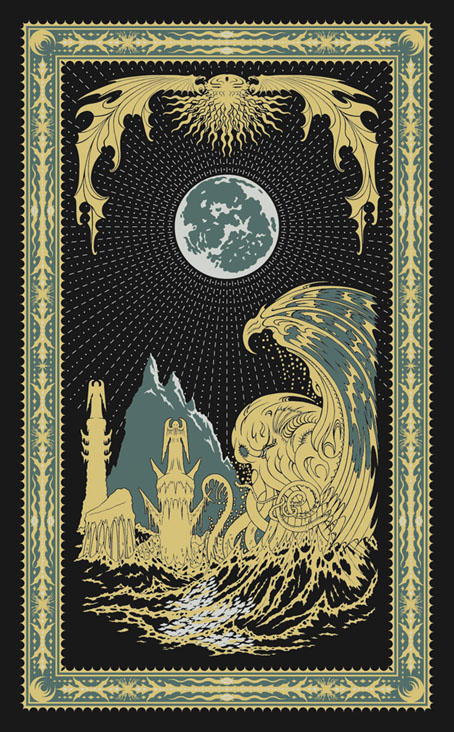
As I mentioned earlier, this edition also features endpapers showing details of my R’lyeh spread from The Call of Cthulhu, plus a poster of my Cthulhu Rising piece from 2004. Which leads to an important note for purchasers: the temporary glue that fixes the poster to the back endpapers, and the ad sheet (see below) to the back cover was stronger than intended so care needs to be taken when detaching these items from the book. I’ve been told that a warning about this will be added to the next batch of books, and the glue (which is that clear stuff used to fix things to magazine covers) will also be changed.

A couple more photos and a list of contents follow below. I’ve worked on a lot of books over the years but this one is up there with the very best; Lovecraft’s finest fiction in a single gorgeous volume, and all for $20.

cthulhu3.jpg

Continue reading “Leather Cthulhu unleashed”

Leather Cthulhu

mythos1.jpg

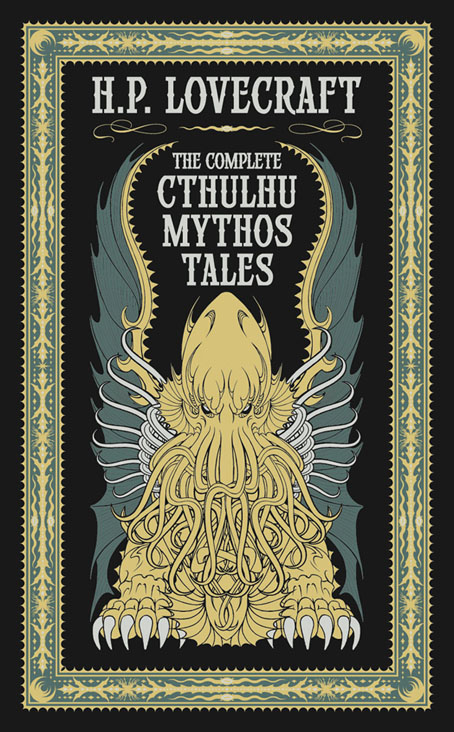
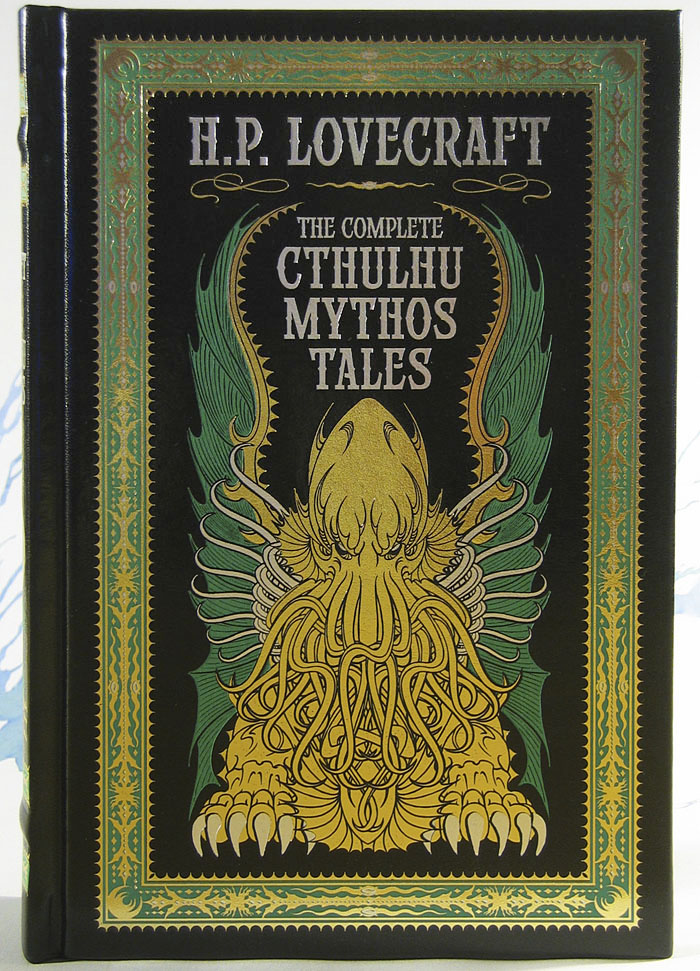
A couple of the projects I’ve been working on for the past few months have yet to be made public but this one from last September has finally shambled into the light of day. The Complete Cthulhu Mythos Tales is a collection of 23 weird tales by HP Lovecraft (some of which are his collaborations with other writers) published by Barnes & Noble in their leatherbound Collectible Editions series. Anyone who’s held one of these volumes will know that they deserve to be called tomes rather than mere books; they’re heavy and lavishly produced, with detailed designs embossed on the front and back boards in a variety of metallic inks.

mythos2.jpg

One of my drawings was used a few years ago inside the big B&N edition of Lovecraft’s collected fiction; more recently I also designed a cover for a B&N paperback edition of the Cthulhu Mythos tales but the brief on that occasion was for something quick using pre-existing artwork. Given that the Mythos stories are my favourites in Lovecraft’s oeuvre I would have preferred to have done something more elaborate so I was very pleased when asked last year to create a new design for this hardback edition. The design on the front panel presented some challenges as I didn’t want to have an isolated head with wings but I also didn’t want to reduce the Cthulhu figure to such an extent that detail would be compromised. (This type of embossed printing imposes a limit on the amount of detail you can put into the design.) The compromise was a frontal view of what I consider to be another Cthulhu Sphinx, after the more elaborate sculpted design in my adaptation of The Call of Cthulhu. I find myself wondering now how this creature might look from the side.

mythos3.jpg

The photos of the boards are courtesy of Betsy Beier at Barnes & Noble, and they show how much more effective the printed design is when you have the light reflecting on it. I’m now eagerly awaiting the arrival of a physical copy. The book will be out at the end of the month, and among the extra features there’s an introduction by Lovecraft scholar ST Joshi, my drawing of R’lyeh on the endpapers, and (if that wasn’t enough) a poster reproduction of my Cthulhu Rising picture.

mythos4.jpg

Elsewhere on { feuilleton }
• The Lovecraft archive

Weekend links 271

flyhead.jpg

Environment Transformer/Flyhead Helmet by Haus-Rucker-Co (1968). From Hippie Modernism at the Walker Art Center, Minneapolis.

• From 2006: Weird Tales: The Strange Life of HP Lovecraft. Geoff Ward examines Lovecraft’s life and work for BBC Radio 3 with contributions from Neil Gaiman, ST Joshi, Kelly Link, China Miéville and Peter Straub. Meanwhile, Ned Beauman wonders whether Ford Madox Ford is “as scary as Lovecraft”.

• Alexei German’s years-in-the-making feature film, Hard to be a God (previously), receives a UK release this week. Paul Duane reports on an overwhelming viewing experience, while Nigel Andrews says it “may be the greatest film since the millennium began”.

• Mixes of the week: Adventures In Sound And Music, 30 July 2015, hosted by Joseph Stannard, and RCMIX9 by worriedaboutsatan.

As Nabokov insisted, “Literature is invention. Fiction is fiction. To call a story a true story is an insult to both art and truth.” The genre thrives because its deceptions are liberating. For Wood, the thrill of reading fiction is intimately connected with the awareness that fiction constitutes “an utterly free space, where anything might be thought, anything uttered.” The excitement comes when, as readers, we’re allowed to participate in this freedom and experience the fiction imaginatively, without being required to believe that it is true.

Joanna Scott on The Virtues of Difficult Fiction

• “Writing used to be a solitary profession. How did it become so interminably social?” asks Meghan Tifft.

• The original, real-life dystopian cityscape of Kowloon Walled City, and the artwork it inspired.

• The Long, Lonely Walk: Nick Ripatrazone on hallways in horror films.

• New cover designs for the Essentials range from Penguin Books.

• Lemi Ghariokwu: “How I designed Fela Kuti’s album covers”.

• “Do CDs sound better than vinyl?” asks Chris Kornelis.

• Magic Fly (1977) by Space | Human Fly (1978) by The Cramps | I Am The Fly (1978) by Wire