Weekend links 804

phantom.jpg

Poster for The Phantom of the Opera, 1925. The first Universal horror film, and the best screen adaptation of Gaston Leroux’s novel, was released 100 years ago this month.

• “Evolution seems to have a thing for mind-bending molecules here on planet Earth. Psychedelics are more widespread in nature than you might think. These remarkable compounds, which can profoundly alter consciousness, arose repeatedly across evolutionary time, stretching back at least 65 million years. To date, some 80 species of fungi, at least 20 plants, and a species of toad have been documented to produce psychoactive molecules. And scientists continue to identify new ones.” Kristin French presents a trip around our surprisingly psychedelic planet.

• “There was no condescending sense with Potter —all too present today as then—that the public were idiots who needed to be intellectually housetrained, by their enlightened ‘betters’. […] Television was not treated as a particularly serious medium, something Potter upended not by performing ‘seriousness’ but by bringing out the possibilities few had believed it contained.” Darran Anderson on the television plays of Dennis Potter.

• At Public Domain Review: AD Manns on a possible origin for the occult lore presented in Charles Godfrey Leland’s Aradia, Or the Gospel of the Witches, a founding text for the witchcraft revival of the 20th century.

• New music: Implosion by The Bug vs Ghost Dubs; Herzog Sessions by Mouse On Mars; VHS Days Vol. 1 by Russian Corvette.

• At Wyrd Britain: A link to a video interview in which the great Ian Miller about his long illustration career.

• At the BFI: David West selects 10 great Hong Kong action films of the 1980s.

• Mix of the week: DreamScenes – November 2025 at Ambientblog.

• At The Wire: Stream the new album by Ann Kroeber & Alan Splet.

Seb Rochford’s favourite records.

• RIP Tatsuya Nakadai, actor.

Phantom Lover (2010) by John Foxx | Phantom Cities (2020) by The Sodality Of Shadows | Phantom Melodies (2018) by Cavern Of Anti-Matter

Weekend links 755

emsh.jpg

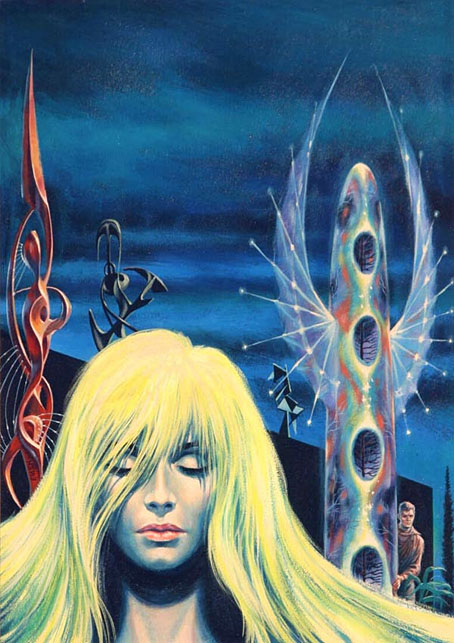
A painting by Ed Emshwiller for the cover of Fantastic Stories of Imagination, July 1962, illustrating The Singing Statues by JG Ballard .

• This week in the Bumper Book of Magic: my comments about the creation of the book’s cover and magical alphabet have been posted at Alan Moore World. At (Quasi), Smoky Man (in Italian) looks at other parts of the book, and includes my answers to his questions about the creation of The Soul, a character originally planned for a comic strip that Alan Moore and I were working on. I’ve been trying recently to find the first sketches I made of The Soul back in 2000 or 2001, without success. If I do find any of them I’ll post them here.

• New music: Juk-Shabb by Cryo Chamber Collaboration is this year’s installment in the Lovecraft-themed album series (previously) from Cryo Chamber. Also this week: Xerrox Vol. 5 by Alva Noto; Nocturne (Soundtrack for an Invisible Film) by Avi C. Engel; and Cat Location Conundrum by Moon Wiring Club.

Code: Damp: An Esoteric Guide to British Sitcoms by Sophie Sleigh-Johnson, being “an alternative occult and esoteric history of England told through one of its most popular cultural forms: the comedy sitcom”.

…the joy of art isn’t only the pleasure of an end result but also the experience of going through the process of having made it. When you go out for a walk it isn’t just (or even primarily) for the pleasure of reaching a destination, but for the process of doing the walking. For me, using AI all too often feels like I’m engaging in a socially useless process, in which I learn almost nothing and then pass on my non-learning to others. It’s like getting the postcard instead of the holiday.

Brian Eno at Boston Review

• “The typographic choices that Godard made were thematic and not only chosen for their stylistic properties.” Arijana Zeric looks inside the design world of Jean-Luc Godard.

• Coming soon from Strange Attractor: The Stammering Librarian: Essays by Timothy D’Arch Smith, edited by Edwin Pouncey & Sandy Robertson.

• At Public Domain Review: Fantastic Planet: The Microscopy Album of Marinus Pieter Filbri (1887–88).

• At the BFI: Michael Brooke offers suggestions for where to begin with Guy Maddin.

• At The Quietus: The Strange World of…Dennis Bovell.

• Mix of the week: A mix for The Wire by KMRU.

• Steven Heller’s font of the month is Gigafly.

Fantastic Cat (1996) by Takako Minekawa | Fantastic Analysis (2001) by Mouse On Mars | Fantastic Mass (2016) by Time Attendant

Weekend links 713

hishida.jpg

Black Cat (1910) by Shunso Hishida.

• “A duck goes quack quack in English but coin coin in French. In Spanish a dog goes guau-guau, not woof woof, while in Arabic it goes haw haw, and in Mandarin wang-wang. In Japanese cats go nyaa, and bees—having no access to the zz sound—go boon-boon.” Caspar Henderson asks “Could onomatopoeia be the origin of language?”

• Coming soon from MIT Press: Blotter: The Untold Story of an Acid Medium by Erik Davis; “the first comprehensive written account of the history, art, and design of LSD blotter paper, the iconic drug delivery device that will perhaps forever be linked to underground psychedelic culture and contemporary street art.”

• At Aquarium Drunkard: The late Damo Suzuki is remembered with a recording of Can playing at the Volkshalle Wagtzenborn-Steinberg, Giessen, October 22, 1971.

• At Unquiet Things: Another collection of Intermittent Eyeball Fodder. I was sorry to hear from that post that artist Dan Hillier had died recently. RIP.

• At Bandcamp Daily: Mouse On Mars discuss 30 years of dynamic electronic music.

• Old music: Rare Soundtracks & Lost Tapes (1973–1984) by Alain Goraguer.

• At Spoon & Tamago: The imaginary architectures of Minoru Nomata.

• Mix of the week: DreamScenes – February 2024 at Ambientblog.

• At Vinyl Factory: Julia Holter on some of her favourite records.

• At Public Domain Review: Wanda Gág’s Millions of Cats (1928).

• Steven Heller’s Font of the Month is Cuatro.

A brief history of London’s gas lamps.

• New music: Pithovirii by Aidan Baker.

Black Cat Bone (2000) by Laika | Black Cat (2005) by Broadcast | Black Cat (2008) by Ladytron

Weekend links 469

X.jpg

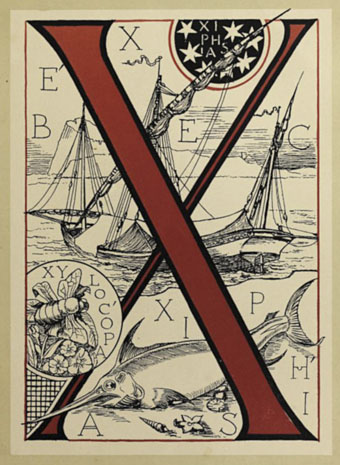
X from Theodore Howard’s ABC (1880) by Theodore Howard.

• “[Parade] has everything: joy and sadness, get-down and wistfulness, mourning and melancholia, group funk and Debussy interludes, echoes of Ellington, Joni, film music, chanson. It’s a perfectly realised whole.” Ian Penman on the enigmas and pleasures of Prince.

• “Mescaline reads like the culmination of a lifetime’s wanderings in the very farthest outposts of scientific and medical history.” Ian Sansom review’s Mike Jay’s history of the psychedelic alkaloid.

• The Day the Music Burned by Jody Rosen: “It was the biggest disaster in the history of the music business—and almost nobody knew. This is the story of the 2008 Universal fire.”

This willing constriction of intellectual freedom will do lasting damage. It corrupts the ability to think clearly, and it undermines both culture and progress. Good art doesn’t come from wokeness, and social problems starved of debate can’t find real solutions. “Nothing is gained by teaching a parrot a new word,” Orwell wrote in 1946. “What is needed is the right to print what one believes to be true, without having to fear bullying or blackmail from any side.” Not much has changed since the 1940s. The will to power still passes through hatred on the right and virtue on the left.

George Packer on what George Orwell’s Nineteen Eighty-Four means today

• Having spent the past week watching Jacques Rivette’s 775-minute Out 1, this interview with Rivette from 1974 was of particular interest.

• At Dangerous Minds: Donald Sutherland as “a sperm-filled waxwork with the eyes of a masturbator” in Fellini’s Casanova.

The Adventures of the Son of Exploding Sausage (1969): the Bonzo Dog Band getting it untogether in the country.

• Dark, velvety dark: Nabokov’s discarded ending to Camera Obscura, introduced by Olga Voronina.

• “Spotify pursues emotional surveillance for global profit”, says Liz Pelly.

• Mix of the week: Then Space Began To Toll by The Ephemeral Man.

• An interview with master of horror manga Junji Ito.

• Announcing the Arthur Machen Essay Prizes.

• RIP film-maker and author Peter Whitehead.

X is for…

X Offender (1976) by Blondie | X-Factor (1981) by Patrick Cowley | X-Flies (1997) by Mouse On Mars

Weekend links 362

yoshi47.jpg

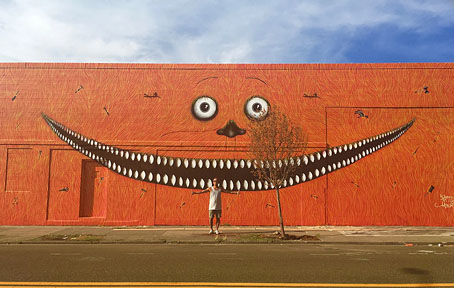
A mural for Forest For The Trees, 2016, by Yoshi47.

• “Who’s the real cunt?” Andrew O’Hagan on the Daily Mail‘s hypocrisies, Little England bigotries and omni-outrage in a review of Mail Men: The Unauthorised Story of the ‘Daily Mail’, the Paper that Divided and Conquered Britain by Adrian Addison.

Deutschlandspiegel 198/1971: a short film at the German Federal Archive which includes footage of Popol Vuh (still in their electronic phase) six minutes in.

• A meeting of remarkable minds: a live radio discussion between Annea Lockwood and Pauline Oliveros from December 1972.

The House In The Woods (aka Martin Jenkins of Pye Corner Audio) at Rare Air, Seattle, 14th May 2017.

• “Peaceful but not to be messed with.” Tony Naylor on how the bee came to symbolise Manchester.

• Mixes of the week: FACT Mix 602 by Deathprod, and Secret Thirteen Mix 222 by Yuji Kondo.

Emptyset and Mouse On Mars’s Jan St Werner on space, time and the evolution of sound.

• At Indiegogo, a funding call for Subotnick: Portrait of an Electronic Music Pioneer.

Shannon Taggart’s Camera Fantastica: an interview by Peter Bebergal.

Study finds mushrooms are the safest recreational drug.

Mary Anne Hobbs‘ favourite albums.

Bumble Bee Bolero (1957) by Harry Breuer | Bee Stings (1998) by Coil | The Bees Made Honey In The Lion’s Skull (2008) by Earth