New Worlds 224

NW-224-1.jpg
Illustration by Mark Reeve.

New issues of New Worlds magazine have been rare things in recent years so the announcement last week of issue number 224 was a special moment:

New Worlds Vol. 66 No. 224, ed. Michael Moorcock (to commemorate the sixtieth anniversary of his taking over editorship of the title), 09/’24, 978-0-9575764-6-9, a new full-colour A4 stapled outsized paperback/magazine, 72pp., illustrated by John Coulthart, Mal Dean, Herbert Sydney Foxwell, Allan Kausch, Mark Reeve, Julius Stafford-Baker; fiction/non-fiction anthology, contributors: John Clute, Coulthart, John Davey, Thomas M. Disch, Kausch, Roz Kaveney, Moorcock (a brand-new Cornelius story), Iain Sinclair, John Sladek, Pamela Zoline; first edition: £20.00 (for pre-ordered signed copies [while stocks last]).

N.B. This title is published on 30th September, 2024. Pre-ordered copies will be signed by Michael Moorcock and the magazine’s publisher.

See: https://jaydedesign.com/products_new.php

Copies in the U.S.A. will soon be available via www.ziesings.com @ $25 (for pre-ordered signed copies [while stocks last]).

If you’re in the mood for a spoilerish review you can see the entire issue leafed through and described here. In addition there’s also the New Worlds Annex which I’m hosting on these pages, a small repository of supplementary material.

There’s no need for me to recount the history of New Worlds, you can read about it in detail here. If you do know the history then you’ll know that the magazine under Michael Moorcock’s editorship acquired a considerable reputation in the late 1960s, upsetting politicians, the proprietors of WH Smiths, and the more conservative readers and writers of science fiction while publishing many important stories. In the 1970s New Worlds became a paperback series for a few years, managing ten numbers before resuming magazine format and increasingly sporadic publication.

NW-224-3.jpg

Mike Moorcock’s Jerry Cornelius story is a Holiday on the Buses scenario set in the usual Cornelius landscape of geo-political chaos. Mark Reeve and Allan Kausch also illustrated this one. I think my piece may be the first time I’ve ever had reason to draw a bus despite being a regular user of public transport. In order to create a contrast with the other illustrations I opted for something in the isometric manner of George Hardie. Not as severely styled as Hardie’s drawings often are but it’s heading in that direction.

The last Moorcock-edited number prior to the present one was in 1996, an issue which included a drawing of mine from the Reverbstorm comic series. The new issue sees Moorcock returning to the editor’s chair for what he insists will be the final time so I feel fortunate to be able to contribute more substantially to this issue than I did in 1996. As well as designing the magazine I’ve illustrated four of the stories, and also wrote a page about the hundredth anniversary of Surrealism which provides a loose theme for the issue as a whole. In a reversal of the usual state of affairs the writing was commissioned first, the design having been offered to other parties earlier this year. This didn’t work out, however, so Mike asked if I could take over, something I was more than happy to do. Rather than follow any pre-existing layouts I started with a blank slate, something I prefer in these situations. The erratic nature of the magazine schedule has meant that many of the recent issues have been standalone items even though each one bears an issue and volume number. The issues that followed the paperback series in the 1970s differed widely from one another, a trend that continued up to 1996; consequently I didn’t have to worry about retaining any attributes of the previous issues.

Continue reading “New Worlds 224”

Space is one trip: the Hawkwind takes off

isos1.jpg

1: The album
Back in the 1990s, when it became apparent that record companies were committed to never-ending CD reissues of their most popular albums, I suggested to a friend that this development would eventually give us releases of the unmixed recordings which the listener would then have to mix themselves: “Now you can be George Martin!” My suggestion wasn’t entirely serious, and there are many reasons why this will never happen, but the wholesale remixing of “classic” albums has been a trend now for ten years or more, and will no doubt continue. It’s easy to see endless reissues as a pernicious development—how many more copies of The Dark Side Of The Moon does the world need?—but I can think of one or two albums which would benefit from a reappraisal of their original mixes. The first two sides of Amon Düül II’s Dance Of The Lemmings, for example, have always sounded sonically inferior to the group’s other albums. The first side in particular is swamped by bass, and the drums, which are so prominent on the previous album, Yeti, are buried in the mix. Given the overtly psychedelic nature of the cover art I sometimes wonder whether anyone in the studio was drug-free during the recording.

Hawkwind shared a record label with Amon Düül II for their first six albums, and the groups are further connected by bass player Dave Anderson who played on Düül’s Yeti in 1970 and Hawkwind’s In Search Of Space in 1971. The latter has just been reissued by Cherry Red in a variety of formats which include the three-disc package (2 x CD and a blu-ray disc) that arrived here at the weekend. The set features two new mixes of the entire album (one of them being the de rigueur 5-channel surround mix), a couple of outtakes, both sides of the Silver Machine single, plus the promo film for the single. The set also contains a substantial booklet which incorporates a reprint of the 24-page logbook that came with early pressings of the album. More about that below.

isos2.jpg

Hawkwind didn’t arrive as fully-fledged cosmic voyagers on their self-titled debut in 1970, it’s here on their second album that the group myth takes flight, presenting the band as travellers through time and space, or “Sonic Assassins” as they were depicted shortly before the album’s release in Codename: “Hawkwind”, a two-page promotional comic strip created by Michael Moorcock and Jim Cawthorn. Many British bands were playing with space themes in 1971 but Hawkwind were the only group to adopt the trappings of science fiction as essential elements of their persona, elements that persisted from one album to the next. In Search Of Space is loosely spacey on the musical side—You Shouldn’t Do That is the earliest example of a future Hawkwind staple, the extended mantra-like groove over which synthesizers swoop and burble—but it’s the album package created by Barney Bubbles and (in the logbook) Robert Calvert that dispels the ambiguity of songs like Master Of The Universe and Adjust Me in a science-fiction scenario where the “space” referred to by the title is dimensional as well as cosmological, with the group’s flattened spacecraft embodied by the physical album. None of this is suggested by the music, you need to read the logbook as well, but the book and the die-cut record sleeve help to frame what would otherwise be a collection of disparate rock songs into a complex artistic statement.

When it comes to the remixing of albums I’ve been sceptical of the benefits of the trend. For the past few years Steven Wilson has been the prime remixer of music from the 1970s and 80s; among other things he remixed Hawkwind’s Warrior On The Edge Of Time and the albums on last year’s Days Of The Underground set, all of which are worth hearing. Less essential have been his new mixes for King Crimson and Tangerine Dream, the latter especially where there’s little discernible difference between the old and new versions. I think the main attraction for many listeners will be the 5-channel surround mixes, especially in the case of Tangerine Dream, but I don’t have a 5-channel sound system so can’t say how effective they are. The new In Search Of Space mixes are the work of another Steve, Stephen W. Tayler, whose reworking of the album has taken me by surprise, giving it a radically different sound rather than the discreet adjusting of levels and instrumentation that I was expecting. Dave Brock has said in interviews that he always dropped acid before making the final mix of the Hawkwind albums up to Warrior On The Edge Of Time, which may explain why In Search Of Space has always sounded rather thin and dry, while the album that followed it, Doremi Fasol Latido, is a bludgeon by comparison, with everything compressed into the wall of sound which Hawkwind had developed in their live performances. Tayler’s new mix of Master Of The Universe is revelatory, bolstering the bottom end and emphasising the inverted echoes on Nik Turner’s voice, while You Shouldn’t Do That explodes into jet-propelled life. Everything sounds more substantial, and possibly more cosmic; I’ve not done a side-by-side comparison yet but I think Tayler has given greater emphasis to the effects throughout the album, especially all the swooshing and burbling electronic instruments. If you’ve ever shared my scepticism about the remixing trend then Tayler’s work here should be considered an argument in its favour.

Continue reading “Space is one trip: the Hawkwind takes off”

The Parade and Baron Verdigris

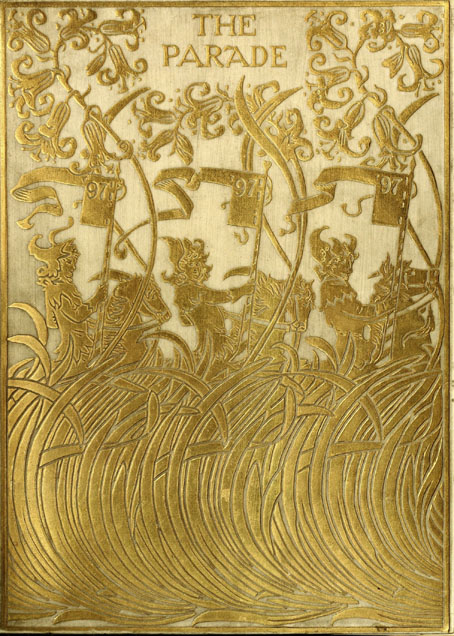
parade01.jpg

Design by Paul Woodroffe.

The Parade, subtitled An Illustrated Gift Book for Boys and Girls, is something that children with wealthy parents or relatives might have received as a Christmas present in December 1897. The contents are an unusual mix of fairy tales, frivolous seasonal fare—A Christmas Mummery, complete with songs and music—and adventure stories set in other parts of the world. The collection was edited by Gleeson White, an art critic whose former position as editor of The Studio magazine explains the very Studio-friendly choice of illustrators.

parade02.jpg

The design on the title page is a curious piece by Aubrey Beardsley, one with less authority than the most of the other drawings he was producing in his penultimate year. Those dots filling out the arabesque plant forms are the kinds of things that amateurs do when they’re uncertain about whether or not to decorate a design. The tendril which terminates in a tasselled confection is, however, a typical example of the artist’s bizarre invention, the kind of caprice that used to infuriate the critics who disliked his work. Beardsley’s career had been launched four years earlier with a profile in The Studio, but by 1897 he was often struggling for money after being fired from The Yellow Book in the wake of the Oscar Wilde scandal. Gleeson White is to be commended for supporting him at a time when many others refused to do so.

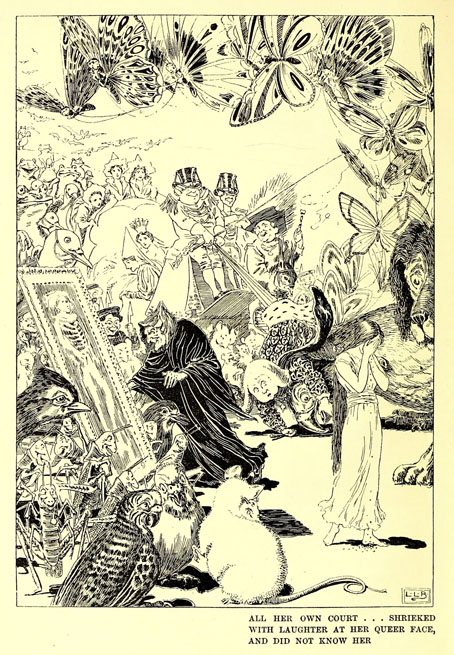
parade03.jpg

L. Leslie Brooke.

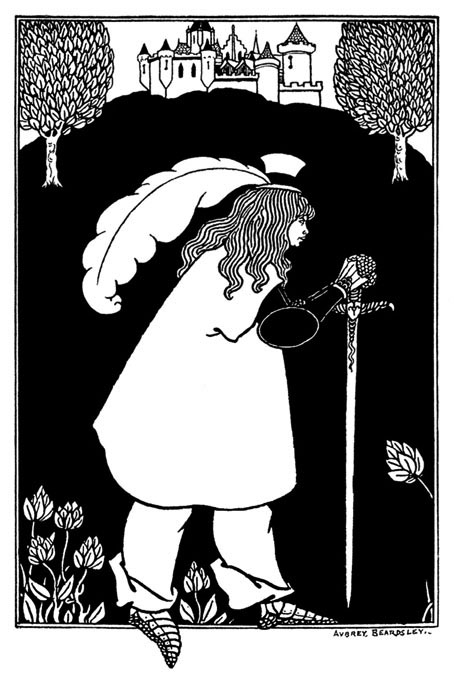
Elsewhere in The Parade there are contributions both written and pictorial from Beardsley’s friend, Max Beerbohm; also a story by Richard Burton, a writer you wouldn’t usually expect to find in a book aimed at children. The list of illustrators includes Charles Robinson, Laurence Housman and Manchester’s own Alfred Garth Jones. Beardsley didn’t draw anything else for The Parade but he’s mentioned again in a list of titles advertised in the book’s final pages as having provided a frontispiece for Baron Verdigris, “A Romance of the Reversed Direction” by one Jocelyn Quilp. The title was unfamiliar, and I wasn’t sure at first whether I’d seen the illustration, but the drawing shown below appears in two of my Beardsley books—albeit at small sizes—including the copious Brian Reade collection from 1967.

beardsley.jpg

“Baron Verdigris” sounds like a minor character from Michael Moorcock’s Dancers at the End of Time trilogy, while the improbable “Jocelyn Quilp” turns out to be a nom de plume of Halliwell Sutcliffe whose book is described as a “singular novella, a curious amalgam of parodies based on a time-travelling theme“; shades of the Dancers again. It’s tempting to think that this may be the sole example of Aubrey Beardsley illustrating science fiction (or something like it)—the book is generic enough to be listed at ISFDB—but Brian Reade describes the story as “pseudo-mediaeval and facetious”, “dedicated to ‘Fin-de-Siécle-ism, the Sensational Novel, and the Conventional Drawing-Room Ballad'”. That does at least explain the peculiarities of the drawing. Maybe the Moorcock comparison is an apt one after all.

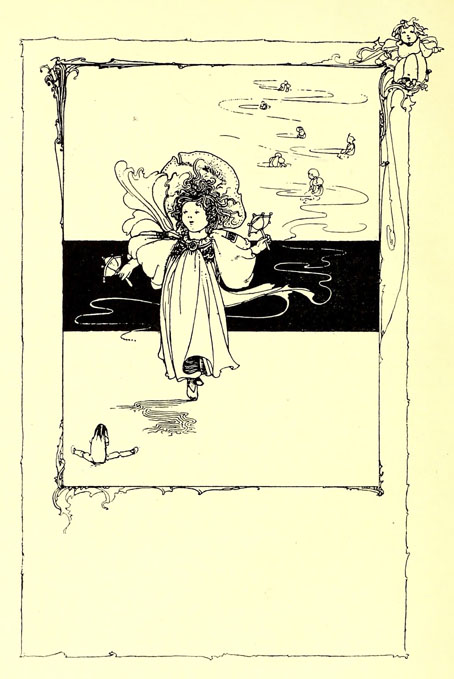
More illustrations from The Parade:

parade04.jpg

Charles Robinson.

parade05.jpg

Léon V. Solon.

Continue reading “The Parade and Baron Verdigris”

Very tasty

final1.jpg

StudioCanal’s blu-ray of The Final Programme seems to have been out for a few months but I only spotted it this week on a visit to Fopp, a welcome upgrade for my old Anchor Bay DVD. Not everything labelled as “cult” would go on my cult list but the term is warranted for this one, still the only feature film based on any of Michael Moorcock’s novels. Moorcock has been persistently vocal about his dislike of Robert Fuest’s adaptation but his readers continue to fly the cult flag. Some films deliver a unique thrill when they present an incursion into the cinematic world of an uncommon cultural component, the less likely, the better: Frank Maxwell in The Haunted Palace intoning the names “Cthulhu” and “Yog-Sothoth”; Florian Fricke of Popol Vuh appearing as a blind piano player in Werner Herzog’s The Enigma of Kaspar Hauser; the credit at the beginning of The Final Programme: “starring Jon Finch as Jerry Cornelius”.

final2.jpg

Jerry Cornelius meets his maker, with what appears to be Stacia from Hawkwind gesturing in the background. StudioCanal has many more such stills, most of which I hadn’t seen before.

Cult, yes; perfect, no. If you’re familiar with the Cornelius novels the film doesn’t capture the spirit of Moorcock’s barbed ironies (although it hits the mark in places), but we live in a world where you wouldn’t expect a Jerry Cornelius feature to exist at all, especially one with such an extraordinary cast: Jenny Runacre, Hugh Griffith, Patrick Magee, Sterling Hayden, Ronald Lacey, Harry Andrews, Graham Crowden, George Coulouris, etc. I always wish that Fuest had let Hawkwind perform at least one song in the arcade scene (or even let us see the group for longer than half a second), while also doing more with some of the settings. But Hawkwind in 1973 were too heavy—sonically, visually, politically—for a film intended for a general audience, and the budget was paltry by today’s standards (£222,000) which makes the existence of the thing seem even less likely. Given this, it’s amazing it looks as good as it does.

final3.jpg

Above and below: panels by Mal Dean from the first UK edition of The Final Programme, 1969.

The main highlight for me among the disc extras is an interview with Kim Newman which I’m looking forward to seeing. I don’t usually listen to commentary tracks but I did listen to the one on the DVD where Fuest mentions that the score by Beaver & Krause was prompted by his hearing the second side of the pair’s Gandharva album. Gerry Mulligan’s lugubrious sax playing doesn’t really suit a Cornelius story but the lineage is another factor that adds to the film’s cult value.

Watch the trailer

final4.jpg

Previously on { feuilleton }
Strange Adventures: a film list
Moorcock: Faith, Hope and Anxiety
Eduardo Paolozzi at New Worlds
Into the Media Web by Michael Moorcock
The Best of Michael Moorcock

New Wave Strangeness: Hawkwind’s Calvert years

days.jpg

Antique badges not included.

My weekend has been spent immersed in Days Of The Underground, the latest box of Hawkwind albums from Cherry Red Records. I’d avoided many of the earlier sets but this one was irresistible for being a 10-disc collection (8 CDs and 2 blu-rays), the core of which is three of the four albums recorded by the group for the Charisma label–Quark, Strangeness And Charm (1977), 25 Years On (credited to Hawklords, 1978), and PXR 5 (1979)–with all three albums being given the Steven Wilson remix treatment. The studio material is complemented by further Wilson mixes of live recordings and alternate takes, plus demo tracks (previously available but I didn’t have them). You also get three bonus video clips: Hawkwind (minus Dave Brock) playing the Quark single on Marc Bolan’s TV show in 1977, together with two promo films from the 1978 Hawklords concert at Brunel University. Absent from the set is the group’s first album for Charisma, Astounding Sounds, Amazing Music (1976), also the two singles that were released that year. I’ve not seen any explanation for these omissions but reasons may include the uneven quality of the music (recorded shortly before the group imploded), and Dave Brock’s lasting dislike of the album.

quark.jpg

Cover design by Hipgnosis; photography by Peter Christopherson with graphics by Geoff Halpin. Aubrey Powell says that Robert Calvert commissioned this one after the pair met each other at a party. The photography made use of the interior of Battersea Power Station in the same year that Hipgnosis used the building for a rather more famous album cover.

Steven Wilson did a great job of remixing the Warrior On The Edge Of Time album so I had high hopes for this set, hopes that have been substantially fulfilled. Many of the adjustments are individually minor–boosted bass, more prominent keyboards, some extended intros–but taken together they offer a refreshed experience of three very familiar albums. The packaging has been well-designed by the estimable Phil Smee with a booklet that presents a snapshot of the graphics produced for the group during this period, not only album artwork but also posters, ads and pages from the tour programmes. As a bonus there’s a small reproduction of the 1977 tour poster, a welcome inclusion since I used to own an original one of these which I’ve either misplaced or lost altogether. The attention to detail extends to the animated graphics of the blu-ray interface; when the Quark album is playing you can watch sparks dancing around the control room. The Marc Bolan TV appearance was something I’d seen many times before (including its original broadcast) but the live Hawklords films are revelatory when there’s so little footage of the band from the 1970s with synched sound. The performances of PSI Power and 25 Years offer a frustratingly brief taste of Robert Calvert’s magnetic stage presence, and make me hope that a video of the entire concert may be released eventually.

pxr5.jpg

Cover art by Philip Tonkyn.

Robert Calvert is the key figure here, to a degree that Hawkwind’s Charisma years are also known as the Calvert years, this being the period when the group’s part-time lyricist, occasional singer and conceptual contributor graduated to lead vocalist and songwriter. Calvert’s new role as front man changed Hawkwind from an ensemble of underground freaks into a more typical rock group, albeit one with a very theatrical singer prone to changing outfits to suit the songs, and with props that included a loudhailer, a machine-gun (fake) and a sabre (real). The songs became shorter and, in places, poppier, although none of the singles managed to repeat the chart success of the Calvert-penned Silver Machine. Nevertheless, Brock and Calvert were a great song-writing team, and the lyrics that Calvert wrote from 1976 to 1978 are better than anything else in the discography: witty, alliterative, and filled with clever rhymes that range widely in their subject matter, from the usual science-fiction fare to Calvert’s own obsessions, especially aircraft and flying. Calvert’s approach to science fiction was more sophisticated than the freaks-in-space approach of the group’s UA years. You get a sense of this from his contributions to the Space Ritual album (only Calvert would have known what an orgone accumulator was), but his Charisma songs go much further, condensing whole novels—Roger Zelazny’s Damnation Alley and Jack of Shadows, Ray Bradbury’s Fahrenheit 451—while maintaining the spirit of the New Wave of SF, where the emphasis was as much on inner as outer space.

Continue reading “New Wave Strangeness: Hawkwind’s Calvert years”