Two sides of Liška

svankmajer1.jpg

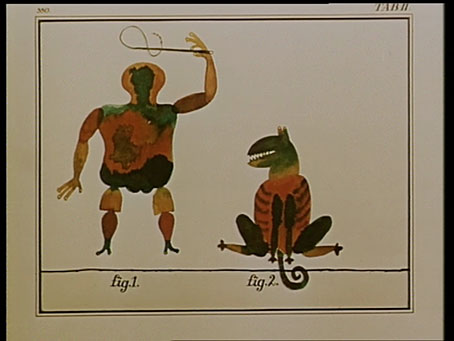
Et Cetera (1966).

A little more on the music of Czech soundtrack composer Zdeněk Liška (1922–1983). Liška seems to stand in relation to Czech cinema as Ennio Morricone does to that of the cinema of Italy, being similarly prolific, highly regarded, and idiosyncratic to a degree that makes his work immediately recognisable. Both men could also draw on their experience outside the film world to fuel their scores: Morricone for many years was a performer with Gruppo di Improvvisazione di Nuova Consonanza, a group of Italian free improvisers, while Liška’s work with electro-acoustic composition and early electronic music explains the frequent eruptions in his lush orchestrations of tape effects, exaggerated echoes and other forms of artificial processing. This kind of cross-pollination doesn’t seem so surprising today but it’s striking and surprising in soundtracks from the 1960s.

Good examples of the opposite poles of Liška can be found in two of Jan Švankmajer’s early shorts. Et Cetera (1966) is one of the director’s most formal exercises, a series of crude drawings (or cut-outs) coming to life to perform a repetitive routine before being interrupted by the words “ET CETERA”. The film plays with the audience by beginning with a title card that states “The End”, and the piece as a whole could easily be screened as an endless loop. Liška’s score is a combination of fairly minimal orchestration with a variety of electro-acoustic effects which are closer to Pierre Henry or İlhan Mimaroğlu than other Eastern European composers.
svankmajer2.jpg

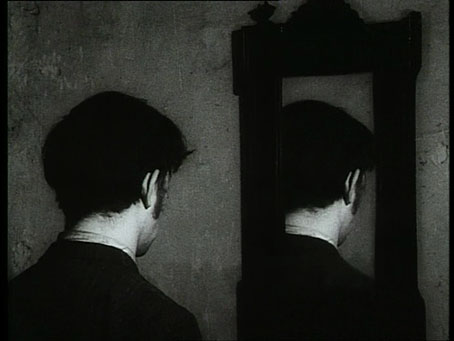
Shade of Magritte: The Flat (1968).

At the opposite end of the scale there’s the score for The Flat (1968), a typical piece of Švankmajer Surrealism with an unfortunate individual locked in a room where everything, from walls to furniture, contradicts his expectations. René Magritte casts a long shadow over this one, with director Juraj Herz making a brief appearance as a bowler-hatted man carrying a chicken. Liška’s score has a driving and reverberent choral rhythm that always makes me think of Krzysztof Komeda’s similar music for Roman Polanski’s Dance of the Vampires (1967). For such a short film it’s a remarkable piece of orchestration. The Brothers Quay are great Liška enthusiasts, and used some of the score from The Flat (and two other Liška pieces) for their 1984 film The Cabinet of Jan Švankmajer, an animated portrait of the director.

Previously on { feuilleton }
Liška’s Golem
The Cremator by Juraj Herz
Atalanta Fugiens

teb.jpg

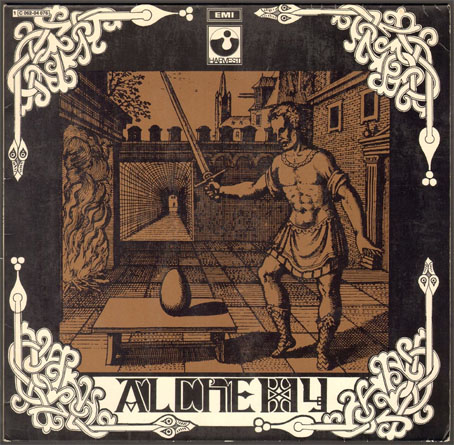
Alchemy (1969) by the Third Ear Band. Design by Dave Loxley.

For an idea of how these posts often come into being, this one is the result of the following chain of association: an article by Leo Robson about the films of Roman Polanski > A re-viewing of Polanski’s Macbeth > A re-listening to albums by the soundtrack artists for Macbeth, British folk group the Third Ear Band > A tracking down of the famous cover image from the first Third Ear Band album.

mm01.jpg

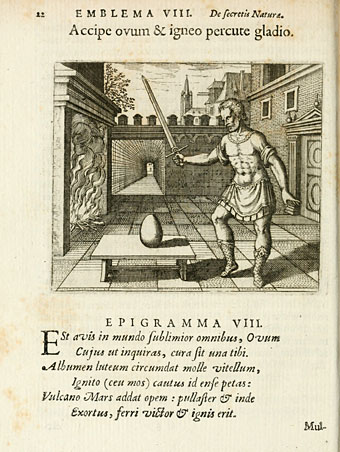
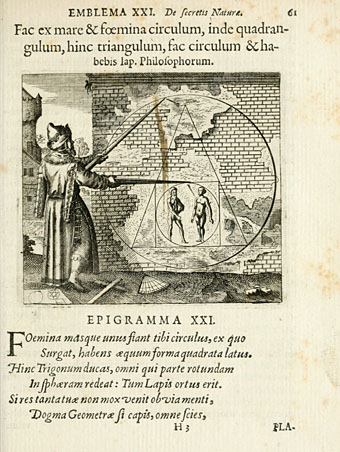
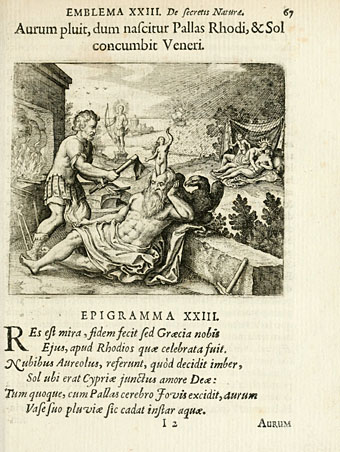
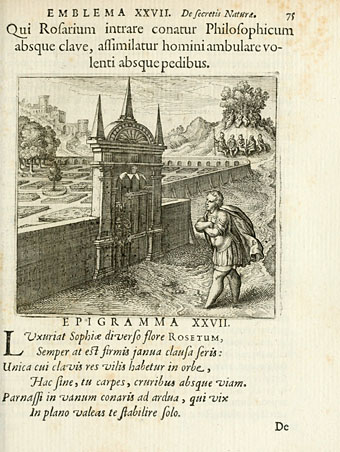
Alchemy is the dominant theme of the first two Third Ear Band albums. The engraving used on the cover of their debut album is one of the most frequently reproduced of all images associated with this branch of occultism, one of fifty emblems from Atalanta Fugiens (1618) by the German alchemist Michael Maier (1568–1622).

The plates are by Matthäus Merian, an artist whose career produced a number of notable alchemical illustrations. A detail from one of his other oft-reproduced pieces, Macrocosm and Microcosm from the Basilica Philosophica (1618), appeared on the cover of Pink Floyd’s Saucer Full of Secrets album a year before the Third Ear Band debut. Merian would no doubt be astonished that his work was so visible to future generations even though his name is seldom mentioned at all. The popularity can be accounted for by the way the best of these images seem almost archetypal whilst being resistant to any easy interpretation. Some of Merian’s plates remind me of Magritte’s paintings; they share a tension between carefully rendered yet impossible images that imply a hidden meaning. As Borges considered metaphysics to be a branch of fantastic literature it’s possible to consider this kind of alchemical illustration as a branch of fantastic art.

A 1687 edition of Maier’s Atalanta Fugiens (retitled Scrutinium Chymicum) may be browsed here or downloaded here.

mm02.jpg

mm03.jpg

mm04.jpg

Continue reading “Atalanta Fugiens”

The Magic Toyshop

toyshop1.jpg

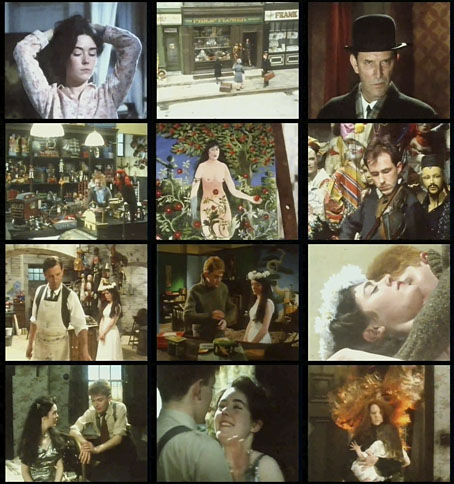
Yet more revenant TV drama. Seems like everything turns up if eventually so long as you’re prepared to wait. I’d looked for this film a couple of times after writing about TV director David Wheatley. The Magic Toyshop (1987) was a feature-length Granada Television adaptation of Angela Carter’s 1967 novel, with Wheatley directing and Carter herself supplying the screenplay. Caroline Milmoe plays Melanie, a teenage girl left in the care of her Uncle Philip after she and her younger brother and sister are orphaned. Tom Bell plays the sinister uncle who owns the toyshop of the title, a place where the toys, puppets and automata are as lively as JF Sebastian’s menagerie in Blade Runner. Melanie’s younger uncles, Finn and Francie, live in fear of the tyrannical Philip who forces them to assist with his life-size puppet shows, while Melanie’s aunt Margaret is not only cowed by her husband but also mute. The arrival of Melanie and her growing sexual awareness upsets the household’s balance of power.

toyshop2.jpg

It was good to see this film again having recently watched David Wheatley’s René Magritte film and his marvellous Borges documentary. In light of those earlier works an adaptation of Angela Carter would seem a natural progression. Aside from an overly-emphatic score, The Magic Toyshop was better than I remembered, the initial viewing no doubt suffering from an expectation that it might be a match for The Company of Wolves (1984). The Granada film had a much lower budget than Neil Jordan’s feature so it’s an unfair comparison. Wheatley and co. saved money with some careful use of the Baker Street set from Granada’s Sherlock Holmes adaptations.

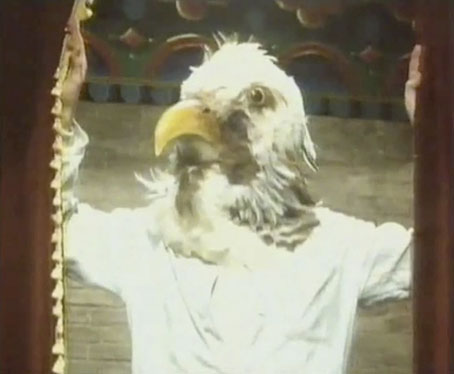
Watching The Magic Toyshop now it’s surprising it was made at all, it’s an odd piece of work stippled throughout with surreal moments, and even Surrealist references, as with Finn’s Loplop-like appearance above. What drama there is refuses the familiar shapes that a TV audience would expect, and there’s also a surprising amount of incestuous desire boiling among the major characters that goes unquestioned. I’ve not read Carter’s novel so I can’t say how it compares but the film feels like a very pure delivery of the author’s landscape of entwined sexuality, fantasy and myth. The Magic Toyshop hasn’t been reissued on DVD so the YouTube version is from a tape copy. It’s also chopped into chunks (why, oh, why, etc) but it’s highly recommended to Angela Carter readers.

The Magic Toyshop: part 1 | part 2 | part 3 | part 4 | part 5 | part 6 | part 7

Previously on { feuilleton }
Borges and I
René Magritte by David Wheatley

The art of Thomas Cole, 1801–1848

cole1.jpg

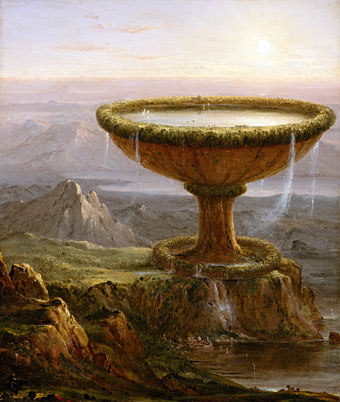
The Titan’s Goblet (1833).

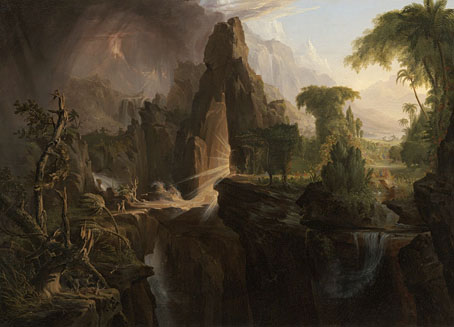
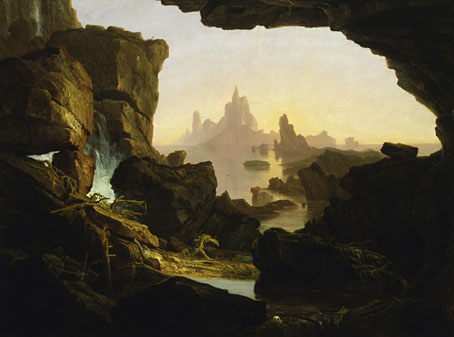
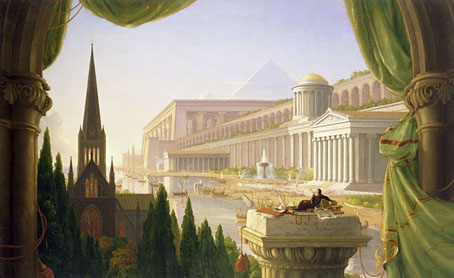
Thomas Cole’s Titan’s Goblet isn’t featured at the Google Art Project, unfortunately, but the following paintings are, and all benefit from being able to explore their details. Cole’s colossal vessel predates Surrealism by a century, and is one of many paintings which always has me mentally labelling him as the American John Martin (1789–1854). Having thought of him for years as an American artist–not least because he founded the Hudson River School–it’s a surprise to learn he was born in Bolton, a town not far from Manchester, with his parents emigrating to the US when he was 17. John Martin also grew up in the north of England so there’s another similarity, although the more important comparison concerns their use of painting to convey the spectacularly vast and unreal scenes common to the imaginative side of Romantic art. The Titan’s Goblet is unusual in not having any particular symbolic or moral significance, unlike the pictures below, it’s Magritte-like in its careful depiction of the impossible. The Subsiding of the Waters of the Deluge, on the other hand, could be exhibited beside Francis Danby’s The Deluge (1840) for a “before and after” effect. Like Martin, Cole enjoyed painting architecture of an exaggerated scale. The Architect’s Dream features an Egyptian temple of stupendous size, while the pyramid looming in the background is closer to William Hope Hodgson’s seven-mile-high Last Redoubt than any structure on the Nile plain.

Of equal interest are Cole’s two well-known series: The Course of Empire (1833–36) and The Voyage of Life (1842), both of which I’d love to see at Art Project size.

cole2.jpg

Expulsion from the Garden of Eden (1828).

cole3.jpg

The Subsiding of the Waters of the Deluge (1829).

cole4.jpg

The Architect’s Dream (1840).

Elsewhere on { feuilleton }
The fantastic art archive

Previously on { feuilleton }
John Martin’s musical afterlife
Albert Bierstadt in Yosemite
Danby’s Deluge
John Martin: Heaven & Hell
Darkness visible
Two American paintings
The apocalyptic art of Francis Danby

Gloves

klingerglove.jpg

A Glove: Anxieties (1881) by Max Klinger.

Although the Glove‘s scenario was given its due Germanic explication by contemporary critics, it defies rational analysis. The last picture, which was seen as a kind of happy ending to the glove’s peregrinations, is particularly ambiguous and leaves the whole meaning of the series in doubt. The story is a parable of loss based on a trivial lost article, like the lost keys in Bluebeard and in Alice, like Desdemona’s missing handkerchief, or like the philosopher’s spectacles in Klinger’s own Fantasy on Brahms, which have slid out of their proprietor’s reach just as he was nearing the summit of a kind of Matterhorn. There are overtones of erotic symbolism and fetishism in the glove and the phalloid monster who abducts it, heightened for a modern viewer by the Krafft-Ebing period costumes and décors (the engravings appeared in 1881, and the drawings were apparently finished in 1878).

John Ashbery describing Max Klinger’s extraordinary series of etchings A Glove (aka Paraphrase on the Finding of a Glove) which in their inexplicable narrative of fetishist obsession anticipate Surrealism. See the entire sequence here or here. For A Glove in print there’s The Graphic Works of Max Klinger from Dover Publications.

dechirico.jpg

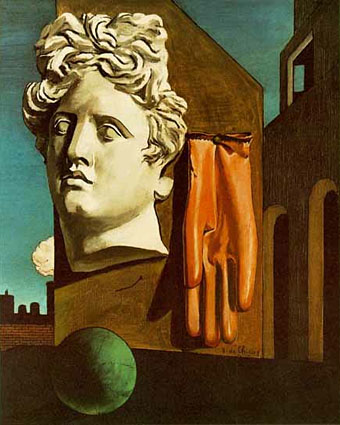
The Song of Love (1914) by Giorgio de Chirico.

Ashbery begins by discussing Giorgio de Chirico’s enthusiasm for Klinger’s work, a passion and influence that provides one of the many connections between the Symbolists and the Surrealists. This “metaphysical” painting looks back to Klinger and forward to Magritte.

michalsglove.jpg

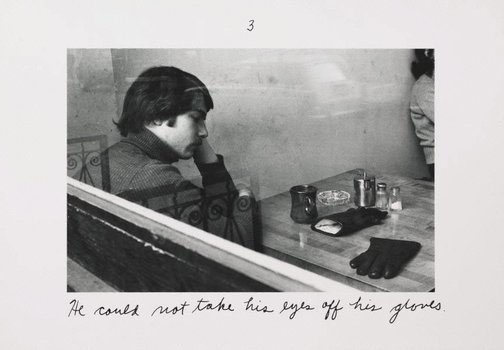
The Pleasures of the Glove, 3 (1974) by Duane Michals.

The enigmatic encounter of ‘The pleasures of the glove’ follows the lead character as he fantasises about a pair of gloves on the hands of a mannequin in a shopfront window. The perverse pleasure of desiring the gloves but not acquiring them leads him on a surreal adventure of first imagining his own glove as a queer furry tunnel that swallows his hand to the fantasy of stroking the naked body of a woman he sees on the bus with her own glove. (more)

A more contemporary take on the same idea, albeit without the intercession of a pterodactyl-like thief. If Klinger is pre-Surrealism then this is the post- version; Michals photographed René Magritte, and many of his other works run in a distinctly Surreal direction. (Thanks to Anne Billson for the tip!)

bartagloves.jpg

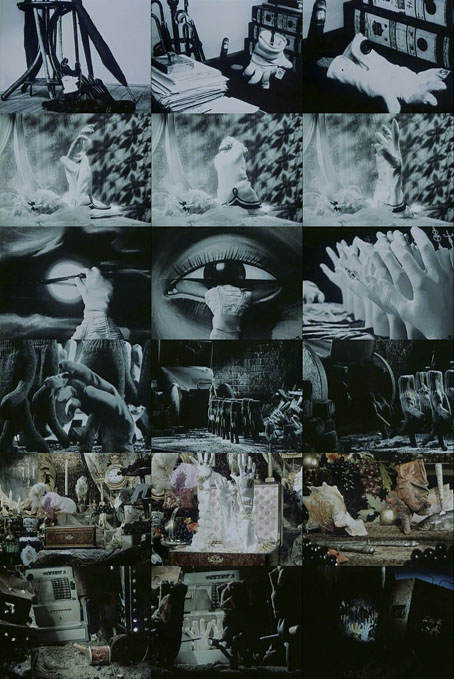
The Vanished World of Gloves (1982) by Czech animator Jiří Barta features sex, Surrealism and a lot more besides, all in the space of 16 minutes. A can of film is unearthed which contains a series of short episodes pastiching different cinematic styles: Chaplinesque slapstick, swashbuckling romance, Buñuel Surrealism, a war film, a Fellini orgy and a science fiction apocalypse. All the parts are played by gloves, of course, and if you didn’t see the credits you might take this at first for a Svankmajer short.

The Vanished World of Gloves: part one | part two

Update: I knew I’d forgotten something… Added de Chirico’s The Song of Love.

Previously on { feuilleton }
More Golems
Max Klinger’s New Salomé
Barta’s Golem