Alla Nazimova’s Salomé

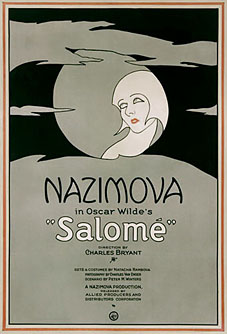
salome1.jpgWe tend to think of cinema as a modern medium, quintessentially 20th century, but the modern medium was born in the 19th century, and the heyday of the Silent Age (the 1920s) was closer to the Decadence of the fin de siècle (mid-1880s to the late-1890s) than we are now to the 1970s. This is one reason why so much silent cinema seems infected with a Decadent or Symbolist spirit: that period wasn’t so remote and many of its more notorious products cast a long shadow. Even an early science fiction film like Fritz Lang’s Metropolis has scenes redolent of late Victorian fever dreams: the vision of Moloch, Maria’s parable of the tower of Babel, the coming to life of statues of the Seven Deadly Sins, and—most notably—the vision of the Evil Maria as the Whore of Babylon. Woman as vamp or femme fatale was an idea that gripped the Decadent imagination, and it found a living expression in the vamps of the silent era, beautiful women with exotic names such as Pola Negri, Musidora (Irma Vep in Feuillade’s Les Vampires) and the woman the studios and press named simply “the Vamp”, Theda Bara (real name Theodosia Burr Goodman).

Alla Nazimova was another of these exotic creatures, and rather more exotic than most since she was at least a genuine Russian, even if she also had to amend her given name (Mariam Edez Adelaida Leventon) to exaggerate the effect. Like an opera diva or a great ballerina she dropped her forename as her career progressed, and is billed as Nazimova only in her 1923 screen adaptation of Oscar Wilde’s play, Salomé. Nazimova inaugurated the project, produced it and even part-financed it since the studios, increasingly worried by pressure from moral campaigners, regarded it as a dangerously decadent work. Nazimova had a rather colourful off-screen life and the stories of orgiastic revels at her mansion, the Garden of Allah, probably didn’t help matters.
salome2.jpg

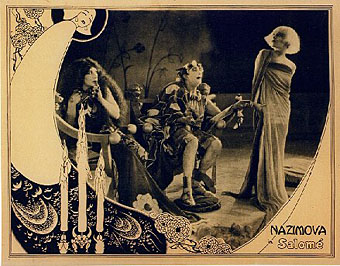
Salomé lobby card (1923).

Continue reading “Alla Nazimova’s Salomé”

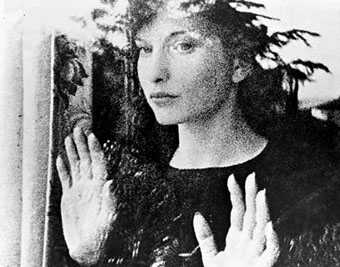
Meshes of the Afternoon by Maya Deren

maya.jpg

Meshes of the Afternoon (1943)
Dir: Maya Deren, Alexander Hammid.
Screenplay: Maya Deren.
Cast: Maya Deren, Alexander Hammid.
Music: Teiji Ito.
18mins, B&W.

Meshes of the Afternoon is one of the most influential works in American experimental cinema. A non-narrative work, it has been identified as a key example of the “trance film,” in which a protagonist appears in a dreamlike state, and where the camera conveys his or her subjective focus. The central figure in Meshes of the Afternoon, played by Deren, is attuned to her unconscious mind and caught in a web of dream events that spill over into reality. Symbolic objects, such as a key and a knife, recur throughout the film; events are open-ended and interrupted. Deren explained that she wanted “to put on film the feeling which a human being experiences about an incident, rather than to record the incident accurately.”

Made by Deren with her husband, cinematographer Alexander Hammid, Meshes of the Afternoon established the independent avant-garde movement in film in the United States, which is known as the New American Cinema. It directly inspired early works by Kenneth Anger, Stan Brakhage, and other major experimental filmmakers. Beautifully shot by Hammid, a leading documentary filmmaker and cameraman in Europe (where he used the surname Hackenschmied) before he moved to New York, the film makes new and startling use of such standard cinematic devices as montage editing and matte shots. Through her extensive writings, lectures, and films, Deren became the preeminent voice of avant-garde cinema in the 1940s and the early 1950s. (MoMA.org)

Maya Deren at Ubuweb. Includes free film downloads
Maya Deren at Senses of Cinema

Previously on { feuilleton }
Jodorowsky on DVD
Jordan Belson on DVD
Kenneth Anger on DVD…finally
Ten films by Oskar Fischinger
Lapis by James Whitney
La Villa Santo Sospir by Jean Cocteau
Expanded Cinema by Gene Youngblood
The Invasion of Thunderbolt Pagoda

New things for April

Several disparate pieces of news worth mentioning recently, so here they are gathered together.

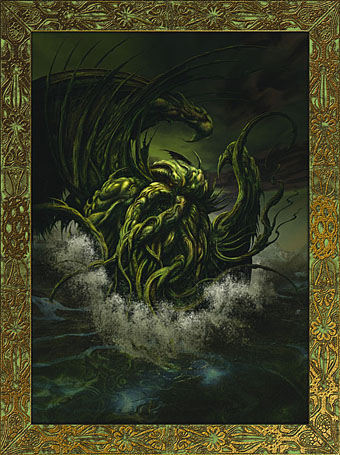
• Some of my Lovecraft art is to be featured in a lavish limited edition volume from Centipede Press.

cthulhu2004.jpg

Artists Inspired by HP Lovecraft
Centipede Press is now accepting pre-orders.
A unique art book available in a cloth slipcase edition and leather deluxe edition.

• Cloth edition in slipcase—2,000 copies—400 pages, four color, sewn with cloth covers, enclosed in a cloth covered slipcase. Front cover image, black embossing, two ribbon markers, fold-outs, detail views.

• The first 300 orders will receive a numbered copy with a special slipcase and a hardcover folder with an extensive suite of unbound illustrations. $395 postpaid.

• Leather edition in traycase—50 copies—400 pages, four color, sewn with full leather binding, enclosed in a giant size traycase. Front cover image debossed on front, two ribbon markers, fold-outs, detail views, signed by most living contributors. $2,000 postpaid.

This huge tome features over forty artists including JK Potter, HR Giger, Raymond Bayless, Ian Miller, Virgil Finlay, Lee Brown Coye, Rowena Morrill, Bob Eggleton, Allen Koszowski, Mike Mignola, Howard V Brown, Michael Whelan, Tim White, John Coulthart, John Holmes, Harry O Morris, Murray Tinkelman, Gabriel, Don Punchatz, Helmut Wenske, John Stewart, and dozens of others.

The field has never seen an art book like this—indeed, it is an art anthology unlike anything ever published before. Many of these works have never before seen publication. Many are printed as special multi-page fold-outs, and several have detail views. The book is filled with four color artwork throughout, all of it printed full page on rich black backgrounds. A special thumbnail gallery allows you to overview the entire contents of this 400-page book at a glance, with notations on artist, work title, publication information, size, and location, when known.

HP Lovecraft fans will simply have to have this book. Because of its sheer size and scope, this book will never be reprinted and will sell out very quickly. Twenty years down the road people will be paying huge prices for this book because of its scope and the quality of reproductions. This is the HP Lovecraft fan’s dream come true. Don’t miss it!

Yes, it is indeed expensive but this is a book for serious collectors.

Bryan Talbot‘s new book, Alice in Sunderland, is finally out. Read a review of it here.

Arthur Magazine is being summoned back from Avalon, which is excellent news. To celebrate, Jay Babcock has posted Alan Moore‘s history of pornography in its entirety here.

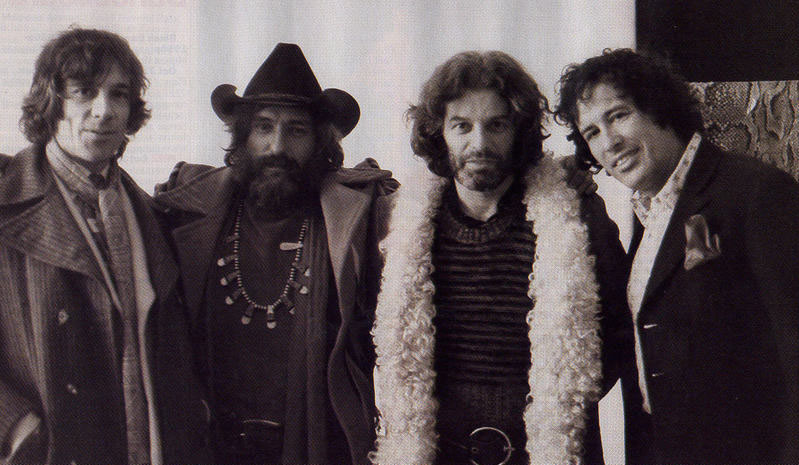
heads.jpg

left to right: Donald Cammell, Dennis Hopper, Alejandro Jodorowsky & Kenneth Anger.

One of my favourite photographs of all time shows four directors at the Cannes Film Festival in 1971, all dolled up in their wildest afghan-and-ascot, hairy-hippy finery, and all of them on the cusp of what should have been majestic, transformative, transgressive careers in cinema that by and large never came to fruition. It was not to be—if only it had been.

John Patterson tell you why we need Jodorowsky as much as we ever did.

Update: And while we’re at it, Eddie Campbell also has a new book out, The Black Diamond Detective Agency. Great playbill cover design.

Jodorowsky on DVD

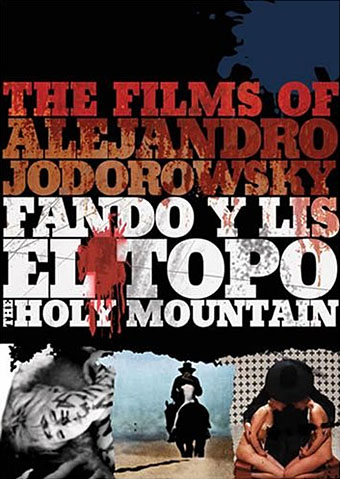
jodorowsky_dvd.jpg

I am an artist. Now the pictures are not made by artists. They are made by companies and produced by multinationals. The art in the picture is lost. Now when artists make pictures, they make them for museums. But museums, for me, are cemeteries.
Alejandro Jodorowsky.

More from the About-Bleeding-Time Dept. (emphasis on “bleeding” in this case). Some of the most extraordinary films ever made finally receive an authorised DVD release in May.

Anchor Bay will release a special limited edition collector’s box set, The Films of Alejandro Jodorowsky, on DVD on 5/1/2007 (SRP $49.98). The set will contain El Topo, The Holy Mountain and Fando Y Lis on DVD, fully restored and remastered from new HD transfers in anamorphic widescreen video, with Dolby Digital 5.1 and 2.0 audio (El Topo is 125 minutes in Spanish, The Holy Mountain is 114 minutes in English, Fando Y Lis is 93 minutes in Spanish). The box set will also include 2 music CDs containing the soundtracks for El Topo and The Holy Mountain, as well as a DVD of Jodorowsky’s never-before-released first film, La Cravate. El Topo and The Holy Mountain will also be available separately (SRP $24.98 each). The El Topo DVD will contain audio commentary by the director, the original theatrical trailer (with English voice-over), a 2006 on-camera interview with the director as well as an exclusive new interview, a photo gallery and original script excerpts. The Holy Mountain DVD will include audio commentary with the director, deleted scenes with commentary, the original theatrical trailer (with English voice-over), the Tarot short with commentary, a restoration process short, restoration credits, a photo gallery and original script excerpts. Fando Y Lis will include audio commentary with the director and the La Constellation Jodorowsky documentary. Subtitles on the discs will be available in English, French, Spanish and Brazilian Portuguese.

Jodorowsky’s official site (in Spanish)
Jodorowsky discusses the new releases with Premiere Magazine
• Jay interviews Jodo: Mean Magazine | LA Weekly

Previously on { feuilleton }
Jordan Belson on DVD
Further back and faster
Kenneth Anger on DVD…finally
The Brothers Quay on DVD
El Topo
Gangsters on DVD
Blade Runner DVD
The Invasion of Thunderbolt Pagoda

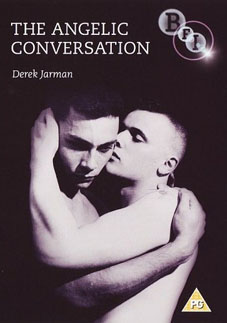
The Angelic Conversation

angelic_jarman.jpg

Title by John Dee, words by William Shakespeare, narration by Judi Dench and music by Coil; Derek Jarman’s oneiric film/poem is released on DVD, along with two other works.

The BFI releases three Derek Jarman films together—Caravaggio (1986), Wittgenstein (1993) and The Angelic Conversation (1985)—all digitally restored and re-mastered for DVD and each with extensive and illuminating extra features.

The films were made with the BFI Production Board, whose aim was to foster innovation in British filmmaking, thus providing a natural home for Jarman’s artistic sensibility. These three films represent highpoints in his career and are perhaps the most enduring in their appeal and relevance to contemporary audiences.

Intense, dreamlike, and poetic, The Angelic Conversation is one of the most artistic of Derek Jarman’s films. With his painter’s eye, Jarman conjured, in a beautiful palette of light, colour and texture, an evocative and radical visualisation of Shakespeare’s love poems.

Of the 154 sonnets written by Shakespeare, most were written to an unnamed young man, commonly referred to as the Fair Youth. Here, Judi Dench’s emotive readings of 14 sonnets are coupled with ethereal sequences; figures on seashores, by streams and in colourful gardens. The disruption of these magical scenes with images of barren and threatening landscapes echoes perfectly the celebration and torment of love explored in the sonnets.

Shot on Super-8 before being transferred to 35mm film, the unique technical approach results in a striking aesthetic, with Coil’s languorous soundtrack completing the intoxicating effect.

Previously on { feuilleton }
James Bidgood
Kenneth Anger on DVD…finally
Un Chant d’Amour by Jean Genet