Weekend links 305

marchbank.jpg

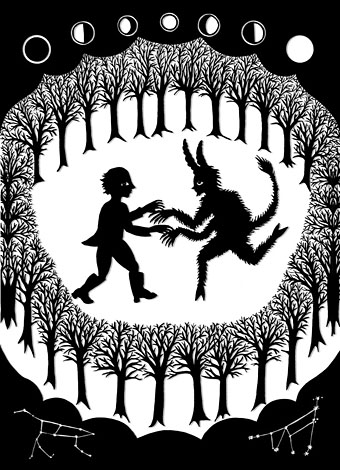
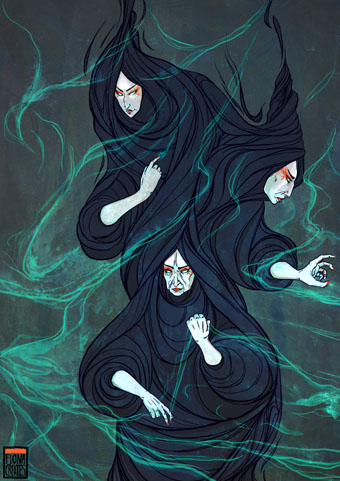
Threads of Fate—The Weird Sisters from Macbeth (2013) by Fiona Marchbank.

• The week in books: Claire Cameron on the difference between US & UK cover designs | Jason Diamond asks “Why do cats love bookstores?” | Alan Moore’s cover art for his forthcoming novel, Jerusalem, has been revealed | Brian Phillips on the typefaces used by New English Library for their Dune covers in the 1970s.

• On writing: Poetry and horror “share a universally human quest toward intimacy” says Evan J. Peterson | “The best work neither shows nor tells: it says by being, not by saying,” says M. John Harrison.

• At the BFI this week: Where to begin with Jerzy Skolimowski, and 10 overlooked British horror films of the 1970s. Both lists include Skolimowski’s excellent The Shout (1978).

Cultures do not, and cannot, work through notions of ‘ownership’. The history of culture is the history of cultural appropriation—of cultures borrowing, stealing, changing, transforming.

Nor does preventing whites from wearing locks or practicing yoga challenge racism in any meaningful way. What the campaigns against cultural appropriation reveal is the disintegration of the meaning of ‘anti-racism’. Once it meant to struggle for equal treatment for all. Now it means defining the correct etiquette for a plural society. The campaign against cultural appropriation is about policing manners rather than transforming society.

Kenan Malik on ill-considered complaints against “cultural appropriation”. Malik isn’t the first to note the intersection of such complaints with those of white supremacists who also want cultural purity and segregation

OUT, DEMONS, OUT!: The 1967 Exorcism of the Pentagon and the Birth of Yippie! An oral history by Larry “Ratso” Sloman, Michael Simmons and Jay Babcock.

• The long-overdue republication of Moebius’s work in English will begin with a new edition of The World of Edena (1985).

• More from radioactive Russia: Nadav Kander’s photographs of Soviet nuclear test sites.

• Comic artist and illustrator Kris Guidio in conversation with Jonathan Barlow.

• Francesca Gavin meets Tadanori Yokoo, “the Grandmaster of Pop-Psych Art”.

• “LSD’s impact on the brain revealed in groundbreaking images”

• Mix of the week: Secret Thirteen Mix 182 by Paul Jebanasam.

• A trailer for Nicolas Winding Refn’s The Neon Demon.

• Tony Conrad: 1940–2016 by Geeta Dayal.

Brian Eno’s favourite records

Neonlicht (1994) by Mitja VS (with Enzo Fabiani Quartet) | On Demon Wings (2000) by Bohren & Der Club of Gore | Shout At The Devil (2002) by Jah Wobble & Temple Of Sound
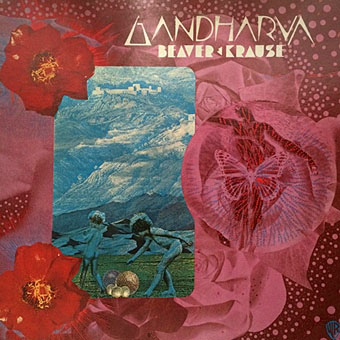
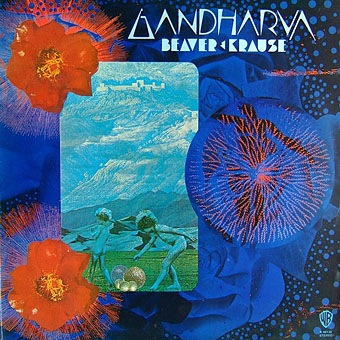
The original Gandharva

gandharva1.jpg

Cover art by Wilfried Sätty. Lettering by David Singer.

Collage artist Wilfried Sätty has been in my thoughts this month, it being ten years ago that Jay Babcock, Richard Pleuger and I drove up to San Francisco and Petaluma to talk to Walter Medeiros and David Singer about Sätty’s life and work. Looking today at the Sätty cover art for Gandharva (1971) by Beaver & Krause reminded me that the original pressing of this album came with the sleeve in a predominantly pink colouration rather than the more familiar blue. I have three copies of the album—vinyl and two CDs, one of which pairs it with Beaver & Krause’s In A Wild Sanctuary (1970)—but I’ve never seen one of the pink variations, and didn’t even know they existed until they started appearing on the web. The CD reissues favour the blue version, as do I, although this may only be a result of familiarity. I’ve enthused about Sätty’s cover a couple of times already but the music is worth hearing for its connections backwards to Cammell & Roeg’s Performance (for which B&K provided the ominous synthesizer tones), and forwards to Robert Fuest’s The Final Programme. Fuest asked Gerry Mulligan to score his film after hearing the Gandharva suite (described in the sleeve notes as “a score from a non-existent film”) which occupies side two of the album.

gandharva2.jpg

Elsewhere on { feuilleton }
The album covers archive

Previously on { feuilleton }
The Occult Explosion
Wilfried Sätty album covers
Nature Boy: Jesper Ryom and Wilfried Sätty
Wilfried Sätty: Artist of the occult
Illustrating Poe #4: Wilfried Sätty
Gandharva by Beaver & Krause

Remembering Arthurfest

arthurfest06.jpg

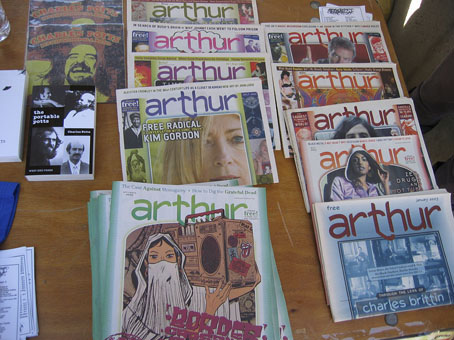
The Arthur table. Free mags!

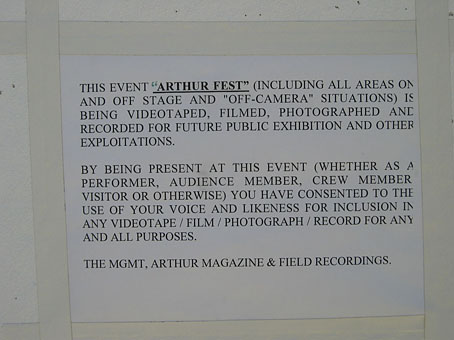
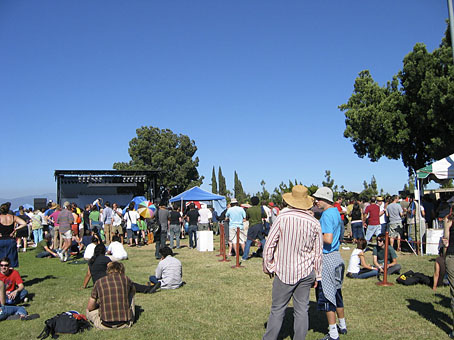
Arthurfest is an as-yet unreleased feature-length documentary by Lance Bangs which captured the two-day music festival of that name in Barnsdall Art Park, Los Angeles. The festival took place ten years ago to the day, and was the first such event organised by the sorely missed Arthur magazine. I was fortunate to witness some of the stunning performances on the park’s tree-bedecked plateau overlooking East Hollywood. Bangs’ cameras were hard to miss at the time—I even photographed one of them—but I’ve never seen any of the footage of the event until the appearance of a teaser which has been posted in advance of a tenth anniversary screening this weekend at Cinefamily, Los Angeles. This is tantalising stuff for the way the cameras bring the bands so much closer than they were when viewed at crowd level. There was also a lot happening each day on three different stages, one of which was indoors in the park’s Gallery Theatre, so it was impossible to see everything. Earth and Sunn O))) played inside the theatre but I missed both their shows as a result of a vampire-like reluctance to queue for a seat in the merciless sunlight. (I did get to drink Jack Daniel’s with the Sunn O))) guys, however…) Fingers crossed that Bangs’ film gets a proper release soon so the rest of us can see it. Meanwhile, here’s a few of my photos of the event…

Update: Arthur‘s Jay Babcock alerts me to footage of the late Jack Rose at the Arthurfest. Also at Lance Bangs’ channel there’s some of the performance by The Juan MacLean. Thanks, Jay!

arthurfest11.jpg

arthurfest18.jpg

The main stage.

Continue reading “Remembering Arthurfest”

Weekend links 234

dezso.jpg

The Devil in the Green Coat by Andrea Dezsö, an illustration for a new, uncensored edition of the Grimm Brothers’ Fairy Tales.

• That { feuilleton } object of cult attention, Penda’s Fen, a 1974 television film by David Rudkin directed by Alan Clarke, continues its long journey out of the shadows. To coincide with a screening in London of a 16mm print, Sukhdev Sandhu looks back at a unique drama, and examines its connections to other British films of the period. There’s still no sign of a DVD release although rumours persist. Related: Penda’s Fen at A Year In The Country.

• “One of the reasons I’m sure I found the horror genre congenial is that it’s almost always focused on the body. The body is the center of all horror films.” David Cronenberg talking to Calum Marsh about his novel, Consumed.

• Mix of the week: Antony Hegarty’s Future Feminist Playlist, and Secret Thirteen Mix 134 by James Ginzburg & Yair Elazar Glotman. Related: Nimbes by Joaniele Mercier & James Ginzburg.

• Another week, another Kickstarter: Suzanne Ciani: A Life in Waves is a planned feature-length documentary about the American synthesist and composer.

• “[Marjorie] Cameron’s connections to Scientology and powerful men once drew headlines, but now her art is getting its due,” says Tanja M. Laden.

Jay Babcock found a Hawkwind Tarot spread in International Times for 1971. Is this an overlooked Barney Bubbles design?

• “Tempered in the flames of hell”: Helen Grant on the precursors of Robert Louis Stevenson’s The Bottle Imp.

Hawthonn: Phil and Layla Legard (and others) remember John Balance with a special musical project.

Derek Jarman Super 8 by James Mackay, a book of stills from Derek Jarman’s Super 8 films.

• “Coltrane’s free jazz wasn’t just ‘a lot of noise’,” says Richard Brody.

This might be the world’s first book on colour palettes.

Paris 1971 (1971) by Suzanne Ciani | The Fifth Wave: Water Lullaby (1982) by Suzanne Ciani | Blue Amiga (2014) by NeoTantrik & Suzanne Ciani

The occult Knapp

knapp01.jpg

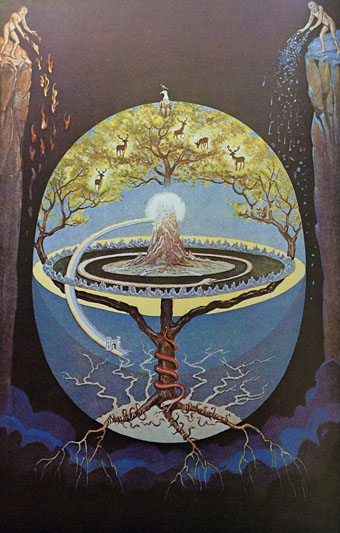
Yggdrasil, the World Tree of Norse mythology.

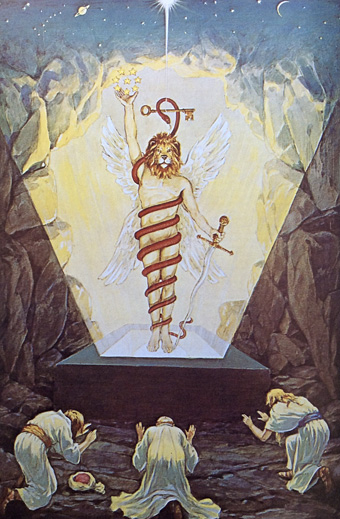
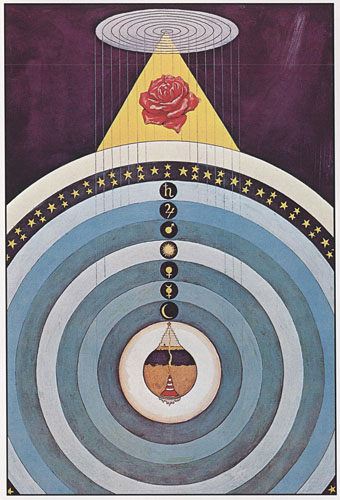
Following up the work of Etidorhpa‘s illustrator, J. Augustus Knapp (1853–1938), I realised that I’d already encountered some of his later paintings. After illustrating books by John Uri Lloyd, Knapp moved to California where he met occult historian, mystic and book collector Manly Palmer Hall. Knapp exchanged Lloyd’s fungi researches and weird fiction for Hall’s mysticism, illustrating The Initiates of the Flame (1922), and Hall’s magnum opus, The Secret Teachings of All Ages (1928). Knapp’s 54 paintings for the latter volume have since proved convenient for the occult encyclopedias that followed, many of which plundered Hall’s study for its illustrations. Knapp’s depictions aren’t always very successful—Odin’s wolves look silly rather than fierce—but they served Hall’s purpose of fixing mythological characters and metaphysical schemes in a colourful manner for a contemporary audience.

knapp06.jpg

Mithra in the form of Boundless Time.

Hall and Knapp also produced their own Tarot deck (see here and here) which can still be bought today from the University of Philosophical Research in Los Angeles. The UPR was founded by Manly Hall, and has a collection of Knapp’s paintings. They also sell Hall’s books, of course, and you can browse a copy of The Secret Teachings of All Ages if you visit the library, as I discovered in 2005 when Jay Babcock and I paid the place a visit.

knapp10.jpg

The Key to Dante’s Divine Comedy.

Continue reading “The occult Knapp”