Harlan Ellison: Dreams with Sharp Teeth

harlan.jpg

Harlan Ellison.

“You have somebody who is one of the greatest writers of the twentieth century.”

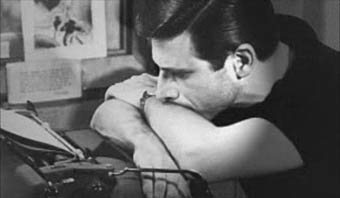
Neil Gaiman on Harlan Ellison, and so say all of us. The quote comes from a trailer for Dreams with Sharp Teeth, a new documentary about Ellison’s life and work which, as far as I can tell, has yet to acquire any distribution. Given Ellison’s reputation you have to wonder why it’s taken this long for someone to make a substantial film about such a great artist and natural performer.
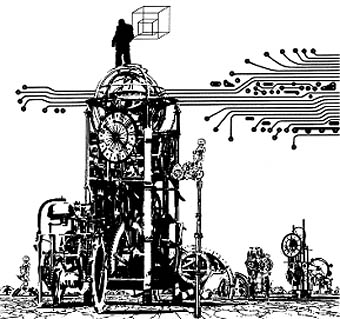
steranko.jpg

“Repent, Harlequin!” Said the Ticktockman, from a 1978 portfolio by Jim Steranko.

But it doesn’t arrive a moment too soon given the quantity of recent web discussion which seems to have forgotten his huge body of work and sees him solely as a person who gets into arguments all the time. He’s always been argumentative, of course, splendidly so, and his take-no-prisoners attitude did much to shake up the conservative world of American science fiction in the late Sixties and early Seventies. As a political commentator he’s always been at the Hunter S Thompson level with a great line in witty vituperation. The filmmakers seem to have caught both sides of Ellison, the writer who doesn’t so much read as perform his texts from memory, and the tightly-wound ball of fury who won’t take shit from anyone. The film site has nearly an hour of clips to watch, including a tremendous speed-reading of Prince Myshkin, and Hold the Relish.

And while we’re on the subject, I’ll give another plug to the landmark collection of HP Lovecraft-derived art due to appear soon from Centipede Press. This features a number of my Lovecraftian works and an introduction from Mr Ellison himself.

Previously on { feuilleton }
• The Bradbury Building: Looking Backward from the Future
• Revenant volumes: Bob Haberfield, New Worlds and others
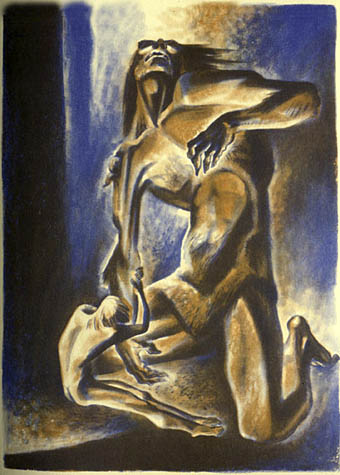
Cain’s son: the incarnations of Grendel

beowulf1.jpg

Beowulf wrestles with Grendel, Lynd Ward (1939).

There’s nothing new in pointing out Hollywood’s crimes against literature, the film business has been screwing up book adaptation since the earliest days of silent cinema. But sometimes the wound is so grievous you can’t help but speak out, in this case against Roger Avary’s Beowulf which is released next month. This is another CGI-heavy confection along the lines Polar Express, with the actors being given digital bodies via motion-capture, and it’s something I’d probably have ignored until I saw this picture of Grendel, the story’s principal monster. Beowulf is one of the earliest surviving Anglo-Saxon poems and Grendel, the bloodthirsty creature which Beowulf battles, is one of the ur-fiends of English literature, along with his equally monstrous, lake-dwelling mother and the dragon which fatally wounds the hero. The trio give us a peek back into the dark imagination from a time before recorded history and Grendel especially has always had something raw and primal about its character. So when you see a beast with such a history portrayed as little more than a diseased muppet you wonder what’s going on. Are the creators inept? Ignorant? Were studio restrictions at work? How does an industry with the talent to give splendid life to the trolls and Balrog of Lord of the Rings, or Davy Jones and crew in Pirates of the Caribbean, screw up so badly?

Continue reading “Cain’s son: the incarnations of Grendel”

New things for October

big_pic.jpg

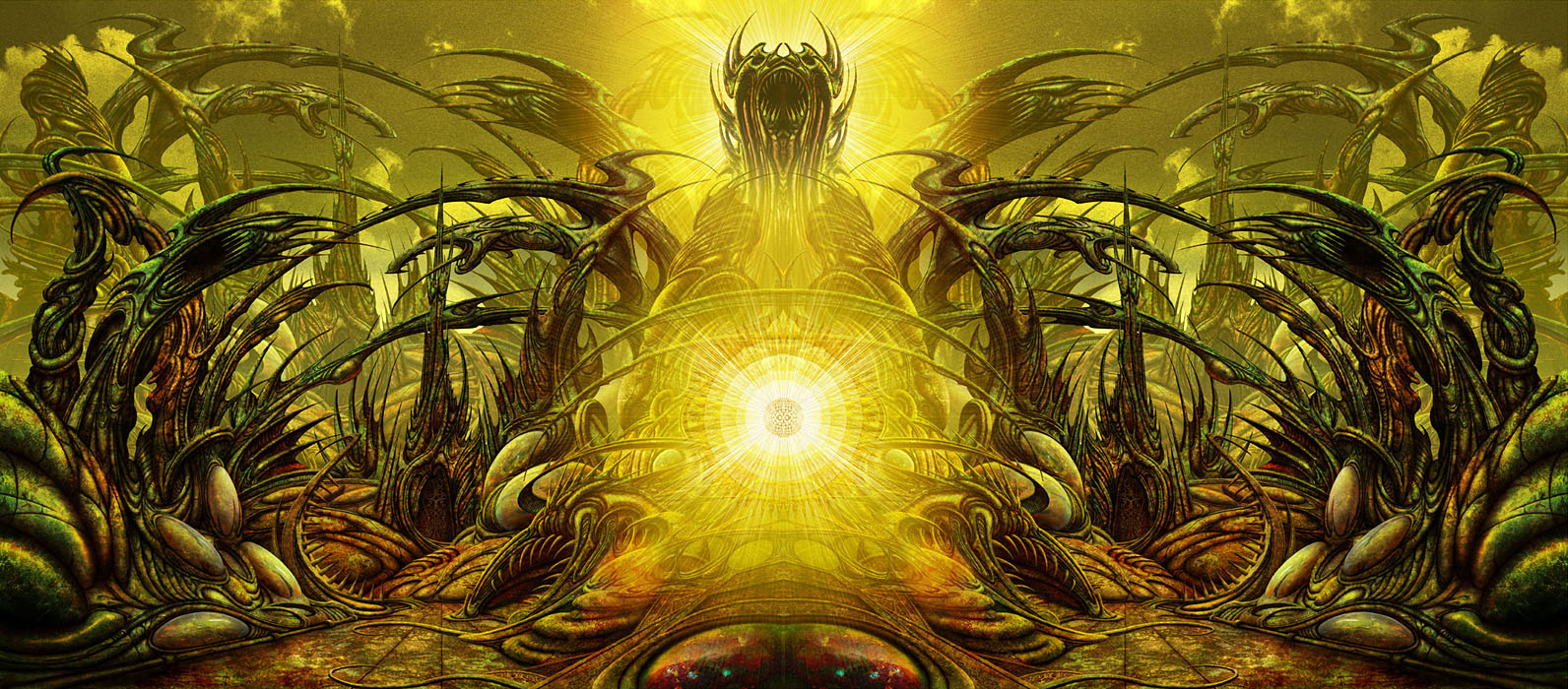
“Mirage in time—image of long-vanish’d pre-human city.”

A couple pieces of news to catch up with here, both Lovecraft-related which is very apt for the month of Halloween. The first is the work I gave a teaser view of in August, a commission for Maison d’Ailleurs, the Museum of Science Fiction, Utopia and Extraordinary Journeys in Yverdon-Les-Bains, Switzerland. The brief for An Exhibition of Unspeakable Things: Lovecraft’s Commonplace Book was to choose an entry from HP Lovecraft’s Commonplace Book, his source of story ideas. The entry I chose implies some of the alien architecture which is a feature of At the Mountains of Madness although I’ll admit that the final result is debatable as architecture.

Continue reading “New things for October”

The Man We Want to Hang by Kenneth Anger

anger_crowley.jpg

The title comes from a newspaper headline, one of many that the tabloid press bestowed on occultist Aleister Crowley whilst titillating their readers with lurid descriptions of orgies and Black Masses throughout the 1920s. Before the Second World War it was still possible to label a self-aggrandising magus “The Wickedest Man in the World”. If only they knew what was coming…

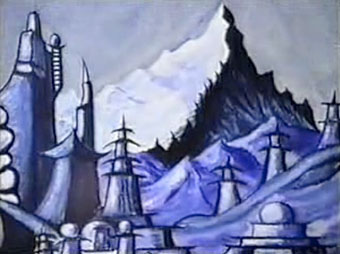
The picture above is a still from Kenneth Anger’s 2002 film of Crowley’s paintings which you can see in two parts at YouTube. The paintings were filmed in exhibition at the October Gallery in 1998 and Anger turns the original tabloid headline around by making the “hang” refer to hanging a painting. Crowley’s crude artwork often turns up in books but there are several pictures in the film I hadn’t come across before. Crowley’s depiction of the Himalayas, where he spent some time mountaineering, look very similar to those of Nicholas Roerich, the painter whose work HP Lovecraft references in At the Mountains of Madness. It would have been nice to have some more information about the pictures but that’s not Anger’s style.

• The Man We Want to Hang pt 1 | pt 2

Previously on { feuilleton }
• Relighting the Magick Lantern
• Kenneth Anger on DVD…finally
• The art of Cameron, 1922–1995
• Austin Osman Spare

In the hands of FATE

fate.jpg

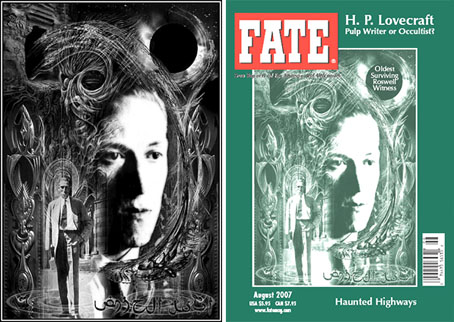
One of my works graces the cover of an American institution this month with the appearance of my HP Lovecraft portrait on the August issue of FATE magazine (volume 60, number 8, issue 688, if you must know). This is for an article about Lovecraft’s occult connections and I believe they’ve also used one of my views of R’lyeh for the article itself although I can’t confirm this just now.

predators.jpg

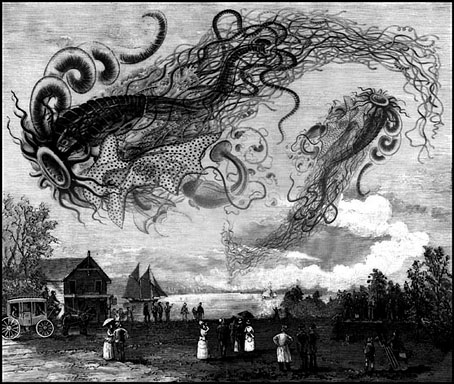
This is the third time my work has appeared in FATE (like TIME, the magazine prefers to see its name in caps). The first occasion was for another Lovecraft feature about Cthulhu in (I think) 1999. Then in 2000 I was commissioned to produce the illustration above for an article on “sky predators” which led me to plunder once again Ernst Haeckel’s Art Forms in Nature, a wonderful book I’ve frequently swiped from when in need of organic weirdness.

A couple of years later this picture was featured in a Fox TV documentary of all things, part of a post X-Files series called Conspiracy Theory. The subject was “flying rods”, one of the less convincing manifestations of cryptozoological phenomena, and the program needed some antique pictures to back up their thin veneer of evidence. They rather scurrilously used my picture to illustrate flying rod history as though this was a Victorian illustration, not a piece of Photoshop work. Fox documentaries, like their news channel, seem to have a flexible approach to the truth.

Previously on { feuilleton }
• New things for June
• Le horreur cosmique