The horror

Last year I was asked to write something about my favourite horror comics for Nørd Nyt, a Danish comics zine. I’d pretty much forgotten about this until the printed copy arrived, so here’s my piece in English, a choice of three favourite horror stories.
breccia.jpg

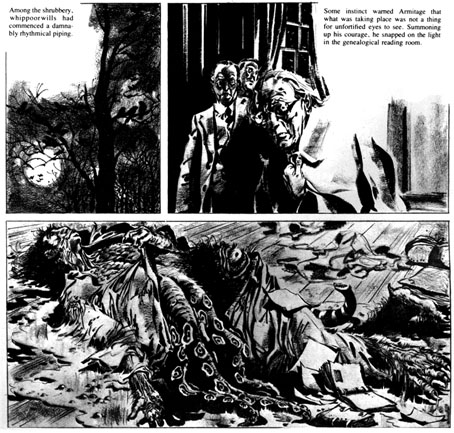
The Dunwich Horror by Breccia (1973)

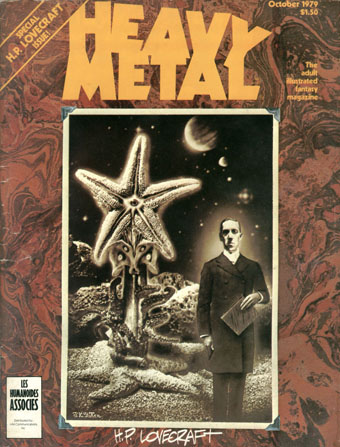
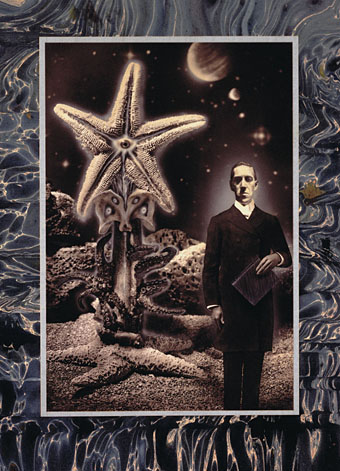
The October 1979 issue of Heavy Metal magazine came as a revelation. I’d only bought a few issues prior to this, and seeing an entire magazine devoted to HP Lovecraft seemed far too good to be true. Lovecraft art is so common now that it needs to be emphasised how scarce this kind of illustration used to be, the most you saw was paperback art of varying quality. There had been a few comic-strip adaptations but they were mostly in American publications or foreign editions I hadn’t seen. As it turned out, Heavy Metal‘s great JK Potter cover promised more than it actually delivered: at least half the magazine was taken up with continuing strips that had nothing to do with Lovecraft, or strips that did little but borrow a few Lovecraftian motifs for a slight horror tale. The one really outstanding piece was Alberto Breccia’s The Dunwich Horror, one of several Lovecraft adaptations the artist produced in 1973. Breccia’s style was sketchy, shadowy and replete with period details. The faces of his characters looked absolutely right for what I still consider to be one of Lovecraft’s darkest stories (people tend to miss the implication that a backwoods magus very nearly destroys humanity). Until I encountered the artists in Heavy Metal I’d given up on comics as an artistic medium, having no time at all for superheroes or the poor science fiction of 2000AD. Artists like Breccia, Moebius and Druillet showed that there was more than one way of drawing imaginative work, that you could use the refined techniques of illustration to tell a story.
yeux.jpg

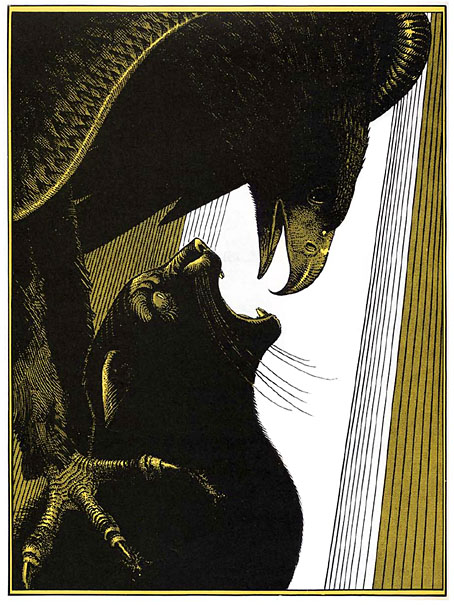
Les Yeux du Chat (The Eyes of the Cat) by Jodorowsky and Moebius (1978)

This story came to my attention when it received its first English translation in the pages of Steve Bissette’s Taboo anthology. It was printed in black on yellow paper, the original French edition having been yellow and black with white highlights. Compared to Jodorowsky’s customary flights of fancy the story is a very simple one, if typically grotesque: a silhouetted figure stands at a tall window overlooking a futuristic (or alien) city, directing with its thoughts the action of an eagle who hunts down a cat in the streets below. The horror comes from the shocking predicament revealed at the end, and the final line of dialogue, although this remains secondary to the formal perfection of the drawing and storytelling. Even by the standards of Moebius’s meticulous draughtsmanship this is a superbly controlled piece of work. Each spread operates as a kind of split-screen, with the left page showing the dialogue and the silhouetted figure, while the full-page illustration opposite shows a simultaneous moment of action somewhere in the city. One thing I immediately liked about this was Moebius’s architecture which even more than usual manages to seem otherworldly yet completely convincing. Everything we see in this brief tale poses questions that remain unanswered. And like many of the best short stories, a few carefully chosen details can imply an entire world.
fromhell.jpg

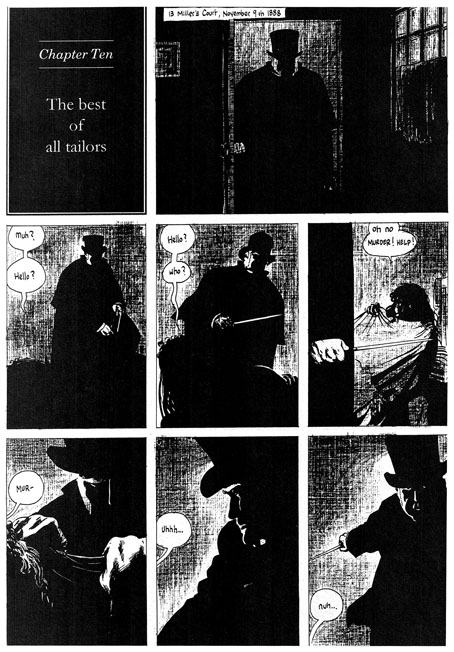
From Hell by Alan Moore and Eddie Campbell (1991–1996)

Horror doesn’t have to be delivered within genre stereotypes, in fact these days it’s often better if it isn’t when so many of those stereotypes—vampires and zombies, for example—have been diminished by over-familiarity. From Hell isn’t a horror story per se—it’s self-described as “a melodrama in sixteen parts”—but it debuted in Steve Bissette’s anthology Taboo where the brief was to offer the reader something dark or challenging that they hadn’t seen before. From Hell certainly fulfilled that brief: Alan Moore’s writing has never shied from the dark—consider the nihilistic Rorschach chapter of Watchmen—but this is as black as he gets. Eddie Campbell has been vocal about his dislike of horror stories but he was the perfect artist here with his long experience drawing ordinary human beings rather than posturing superheroes. Together the pair delivered a story that was novelistic in scope and minute in its attention to detail. Most people would have thought they knew more than enough about Jack the Ripper but no other representation has been this thorough in its exploration of all aspects of the case.

Watchmen had already aimed for a panoramic range of characters—from the president to a newspaper-seller—but From Hell went much further and in greater detail, with a scope that ranges from a group of homeless women to the head of the British Empire and all the classes in between. One of the most impressive aspects of the story was its exposure of the awful gap at the heart of previous dramatisations, namely the reduction of the lives of the murdered women to a cast of frequently nameless unfortunates who we glimpse for a moment sidling up an alley before their blood splashes on a wall. Moore’s script showed us (as much as is possible) the real women behind the roll-call of victims, crushed by poverty yet still distinct individuals. Looking for human detail has always been a feature of Moore’s writing, it’s why his work seemed so fresh in the 1980s compared with lesser writers who were simply recycling clichés as though there was no other way to behave. So too with Campbell’s artwork which has never been subject to the exaggerations of the superhero genre. One of my favourite moments in the entire story was utterly human and utterly trivial: the scene in Chapter 3 when Walter Sickert and Annie Crook meet. Annie says “I need a wee” so she hitches up her shift and squats in the road. It’s the accumulation of numerous human moments such as this—the moments that genre comics invariably avoid—that makes From Hell such a powerful and memorable piece of work. Eddie Campbell’s art shows us the true London dark, a city as black and terrible as it would have been in the days before electric light.

Previously on { feuilleton }
Heavy Metal, October 1979: the Lovecraft special
Weekend links 157

focusgroup.jpg

Elektrik Karousel, a new release on the Ghost Box label by The Focus Group. “For a clue to its moods, think Czech animation, Italian Giallo, early Radiophonics, HP Lovecraft stories, 1960s underground cinema, Lewis Carroll and baroque psych.” Julian House’s package design is “heavily inspired by 1960s underground press and conceived as a kind of mind altering DIY board game”.

Joseph Stannard of The Outer Church compiles a mix for Kit Records, and talks about rural psychedelia and malevolent lighthouses, among other things.

• At Sci-Fi-O-Rama: a sampling of Dan Nadel & Norman Hathaway’s Electrical Banana – Masters of Psychedelic Art (2012).

Stranger than Paradise: Tilda Swinton photographed by Tim Walker in the Surrealist Wonderland of Las Pozas, Mexico.

Whistler in Limehouse & Wapping: stunning etchings by the 25-year-old artist when he was newly arrived in London.

• The complete catalogue of Sunn O))) recordings is now on Bandcamp for preview and purchase.

La Danza de la Realidad: Alejandro Jodorowsky returns to his childhood in Tocopilla, Chile.

• Enjoy The Silence: Jude Rogers talks to Michael Rother about joy of quiet.

Dressing the Air, “the Bureau of Sensory Intelligence”, had a relaunch.

Fast forward – and press play again: Cassettes are back

The Lovecraft Expert: An Interview with S.T. Joshi

Book Graphics: an illustration blog.

Paint Box (1967) by Pink Floyd | Beat Box (1984) by Art of Noise | Glory Box (1994) by Portishead

Abrahadabra

abrahadabra01.jpg

01 First (1985).

I’ve linked to so many publications at the Internet Archive I’m a little surprised it’s taken me this long to find something featuring my own work. Abrahadabra was a Dutch periodical covering subjects familiar to readers of the esoteric magazines of the 1980s (RE/Search, Rapid Eye, etc): Industrial music of the TG/Psychic TV/Coil variety, transgressive writers such as Burroughs, Ballard and Bataille, weird fiction of the Lovecraft/Machen school, and a heavy emphasis on occultism. My friend Ed was one of the contributors which is how my Pan drawing ended up in the Witches issue in 1987.

For a publication with minimal resources the production was often impressive, the drawing on the cover of the Austin Spare issue, for instance, being printed in silver ink on black paper. The contents were mostly in Dutch but each issue featured interesting and often original graphics. I also drew a small Horus head for issue 11 (which I’d forgotten about until I saw it again), whose title design was used on the cover of issue 12. Some of the other issues I hadn’t seen before so it’s good to find them scanned and easily available. The 1980s was the last time print was used as the primary medium for underground culture to talk to and disseminate itself. By the end of the decade many of the small magazines had either evolved—both RE/Search and Rapid Eye turned into books—or expired. The final Abrahadabra is dated 1990.

abrahadabra02.jpg

02 Second (1985).

abrahadabra03.jpg

03 Third (1985).

abrahadabra04.jpg

04 Sex (1985).

abrahadabra05.jpg

05 Derangement (1985).

Continue reading “Abrahadabra”

Cthulhu Labyrinth

cthulhulabyrinth.jpg

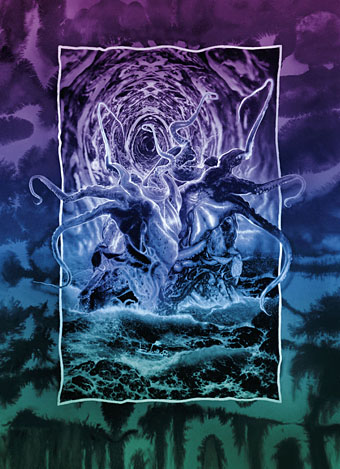
Something I was working on last August when I was putting together new pictures for the Cthulhu calendar, I’d actually forgotten about this until this week. The idea was to do something that was more of an abstract design than the rest of the art; having got this far I was undecided whether I wanted to try and incorporate the labyrinth shape into a larger picture. With time running out and nothing resolved I ended up using the Keep Calm Cthulhu design which, looking back, I feel this alone could easily have replaced. (They both share the same Cthulhu glyph.) As it is I may make this one available as another CafePress design since it’s more suited to T-shirts and things. If it needs a justification then consider the story of The Call of Cthulhu as a labyrinthine investigation which reveals Cthulhu dreaming at its centre.

Elsewhere on { feuilleton }
The Lovecraft archive

The Stone Tape

stonetape1.jpg

The Stone Tape has accrued a considerable cult reputation since it was first broadcast as a BBC ghost story during Christmas, 1972. I was too young to see the original transmission—I used to hear awed reports from those who remembered it—and didn’t get to see it until the BFI brought out on DVD a few years ago. That disc is now deleted, and the play is another unfortunate omission from the BFI’s Ghost Stories box set, so this seems a good opportunity to point the curious to the full-length copy that’s currently on YouTube.

stonetape3.jpg

In the past I’ve compared Nigel Kneale, the writer of The Stone Tape, to HP Lovecraft. This isn’t a comparison the often curmudgeonly Kneale might have agreed with but you can find similarities in the way both Kneale and Lovecraft (in his later fiction) created scenarios featuring scientists or technical people which grade from science fiction to outright horror. The horror can be something ancient and earthbound or, as in the case of Kneale’s Quatermass cycle, it can be extraterrestrial. Kneale’s narratives may return continually to scientific investigation but he was smart enough to avoid explaining away his mysteries. The Stone Tape is an uncanny masterpiece that often seems so bare-bones you can hardly believe the effect it’s creating compared to lavishly-budgeted yet inferior feature films. Something about Kneale’s drama works it way insidiously under the skin then lodges there. It leaves with its mysteries intact.

stonetape2.jpg

One reason Kneale’s Christmas play may have been left out of the BFI box is that it doesn’t fit the MR James model of accumulation-of-clues leading to revelation-of-spook. In Kneale’s story an industrial research and development team move into an old mansion building which turns out to be haunted. The manifestation of the ghost—usually the end point of most supernatural stories—quickly becomes an almost commonplace occurrence when the team decide to start probing its presence with their machines. Like most TV plays of the period this is done in the electronic studio but any absence of film atmosphere is compensated for by excellent writing and performances. Jane Asher plays a computer programmer and the only female professional in a group of loud and blustering men. She’s not only the person most sensitive to the spectral happenings but also proves to be the only one with the brains and tenacity to fathom the true nature of the haunting.

The conviction in the performances, Asher’s especially, and the quality and detail of Kneale’s characterisation, is what makes this production work so well. Among the other actors Michael Bryant is the stubborn team leader while Iain Cuthbertson plays the mediating foreman. Cuthbertson later had a major role in the cult TV serial Children of the Stones, and in 1979 was a memorable Karswell in an adaptation of MR James’ Casting the Runes. Also among the cast is Michael Bates who most people will know as the bellowing prison guard in A Clockwork Orange. The sound effects are by the Radiophonic Workshop’s Desmond Briscoe who also created electronic effects for The Haunting, Phase IV and The Man Who Fell to Earth. Director Peter Sasdy worked on a couple of the lesser Dracula films for Hammer but this is his finest hour-and-a-half. And if that isn’t enough priming for you I don’t know what else would suffice. I urge anyone who hasn’t seen this drama to turn off the lights and start the tape. It’s perfect Halloween viewing that grips to the very end.

Previously on { feuilleton }
Haunted: The Ferryman
Schalcken the Painter