More trip texts

parry1.jpg

More psychedelia of a sort. Anthologist Michel Parry, who died last year, was a familiar name to British readers of fantasy, horror and science fiction for his themed collections: Beware of the Cat (1972; horror stories about cats), The Devil’s Children (1974; horror stories about children), The Hounds of Hell (1974; horror stories about dogs), Jack the Knife (1975; Jack the Ripper stories), The Supernatural Solution (1976; occult investigators), Sex in the 21st Century (1979), and so on.

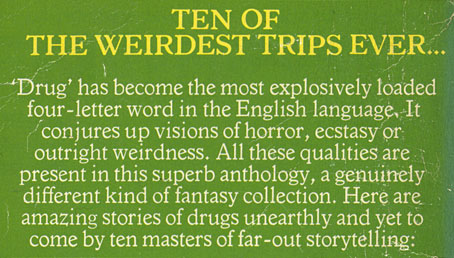
Parry also compiled multi-volume anthologies throughout the 1970s, two of which have always stood out for me: the Mayflower Books of Black Magic Stories ran to six volumes presenting a wide range of occult fiction that included a number of obscure tales from Victorian and Edwardian writers; for Panther Books he compiled three collections of drug-related fantasy and SF stories that are just as varied, and may even be unique for the way they place authors as such as Lord Dunsany and Norman Spinrad together in the same volume. Both series are very much of their time—occult psychedelia!—and are worth seeking out, if you can find them. I emphasise the last point because it’s taken me a while to find a copy of Strange Ecstasies that wasn’t being offered for bizarrely inflated prices; my paperback habit has its limits… None of these anthologies have been reprinted so they’ll become increasingly scarce. For more invented drugs, there’s a good list at Wikipedia.
parry2.jpg

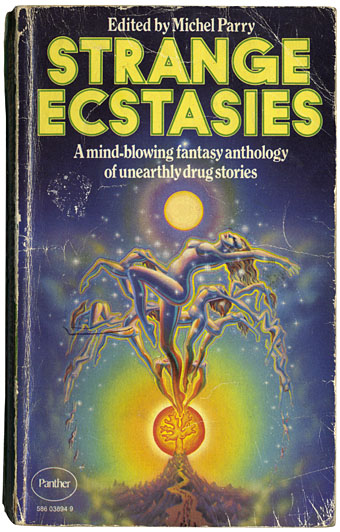
Cover art by Bob Haberfield.

Strange Ecstasies (1973)
The Plutonian Drug (1934) by Clark Ashton Smith
The Dream Pills (1920) by FH Davis
The White Powder (1895) by Arthur Machen
The New Accelerator (1901) by HG Wells
The Big Fix (1956) by Richard Wilson
The Secret Songs (1962) by Fritz Leiber
The Hounds of Tindalos (1929) by Frank Belknap Long
Subjectivity (1964) by Norman Spinrad
What to Do Until the Analyst Comes (1956) by Frederik Pohl
Pipe Dream (1972) by Chris Miller
parry3.jpg

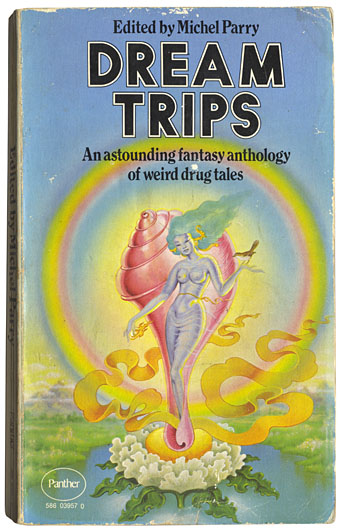
Cover art by Bob Haberfield.

Dream Trips (1974)
The Hashish Man (1910) by Lord Dunsany
As Dreams Are Made On (1973) by Joseph F. Pumilia
The Adventure of the Pipe (1898) by Richard Marsh
Dream-Dust from Mars (1938) by Manly Wade Wellman
The Life Serum (1926) by Paul S. Powers
Morning After (1957) by Robert Sheckley
Under the Knife (1896) by HG Wells
The Good Trip (1970) by Ursula K. Le Guin
No Direction Home (1971) by Norman Spinrad
The Phantom Drug (1926) by AW Kapfer
parry4.jpg

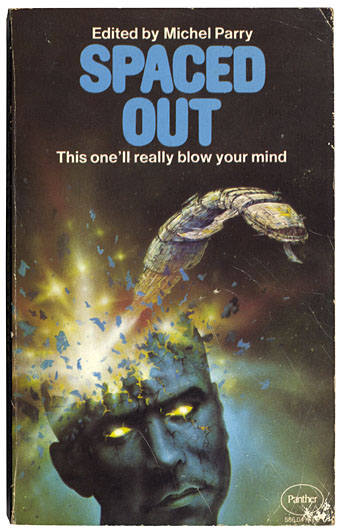
Cover art by Brian Froud.

Spaced Out (1977)
The Deep Fix (1964) by Michael Moorcock
All the Weed in the World (1961) by Fritz Leiber
The Roger Bacon Formula (1929) by Fletcher Pratt
Smoke of the Snake (1934) by Carl Jacobi
Melodramine (1965) by Henry Slesar
My Head’s in a Different Place, Now (1972) by Grania Davis
Sky (1971) by RA Lafferty
All of Them Were Empty— (1972) by David Gerrold

Previously on { feuilleton }
Trip texts
Acid albums
Acid covers
Lyrical Substance Deliberated
The Art of Tripping, a documentary by Storm Thorgerson
Enter the Void
In the Land of Retinal Delights
Haschisch Hallucinations by HE Gowers
The art of LSD
Hep cats

The Complete Citizen Kane

ck1.jpg

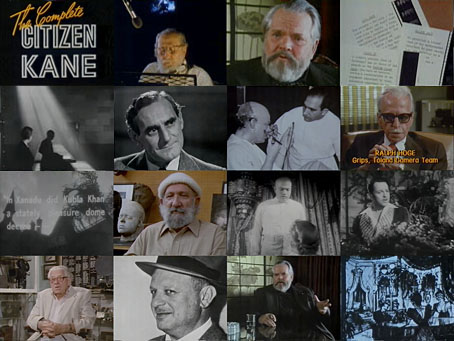
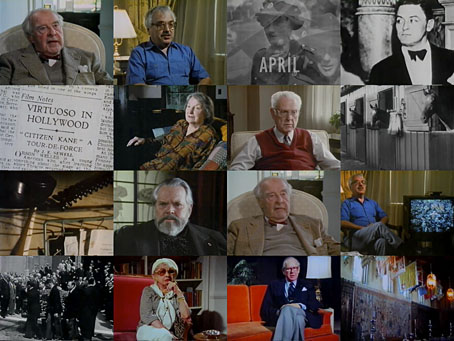
The Orson Welles centenary approaches so the posts this week will be devoted to one of my favourite film directors. The Complete Citizen Kane was an especially generous BBC documentary—comprehensive, authoritative and 90 minutes in length—screened in 1991 for the 50th anniversary of Welles’ most celebrated film. Christopher Swayne and Charles Cabot were the producers, and the narration is by Leslie Megahey, producer and interviewer of The Orson Welles Story (1982), a two-part documentary for the BBC’s Arena that ran for 165 minutes. Megahey’s Welles film was a definitive work for persuading Welles and his collaborators to discuss the director’s entire career at length. Clips of the long Welles interview turn up in The Complete Citizen Kane, as do clips from a later BBC series, The RKO Story (1987), which devoted a whole programme to Welles’ time at the studio.

ck2.jpg

The Complete Citizen Kane captures the attention at the outset by showing you a film that never existed, Orson Welles’ Heart of Darkness, the film that would have been Welles’ first project for RKO before it was cancelled due to expense. Helping narrate the evolution of Citizen Kane is William Alland, the actor who played the investigative reporter in the film, and also the voice of the News on the March sequence. Despite obvious sympathies, the documentary devotes some time to Pauline Kael’s controversial Raising Kane essay, and the fraught question of who contributed what to the finished screenplay. The Complete Citizen Kane ends with an extract from a radio show featuring Orson Welles talking to HG Wells shortly after Welles had shocked America with his adaptation of The War of the Worlds. All arts documentaries should be this good.

Previously on { feuilleton }
Return to Glennascaul, a film by Hilton Edwards
Screening Kafka
The Panic Broadcast

Prawdziwie magiczny sklep, a film by Mieczyslaw Waskowski

magic.jpg

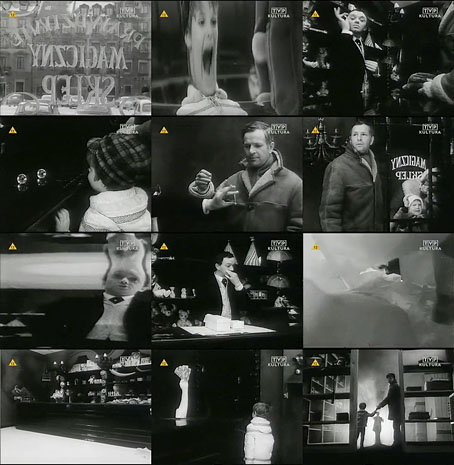
Another short film by Mieczyslaw Waskowski, this is very different to the abstraction of Somnabulists being a remarkably faithful adaptation of HG Wells’ short story, The Magic Shop. Waskowski wrote and directed Prawdziwie magiczny sklep for Polish television in 1969. The title translates as “Truly Magical Shop” although “Genuine Magic Shop” would be more accurate, a description the vaguely sinister (and magical) proprietor in Wells’ story offers to the father and son who pay his establishment a visit.

The Magic Shop had been adapted by US television five years earlier for The Alfred Hitchcock Hour, a version that by coincidence was mentioned in the Guardian‘s print edition this weekend in a list of Reece Shearsmith’s favourite anthology dramas. I’m afraid I can’t share Shearsmith’s enthusiasm on this occasion (see an earlier post); the Wells story has been a favourite for years, and I was unimpressed by the skewing of the Hitchcock Hour version which turned the boy into a much older delinquent-in-the-making. The frisson of the original story comes from the disparity between the young son’s acceptance of the genuinely magical occurrences in the shop, and the growing alarm of the narrator-father when events graduate from the inexplicable to the sinister. Waskowski’s adaptation is more whimsical than Bradbury-dark but it still follows Wells very closely, at least until the end where things are padded out with an extra scene.

The version linked here is without subtitles but the visual storytelling is clear enough. Viewers familiar with The Saragossa Manuscript (1965) may recognise the actors playing the father and shopkeeper from Wojciech Has’s equally adept adaptation. The Wells story may be read here.

Previously on { feuilleton }
Uncharted islands and lost souls
Doctor Moreau book covers
The Island of Doctor Moreau
Harry Willock book covers
The Time Machine
The Magic Shop by HG Wells
HG Wells in Classics Illustrated
The night that panicked America
The Door in the Wall
War of the Worlds book covers

More vapour trails

jeter.jpg

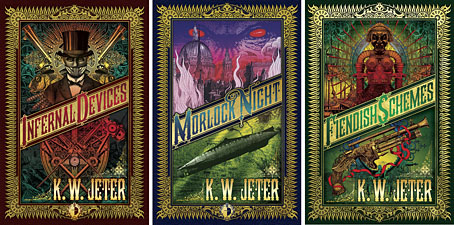
Those covers everyone likes. My designs for KW Jeter’s steampunk novels from Angry Robot and Tor Books.

When I wrote a brief history of steampunk for Eye magazine last year I ended by somewhat provocatively declaring that until something better appeared this was the defining aesthetic of the moment. A year later, the movement (if we can use that term) continues to evolve despite the steady drip of complaints that it’s all reactionary, historically illiterate, and so on. Much of the ire remains nonsensical, and often seems to boil down to a common disdain for people enjoying themselves in some unorthodox manner.

manual.jpg

Design by Galen Smith after the Hetzel editions of Jules Verne’s novels.

If I hadn’t got involved on the art side I would have found it difficult to avoid being attracted by steampunk in one form or another since so much of it originates in areas I was already interested in, not least HG Wells and Victorian science fiction. The rapid evolution of the past few years means we’re currently seeing an aesthetic leaving behind its origins to become an international subculture. What’s striking about this activity—and this is something that doesn’t seem to have been discussed very much—is the way the whole thing has been birthed by genre fiction rather than by pop music, as was the case for the second half of the 20th century. This piece is meant to be a news post, however, not another cultural critique, but if I happen to write any more on the subject there’s something there that’s worth exploring.

manual2.jpg

As to the news: this month finds my steampunk artwork manifesting in three very different locations in one of those odd coincidences of timing that occur now and then. First up there’s the Steampunk User’s Manual edited by Jeff VanderMeer & Desirina Boskovich, a follow-up to 2011’s Steampunk Bible. For the new volume I designed spreads for three entries by Jess Nevins from The Encyclopedia of Fantastic Victoriana: Alternative History Edition.

Continue reading “More vapour trails”

Uncharted islands and lost souls

lostsouls1.jpg

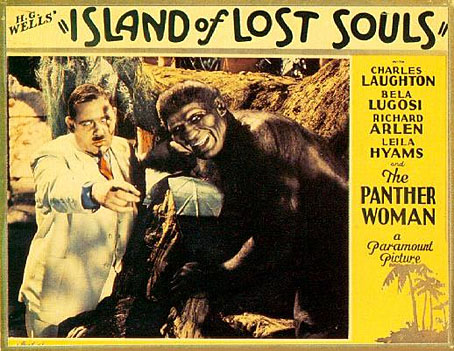
The pulp fiction of the early 20th century favoured remote or uncharted islands as locations for the bizarre and the fantastic; in isolated jungles all manner of savage and grotesque behaviour could take place out of sight of the civilised world. Islands are secure from interference; they can be visited by accident or intention, and later fled from when everything goes wrong. The Island of Doctor Moreau is an early example of the type although Jules Verne’s The Mysterious Island (1874) pre-dates it by twenty-two years. The Island of Lost Souls (1932), the first film adaptation of the Wells novel, is one of a crop of mysterious islands that appeared in the 1930s following the success of the Universal adaptations of Dracula (1931) and Frankenstein (1931). The recent Eureka DVD/Blu-ray edition of the film is the first UK release to present the film in its original, uncensored form. I watched it this weekend.

lostsouls3.jpg

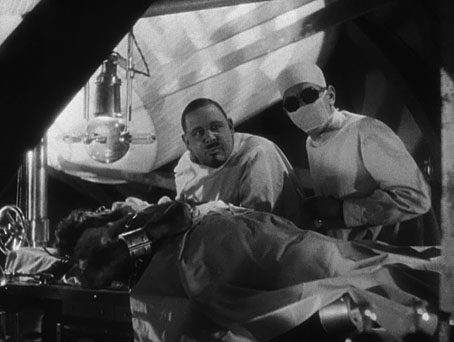
Moreau (Charles Laughton) and Montgomery (Arthur Hohl) at work.

HG Wells famously hated the film, and his vociferous complaints helped to ensure it was banned in Britain until 1958. Even without Wells’ complaints there was enough there to bait the censors who declared it to be “against nature”: writers Philip Wylie and Waldemar Young push the erotic implications of Wells’ story to a degree that would have been impossible in 1896, and would be equally impossible two years later when the Hays Code clamped down on cinematic salaciousness. Charles Laughton’s Moreau is eager to discover whether Lota, the Panther Woman (Kathleen Burke), will show any sexual interest in the marooned Edward Parker (Richard Arlen). The bestiality theme continues when Parker’s fiancée arrives on the island and finds one of Moreau’s Beast People at her bedroom window. Add to this Moreau’s declaration that he feels like God (a similar line was cut from James Whale’s Frankenstein), a traditional British squeamishness towards maltreating animals (unless they’re foxes), and the Panther Woman’s skimpy outfit, and it’s no surprise that the authorities collapsed with the vapours.

lostsouls4.jpg

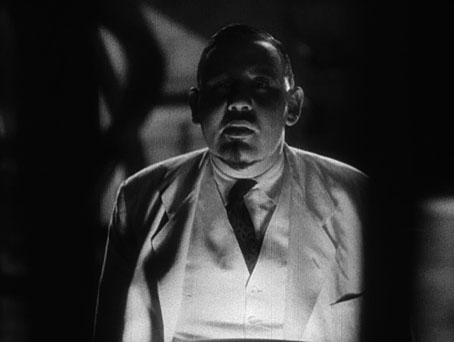
Sensationalism aside, this is one of the greatest horror films of the early 1930s, and one which follows its source material with much more fidelity than Universal’s Dracula and Frankenstein. The production had been commissioned by Paramount to capitalise on the success of the Universal films, hence the presence of a very hirsute Bela Lugosi as the Sayer of the Law. Cinematographer Karl Struss had worked the year before on Rouben Mamoulian’s excellent Dr. Jekyll and Mr. Hyde; prior to this he photographed Sunrise (1927) for Friedrich Murnau. The combination of Struss’s chiaroscuro compositions, some adept direction from Erle C. Kenton (including crane shots), and a tremendous performance by Charles Laughton puts The Island of Lost Souls in a different league entirely to Tod Browning’s stagey and over-rated Dracula. Laughton’s cherub-faced Mephistopheles is a performance that runs counter to the cod theatricals of the period: he’s sly, confident and completely authoritative even if he looks nothing like Wells’ white-haired doctor.

Continue reading “Uncharted islands and lost souls”