Weekend links 123

niceron.jpg

La Perspective Curieuse (1663) by Jean François Nicéron. From Curious Perspectives at BibliOdyssey.

1612 Underture is a forthcoming album by The Eccentronic Research Council and Maxine Peake which extends the electronics + occult concept to encompass Kraftwerk and the Pendle Witches. The Quietus has a review of their album, and an interview and report about a recent live performance (I missed the latter, unfortunately), while the Guardian’s interview with the splendid Ms Peake reveals that “musically, her tastes range from Japanese black metal, garage rock and folk, to techno and psychobilly.” The famous Lancashire witches also happen to be the subject of Jeanette Winterson’s latest novel, The Daylight Gate.

• Yet more Marker: The Owl’s Legacy: Chris Marker’s 13-Part Search for Western Culture’s Foundations in Ancient Greece, and J. Hoberman on The Lost Futures of Chris Marker.

Dr Oliver Sacks talks about how hallucinogenic drugs helped him empathize with his patients.

Paulo Coelho’s ill-judged Joyce-bashing has made him a butt of scorn this week, but he’s a safe target because, with books that multitask a little too openly as self-help manuals, he’s not so clubbable. Unlike, say, Ian McEwan, who not-that-differently declared against “the dead hand of modernism“, for all the world as if the dominant literary mode in post-war England was Steinian experimentation or some Albion Oulipo, against which young Turks hold out with limpidly observed interiority, decodable metaphors, strained middle-class relationships and eternal truths of the human condition(TM).

China Miéville on the always contentious future of the novel.

The Foliate Head: a new book by Marly Youmans with illustrations by Clive Hicks-Jenkins.

Hysterical Literature: Session Two: Alicia reads from Leaves of Grass by Walt Whitman.

Dreaming in Dirigibles: The Airship Postcard Albums of Lord Ventry.

The Art of the Literary Fake (with Violin) by Jeff VanderMeer.

RIP Neil Armstrong, first human on the Moon.

Macho Man: Morgan Meis on Robert Hughes.

• Book covers by Hannes Bok.

This Is Now!

Squid Moth

Lunar Rhapsody (1947) by Dr Samuel J. Hoffman | Lunar Musick Suite (1976) by Steve Hillage | Back Side Of The Moon (Steve Hillage’s Under Water Deep Space Remix) (1991) by The Orb.
Morlocks, airships and curious cabinets

morlock.jpg

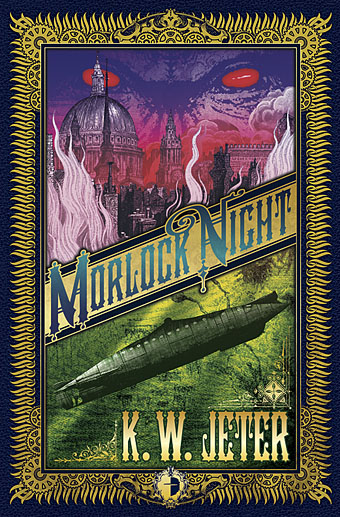
Things I was working on late last year continue to percolate or, if you prefer, build a head of steam. My cover for KW Jeter’s Morlock Night appears in a short piece by Rick Poynor in July’s Creative Review. That feature is prompted by the British Library’s Out of the World exhibition. Nice to see something of mine with Hannes Bok’s illustration for Who Goes There? by John W Campbell, the story which was filmed as The Thing from Another World, and later, John Carpenter’s The Thing.

Morlock Night is also one of my contributions to the lavish Steampunk Bible which editors SJ Chambers and Jeff VanderMeer have been promoting for the past couple of months. USA Today ran a feature on the book which included my piscine airship among the selected illustrations.

Next up will be the Thackery T Lambshead Cabinet of Curiosities for which I’ve provided a number of illustrations and decorative title pages. Jeff V has a preview shot of the cover. That will be out next month. More later.

Previously on { feuilleton }
The Steampunk Bible
Steampunk Reloaded
Steampunk overloaded!
Vickers Airship Catalogue
The Air Ship
Dirigibles
More Steampunk and the Crawling Chaos
The art of François Schuiten
Steampunk Redux
Steampunk framed
Steampunk Horror Shortcuts
The Airship Destroyer
Zeppelin vs. Pterodactyls
The Hetzel editions of Jules Verne

Weekend links 47

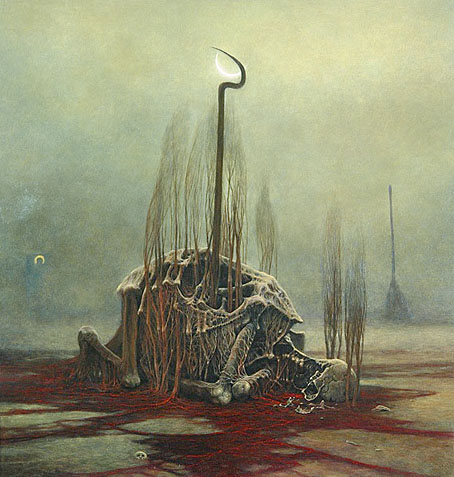
beksinski1.jpg

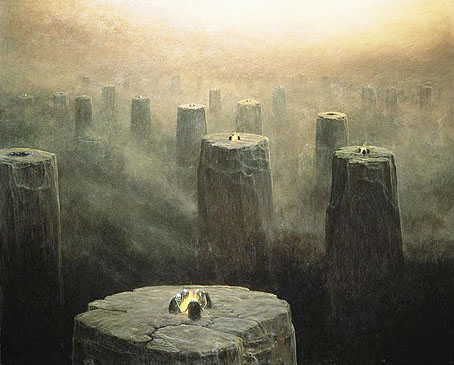
DG-2499 (1975) by the fantastic (in every sense of the word) Zdzisław Beksiński (1929–2005). See the Dmochowski Gallery for a comprehensive collection of the artist’s work. Thanks to BibliOdyssey for the tip.

• More ICA events: From Animism to Zos: Strange Attractor Salon will be “a series of weekly events, consisting of a talk and a film, exploring some lesser-known intersections of culture, history, mind and nature” running from 10 March–12 May, 2011.

• And on May 10, the London Word Festival presents a Dodgem Logic evening with entertainment provided by contributors to that magazine:

Alan Moore’s reinvigoration of the underground fanzine, Dodgem Logic, comes alive in the non-conformist surroundings of Hackney’s Round Chapel. A night of art, comedy, comment and put-something-back localism. (…) With Robin Ince heading up a colossal stand-up bill, artists Steve Aylett, Savage Pencil, Melinda Gebbie and Kevin O’Neill panel-up to talk about their comic work, while music comes from hyperactive racketeers The Retro Spankees. With an exhibition of artwork from the magazine, and conducted by editor-in-chief Alan Moore.

• Taschen publishes a collection of Dennis Hopper’s photographs this week. The Independent has a small selection here. Also new from Tachen, Alex Steinweiss, The Inventor of the Modern Album Cover.

Bass Notes: The Film Posters of Saul Bass at the Kemistry Gallery, London.

beksinski2.jpg

DG-2507 by Zdzisław Beksiński.

While riding through the bustling streets of London from 1603 to 1621, one was liable to hear the shout “Long live Queen James!” King James I of England and VI of Scotland was so open about his homosexual love affairs that an epigram had been circulated which roused much mirth and nodding of the heads: Rex fuit Elizabeth: nunc est regina Jacobus—”Elizabeth was King: now James is Queen.”

There’s more about the private life of the man who gave his name to the King James Bible here.

Addams and Evil, a Tumblr devoted to the great Charles Addams.

Hannes Bok again at Golden Age Comic Book Stories.

Caravaggio’s crimes exposed in Rome’s police files.

Deserted City, photographs by Kim Høltermand.

• The blue sand dunes of the planet Mars.

• A map of the ghost signs of Chicago.

The movie title stills collection.

The pitfalls of e-book buying.

Life On Mars? (1971) by David Bowie | Uncle Sam’s On Mars (1979) by Hawkwind | Eyes On Mars (1980) by Chrome | Cache Coeur Naif (1997) by Mouse on Mars.

Weekend links 42

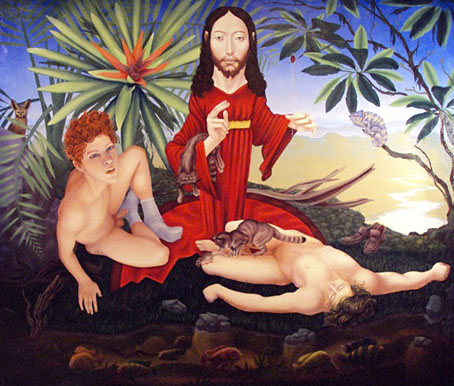
martin.jpg

Blasphemous Rumours (2009/2010) by Ryan Martin. The artist now has a dedicated site for his paintings.

The Museum of Censored Art, a mobile gallery, will be showing the withdrawn David Wojnarowicz film outside the National Portrait Gallery, Washington DC, until their contentious gay art exhibition closes next month. Related: Bishop of Mallorca criticises calendar—which shows Catholic youths posing naked—for ‘not respecting Christian symbols’.

• Didier Lestrade published French gay zine Magazine in the 1980s, and later co-founded Têtu. He’s interviewed at BUTT and has started uploading the entire run of Magazine about which he says: “I don’t want to stamp some kind of logo on this material. It’s gay. It’s gay history. It belongs to everybody. If you want to take a piece of it, please try to mention the origins of it, a simple code word “Magazine” will be enough. If you wanna be more specific, be my guest.”

HMV, Britain’s last big music chain, is closing 60 branches. Yet a new wave of CD stores is thriving. Oh, HMV, how I’ll miss your £17 CDs (and double-CDs at £34)… On second thoughts, no I won’t, your wretched retail barns always exemplified the greed endemic in the music business.

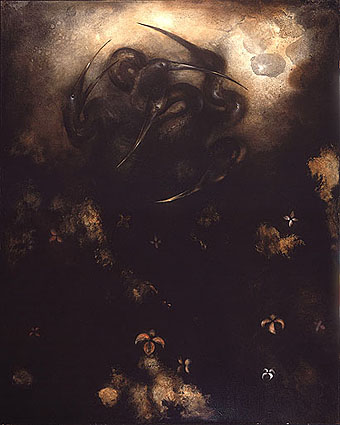
kasner.jpg

Love Comes/Destroyer by Stephen Kasner.

• Artist Stephen Kasner‘s work has adorned music releases by Sunn O))), Isis and others. He’s currently another American creator in need of assistance with medical expenses. Details here.

The Ghosts of Old London: the gloomy Victorian metropolis in all its deteriorated splendour. See also: In Search of Relics of Old London.

• “It’s time to recognise [Sandy] Denny as not simply a folksinger but one of Britain’s great poets of song,” says Rob Young.

Louis Pattison talks to Locrian about JG Ballard, old VHS tapes and their new album The Crystal World.

The Dreams That Stuff Is Made Of: Lebbeus Woods’ big drawings.

Hannes Bok portfolios at Golden Age Comic Book Stories.

An Iranian rapper named Salome. Also here and here.

A Moment of (Alan) Moore.

RIP Mick Karn.

Book Worship.

Sons of Pioneers (1981) by Japan; Tao-Tao (1982) by Masami Tsuchiya; Glow World (1983) by Bill Nelson.

Dugald Stewart Walker revisited

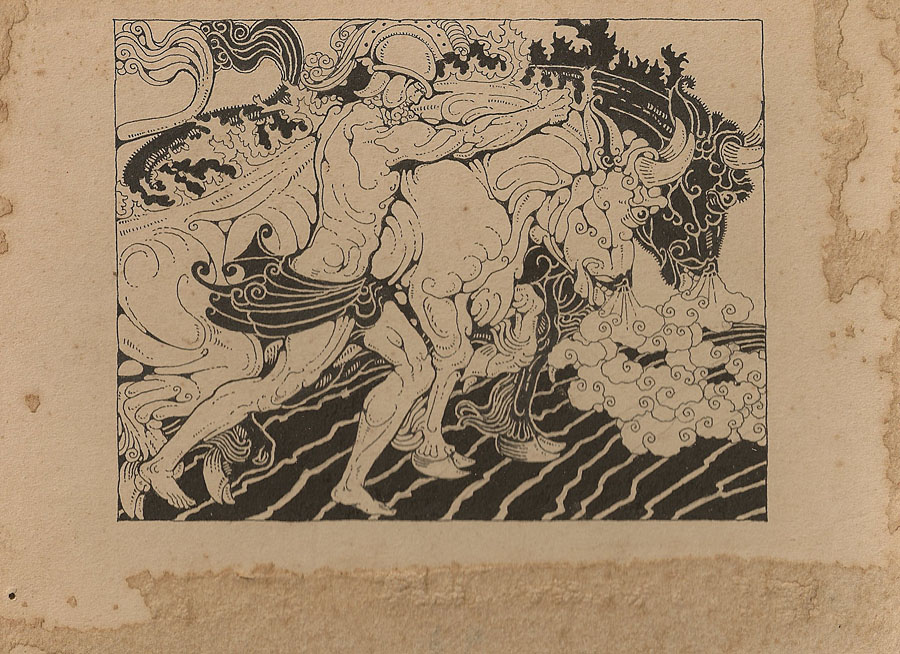
dsw5.jpg

The Golden Porch (1925).

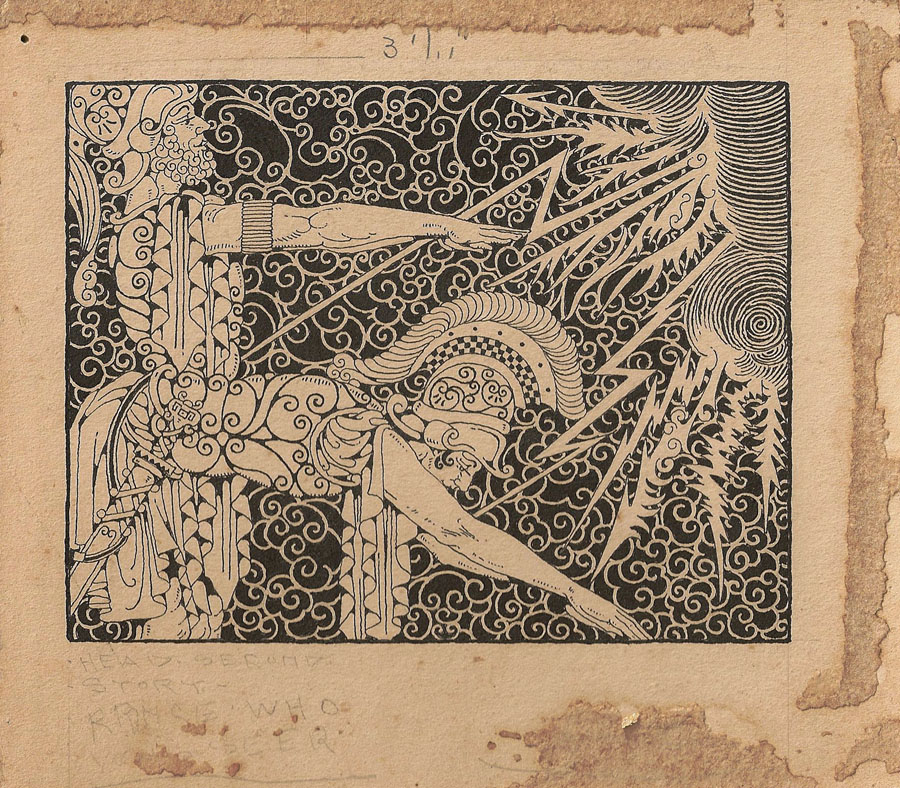
A post prompted by an email from Deborah Hirsch who wrote to tell me about some original works she’d found by American illustrator Dugald Stewart Walker (1883–1937), scans of which are shown here with her permission. This has made me take another look at Walker’s drawings, many of which I’d overlooked during earlier searches. His body of work runs from the usual fairy-tale illustration to some very fine renderings of tales from Ancient Greece. He was also an excellent peacock illustrator although you’ll have to look elsewhere for those; Golden Age Comic Book Stories has made several postings of his book plates. The drawings shown here are from Snythergen (1923) by Hal Garrott, The Golden Porch (1925) and Orpheus with His Lute (1926), both by WML Hutchinson.

dsw6.jpg

The Golden Porch (1925).

Every so often an artist’s work sets me wondering about their sexuality, a consideration which agitates some, especially surviving relatives, who find such speculation to be unwarranted or vulgar. The matter is relevant for two reasons: firstly, if an artist turns out to be gay or bisexual (as was the case with Hannes Bok) then certain details in their work become informed by that knowledge. Secondly, there’s still a lot more work to be done in retrieving from history the lives of gay people who have added to our culture in some way. Illustrators receive little attention in this area since illustration has always been the poor cousin to gallery art. I try to be wary of projecting my own concerns onto an artist for whom such attention may be unwarranted, and I’m not saying one can read anything substantial into Walker’s life simply by looking at his pictures. I do, however, have a mental checklist for any gay vs. straight appraisal which includes among its subjects common themes such as Greek myths (especially those concerning Orpheus and Narcissus), a recurrence of nude males, excessively florid décor, etc. Let’s just say that certain aspects of Walker’s work are (as Sherlock Holmes would say) “suggestive”, and the ex libris plate at the end of this post is notable for illustrating Keats’ famous quote about truth and beauty with a peacock and a (nude?) boy. If anyone has any relevant details about Dugald Stewart Walker’s life, as always they’re encouraged to leave a comment.

A Dugald Stewart Walker set at Flickr
Dream Boats and Other Stories (1920) at the Internet Archive

Continue reading “Dugald Stewart Walker revisited”