Crystal worlds

finlay.jpg

The Crystal World by JG Ballard. An illustration by Virgil Finlay for the Summer–August 1966 issue of Things To Come, the Science Fiction Book Club mailer.

1: Crystal words

JG Ballard didn’t have a pleasant experience with LSD when Michael Moorcock procured a dose of the drug for him in 1967, describing his acid trip in later years as a “psychotic nightmare”. I’ve often wondered how Ballard’s fiction might have developed in the 1970s if his experience had been a more positive one, something I was thinking about again when re-reading The Illuminated Man, a story collected in The Terminal Beach which was later reworked as The Crystal World, the fourth book in Ballard’s disaster quartet. There’s a psychedelic strain to Ballard’s writing which has long been overwhelmed by the popular enthusiasm for the condensed fictions of The Atrocity Exhibition and the three “concrete” novels of the 1970s: Crash, Concrete Island and High-Rise. The Crystal World was published in 1966 when LSD was still legally available in Britain, and even though the genesis of the book pre-dates the decade’s psychedelic fervour, the bejewelled prose chimes so well with the mood of the time it’s easy to assume it was inspired by psychedelic experience. Many readers thought as much, and in interviews Ballard had to emphasise that the novel was a product of his imagination and nothing more.

illuminated.jpg

The Magazine of Fantasy and Science Fiction, May 1964. Cover art by Ed Emshwiller.

After devastating the planet with plausible disasters in his first three novels, Ballard in The Crystal World offers a distinctly fantastic scenario, in which an interstellar phenomenon (“the Hubble Effect”) is manifesting on Earth as the spontaneous crystallisation of all objects, animate or inanimate. The process begins in isolated areas before spreading worldwide; in keeping with many other Ballard stories from this period, time is responsible for the changes taking place:

Just as a supersaturated solution will discharge itself into a crystalline mass, so the supersaturation of matter in a continuum of depleted time leads to its appearance in a parallel spatial matrix. As more and more time “leaks” away, the process of supersaturation continues, the original atoms and molecules producing spatial replicas of themselves, substance without mass, in an attempt to increase their foothold upon existence.

The Illuminated Man

As with other Ballard stories, the scientific hand-waving is merely a pretext. In The Illuminated Man and The Crystal World “leaking time” provides an excuse to transform areas of Florida swamp and African jungle into glittering arcades of prismatic foliage, where birds are crystallised in mid-flight, reptiles transmute into heraldic emblems, and everything fluoresces with an iridescent radiance. The Illuminated Man is a sketch of the novel, with a different location but similar events, in which a hazardous mutating landscape becomes the stage for a small group characters pursuing each other and their own obsessions. Landscape is the important factor in The Drowned World, The Drought and The Crystal World; all three novels are essentially Surrealist landscapes whose reflections of interior states are the primary interest of the novelist, the narrative and the characters being very much secondary elements. In this respect it’s disappointing that The Crystal World has yet to be brought to life by an inspired illustrator, as we’ll see below. And while the novel may seem to be the least realistic of Ballard’s disasters it has a connection to future events. The Illuminated Man offers one of the first examples in science fiction (maybe the first) of an isolated zone which is being transformed by an extraterrestrial phenomenon, a concept usually credited to the Strugatsky Brothers in their novel Roadside Picnic (1972), and popularised by Andrei Tarkovsky in Stalker (1979). (Algis Budrys had done something similar in an earlier novel, Rogue Moon, but Budrys’s infected zone isn’t located on the Earth.) Tarkovsky’s film would subsequently provide the containment zone around the irradiated region of Pripyat in Ukraine with a template for unauthorised behaviour, where the illicit guides to the region took to describing themselves as “stalkers”. Until my re-read of The Illuminated Man I hadn’t registered Ballard’s reference to an additional outbreak of crystallisation occurring in the Pripet Marshes in what was then the Soviet Union, a vast region that includes the irradiated zone of Pripyat. The Soviet scientists attempt to deal with outbreak in their usual inefficient manner but for the world at large efficiency proves to be of little consequence either way; Ballard’s disasters aren’t problems to be solved, as they would have been for an earlier generation of writers. Global calamity is dealt with by gradual accommodation, and a reconfiguring of the human psyche which eventually comes to accept the altered landscape.


2: Crystal visions

venosa.jpg

Celestial Tree (1976) by Robert Venosa.

The most obvious psychedelic elements of The Crystal World are the novel’s emphasis on rainbow spectra and brilliant lights, the endless descriptions of prismatic diffractions and iridescence. But jewels and crystals are an important feature of psychedelic and visionary experience, a quality that Aldous Huxley explored at length in Heaven and Hell (1956):

Men have spent enormous amounts of time, energy and money on the finding, mining and cutting of coloured pebbles. Why? The utilitarian can offer no explanation for such fantastic behaviour. But as soon as we take into account the facts of visionary experience, everything becomes clear. In vision, men perceive a profusion of what Ezekiel calls “stones of fire,” of what Weir Mitchell describes as “transparent fruit.” These things are self-luminous, exhibit a preternatural brilliance of colour and possess a preternatural significance. The material objects which most nearly resemble these sources of visionary illumination are gem stones. To acquire such a stone is to acquire something whose preciousness is guaranteed by the fact that it exists in the Other World.

Hence man’s otherwise inexplicable passion for gems and hence his attribution to precious stones of therapeutic and magical virtue. The causal chain, I am convinced, begins in the psychological Other World of visionary experience, descends to earth and mounts again to the theological Other World of heaven. In this context the words of Socrates, in the Phaedo, take on a new significance. There exists, he tells us, an ideal world above and beyond the world of matter. “In this other earth the colours are much purer and much more brilliant than they are down here…. The very mountains, the very stones have a richer gloss, a lovelier transparency and intensity of hue. The precious stones of this lower world, our highly prized cornelians, jaspers, emeralds and all the rest, are but the tiny fragments of these stones above. In the other earth there is no stone but is precious and exceeds in beauty every gem of ours.”

In The Illuminated Man Ballard extends his own thoughts about precious stones to touch on the numinous:

Perhaps it is this gift of time which accounts for the eternal appeal of precious gems, as well as of all baroque painting and architecture? Their intricate crests and cartouches, occupying more than their own volume of space, so contain a greater ambient time, providing that unmistakable premonition of immortality sensed within St Peter’s or the palace at Nymphenburg. By contrast the architecture of the 20th century, characteristically one of rectangular unornamented facades, of simple Euclidean space and time, is that of the New World, confident of its firm footing in the future and indifferent to those pangs of mortality which haunt the mind of old Europe.

moreau.jpg

A moment of frozen time: Salome Dancing Before Herod (1876) by Gustave Moreau.

There’s an overt spirituality to The Illuminated Man and The Crystal World (both stories feature priests among their small cast of characters), which again seems psychedelic when placed in the context of crystalline transmutation, and which is diametrically opposed to the hard-edged materialism of the late novels. The second part of The Crystal World takes its title from the short story, with “illuminated” here referring to a process of psychological (or even spiritual) illumination in addition to the more obvious generation of light.

myths.jpg

A late manifestation of the Symbolist Ballard, 1982. Cover art by Bill Botten.

I think of this side of Ballard’s work as less religious than Symbolist, an expression of his enthusiasm for Symbolist art and artists; the opening chapter of The Crystal World has the priest with an artist’s surname, Father Balthus, comparing the gloomy light around Port Matarre to the impending storm in Arnold Böcklin’s Isle of the Dead. The painting chosen to wrap the covers of the first edition of The Crystal World was The Eye of Silence by Max Ernst, a choice almost certainly suggested by Ballard himself who included the same picture in a list of favourite Surrealist paintings for New Worlds. The painting is the closest that Ernst gets to the jewelled settings of Gustave Moreau, an artist whose Byzantine architectures are studded with precious stones.

The Symbolist Ballard surfaced in occasional short stories throughout the late 60s and the concrete 70s but didn’t return in full until 1979 with the publication of The Unlimited Dream Company. The novel is such a dramatic break with the concrete novels it suggests a sudden release of pressure, as the Symbolist Ballard erupts into life with another story about the wholesale transformation of a circumscribed zone. The locus this time is Ballard’s home territory of Shepperton which is turned into a tropical paradise by the arrival of a wounded pilot (significantly named Blake) whose small plane has crashed into the River Thames. Blake may be suffering from brain damage, he may be imagining all the novel’s events in the moments before his death, or he may even be a new messiah; as with The Crystal World, the explanation is a side issue, the author is more interested in the transformed environment and its effect on the inhabitants of the town.

Continue reading “Crystal worlds”

Weekend links 720

moreau.jpg

The Poet and the Siren (1893) by Gustave Moreau.

• “Some books become talismans. Because they are strange, wildly different to the common run of literature; because they are scarce, and only a few precious copies are known to exist; because, perhaps, they liberate by transgressing the moral limits of the day; because their authors are lonely, elusive visionaries; because, sometimes, there is an inexplicable glamour about the book, so that its readers seem to be lured into a preternatural reverie. This book possesses all those attributes.” Mark Valentine in an introduction he wrote for a 1997 reprint of The Book of Jade (1901) by David Park Barnitz. The book’s author was an American writer who died at the age of 23 after publishing this single volume, a collection of poetry inspired by his favourite Decadent writers. Praise from HP Lovecraft, Clark Ashton Smith and Thomas Ligotti has since helped maintain the book’s reputation. The Book of Jade turned up recently at Standard Ebooks, the home of free, high-quality, public-domain texts. Also the home of an increasingly eclectic list of publications.

• At n+1: The Dam and the Bomb by Walker Mimms, a fascinating essay about the entangling of Cormac McCarthy’s personal history with his novels which makes a few connections I didn’t expect to see. Also a reminder that I’ve yet to read McCarthy’s last two books. Soon…

• The latest installation from teamLab is Resonating Life which Continues to Stand, an avenue of illuminated eggs on the Hong Kong waterfront.

• At The Wire: Symphony of sirens: an interview with Aura Satz, David Toop, Elaine Mitchener, Evelyn Glennie and Raven Chacon.

• At Unquiet Things: The Art of Darkness presents The Sleeper May Awaken: Stephen Mackey’s Unrestful Realms.

• RIP Marian Zazeela. There’s a page here with a selection of her beautiful calligraphic poster designs.

• At Spoon & Tamago: Tomona Matsukawa’s realistic paintings reconstruct fragments of everyday life.

• At Public Domain Review: Thom Sliwowski on The Defenestrations of Prague (1419–1997).

Trinity (2024), a short film by Thomas Blanchard. There’s a lot more at his YouTube channel.

• At Dennis Cooper’s: Lotte Reiniger’s Day.

Sirens (1984) by Michael Stearns | Sirens (1988) by Daniel Lanois & Brian Eno | Siren Song (2009) by Bat For Lashes

Ragnar von Holten’s Maldoror

vonholten1.jpg

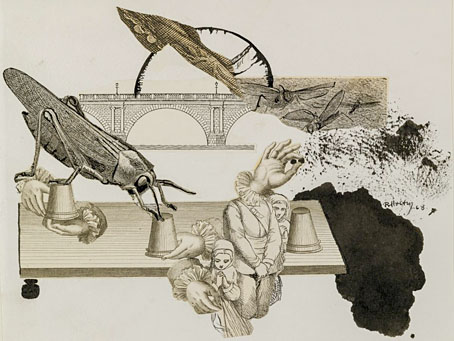
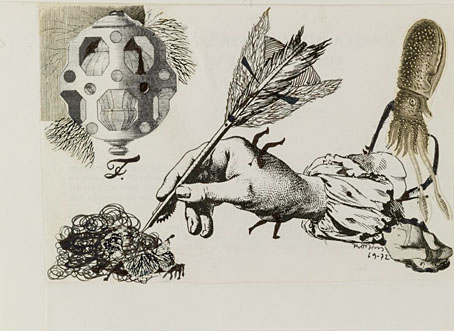
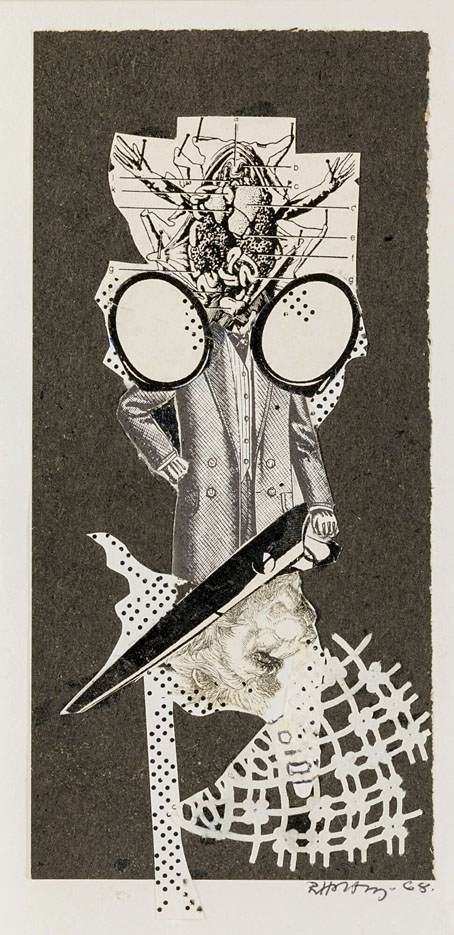
More Maldoror, and more collage, this time from Swedish artist and art historian Ragnar von Holten (1934–2009). The Historical Dictionary of Surrealism describes von Holten as a Gustave Moreau enthusiast who first contacted the Paris Surrealists in 1960 when he was organising a retrospective of Moreau’s work at the Louvre. André Breton had long been a champion of Moreau, especially in the decades when the artist was out of fashion, and wrote a preface for von Holten’s L’Art Fantastique Gustave Moreau. One of the many things I like about the Surrealists is the continuity they provide with the history of fantastic and visionary art.

vonholten2.jpg

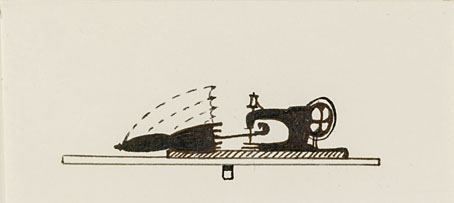
Von Holten’s Maldoror collages were begun in the late 1960s and completed in 1972 when they were published in a Swedish edition of the novel. I don’t know how many illustrations there were in all but you can see more at the Moderna Museet website. Not all the collages are labelled as being derived from Maldoror but many of the titles refer to the text all the same. Also there are two drawings intended as vignettes, one of which depicts in a rather literal fashion Lautréamont’s most popular metaphor.

vonholten3.jpg

vonholten4.jpg

Elsewhere on { feuilleton }
The Surrealism archive

Previously on { feuilleton }
Harry O. Morris’s Maldoror
Covering Maldoror
Kenneth Anger’s Maldoror
Chance encounters on the dissecting table
Santiago Caruso’s Maldoror
Jacques Houplain’s Maldoror
Hans Bellmer’s Maldoror
Les Chants de Maldoror by Shuji Terayama
Polypodes
Ulysses versus Maldoror
Maldoror
Books of blood
Magritte’s Maldoror
Frans De Geetere’s illustrated Maldoror
Maldoror illustrated

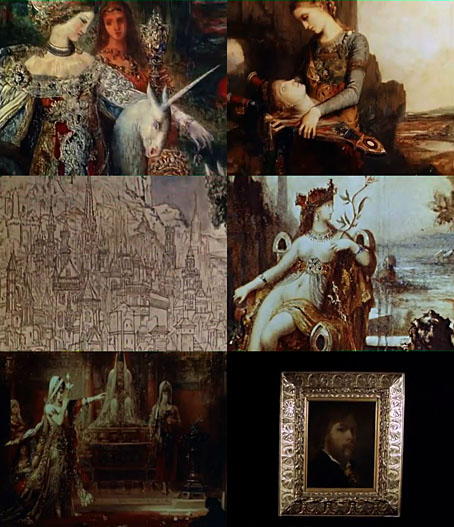
Gustave Moreau (1826–1898), a film by Nelly Kaplan

moreau1.jpg

André Breton has acknowledged that his personal ideal of female beauty was established in his adolescence when he visited the Gustave Moreau museum in Paris; like Joris-Karl Huysmans’s protagonist, Des Esseintes, Breton was enthralled by Moreau’s depiction of figures such as Salomé.

Keith Aspley, Historical Dictionary of Surrealism

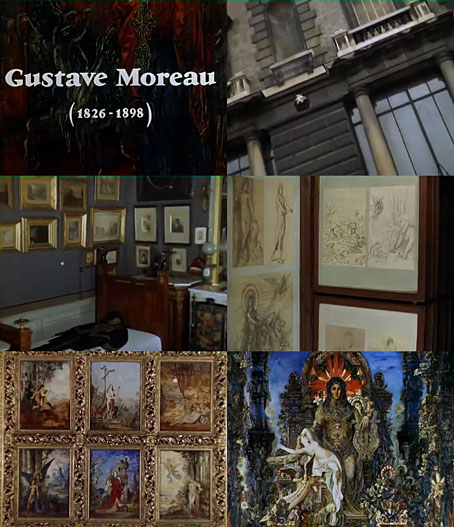
André Breton happens to be one of four narrators whose voices may be heard (all speaking French) in this short study of Gustave Moreau’s paintings and drawings made in 1961. Director Nelly Kaplan was an Argentinian writer and film-maker who moved to Paris in the 1950s where she became creatively involved with Abel Gance, and with what was left of the original Surrealist movement based around the autocratic Breton. I’ve often drawn attention to Breton’s pettiness, especially his penchant for excommunicating from his circle anyone he disagreed with, but he deserves credit for championing Gustave Moreau during the decades when the artist was resolutely beyond the critical pale. A lesson I learned from the Surrealists early on is that you don’t let other people dictate the limits of your cultural tastes.

moreau2.jpg

Moreau was still beyond the pale in 1961 so Kaplan’s film was in the vanguard of the reappraisals that were to take place later in the decade, culminating in major exhibitions in the early 1970s. One of the curators of the Hayward exhibition of 1972, Philippe Jullian, made an unfinished Moreau painting, The Chimeras, a key reference in his landmark study of Symbolist art, Dreamers of Decadence (1971). You see a few details from this picture in Kaplan’s film when the camera is roaming the walls of the Moreau Museum, formerly the artist’s residence in the rue de la Rochefoucauld, Paris. The years of neglect had their advantages, one of them being that the house/museum hasn’t had to change very much in order to accommodate visitors; the same goes for Moreau’s art which didn’t get scattered around the world like the works of his contemporaries. The upper floors of the museum are filled with original paintings, together with preliminary sketches which you see here in their hinged frames which allow you to leaf through them like pages of a book. No film or book does justice to the jewelled splendour of the finished paintings, however, especially the detailed works like Jupiter and Semele. You really have to see these things in person if you can.

Previously on { feuilleton }
New Life for the Decadents by Philippe Jullian
More chimeras
Philippe Jullian, connoisseur of the exotic
Ballard and the painters

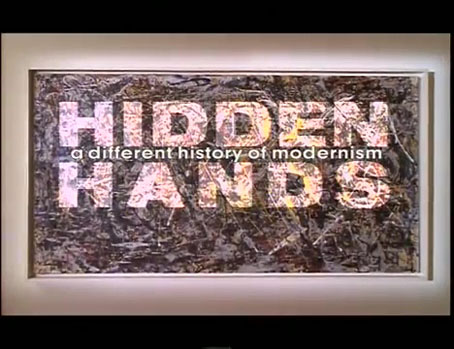
Hidden Hands: A Different History of Modernism

hh1.jpg

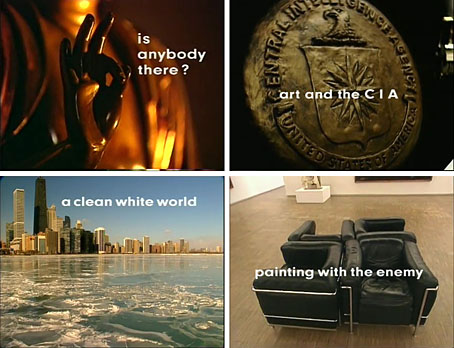
I thought I’d finished with the arts documentaries until I remembered this four-part series from 1995. Hidden Hands was based on researches by Frances Stonor Saunders who also co-produced. As the subtitle suggests, the programmes examined aspects of Modernist art and architecture that weren’t exactly unknown but were often downplayed (sometimes deliberately ignored) by the art establishment. The episodes were as follows:

1: Is Anybody There? The occult roots of abstract painting, especially the influence of Theosophy on Vasily Kandinsky and Piet Mondrian. Kazimir Malevich and František Kupka are also mentioned at the beginning of the programme but we don’t hear anything more about them.

2: Art and the CIA. A history of the Congress for Cultural Freedom, a CIA front for channelling money to avant-garde exhibitions and literary magazines during the Cold War.

3: A Clean White World. Modernist architecture as a reaction to, and proposed solution for, the squalor of 19th-century city life. Also the similarity between the impulses that drove the Modernist architectural ideal, and the later health and purity obsessions of European fascist states.

4: Painting with the Enemy. The inadvertent way in which the animus towards “degenerate art” shared by the Nazis and the Vichy regime in occupied France helped sustain Modernism during the war years.

hh2.jpg

This is a very good series on the whole, informative and with a roster of authoritative interviewees. The narration overstates the contrarian angle in places but that’s television for you. Much of the history under investigation wasn’t necessarily hidden, more sidestepped by general discussions of 20th-century art. Even so, fifteen years earlier in the architecture episode of The Shock of the New, Robert Hughes covered similar territory and with similar criticisms, following the development of what would become known as the International Style while noting Mussolini’s adoption of a Modernist idiom for the architecture of Fascist Italy.

Elsewhere, when Hughes reviewed a major Kandinsky retrospective he paid sufficient attention to Kandinsky’s Theosophical beliefs; this was in 1982 for TIME magazine, not exactly an obscure publication. Theosophy’s ectoplasmic tentacles are all over the art of the late 19th century so you’d expect some crossover into the art of the new century, as there was in the careers of the artists themselves. (Matisse was a pupil of Gustave Moreau, for example, an inconvenient detail that often irritated critics.) Given the amount of artists swayed by Madame Blavatsky’s writings, a more interesting argument might have been to propose Theosophy as the prime cause of early abstraction rather than another inconvenient factor in its development. Hilma af Klint’s pioneering abstract paintings were as much products of her Theosophical studies as were those of Kandinsky but in the 1990s nobody was paying her very much attention.

hh3.jpg

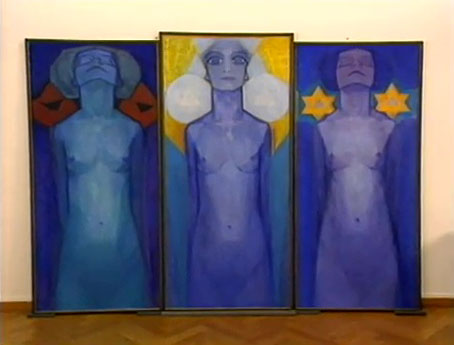
Mondrian’s mysticism: Evolution (1910–1911).

As for the CIA, the agency’s clandestine cultural adventures were exposed by a leak in the late 1960s—Stephen Spender famously resigned in shame from his editorship of Encounter magazine—so this could almost be classed as old news. What you wouldn’t have had in the past, however, is the agents involved in the scheme openly discussing their activities.

Continue reading “Hidden Hands: A Different History of Modernism”