Weekend links 421

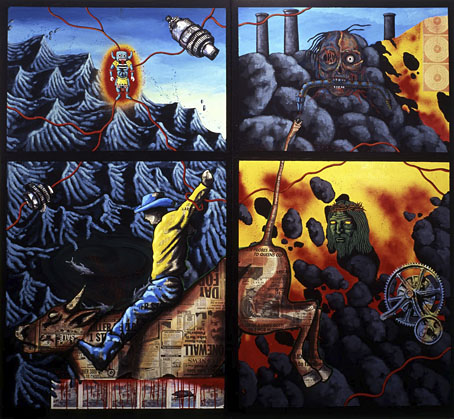
wojnarowicz.jpg

The Death of American Spirituality (1987) by David Wojnarowicz.

Dau: “Art imitating life on an unprecedented scale”. Siddhant Adlakha on a colossal Russian feature-film project that sounds like a real-life equivalent of Synecdoche, New York. Adlakha’s piece, which claims that Dau is finished, was written a year ago but there’s still no sign of the film itself. Wikipedia has more details and links.

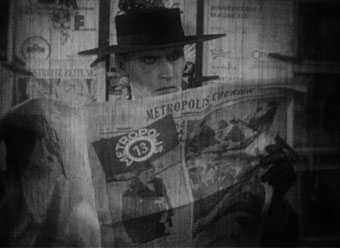
Metropolis Magazine from Phantasm Press is a facsimile republication of the 32-page theatre programme produced for the UK premier of Fritz Lang’s feature film.

Children Of The New Dawn is a preview of the score for Mandy by the late Jóhann Jóhannsson. From last year: The Drowned World (live) by Jóhann Jóhannsson.

Grand Panorama of a Whaling Voyage ’Round the World (1848) by Benjamin Russell & Caleb Purrington is the longest painting in North America.

• “This summer, there is only one book to take to the Terminal Beach”: Applied Ballardianism: Memoir from a Parallel Universe by Simon Sellars.

• “La série des Fredi en trois volumes est une étude sincère et consciencieuse de l’inversion sexuelle.”

• “The Book was Mallarmé’s total artwork, a book to encompass all books,” says Sylvia Gorelick.

• At BLDGBLOG: Graphic Inferno, art by Rico Lebrun based on Dante’s Divine Comedy.

• Mixes of the week: XLR8R Podcast 549 by Hólmar, and FACT Mix 661 by Kelly Lee Owens.

• “Dealing with creative block? A deck of cards might help,” says Abigail Cain.

The Instagram account archiving exquisite interiors from vintage porn.

Polish composers report from Outer Space

Wind From Nowhere (1994) by Uzect Plaush | Slolooblade : The Drowned World (1994) by Mo Boma | Inner Space Memorial for JG Ballard (2014) by Janek Schaefer

Weekend links 323

taylor.jpg

Mescaline Woods (1969) by Gage Taylor.

• The soundtrack to The Man Who Fell to Earth will be released for the first time next month in a double-disc set (CD & vinyl). This isn’t, as some people have hoped, David Bowie’s unheard music for the film, but a collection of the pre-existing songs and other pieces, plus the original compositions by John Phillips. Consequence of Sound has a track list.

• At Scream Addicts: Joe R. Lansdale talks about the only film adaptation of Shirley Jackson’s The Haunting of Hill House that you need to see: the 1963 version directed by Robert Wise.

• The new wave of new age: How music’s most maligned genre finally became cool by Adam Bychawski.

• Transmissions From The Abyss: Dark ambient music for the perfect headspace by S. Elizabeth.

Jason Farrago reviews Art Aids America, an exhibition at the Bronx Museum, New York.

Curse Go Back: a limited reissue of tape experiments by William Burroughs.

Samuel Wigley on Notorious at 70: toasting Hitchcock’s dark masterpiece.

Toyah Willcox remembers working with Derek Jarman on The Tempest.

• “Why are musicians so obsessed with David Lynch?” asks Selim Bulut.

• Read the original 32-page programme for Fritz Lang’s Metropolis.

David Parkinson chooses 10 essential films starring Oliver Reed.

• Mixes of the week: The Sounds of the Dawn NTS radio shows.

Keith Haring envisions Manhattan as a kingdom of penises.

Frank Guan on Massive Attack’s Blue Lines, 25 years on.

Honky Tonk Pts 1 & 2 (1956) by Bill Doggett | I’ve Told Every Little Star (1961) by Linda Scott | I’m Deranged (1995) by David Bowie

In Germany before the war

1: Fritz Haarmann (1879–1925)

hanover.jpg

Arrow shows Haarmann’s attic residence in Rote Reihe, Hanover.

Haarmann was one of several serial murderers haunting Weimar Germany, variously nicknamed “the Butcher of Hanover”, “the Vampire of Hanover”, “the Wolf Man”, etc. for his sexual assault, murder and dismemberment of at least 24 boys and young men between 1918 and 1924. Haarmann also sold meat on the black market which led to rumours that some of the mince and other produce he sold was human flesh.

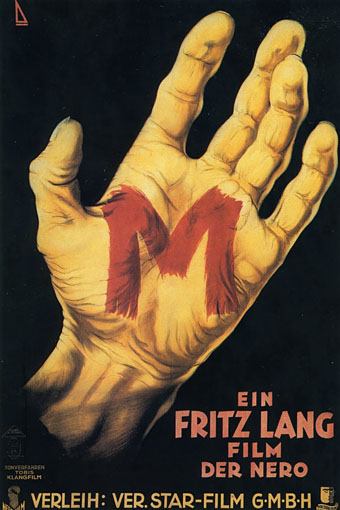
2: M (1931), a film by Fritz Lang.

m-poster.jpg

Thea von Harbou’s script for M is based in part on the Haarmann case although Lang’s child-killer is shown preying on girls rather than boys. Peter Lorre is superb in his first major role as the murderer, while Lang’s use of the new sound technology is remarkably inventive when compared to his stagey contemporaries in Hollywood.

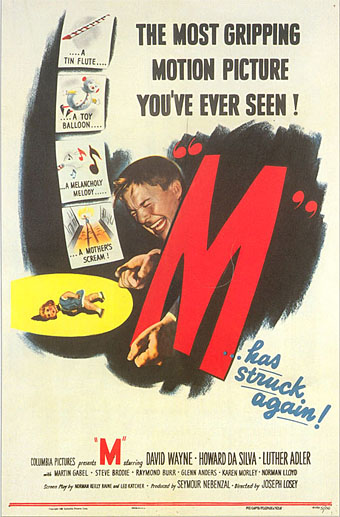
3: M (1953), a film by Joseph Losey.

m-1951.jpg

Lang’s masterwork reworked as a Los Angeles film noir by Joseph Losey before McCarthyism sent him to Europe. This is one noir I still haven’t seen even though a major sequence takes place in that cult location, the Bradbury Building.

Continue reading “In Germany before the war”

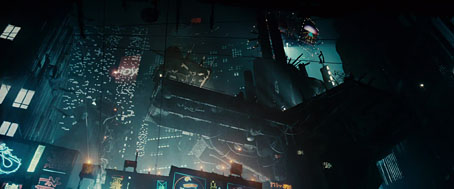
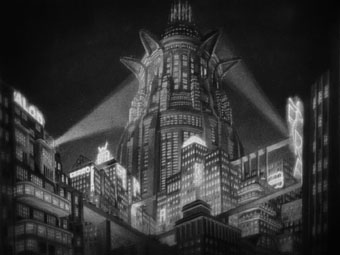
Blade Runner vs. Metropolis

br01.jpg

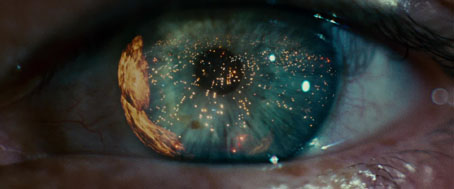
Given the chronology this should really be “Metropolis vs. Blade Runner” but most people are more familiar with Ridley Scott than Fritz Lang so I’ve let Blade Runner determine the order of the shots.

metropolis01.jpg

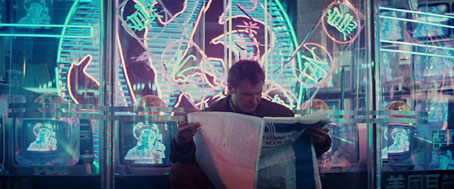
These shot comparisons aren’t exactly news but they’ve become more evident since rewatching the restored print of Metropolis. Among other things, the rediscovered footage yielded a scene with a character reading a newspaper that’s a match for Harrison Ford’s first appearance. The similarities extend, of course, to the thematic: futuristic megacities, flying vehicles, the creation of artificial human beings. Both films also end with a struggle to the death on the roof of a building. The cinematographer for Blade Runner was Jordan Cronenweth; Metropolis was the work of Karl Freund, Günther Rittau and Walter Ruttmann.

br02.jpg

metropolis02.jpg

br03.jpg

metropolis03.jpg

Continue reading “Blade Runner vs. Metropolis”

Einstein on the Beach

einstein1.jpg

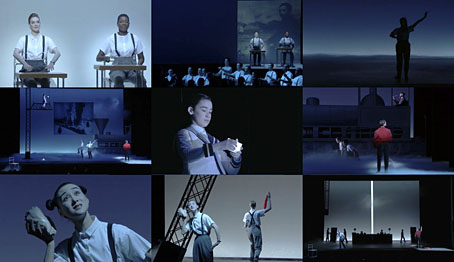
Well this was a revelation. Einstein on the Beach (1976) is Philip Glass’s first opera, a collaboration with theatrical producer Robert Wilson, and the only Glass opera with which I’m familiar. With a running-time of almost five hours it’s not light listening, and when many of the pieces consist of little more than slabs of keyboard or choral arpeggios it’s always been evident that visuals are required to augment music that otherwise threatens to outstay its welcome.
einstein2.jpg

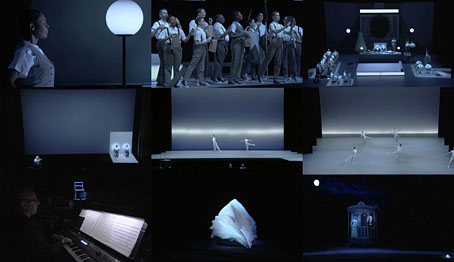
The opera has been revived several times, and in 2012 a touring presentation was staged. Despite it being one of the most celebrated works by Glass and Wilson a complete performance has never been filmed, until this month, that is, a staging at the Theatre du Chatelet in Paris. The shots here are from a video stream of the entire four-and-a-half hour show, and it’s astonishing to discover how much your appreciation is elevated—and the music enhanced—by the performance and the production.

Einstein’s life is the ostensible subject but it’s up to the audience to interpret the many allusive symbols and motifs that may (or may not) be derived from either the man’s biography or his scientific theories. The libretto is strictly formal and fragmented, and while the score alone may drive some listeners to distraction the visuals change continually, maintaining the interest while the text and music work through their cycles. Philip Glass had this to say about the work in 2012:

The opera isn’t a narrative about Einstein’s life. What connected Bob and I was how we thought about time and space in the theatre. We worked first with the time—four hours—and how we were going to divide it up. Then we thought about the images, and then the staging. I discovered that Bob thinks with a pencil and paper; everything emerged as drawings. I composed music to these, and then Bob began staging it.

Yet the piece is actually full of Einstein. Practically every image comes from Einstein’s life or ideas: trains, spaceships, clocks. And I suggested we have a musician taking his part, because Einstein played the violin—although he was such an amateur musician he couldn’t possibly have played the music I composed for him. (more)
einstein3.jpg

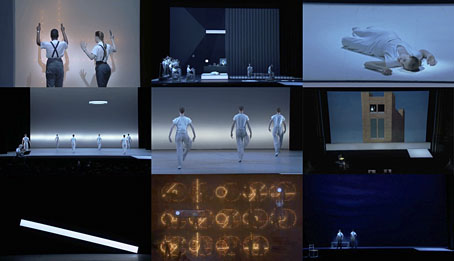
I’ve seen many photos of Wilson’s designs for the opera in the past but static views do nothing to convey the drama and impact of his designs when you see them coming together on the stage. The same goes for the performers, many of whom are required to be trained dancers as well as actors: several scenes are elaborate dance pieces. It’s been a pleasure to see at last the presentation of the mysterious “Knee Play” sections which separate the four acts. And I was surprised by the similarity—intentional or not—of some sequences to the shots of the slaving workers in Fritz Lang’s Metropolis, especially the climactic (and incredible) “Spaceship” scene where the whole stage erupts into light and movement. It’s easy to see why New York’s art crowd were so beguiled by this opera following its first performances in the 1970s, it really is a remarkable piece of work. The streaming version will apparently remain active for a while (there’s also a DVD release planned), and while I wouldn’t want anyone to indulge in piracy I’ll note that there’s currently a torrent of the entire video circulating if you know where to look. If you’ve any time for Philip Glass I can’t recommend this too highly. (Via Metafilter.)

Previously on { feuilleton }
Milton Glaser album covers