An unseasonable bloom

orchid1.jpg

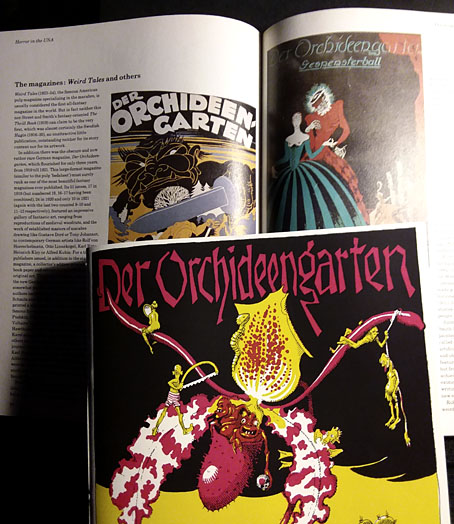
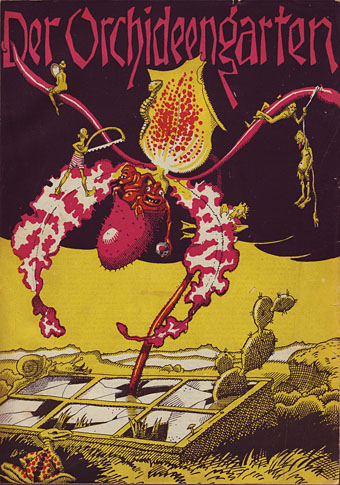
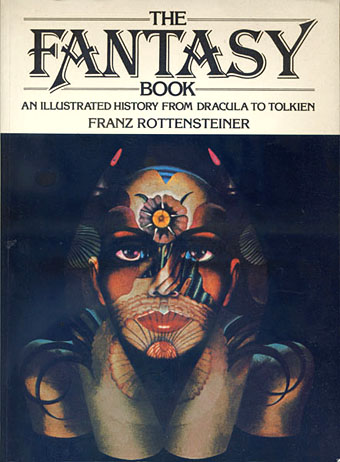
It’s a strange thing to compare the covers of Der Orchideengarten in Franz Rottensteiner’s The Fantasy Book (1978) with the facsimile of the first issue which has just been published by Zagava. For years the two covers and Rottensteiner’s laudatory description were all I knew of a magazine that nobody else seemed to write about. As with all such enigmas, this made the magazine all the more intriguing. Der Orchideengarten was short-lived, running from 1919 to 1921, and German, which no doubt did little to aid its post-war reputation. Whatever reputation it may have had was quickly eclipsed by Weird Tales and a host of other Anglophone publications some of whose creations still dominate the fantasy landscape today. One of the many services Rottensteiner’s study provided was to treat fantasy as a genre with manifestations all over the world, not only in Britain and America.

orchid2.jpg

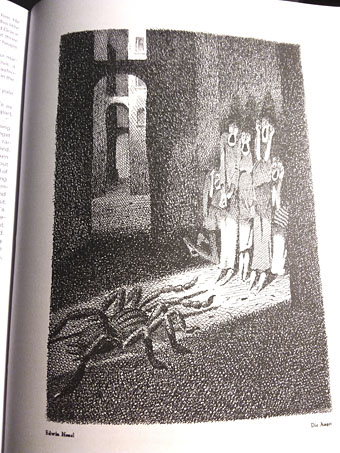
The visibility of Der Orchideengarten began to change in 2009 when Will at the now-defunct A Journey Round My Skull, having also had his curiosity piqued by Rottensteiner’s book, acquired a few copies of the magazine. I ran some of the interior illustrations here, the sight of which was genuinely revelatory since these weird and macabre drawings had been buried for 90 years. The situation changed again late last year when the entire run of the magazine was made available at the University of Heidelberg’s remarkable online archive.

What struck me in 2009—and what continues to strike me today—is the difference in tone between the illustrations, covers included, of Der Orchideengarten with its later Anglophone counterparts, especially Weird Tales. The latter presented itself very much in the pulp tradition, and many of the illustrators of the early issues were just as happy working with adventure or detective titles as they were with fantasy or horror. The German artists are less illustrational and much more grotesque, closer at times to Expressionist painting than anything you’d find in an American magazine. I continue to wonder how fantasy as a genre might have developed if it had owed less to Britain’s ghost stories and America’s adventure idioms.

orchid3.jpg

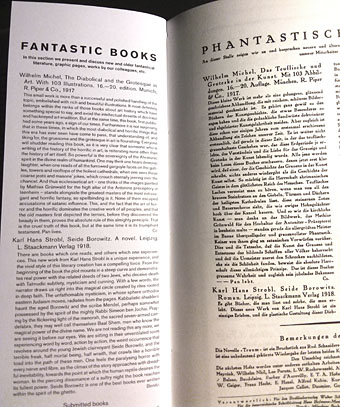
Any speculation is easier now we have this facsimile of the first issue which (as I mentioned in a weekend post) contains a translation into English by Helen Grant of the complete contents of the magazine. This has been cleverly achieved by interleaving narrower pages of translated text with the originals so the integrity of the magazine is maintained. The facsimile is a quality production with superb printing of all the illustrations and graphics. One of the ironies of our connected world is that contemporary magazines continue to be killed off while the easier accessibility of so much culture from the past makes resurrections like this one more likely.

orchid4.jpg

Whether we see more facsimile issues will no doubt depend on the success of this first number which may be ordered here. A few more page samples follow.

Continue reading “An unseasonable bloom”

Heavy Metal, October 1979: the Lovecraft special

hm1.jpg

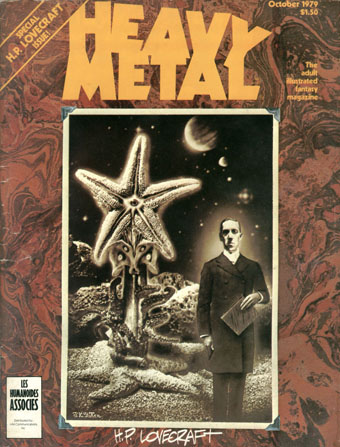
Mr Lovecraft by JK Potter.

HP Lovecraft died seventy-five years ago on 15th March, 1937. Twenty-five years ago I was halfway through drawing my comic strip adaptation of The Call of Cthulhu, conscious at the time that, yes, it was fifty years ago today… I mentioned at the weekend the special Lovecraft edition of Heavy Metal that was published in October 1979; of the many stimuli that led to the drawing of CoC, this magazine was by far the most important. Given the date, now seems as good a time as any to say something about it.

hm2.jpg

Illustration for the contents page by Stephen R. Bissette.

Heavy Metal was the US offshoot of Métal Hurlant, the sf/fantasy comics magazine founded by Jean Giraud (Moebius), Philippe Druillet and Jean-Pierre Dionnet in 1974. Copies of Métal Hurlant could be found in London but none ever made it further north. The advent of Heavy Metal provided an invaluable introduction to a generation of European artists whose work was otherwise difficult to find. Even better: their stories were being translated into English for the first time. The late 70s was a dizzying period for a Lovecraft reader: HR Giger appeared apparently out of nowhere in 1977 when Big O published the first UK collection of his art (which I couldn’t afford at the time), a book with Necronomicon in the title; a year later Thames & Hudson published Franz Rottensteiner‘s The Fantasy Book, an overview of the genre that devoted eight pages to Lovecraft and Arkham House, and which included many illustrations I’d never seen before; in 1979 Giger was all over the newspapers and magazines thanks to Alien; then in October the Lovecraft special dropped onto the shelves. I was stunned: this was that rare occasion when someone creates exactly the thing you want to see at precisely the right moment.

hm3.jpg

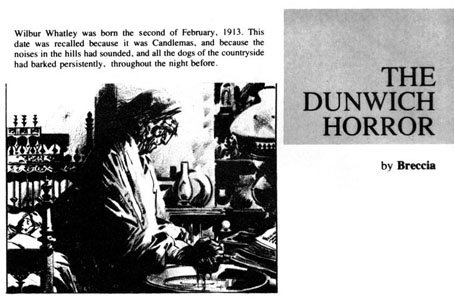
The Dunwich Horror by Alberto Breccia. A superb adaptation.

Looking back, the issue isn’t quite as good as it seemed at the time: many of the stories are slight, a couple have nothing whatever to do with Lovecraft, and, Breccia aside, none of the artists tackle the major works. What counted in the end was the idea of the issue, the implication that Lovecraft’s imagery was there to be seized and reworked in visual form. There were better issues of the magazine, before and after, but for the next six years this one remained for me a tantalising possibility. They hadn’t got it quite right…what if someone else did? After searching comic shop shelves in vain I eventually decided to have a go myself.

Continue reading “Heavy Metal, October 1979: the Lovecraft special”

Weekend links 6

dkng.jpg

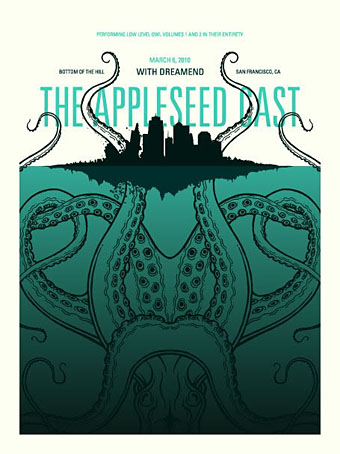
Shades of Toho: the city of San Francisco encounters its octopoid nemesis on this gig poster from DKNG. Via OMG Posters!

• Related to the above: Godzilla Haiku.

View from Another Shore: a fantastic (so to speak) and overdue interview with Franz Rottensteiner, writer and editor of landmark studies of fantasy and science fiction.

Ronald Searle: a life in pictures: an appreciation by Guardian cartoonist Steve Bell.

• 832 masks: The Maskatorium at Flickr.

The Cult of the Theremin: lots of theremin links including this page of scans from a beautiful Art Deco theremin brochure. (Thanks to Kara for the tip!) Related: the DIY IKEA lamp theremin.

Music & Science Fiction, an exhibition at Maison d’Ailleurs.

• Nathalie found a stoned angel in Rome.

• EVB’s Boy of the Week is a Spanish guy in his underwear drawn by Jacobo Labella.

• Film of the month: Sally Potter’s Orlando on DVD, featuring the luminous enigma of Tilda Swinton.

Der Orchideengarten

orchideengarten.jpg

Will at A Journey Round My Skull turned up some gold this week in the form of several covers from a German periodical, Der Orchideengarten, which ran for 51 issues from 1919 to 1921. This is generally credited as being the world’s first fantasy magazine which makes its unaccountable obscurity all the more surprising. Both Will and I first encountered the magazine in Franz Rottensteiner’s essential history of fantasy, The Fantasy Book, published by Thames & Hudson in 1978, with a US edition produced by Collier Books. As well as being a wide-ranging history, Rottensteiner’s book is profusely illustrated throughout and includes two tantalising and distinctly weird covers from Der Orchideengarten, a magazine which Rottensteiner describes as “one of the most beautiful fantasy magazines ever published.” Over the years I’ve found myself becoming thoroughly acquainted with most of the book’s contents as authors were discovered and various gaps filled. One of the few points of obscurity left was that column which describes Der Orchideengarten and those two covers. So you can perhaps appreciate the excitement at seeing more of these rare specimens brought to light.

strobl.jpg

There’s no need to repeat the history when you can read it for yourself on Will’s page and see the covers. One of the magazine editors was author Karl Hans Strobl whose collection of weird tales, Lemuria, had been published two years earlier. This monochrome copy of the cover design is by Richard Teschner, taken from one of my Art Nouveau design books where it stands out like a rather grotesque sore thumb. I don’t know if Teschner was a contributor to Der Orchideengarten but on the strength of this he should have been.

Update: Will posts some interior illustrations.

Elsewhere on { feuilleton }
The illustrators archive

Previously on { feuilleton }
The Great God Pan
Jugend Magazine
Meggendorfer’s Blatter
Simplicissimus