The Englishman who Posted Himself and Other Curious Objects

tingey.jpg

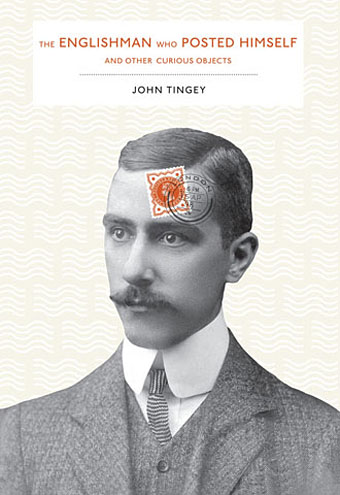
Cover design by Deb Wood.

Arriving most appropriately by post last week from Princeton Architectural Press was this fascinating book by John Tingey, an account of Mr W. Reginald Bray (1879–1939) of South London, and his games with the British postal service:

In 1898, Bray purchased a copy of the Post Office Guide, and began to study the regulations published quarterly by the British postal authorities. He discovered that the smallest item one could post was a bee, and the largest, an elephant. Intrigued, he decided to experiment with sending ordinary and strange objects through the post unwrapped, including a turnip, a bowler hat, a bicycle pump, shirt cuffs, seaweed, a clothes brush, even a rabbit’s skull. He eventually posted his Irish terrier and himself (not together), earning him the name “The Human Letter.”

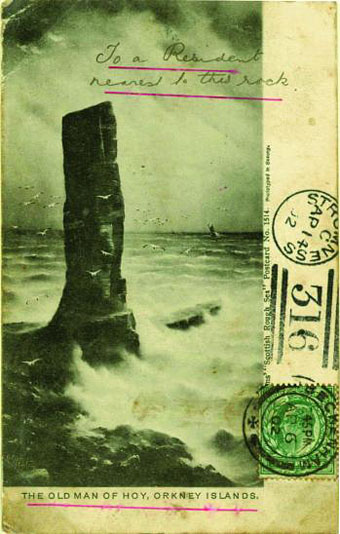
In addition to posting himself (twice!), Bray also challenged the nation’s postmen by addressing his cards and letters with rebuses, with longitude and latitude coordinates or, as in the example below, a pictorial clue to the location of the recipient. Tingey’s book is illustrated throughout with examples of Bray’s inventiveness, and includes a selection of the autographs he plied from famous individuals of the era (many of whom, it should be noted, are now very un-famous indeed). One of the few people to refuse an autograph was a name with which I’m familiar, the British Symbolist painter George Frederick Watts, and his letter of refusal is also included.

The Englishman who Posted Himself and Other Curious Objects may be purchased direct from the publisher.
tingey2.jpg

Previously on { feuilleton }
A postcard from Doctor Kafka

Weekend links 31

bock.jpg

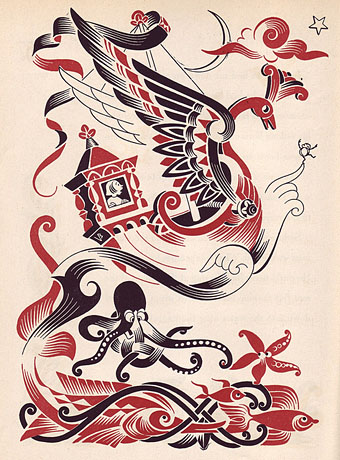
One of a series of illustrations by Vera Bock for A Ring and a Riddle (1944) by M.Ilin and E. Segal. Via A Journey Round My Skull.

The Creator of Devotion: Photos from a Vogue Hommes Japan feature by Matthew Stone. And also here.

Dressing For Pleasure: Jonny Trunk gets out the rubber gear. Related: King of Kinky.

Salvator Rosa (1615–1673) is having a show at the Dulwich Picture Gallery, London.

Hackney Dissenting Academy #1: Throbbing Gristle, Iain Sinclair & Alan Moore.

Out Of The Flesh (1984) by Chakk. A great single never reissued on CD.

• Photographer Charles Gatewood remembers William Burroughs.

mural.jpg

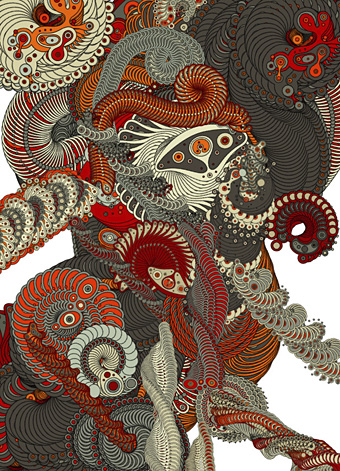
The Endless Mural. Follow links here to have a play around.

Vinyl record sales are at the top of a four-year sales trend.

Can explosions move faster than the speed of light?

• Buckminster Fuller’s Dymaxion Car is reborn.

• Maximus Clarke talks with William Gibson.

Why Stephen Fry loves Wagner.

Kafka’s Last Trial.

• Alice Coltrane in concert, Warsaw, 1987: Harp solo | Impressions | Lonnie’s Lament | A Love Supreme.

Jugend, 1896

jugend-96-05.jpg

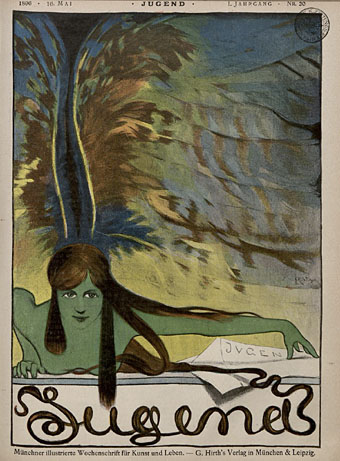
So, then, I’ve now looked through several thousand pages of Jugend magazine and a few things have become apparent. If you’re interested in fin de siècle art and design then all the most interesting material is in the first four years of the magazine’s run, from 1896 on. After 1900 there are still examples of the florid Art Nouveau motifs which filled their earlier pages but the overall style becomes progressively dull, with endless pictures of German towns and hearty country folk. The magazine also begins to reflect an obviously belligerent mood in the country as a whole, pictures of military types and patriotic themes proliferate and the satirical material grows overtly aggressive towards neighbouring nations. Racist cartoons are to be expected—British magazines of the period are much the same—but there’s also a vicious antisemitism boiling away in later issues of Jugend which creates a toxic mix when seen beside the war-mongering on display elsewhere.

jugend-96-01.jpg

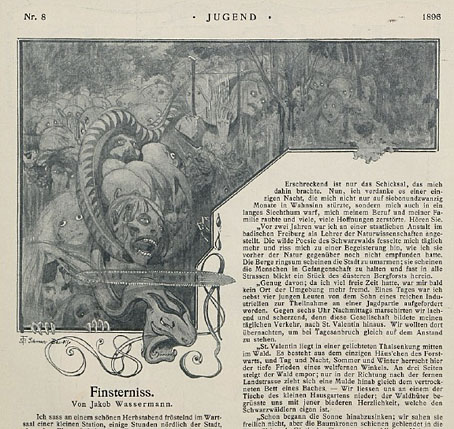
Politics aside, these magazines are still a revelation. Pan magazine was being published at the same time (its entire run is also available in the Heidelberg archives) and is the finer journal if it’s art you’re interested in. But Jugend, being a lighter read, contains a wealth of strange and surprising illustrations. Many are naive or just plain bad, of course, but some are quite remarkable. This is the first of a number of posts I’ll make which highlight illustrations that catch my eye. I’ll also be making some follow-up posts about individual artists as the magazine has been a great introduction to minor illustrators I’ve not come across before. This first post is from the two volumes covering 1896 which can be browsed and downloaded here and here.

Continue reading “Jugend, 1896”

Weekend links 3

orator.jpg

It’s a curious feeling when a drawing which is nearly 26 years old makes it out into the world. The image above is the cover of a new 7″ single release, Dominion of Avyaktam by metal band Orator, the picture being something I drew in 1984 entitled Mahakala after the Tibetan deity which it depicts. The inspiration was the cover of another recording, a Nonesuch Explorer album, Tibetan Buddhism – Tantras Of Gyütö: Mahakala, and also the track Mahakala by 23 Skidoo from their 1983 album The Culling is Coming. The skull is drawn from a real one I was given. Looking at this today none of the elements seem to work together—and the landscape stuff looks like a lazy way of filling in space—but it’s nice to see it find a home. Dominion of Avyaktam is out now on the Legion of Death label.

• Surprise of the week: two books I’ve worked on were nominated for Nebula Awards, Jeff VanderMeer’s Finch, and Kage Baker’s The Hotel Under the Sand whose interior I designed.

• More music: a recording of Paul Schütze’s Third Site played live in 1999 (with Clive Bell, Raoul Björkenheim, Simon Hopkins & Thomas Köner’s voice) is now available as a free download on his website. More Schütze: Paul Schütze & Simon Hopkins playing a set at the Horbar in Hamburg on December 28, 2009.

• The incredible pinscreen animations of Alexander Alexeieff and Claire Parker are finally available on DVD. Also new to DVD, Alan Bennett at the BBC, a four-disc set of some of his TV plays including a particular favourite of mine, his Kafkaesque drama The Insurance Man.

• More Ghost Box business: Jon Brooks aka The Advisory Circle has a blog. And Ghost Box’s Jim Jupp was interviewed recently by Peter Bebergal at Mystery Theater. Related (forgot to mention this last week): The ASDA Mix, a great mixtape of spooky retro weirdness by Moon Wiring Club available for free at The Wire.

The trailer for Mellodrama, a documentary about the Mellotron by Dianna Dillworth.

• The Parajanov Festival will be screening some of the director’s films in London and Bristol.

• Lots of weird and wonderful exhibits at the ~Wunderkammer~.

La Tour by Schuiten & Peeters

tour1.jpg

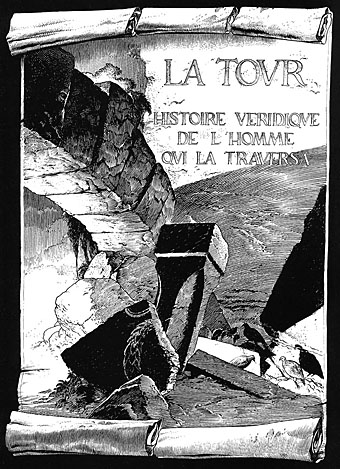
La Tour (1987) by François Schuiten and Benoît Peeters is the third story in the Cités Obscures series, although it’s the fourth volume if you want to be strictly canon about things, L’archivist, a guide to places in the Obscure World, having preceded it.

piranesi1.jpg

Carcere Oscura by Piranesi (1750).

This is another book where Schuiten and Peeters’ interests tick a list of my own obsessions, being a tale which seems to originate in the question “What would it be like if you crossed Piranesi‘s Prisons etchings with Bruegel’s Tower of Babel?” The protagonist of La Tour, Giovanni Battista, has his name borrowed from Piranesi’s forenames and his appearance taken from Orson Welles’ Falstaff in Chimes at Midnight. The story owes something to Kafka, although it lacks Kafka’s drift towards paradox, concerning a colossal building referred to throughout as The Tower, a structure we only ever see in close-up—and then mostly from the inside—but whose height must reach several thousand feet.

tour2.jpg

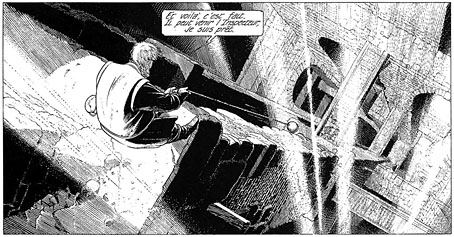
Battista (above) is one of the Keepers, a group of men charged with maintaining small sections of the Tower whose structure suffers continual decay and collapse. Tired of years spent in complete isolation, and concerned that other Keepers aren’t doing their job, Battista goes in search of the Tower’s feared Inspectors, only to discover that the lack of maintenance is endemic and few of the Tower’s scattered residents have any idea of the origin or purpose of the vast building where they’ve spent their lives, never mind a concern for its upkeep. There are no Inspectors, and while Battista is worried at the beginning about vines in the stonework, we later see small forests growing among the ruins. Kafka resonances come with the mention of the mysterious Base, and the equally mysterious Pioneers, those builders and engineers who went ahead years or even centuries before, climbing skyward.

Continue reading “La Tour by Schuiten & Peeters”