Weekend links: the Halloween edition

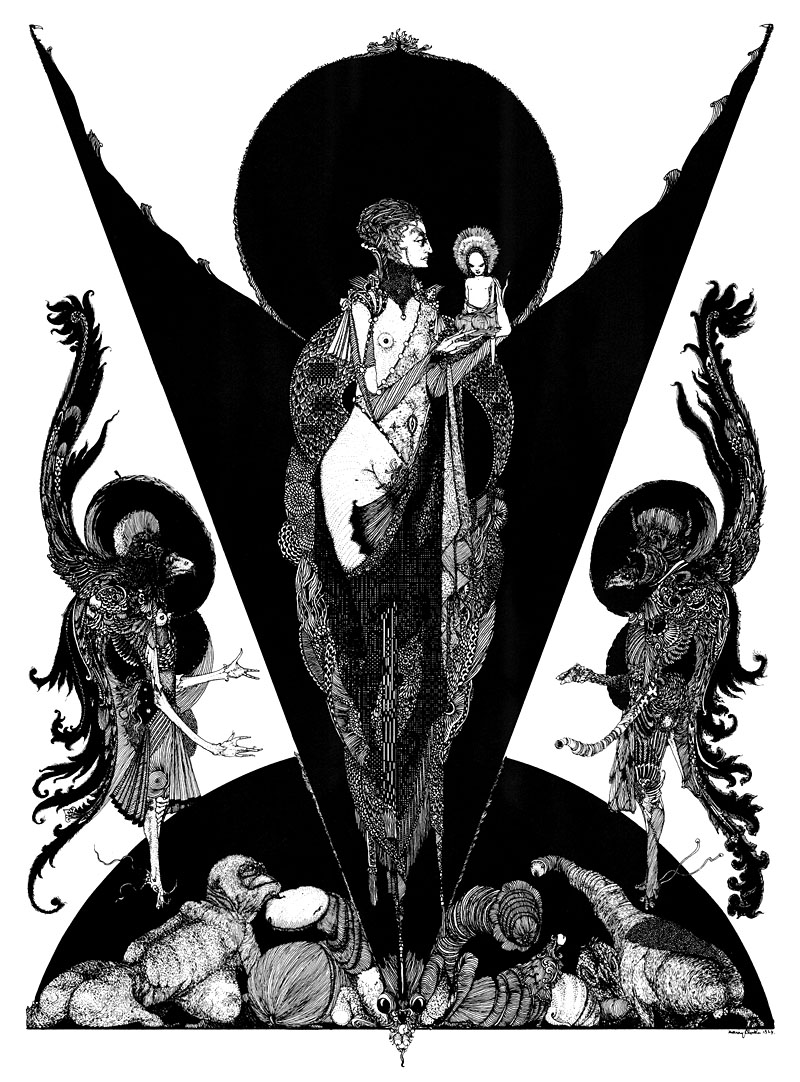
goddem.jpg

Goddem with Attendants (1924) by Harry Clarke.

• Some of Harry Clarke’s extraordinary illustrations from Goethe’s Faust can be seen at A Journey Round My Skull. And a reminder for anyone who missed them, Clarke’s Poe illustrations at Golden Age Comic Book Stories.

HP Lovecraft – Audio Books, Radio Plays, & Audio Documentaries. Out-of-print recordings and (no doubt) pirate copies of more recent things. I found this page by accident so it was a surprise to see my 1999 Lovecraft portrait used there. I used to own the David McCallum Dunwich Horror, an album with a singularly appalling sleeve illustration.

• Better album sleeves can be found here: Prospective 21e Siècle, a collection of foil designs from 1967. Some of the very challenging music within can be downloaded at the Avant Garde Project archive. Related: Have an electroacoustic Halloween with İlhan Mimaroğlu’s Le Tombeau d’Edgar Poe (1964) and Wings of the Delirious Demon (1969).

startrails.jpg

Star Trails and the Captain’s Ghost, a photo by Chris Kotsiopoulos at Astronomy Picture of the Day.

• “The horror industry is totally male dominated from its directors to its slashers, and even its bloggers…and I think that needs to change.” Day of the Woman, a blog for the feminine side of fear.

6 of the Scariest Queer Horror Books Ever. I think I’d agree with the commenter in picking The Haunting of Hill House by Shirley Jackson.

• Designer Jonathan Barnbrook (pictured in a graveyard by the looks of things) is interviewed at MyFonts.

A Weird and Scratching Beauty: The Art of John Coulthart and Call of Cthulhu.

Is the Royal Masonic School for Boys the scariest building in Britain?

50-million-year-old insect trove found in Indian amber.

The Café Kaput Samhain 2010 mixtape.

The Groovy Age of Horror.

Monster Mash (1962) by Bobby “Boris” Pickett & The Crypt-Kickers.
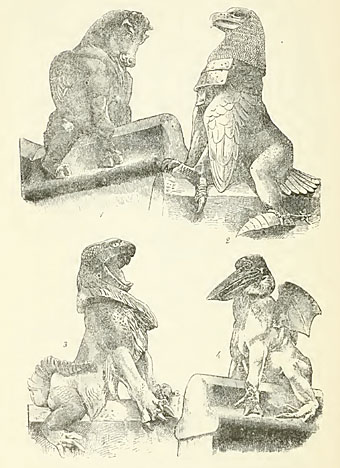
Monsters in art

monstres1.jpg

Frontispiece for Goethe’s Faust (c. 1843) by Eugène Delacroix.

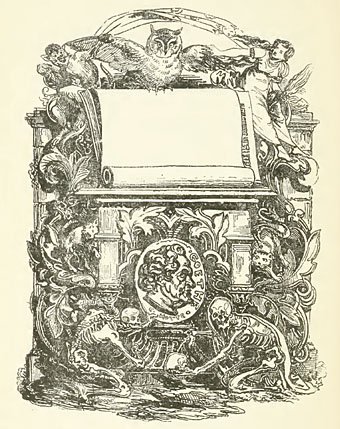
Or a couple of pages from Les monstres dans l’art; êtres humains et animaux bas-reliefs, rinceaux, fleurons, etc., a study of aesthetic teratogenesis by Edmond Valton from 1905. The Delacroix frontispiece gives a better view than the one at the Davison Art Center but they have more of the Faust lithographs. Emmanuel Frémiet’s animals were created to adorn the restored medieval Château de Pierrefonds for Napoleon III. The artist had smaller ceramic copies of the statues made later, of which the lizard is an improvement on the stone version.

monstres2.jpg

Fantastic animals (c. 1870) by Emmanuel Frémiet.

Previously on { feuilleton }
The House with Chimaeras
Frémiet’s Lizard

Weekend links 19

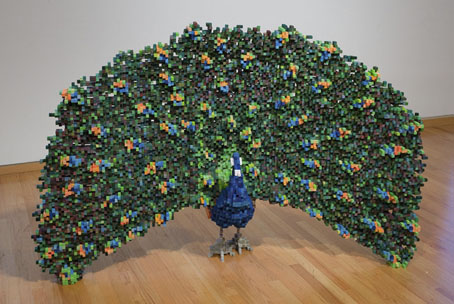
smith.jpg

Peafile (2006) by Shawn Smith; plywood, ink, acrylic paint.

Surreal Friends, an exhibition of work by Leonora Carrington, Remedios Varo and Kati Horna at the Pallant House Gallery, Chichester, UK. Related: The surrealist muses who roared, Leonora Carrington and other women Surrealists profiled.

Landscapes From a Dream: How the Art of David Pelham Captured the Essence of JG Ballard’s Early Fiction. A graphic design essay at Ballardian.

• “(T)he significant thing is not the behaviour of the players but the attitude of the spectators: and, behind the spectators, of the nations who work themselves into furies over these absurd contests, and seriously believe — at any rate for short periods — that running, jumping and kicking a ball are tests of national virtue. (…) It is the most violently combative sports, football and boxing, that have spread the widest. There cannot be much doubt that the whole thing is bound up with the rise of nationalism — that is, with the lunatic modern habit of identifying oneself with large power units and seeing everything in terms of competitive prestige.” The Sporting Spirit by George Orwell, December 1945.

• One of my cult pop albums from the 1980s, A Secret Wish by Propaganda, is reissued in a 25th anniversary edition next month. I no doubt have most of the bonus tracks already but the prospect is still irresistible.

Tangier Cut-Up, an uncollected piece by William Burroughs from Esquire, September 1964.

Ghostwriter —  The Continuing Adventures Of The Strange Sound Association.

Faust And Last And Always: Germany’s Most Radical Rock Group Talk.

Hollingsville at Resonance FM. Related: Graphic Design on the Radio.

iPad Publishing No Savior for Small Press, LGBT Comics Creators.

The Largest Oil Spills in History, 1901 to Present.

1948 Buick Streamliner by Norman E Timbs.

Neville Brody’s work on display in Tokyo.

Dr Mabuse (1984) by Propaganda; Vladek Sheybal, cowled monks, Fritz Lang references and Anton Corbijn directing.

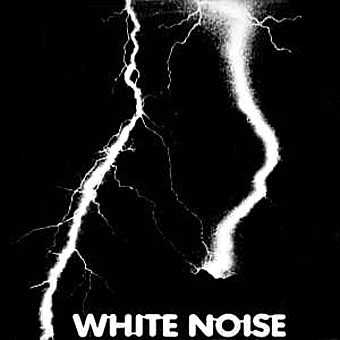
White Noise: Electric Storms, Radiophonics and the Delian Mode

white_noise.jpg

Many sounds have never been heard—by humans: some sound waves you don’t hear—but they reach you. “Storm-stereo” techniques combine singers, instrumentalists and complex electronic sound. The emotional intensity is at a maximum. Sleeve note for An Electric Storm, Island Records, 1969.

An Electric Storm by White Noise is reissued in a remastered edition this week. It’s a work of musical genius and I’m going to tell you why.

Hanging around with metalheads and bikers in the late Seventies meant mostly sitting in smoke-filled bedrooms listening to music while getting stoned. Among the Zeppelin and Sabbath albums in friends’ vinyl collections you’d often find a small selection of records intended to be played when drug-saturation had reached critical mass. These were usually something by Pink Floyd or Virgin-era Tangerine Dream but there were occasionally diamonds hiding in the rough. I first heard The Faust Tapes under these circumstances, introduced facetiously as “the weirdest record ever made” and still a good contender for that description thirty-four years after it was created. One evening someone put on the White Noise album.

It should be noted that I was no stranger to electronic music at this time, I’d been a Kraftwerk fan since I heard the first strains of Autobahn in 1974 and regarded the work of Wendy Carlos, Tangerine Dream, Brian Eno and Isao Tomita as perfectly natural and encouraging musical developments. But An Electric Storm was altogether different. It was strange, very strange; it was weird and creepy and sexy and funny and utterly frightening; in places it could be many of these things all at once. Electronic music in the Seventies was for the most part made by long-hairs with banks of equipment, photographed on their album sleeves preening among stacks of keyboards, Moog modules and Roland systems. You pretty much knew what they were doing and, if you listened to enough records, you eventually began to spot which instruments they were using. There were no pictures on the White Noise sleeve apart from the aggressive lightning flashes on the front. There was no information about the creators beyond their names and that curious line about “the emotional intensity is at a maximum”. And the sounds these people were making was like nothing on earth.

Continue reading “White Noise: Electric Storms, Radiophonics and the Delian Mode”