Power Spot by Michael Scroggins

powerspot.jpg

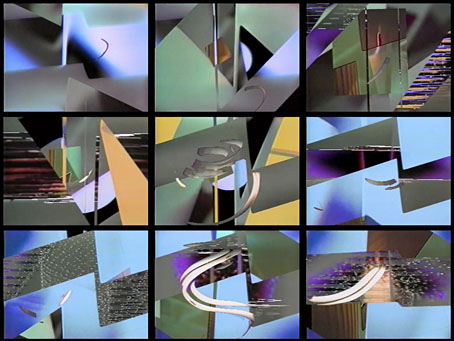
I was going to post this anyway but there’s a coincidental connection with yesterday’s post in the person of Richard Horowitz whose keyboards can be heard on the soundtrack. The music is Power Spot, the opening number on the album of the same name released by ECM in 1986. Also present on the album are Brian Eno (who co-produces with Daniel Lanois), Michael Brook and others. I’d tell you that Power Spot is a great album but then I like everything Hassell does so I’m rather biased. But it is a great album.

Michael Scroggins’ video was commissioned to accompany the release of the album, and if it looks of its time today it’s still an impressive piece, not least because Scroggins says it was created through live improvisation. That puts it in a different class to earlier abstract accompaniments for music which are either animated frame-by-frame or created independently with the music added later. (Thanks to Paul Schütze for the tip.)

Elsewhere on { feuilleton }
The abstract cinema archive

Weekend links 210

usaoov.jpg

Crashing Diseases And Incurable Airplanes (2014) by USA Out Of Vietnam. Artwork by Amy Torok.

Amy Torok’s cover art for the debut album by Canadian band USA Out Of Vietnam is pleasingly reminiscent of the surreal and psychedelic collages of Wilfried Sätty. The music within has been described as “a cross between ELO and Sunn O)))” which it is up to a point, although to these ears the group are more in the Sunn O))) camp than the post-Beatles pop of Jeff Lynne and co. The sound is big whatever label you apply, and promises much for the future.

Mysterious creatures of Monterey Bay Aquarium’s ‘Tentacles’. The Aquarium bought one of my drawings last year for this exhibition which juxtaposes tentacular artwork with live creatures. The show runs until 2016.

• Jon Hassell’s 1990 album, City: Works Of Fiction, has been reissued in an expanded edition including a live concert collaboration with Brian Eno, and a collection of remixes/alternate takes.

• Photographer Jonathan Keys uses antique camera equipment to give his views of contemporary Britain a patina of the past.

Roman Polanski and the man who invented masochism. Nicholas Blincoe on Leopold von Sacher-Masoch and Venus in Fur (sic).

• Mixes of the week are by James Pianta, E.M.M.A. (whose Blue Gardens album I helped design), and Balduin.

• Sweet Jane unearths another great article about psychedelic London: The Fool and Apple Boutique, 1968.

• “Did Chris Marker think history to be not only an infinite book but a sacred one?” asks Barry Schwabsky.

• Front Free Endpaper on the story behind the cover photo of A Boy’s Own Story by Edmund White.

Mapping the Viennese Alien Event Site. Christina Scholz explores another Zone.

Moondog: The Viking of 6th Avenue. The first and only movie about Moondog.

Rick Poynor on rediscovering the lost art of the typewriter.

• At BLDGBLOG: 100 Views of a Drowning World.

Miguel Chevalier’s magic carpets

Venus In Furs (1967) by The Velvet Underground | Sex Voodoo Venus (1985) by Helios Creed | Venus As A Boy (1993) by Björk

Weekend links 203

budich.jpg

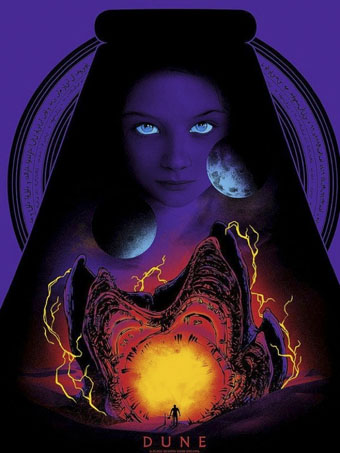
A Dune-inspired piece by Joshua Budich for In Dreams: an art show tribute to David Lynch at Spoke Art.

• “[Montague] Summers was a friend of Aleister Crowley and, like [Jacques d’Adelswärd] Fersen, conducted homoerotic black masses; whatever eldritch divinity received their entreaties was evidently propitiated by nude youths.” Strange Flowers goes in search of the Reverend Summers.

• More Jarmania: Veronica Horwell on the theatrical life of Derek Jarman, Paul Gallagher on When Derek Jarman met William Burroughs, and Scott Treleaven on Derek Jarman’s Advice to a Young Queer Artist.

Robert Henke of Monolake talks to Secret Thirteen about his electronic music. More electronica: analogue-synth group Node have recorded a new album, their first since their debut in 1995.

This hypertrophied response to decay and dilapidation is what drives the “ruin gaze”, a kind of steroidal sublime that enables us to enlarge the past because we cannot enlarge the present. When ruin-meister Giovanni Piranesi introduced human figures into his “Views of Rome”, they were always disproportionately small in relation to his colossal (and colossally inaccurate) wrecks of empire. It’s not that Piranesi, an architect, couldn’t do the maths: he wasn’t trying to document the remains so much as translate them into a grand melancholic view. As Marguerite Yourcenar put it, Piranesi was not only the interpreter but “virtually the inventor of Rome’s tragic beauty”. His “sublime dreams”, Horace Walpole said, had conjured “visions of Rome beyond what it boasted even in the meridian of its splendour”.

Frances Stonor Saunders on How ruins reveal our deepest fears and desires.

Gustave Doré. L’imaginaire au pouvoir: Four short films from the Musée d’Orsay to accompany their current exhibition, Gustave Doré (1832–1883): Master of Imagination.

• At Dangerous Minds: Remembering Cathy Berberian, the hippest—and funniest—lady of avant-garde classical music.

• “Merely a Man of Letters”: Jorge Luis Borges interviewed in 1977 by Denis Dutton & Michael Palencia-Roth.

Luke Epplin on Big as Life (1966), a science-fiction novel by EL Doctorow which the author has since disowned.

The Psychomagical Realism of Alejandro Jodorowsky: Eric Benson talks to the tireless polymath.

• A video essay by Matt Zoller Seitz for the 10th anniversary of David Milch’s Deadwood.

Eugene Brennan on Scott Walker’s The Climate of Hunter (1984).

Dune at Pinterest.

• Prophecy Theme from Dune (1984) by Brian Eno | Olivine (1995) by Node | Gobi 110 35′ south 45 58′ (1999) by Monolake

Opening the Seven Gates of Transcendental Consciousness

burchette1.jpg

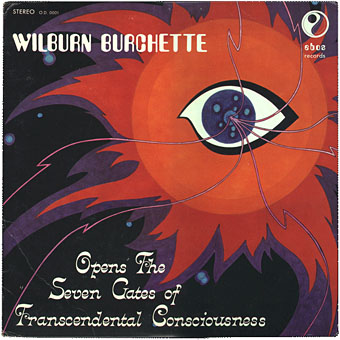
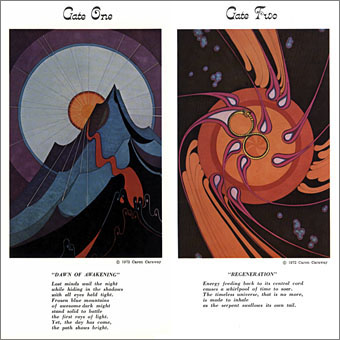
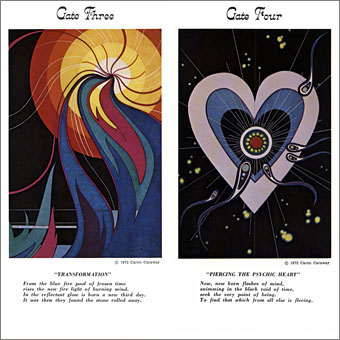
Wilburn Burchette Opens The Seven Gates Of Transcendental Consciousness (1972). Art by Caren Caraway.

For the next two weeks I’ll be playing out the end of the year with a 2-CD compilation from Light In The Attic, I Am The Center (Private Issue New Age Music In America, 1950–1990), 20 tracks of ambient/meditation music, most of which has never been widely distributed before. The “New Age” label is a thing I’ve loathed for years so buying this has meant trashing a decades-long embargo; it helps to examine your prejudices now and then.
burchette2.jpg

New Age in the 1970s referred, among other things, to the oft-promised, seldom-evident “Age of Aquarius”, a term vague enough to be used on albums by Steve Hillage, Manuel Göttsching and others without referring to anything specific. In the 1980s it was taken up by publishers as a marketing label, a catch-all for anything “spiritual” or mildly occult. (I can’t imagine the Goetic Demons ever being called New Age, even if you sprayed them pink.) Out went all the witchy strangeness of the occult boom of the 1970s—spiky typefaces, magical primers sold like Dennis Wheatley novels—in came a profusion of pastel shades, airbrushed pyramids and sparkly, crystal things. Having a fondness for the witchy strangeness I wasn’t impressed. I was even less impressed when New Age became a prevalent label for a style of instrumental music which was too obtrusive to be ambient (in the Brian Eno sense of the word), and also too bland and unassertive to be either jazz or electronica. The popularity of labels such as Windham Hill meant that the large record chains started using New Age as another catch-all label, this time for anything that wouldn’t fit the rock, jazz or folk categories. Along with Windham Hill releases you’d find Eno’s ambient recordings, Harold Budd, Jon Hassell, various German things like Cluster, and anything else that resisted easy labelling. The way the music business tries to hammer everything into a small number of boxes has always been annoying but this seemed like a major insult, hence my loathing of the term.
burchette3.jpg

I Am The Center is a curious album in that it embraces both the recent New Age music label while also harking back to the spiritual yearnings of the 1970s. The general effect is of an impossible collision between the Harold Budd of Pavilion of Dreams, Steve Hillage’s Rainbow Dome Musick, and the lighter moments of Alice Coltrane. Many of the tracks are so good I’ve been searching through Discogs.com to discover more about the artists which is how I came across this album art from Wilburn Burchette. Witch’s Will is Burchette’s track on I Am The Center, from his Guitar Grimoire (1973) album. Looking through his discography, with its attention-grabbing titles and cover art, it’s surprising that his albums haven’t yet been reissued. This will no doubt change soon, especially when his music is like an American equivalent of Achim Reichel’s spacey guitar improvisations. The sleeve and booklet art for Wilburn Burchette Opens The Seven Gates Of Transcendental Consciousness is by Caren Caraway, and the album features notes by the indefatigable UFO/paranormal researcher Brad Steiger. They really don’t make them like this any more.

Joe Muggs enthused about I Am The Center last month for FACT. As I said about the Outer Church album earlier this year, compilations provide an invaluable service in concentrating the attention on overlooked or under-examined areas of music. I’m looking forward to seeing what emerges in the wake of this one.

Continue reading “Opening the Seven Gates of Transcendental Consciousness”

Ear to the Ground

tieghem.jpg

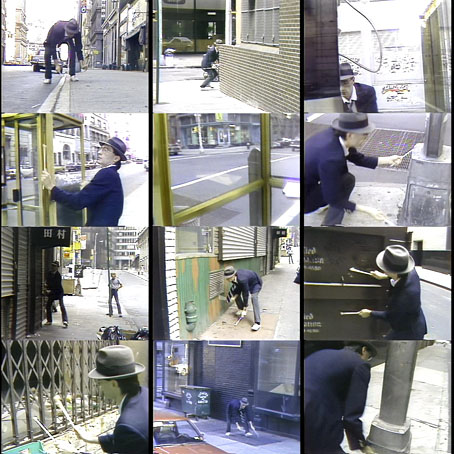
The name of percussionist David Van Tieghem won’t be familiar to most people, but if you’ve ever heard Eno & Byrne’s My Life In The Bush Of Ghosts, Speaking In Tongues by Talking Heads, any of Laurie Anderson’s early albums or Steve Reich’s Music For 18 Musicians then you’ve heard some of Van Tieghem’s session work.

For Ear to the Ground, a four-minute video piece by John Sanborn & Kit Fitzgerald, Van Tieghem leaves the recording studio to play the city streets of New York: pavements, fences, doorways, etc. This may be a typical product of the NYC art crowd of the late 1970s but it also seems prescient for the way it predicts the urban percussion/performance that would flourish a couple of years later in Europe, a micro-genre exemplified by Einstürzende Neubauten, 23 Skidoo, Test Department, the Bow Gamelan Ensemble and others. Watch Ear to the Ground at Ubuweb.