Language of the Birds: Occult and Art

laffoley.jpg

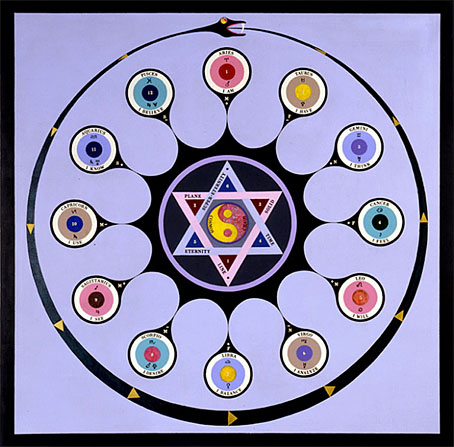
Astrological Ouroboros (1965) by Paul Laffoley.

Language of the Birds is an occult-themed art show at 80WSE, New York University, that opened this week and runs to 13 February, 2016. Curator Pam Grossman has assembled a stunning collection of work by artists, occultists, and occult-artists old and new:

Kenneth Anger * Anohni * Laura Battle * Jordan Belson * Alison Blickle * Carol Bove * Jesse Bransford * BREYER P-ORRIDGE * John Brill * Robert Buratti * Elijah Burgher * Cameron * Leonora Carrington * Francesco Clemente * Ira Cohen * Brian Cotnoir * Aleister Crowley * Enrico Donati * El Gato Chimney * Leonor Fini * JFC Fuller * Helen Rebekah Garber * Rik Garrett * Delia Gonzalez * Jonah Groeneboer * Juanita Guccione * Brion Gysin * Frank Haines * Barry William Hale * Valerie Hammond * Ken Henson * Bernard Hoffman * Nino Japaridze * Gerome Kamrowski * Leo Kenney * Paul Laffoley * Adela Leibowitz * Darcilio Lima * Angus MacLise * Ann McCoy * Rithika Merchant * William Mortensen * Rosaleen Norton * Micki Pellerano * Ryan M Pfeiffer & Rebecca Walz * Max Razdow * Ron Regé, Jr. * Rebecca Salmon * Kurt Seligmann * Harry Smith * Kiki Smith * Xul Solar * Austin Osman Spare * Charles Stein * Shannon Taggart * Gordon Terry * Scott Treleaven * Panos Tsagaris * Charmion von Wiegand * Robert Wang * Peter Lamborn Wilson * Lionel Ziprin

carrington.jpg

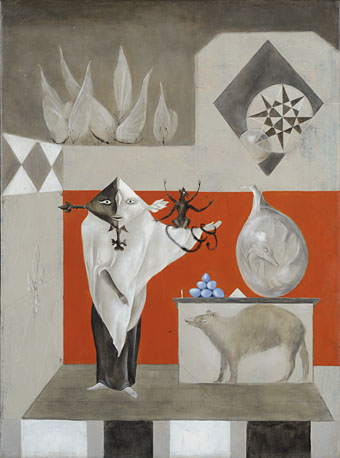
El Nigromante (1950) by Leonora Carrington.

More details for lucky New Yorkers may be found here. In addition, there’s an Occult Humanities Conference that runs through the weekend of February 5th.

More Spare things

spare.jpg

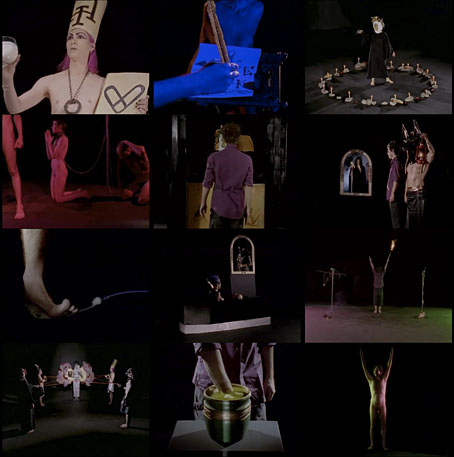
A couple of Austin Spare-related news items arrive in the same week so it’s worth linking again to Earth: Inferno (2003), a short film by Mor Navón & Julián Moguillansky based on the book by Austin Osman Spare. This is a production I have to damn with faint praise by being pleased that Spare is the focus of the work while being disappointed in the film as a whole. Despite the elaborate costumes, careful tableaux and copious nudity, Earth: Inferno confirms that an occult film needs to be more than a record of people dressing up and gesturing hieratically. If nothing else, occult rituals transform the perceptions of those involved, and this quality should be represented or implied in any film dealing with magical operations. The films of Kenneth Anger and Derek Jarman show different approaches, with the raw image transformed by superimposition, exaggerated grain, accelerated/decelerated motion, and so on. Inauguration of the Pleasure Dome and In the Shadow of the Sun are examples to follow. And now the news:

Lost Envoy: The Tarot Deck of Austin Osman Spare, edited by Jonathan Allen & Mark Pilkington. Out later this year from the fabulous Strange Attractor.

Surrealism, Austin Osman Spare and the Occult Underground of 1890s and 1990s London:

Nadia Choucha discusses the context and evolution of her ground-breaking book, Surrealism and the Occult, first published in 1991. The book traces the evolution of Surrealist ideas and situates them within the occult currents of fin-de-siècle European culture, revealing how these currents infused the work of various thinkers and artists in their quest for the ‘marvellous’. The work of Austin Osman Spare is also discussed as a way of comparing and contrasting his methods and techniques with those of the Surrealists. With the 25th anniversary of the publication of the book approaching, this evening will also present an analysis of the work as occurring within a unique historical and cultural moment.

Jun 23rd, 6:30 pm–8:00 pm at the Last Tuesday Society, London.

Previously on { feuilleton }
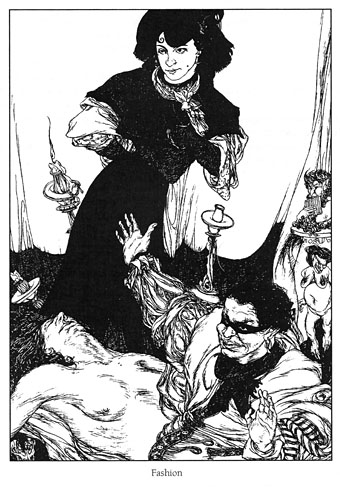
A Book of Satyrs by Austin Osman Spare
Spare things
Dreaming Out of Space: Kenneth Grant on HP Lovecraft
MMM in IT
Abrahadabra
Murmur Become Ceaseless and Myriad
New Austin Spare grimoires
Austin Spare absinthe
Austin Spare’s Behind the Veil
Austin Osman Spare

A Book of Satyrs by Austin Osman Spare

spare01.jpg

The Oxford English Dictionary notes that the word “satire” is

Formerly often confused or associated with satyr, from the common notion (found already in some ancient grammarians) that Latin ‘satira’ was derived from the Greek ‘satyr’, in allusion to the chorus of satyrs which gave its name to the Greek ‘satyric’ drama.

The word derives from “satura”

in early use a discursive composition in verse treating of a variety of subjects, in classical use a poem in which prevalent follies or vices are assailed with ridicule or with serious denunciation (OED)

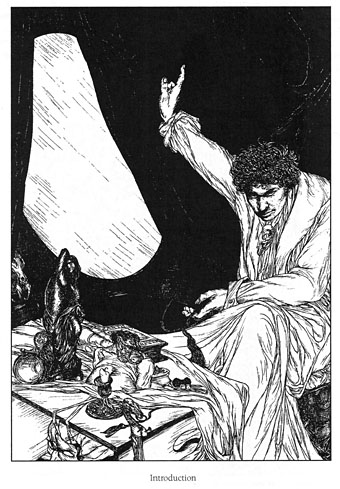
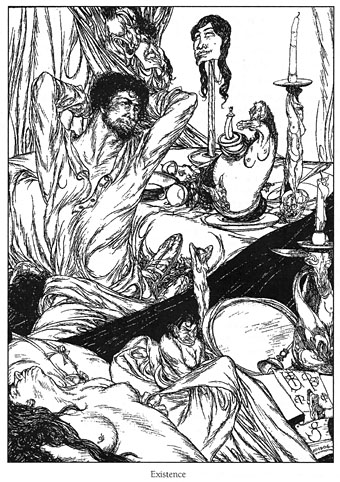
but Austin Osman Spare’s A Book of Satyrs deliberately confuses satyr with satire, being a collection of satirical drawings among which may be found a small number of satyrs. Spare’s book was published in 1907 in an edition of 300 copies; it was reprinted by John Lane in 1909, and has been reissued since but any edition of Spare seems fated to vanish almost as soon as it appears, hence this unauthorised scan at the Internet Archive. Technically, these are some of the most detailed drawings that Spare produced so it’s to their benefit that the copies are a decent size; the meaning may not always be clear but you can at least wander among the accumulations of body parts, masks and bric-a-brac. Most are dated 1906, Spare’s 20th year.

spare02.jpg

spare03.jpg

Continue reading “A Book of Satyrs by Austin Osman Spare”

Weekend links 257

tarot.jpg

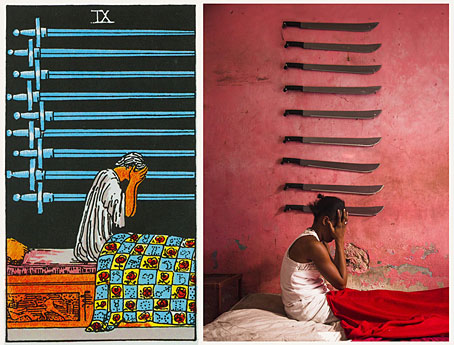
The Nine of Swords by Pamela Colman Smith, and the same card from The Ghetto Tarot, a Haitian deck created by photographer Alice Smits and Haitian art group Atis Rezistans.

Almost four months after the murders in Paris, Charlie Hebdo continues to be problematic, to use a common epithet. The “p” word occurs with such frequency in current discussions about offence—and those discussions so often seem like a secular version of old religious arguments, with Manichean forces pitted against each other, and the same schisms, heresies and witch hunts—that I’ve taken to translating “problematic” as “sinful”. Charlie Hebdo is nothing if not a heretical text even if many of those pronouncing on its heresies have never read a copy. Back in January I was confident that we’d be seeing a great deal of equivocation (if not outright victim-blaming) when people began to look closely at the magazine, or at least read hasty appraisals of its contents. You didn’t have to be a psychic to predict any of this because the equivocations are merely the current manifestation of a familiar syndrome. This week’s authorial objections about PEN America honouring Charlie Hebdo have led to a reiteration of the grumblings we heard in January: “Yes, of course, we condemn the violence but…” But, what? “But, it’s a sinful publication…”(This piece by one of the PEN objectors in the LRB is typical.) Publication liberties, which in the UK are more constrained than in the US, are apparently best championed for the virtuous (the responsible, the respectful, etc), not the sinful. In 1963 “Yes, but…” equivocations about freedom of speech were being deployed in the letters page of the Times Literary Supplement with worthies such as Victor Gollancz and Edith Sitwell wondering why it was necessary to defend a deplorable book like The Naked Lunch; in 1992 I sat in a courtroom watching a judge make similar comments when grudgingly overturning an obscenity ruling against David Britton’s Lord Horror novel. The same judge then upheld the obscenity charge against Britton & Guidio’s Meng & Ecker comic which he regarded as trashier fare, “luridly bound” and containing “pictures that will be repulsive to right-thinking people”.

So much for old arguments. Jodie Ginsberg at Index on Censorship goes into some detail about the PEN kerfuffle in a piece entitled “I believe in free expression, but…”; Justin EH Smith for Harper’s says:

I heard from [friends and equals] countless variations on the banality that “violence is always wrong.” How did I know that this judgment, though perfectly true in itself, was only a banality, the expression of a sentiment that had little to do with pacifism? By the clockwork predictability of the “but” that always followed.”

Kenan Malik, who writes a great deal about these issues (his new book is The Quest for a Moral Compass: A Global History of Ethics) posted a statement from Jo Glanville from English PEN, and a lengthy piece by Leigh Phillips. This affair will rumble on.

• More sinful material: Samuel R. Delany’s Hogg is a novel so transgressive/offensive that it took 26 years to find a publisher. You seldom see any mention of the book when Delany’s work is being discussed, especially in prudish SF circles, but Dennis Cooper’s blog ran a retrospective feature about it this week. Caveat lector. Related: Stories for Chip: A Tribute to Samuel R. Delany is looking for crowdfunding.

• “[Judy] Oppenheimer relates that Jackson kept a library of over two hundred books on witchcraft, and her interest in the subject was not purely academic.” Martyn Wendell Jones on Shirley Jackson.

The Satyr and Other Tales, a collection by Stephen J. Clark, the title story of which is “inspired by the life and ethos of sorcerer and artist Austin Osman Spare”.

• Mixes of the week: Bacchus Beltane 2: The Mists of Avalon by The Ephemeral Man, and The Ivy-Strangled Path Vol. VI by David Colohan.

Boy and his SIR: BDSM and the Queer Family, a photo series by Kevin Warth, and Xteriors II, a photo series by Desiree Dolron.

• The Quest for Stenbock: David Tibet talks to Strange Flowers about his obsession with the eccentric Count.

Dark Star: HR Giger’s World is a documentary about the artist by Belinda Sallin.

1 in 3 Impressions, a free EP of Moog music by M. Geddes Gengras.

The rise and fall of the codpiece

Blade Runner Reality

Some Weird Sin (1977) by Iggy Pop | Sin In My Heart (1981) by Siouxsie and The Banshees | It’s A Sin (1987) by Pet Shop Boys

Yuggoth details

yuggoth01.jpg

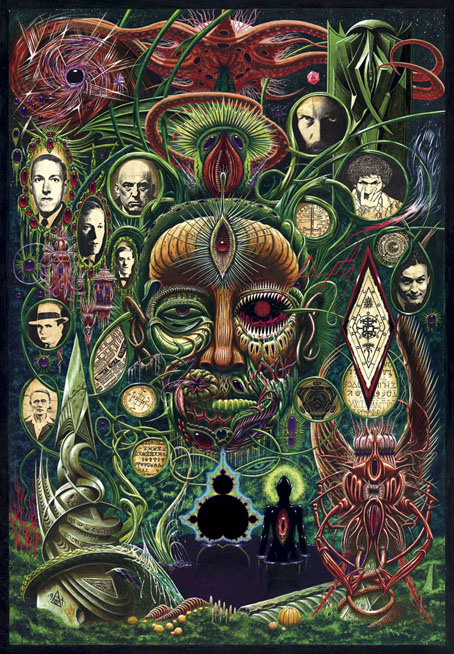
Yuggoth Cultures (1994) by John Coulthart.

Earlier this week I spent a day scanning this painting—which I’m now surprised to find is 21 years old—so I might at last have a good quality digital copy. There’s been a copy on the website for years but that was a print made at a high-street copy shop that did nothing for the detail and range of colour. It’s quite a large piece—49.54 x 71.39 cm (19.5 x 28.1 inches)—done with acrylics on board. Since 2003 the painting has been used (in another poor reproduction) on the cover of The Starry Wisdom, the controversial collection of Lovecraftian fiction from Creation Books. The painting wasn’t originally intended for that collection, however, and doesn’t quite fit since a number of the portraits don’t feature in the book at all.

Yuggoth Cultures would have been an earlier collection of Lovecraftian fiction and non-fiction that Alan Moore had begun writing for Creation in 1993. Alan’s idea was to take Lovecraft’s Fungi from Yuggoth sonnet sequence as the basis for a collection that would explore Lovecraft’s fictional world and also draw together a variety of figures from the same era: fellow writers, occultists like Aleister Crowley and Austin Spare, and Harry Houdini for whom Lovecraft ghost-wrote Imprisoned with the Pharaohs in 1924. Unfortunately the stars were not right on this occasion; Alan took the sole copy of the half-written manuscript to London in order to read selections at an event in Soho but left the papers in a cab. Some pieces survived, having been copied and stored elsewhere—The Courtyard in The Starry Wisdom is one of these—and there was talk for a while of the lost pieces being rewritten but enthusiasm for the project flagged.

yuggoth08.jpg

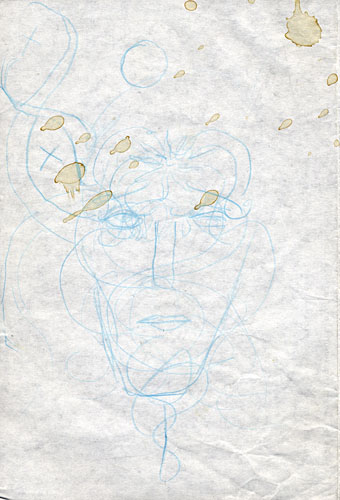
This is Alan’s sketch for the cover, the idea being to have a Lovecraft head made of fungal growths rather like an Arcimboldo painting. The head would be sprouting tendrils whose loops would contain pictures of some of the people featured in the book. Alan’s quick sketch is actually a better approximation of Lovecraft’s strange features than my painted version which isn’t narrow enough. For the record (and because people always ask), the other people on the cover are Alan himself, Austin Osman Spare, Aleister Crowley, Harry Houdini, Robert E Howard (not Al Capone as people often think) and Clark Ashton Smith.

yuggoth09.jpg

yuggoth10.jpg

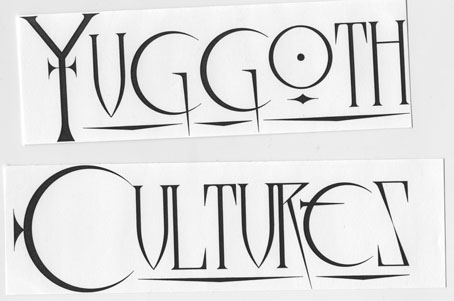
While searching through the archives I discovered these lettering designs although they’re probably not bold enough to read very well on such a busy painting. Before I started using a computer, designs like this had to be drawn at large size then scaled down using a photocopier.

Continue reading “Yuggoth details”