The Age of Enchantment: Beardsley, Dulac and their Contemporaries

dulac.jpg

“Everything about her was white.” Illustration by Edmund Dulac for
The Dreamer of Dreams by Queen Marie of Roumania (1915).

A major exhibition of British fantasy illustration opens at the Dulwich Picture Gallery this Wednesday, running to February 17th, 2008. Considering the huge resurgence of popularity in fantasy for children I’m surprised none of the UK galleries have done this before now. The Dulwich organisers have chosen a suitably wintry picture by the wonderful Edmund Dulac to promote the exhibition which—intentionally or not—happens to look like a precursor of the poster art for The Golden Compass.

With the death of Aubrey Beardsley in 1898, the world of the illustrated book underwent a dramatic change. Gone were the degenerate images of scandal and deviance. The age of decadence was softened to delight rather than to shock. Whimsy and a pastel toned world of childish delights and an innocent exoticism unfolded in the pages of familiar fables, classic tales and those children’s stories like The Arabian Nights and Hans Andersens’ Stories. These were published with lavish colour plates and fine bindings: these were the coffee table books of a new age.

As a result a new generation of illustrators emerged. This new group of artists was intent upon borrowing from the past, especially the fantasies of the rococo, the rich decorative elements of the Orient, the Near East, and fairy worlds of the Victorians. The masters of this new art form were artists like Edmund Dulac and Kay Nielson, whose inventive book productions, with those of Arthur Rackham, became legendary. Disciples gathered, like Jessie King and Annie French, the Scottish masters of the ethereal and the poetic, the Detmold Brothers, masters of natural fantasy, as well as those who remained in Beardsley’s shadow: the warped yet fascinating works of Sidney Sime, a joyously eccentric coal-miner turned artist, Laurence Housman, master of the fairy tale, the precious inventions from the classics by Charles Ricketts, the Irish fantasies of Harry Clarke, himself a master of stained glass as well as the gift book, and the rich and exotic world of Alaistair. Children’s stories were transformed by the imaginations of a group still bowing to the Victorians Walter Crane, Randolph Caldecott and Kate Greenaway and the fairies of Richard Doyle but these were now given a more colourful intensity by Charles Robinson, Patten Wilson, Anning Bell, Bernard Sleigh and Maxwell Armfield.

The exhibition of British fantasy illustration will be the first such exhibition in Britain and the first worldwide for over 20 years (the last being in New York in 1979). All works, of which over 100 are planned, will come largely from British museums and private collections, many of these will never have been seen publicly before in Britain.

The exhibition is curated by Rodney Engen.

AS Byatt reviewed the exhibition for The Guardian and also looked at the sinister perversity underlying many of the Edwardian fairy tales.

Edmund Dulac at Art Passions

Books by Queen Marie of Roumania:
The Dreamer of Dreams (1915; illus: Edmund Dulac)
The Stealers of Light (1916; illus: Edmund Dulac)
Vom Wunder der Tränen (1938; illus: Sulamith Wülfing)

Elsewhere on { feuilleton }
The illustrators archive

Previously on { feuilleton }
Masonic fonts and the designer’s dark materials
Ave Atque Vale!

ave.jpg

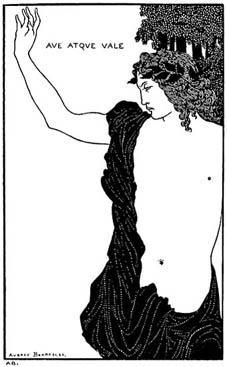
Aubrey Beardsley illustrates Catullus for The Savoy, no. 7 (1896).

Farewell then, Mister Aitch, now he’s decided to call it a day at the wonderful and unique Giornale Nuovo. He’d been blogging (must we call it that? It seems we must…) for five years which probably makes him first generation in the concentrated timescale of web-existence. Five years is a long time to be doing anything never mind regularly throwing hard-won morsels of research to the browsing hordes.

His posts will be missed here since it was his journal, along with a handful of others (Bldg Blog, The Nonist, BibliOdyssey among them), which confirmed for me that this discipline could have a purpose beyond mere diaristic vanity, something I enjoy reading but had no desire to engage in myself. One of the specialist concerns at Giornale Nuovo was the etching or engraving and Mister Aitich managed to cover this area so comprehensively I frequently found that artists I’d considered writing about were already discussed there in far greater detail than I could summon the energy (or the book resources) for myself. Those book resources are a thing of wonder and I remain eternally jealous of Mister Aitch’s library.

Happily Giornale Nuovo will remain online as an archive, which is good to hear. This raises again the spectre of what’s to happen to all this energy and activity when we let it go. Books regularly outlive their creators but all these fragile electronic media are dependent on the whims of webhosts and developing technology. Do we want this work to survive for the benefit of future historians or not? Or should we celebrate it as ephemeral and transient? What happens when the web advances beyond Unix networks, PHP and HTML? The British Library has already expanded its deposit scheme to encompass electronic works but online publications differ from their paper equivalent in that the publisher—legally obliged in the UK to send one copy of every printed volume to the British Library—is invariably also the author. What happens if the author dies before they have a chance to submit their work which then sinks into the swamp of a billion other weblogs? When do you decide to submit a work which is forever unfinished?

I’ll leave those questions to librarians and the scholars at the Long Now Foundation who consider some of the issues presented by the prospective obsolescence of present technology. In the meantime we’ll raise a farewell toast to Mister Aitch and wish him all the very best. Don’t be hesitant in browsing his archives, there’s a wealth of eclectic, eccentric and neglected culture there deserving of your attention.

Strange cargo: things found in books

books1.jpg

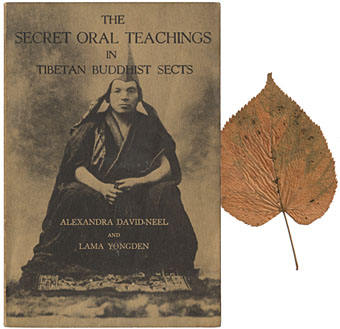
The Secret Oral Teachings in Tibetan Buddhist Sects by Alexandra David-Neel & Lama Yongden, City Lights Books (1972).

One of the additional pleasures of buying old books besides finding something out-of-print (or, it has to be said, something cheap) occurs when those books still possess traces of their previous owners. A recent posting on The Other Andrew’s page concerned book inscriptions, something any book collector will be used to seeing. Less common are the objects which slip from the pages when you’ve returned home. There are several categories of these.

1: Bookmarks

I have a substantial collection of bookmarks proper, from embossed strips of leather to the more mundane pieces of card of the type that bookshops frequently give away. But I also make a habit of using odd inserts to mark a place as did the previous owners of these volumes. The City Lights book (above) came with a very fragile leaf inside it which may well be as old as the book. Another City Lights book I own, the Artaud Anthology from 1965, included a newspaper article about Artaud. Newspaper clipping inserts are discussed below.

Continue reading “Strange cargo: things found in books”

The art of John Austen, 1886–1948

austen1.jpg

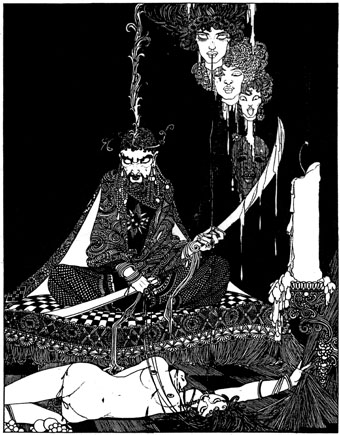
A few drawings by British illustrator John Austen (1886–1948), like Patten Wilson another artist whose work is hard to come by today. Austen was one of the many young illustrators over whom Aubrey Beardsley’s etiolated shadow fell from 1900 onwards and it’s the first ten years of Austen’s work I find most interesting, mainly because of the Beardsley stylings. He’s not as original or as elegant as Harry Clarke but he’s a lot better than the frequently overrated (yet interesting for other reasons) Hans Henning Voigt, or Alastair as he preferred to be known.

Continue reading “The art of John Austen, 1886–1948”

My pastiches

rev3cov.jpg

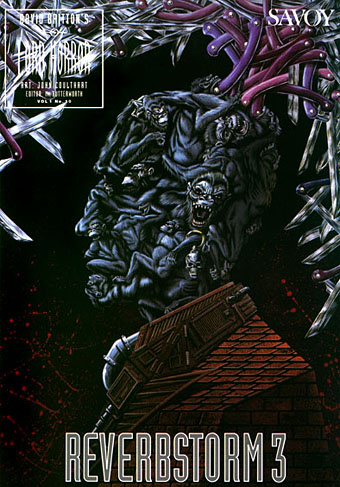
Lord Horror: Reverbstorm #3 (1992).

Following from the post about an art forgery exhibition (and Eddie Campbell discussing his American Gothic cover for Bacchus), I thought I’d post some of my own forgeries, or pastiches as we call them when no deception is intended.

Reverbstorm was the Lord Horror comic series I was creating with David Britton for Savoy in the 1990s. The Modernist techniques of collage (as in the work of Picasso and others) and quotation (as in TS Eliot’s The Waste Land) became themes in themselves as the series developed, so it seemed natural to imitate the styles of various artists as we went along. Pastiche is also a chance to flagrantly show off, of course, and I can’t deny that this was also one of my impulses here.

Issue #3 of Reverbstorm had marauding apes as its theme, from the Rue Morgue to Tarzan and King Kong, so I had the idea of doing an ape cover in the style of the celebrated paintings by Giuseppe Arcimboldo (1527–1593) which make human heads out of fruit, flowers or animals. Easy enough to have the idea but making it work took a lot of effort and required careful sketching beforehand, something I rarely do. The painting was gouache on board, a medium I’d been using for years and this was about the last gouache work I did before switching to acrylics.

Continue reading “My pastiches”