Mark Twain

twaintesla.jpg

Nikola Tesla and Mark Twain, 1894.

Mark Twain died 100 years ago today, April 21st, 1910, and the anniversary is being marked in America by a variety of events throughout the year, some of which are listed on this dedicated site. I’ve always been grateful to Twain for cheering a portion of my dismal school days with The Adventures of Huckleberry Finn, one of two books we were forced to read that I actually enjoyed. (The other was Lord of the Flies; both stories, perhaps significantly, concern Wild Boys.) I’ve wanted to re-read Huckleberry Finn for years, perhaps now would be a good time to actually do so.

Unlike many writers of his generation, Twain’s work still seems vital today, and not only his fiction. His broadsides and polemics return continually to basic issues of tolerance and humanity and are often as relevant now as they were a century ago. Twain had little patience for the hypocrisies of his fellows when it came to matters of religion, warfare or the treatment of other human beings; like his contemporary, Oscar Wilde, he’s always been endlessly quotable. Consider these two extracts:

Citizenship? We have none! In place of it we teach patriotism which Samuel Johnson said a hundred and forty or a hundred and fifty years ago was the last refuge of the scoundrel—and I believe that he was right. I remember when I was a boy and I heard repeated time and time again the phrase, ‘My country, right or wrong, my country!’ How absolutely absurd is such an idea. How absolutely absurd to teach this idea to the youth of the country. True Citizenship at the Children’s Theater, 1907

But the truth is, that when a Library expels a book of mine and leaves an unexpurgated Bible lying around where unprotected youth and age can get hold of it, the deep unconscious irony of it delights me and doesn’t anger me. Letter to Mrs FG Whitmore, February 7, 1907

(more)

…then wonder what Twain would have to say about America’s current crop of blustering yahoos with their flags and crosses and misspelled signs.

A copy of the first edition of The Adventures of Huckleberry Finn, illustrated throughout by EW Kemble, can be downloaded at the Internet Archive. For Twain’s dim view of the Bible and its adherents, see his Letters from the Earth. The Tesla Memorial Society has another photograph of Twain in the great inventor’s laboratory.

Repin and Ljuba

repin.jpg

Sadko in the Underwater Kingdom (1876).

This painting by Russian artist Ilya Yefimovich Repin (1844–1930) is included in one of my Symbolist art books despite its pre-dating the Symbolist period and there being little else in the artist’s career which might suit the label. It’s a curious picture, however, illustrating a medieval folk tale and depicting the moment when the Sadko of the title is forced by the Sea Tsar to choose a wife from a line of aquatic maidens. It was art historian Philippe Jullian who had me returning to Repin, and the reminder gives me an excuse to post something by Serbian Surrealist Ljuba (aka Ljuba Popovic) whose colours, fauna and metamorphic female figures are a match for Repin’s sirens. Last time I looked for Ljuba pictures there were few available, a situation which has now been remedied by blogs such as this one.

ljuba.jpg

Lot and Lotus (1972).

Previously on { feuilleton }
The art of Ivan Bilibin, 1876–1942
Magic carpet ride
Short films by Walerian Borowczyk
The art of Ljuba Popovic

Exposition Universelle films

expo2.jpg

The Exposition entrance at the Place de la Concorde.

Yes, films of the Paris Exposition Universelle of 1900. This week I’ve been reading Philippe Jullian’s book about the Exposition (more about the admirable Monsieur Jullian later) and it was only when he mentioned early cinema screenings as one of the entertainments that I realised I hadn’t looked for films of the Exposition itself. YouTube has the goods, of course, and those goods are unavoidably primitive given the age of the prints and the infancy of the medium. Quality isn’t the point, however, what matters is the thrill of looking back 110 years to see these fleeting structures and their visitors. Most of the footage seems to have been filmed by the Edison Company and the filmmakers conveniently let us know that it was the month of August. According to Jullian, Paris was suffering from a heatwave at the time but you wouldn’t know it from the way everyone is dressed although most of the women (and some of the men) are carrying parasols. In addition to the period footage, there’s also the channel of a 3D animator who’s been creating computer models of the buildings. I’ve thought for some time that these vanished expositions could be resurrected using 3D modelling so it’s encouraging to find someone doing exactly that.

The films:
Thomas Edison’s L’ Exposition Universelle de 1900 à Paris | A compilation of the shorts with intertitles.
Panoramic view of the Place de la Concorde
Esplanade des Invalides
Panorama from the Moving Boardwalk
Eiffel Tower lift
The Palace of Electricity

Update: The Edison shorts and some other Exposition clips not listed above can also be found in the Edison film archive at the Library of Congress. You need to go to this page and use the search term “paris” to receive a list. They’re still low-res, unfortunately, but at least the files haven’t been put through YouTube’s compression filters.

expo1.jpg

The Palace of Electricity.

Previously on { feuilleton }
Exposition jewellery
Exposition Universelle catalogue
Exposition Universelle publications
Exposition cornucopia
Return to the Exposition Universelle
The Palais Lumineux
Louis Bonnier’s exposition dreams
Exposition Universelle, 1900
The Palais du Trocadéro

Weekend links 11

orazi4.jpg

Panneaux decoratifs (1900) by Manuel Orazi at NYPL.

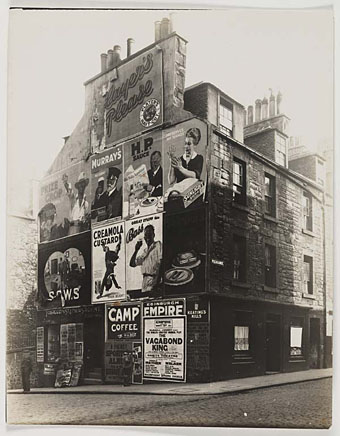
Ghostsigns: “a collaborative national effort to photograph, research and archive the remaining examples of hand painted wall advertising in the UK and Ireland.”

• Golden Age Comic Book Stories posts some Alphonse Mucha.

Voyage Fantastique – An illustrated guide to the body and mind at A Journey Round My Skull.

The gallery of the International Exhibition of Calligraphy.

Trevor Wayne Pin-Up Show, a new photo collection of the tattooed Mr Wayne which includes photos and a foreword by Clive Barker.

Phallophonies, a gallery exploring the penis in religious art. Related: “Churchgoers are outraged over a crucifix in a Catholic church that they say shows an image of genitalia on Jesus.”

Hollingsville: “Expect live and unscripted wanderings around voodoo science parks, examinations of cities as battle suits and thoughts on pods, capsules and world expos.”

Phantom Circuit #33 is a Ghost Box special featuring an interview with Jim Jupp (Belbury Poly) and Julian House (The Focus Group). Related: Ghost Box films at YouTube.

Eldritchtronica and Wyrd Bliss, a mixtape by Simon Reynolds.

• Avant garde music and cinema meet at The Sound of Eye.

• Make your own newspaper with Newspaper Club.

Drawdio: A pencil that lets you draw music.

Yoko Ono collects rare books.

KittehRoulette.

• Song of the week: The Four Horsemen (1972) by Aphrodite’s Child.

Record Store Day

vinyl.jpg

The White Album by Flickr user Fab.C.

April 17th is Record Store Day in the UK and the US, a celebration of the importance of small record shops. In the spirit of this {feuilleton} encourages you to show some love to your local music merchant if you can. There’s a website for the US side of things with details of special releases that bands have produced in support of the day. FACT Mag ran an A–Z of similar releases which will be available in the UK and the Guardian has an article interviewing Johnny Marr, Tracey Thorn, Jon Savage and others about their favourite places past and present. No surprise to see Manchester shops highlighted given the contributors; Johnny Marr plugs Piccadilly Records and Beatin’ Rhythm (the latter a great source for obscure psychedelia, among other things) while Mr Savage also recommends Kingbee out in the wilds of Chorlton, the place where he discovered The Tornados’ Do You Come Here Often, one of the songs on his Queer Noises compilation.