Ludwig’s Winter Garden

munich1.jpg

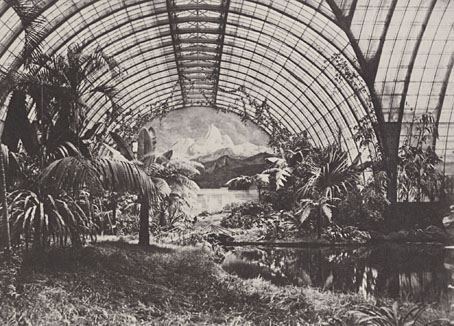
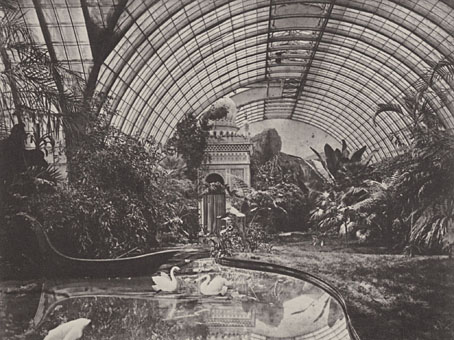
Another monarch, and another glass-canopied hothouse. The extravagances of Ludwig II of Bavaria have featured here before but I’d overlooked the Winter Garden he had built in 1871 on the roof of the Munich Residenz, the home of the Bavarian royal family when they were in the capital. The views here are by court photographer Joseph Albert, and there isn’t much else online apart from this page at the palace website where we can see another Albert photo, and a painting by Julius Lange showing the idealised vision the king would have had in mind. With its painted scenery, “Moorish” tent, and artificial lighting—including rainbow and moonlight effects—Ludwig’s garden looks back to the exotica of the Royal Pavilion at Brighton, and also ahead to our current crop of theme parks and fantasy worlds. The Winter Garden was demolished after Ludwig’s death but the Residenz still contains other splendours, not least the jaw-dropping excess of the Antiquarium.
munich2.jpg

Previously on { feuilleton }
The Schönbrunn Palm House
The Royal Greenhouses of Laeken
Arcades panoramas
Arcades
Schloss Falkenstein
Schloss Linderhof
Schloss Neuschwanstein
Passage des Panoramas
Passages 2
Passages

The Schönbrunn Palm House

palmenhaus1.jpg

Photo by Roberto Verzo.

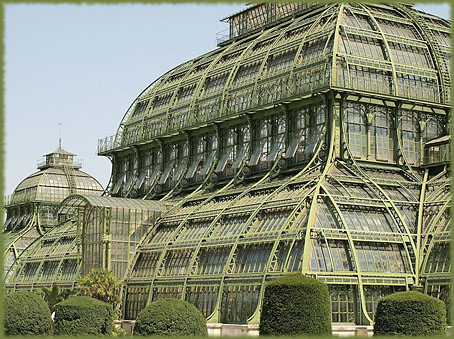
If the Schönbrunn Palm House, Vienna, lacks the elegance of Alphonse Balat’s beautiful Winter Garden in Brussels, the structure does have a distinct style of its own. Roberto Verzo’s Flickr views manage to hide the visitors and background details, giving the impression that the building might be larger than it is. Much as I’d love these places to have a Piranesian grandeur à la Schuiten the reality is somewhat diminished. The Palm House was built in the 1880s from a design by Franz Xaver Segenschmids, and is another royal palace adjunct. According to the Schönbrunn palace website this one is more visitor-friendly than the Laeken greenhouses, being open to the public all year round.

• The Schönbrunn Palm House at Wikimedia Commons
• The Schönbrunn Palm House at Flickr

palmenhaus2.jpg

Photo by RobertG.

palmenhaus3.jpg

Photo by Friedrich Böhringer.

Previously on { feuilleton }
The Royal Greenhouses of Laeken
Arcades panoramas
Arcades
The art of François Schuiten
Passage des Panoramas
Passages 2
Passages

The Royal Greenhouses of Laeken

laeken1.jpg

The Winter Garden, photo by William Helsen.

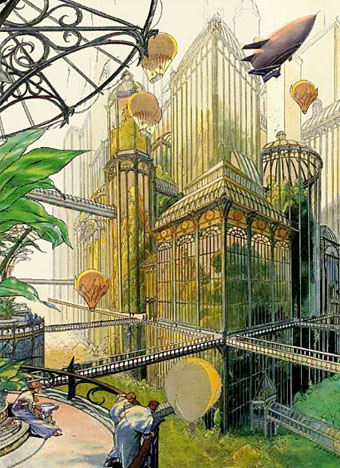
My arcades fetish has been aired here a few times to which one might add a complementary fetish for iron-and-glass structures in general, especially railway stations, palm houses and winter gardens. The Royal Greenhouses at Laeken, Brussels, are an impressive example of the latter, even if they happen to owe their existence to King Leopold II whose barbaric exploitation of the Congo is recounted in Joseph Conrad’s Heart of Darkness. Alphonse Balat was the architect of the central Winter Garden built between 1874 and 1876, and reading up on him it turns out that the celebrated Art Nouveau architect Victor Horta was one of Balat’s apprentices. Horta never had the opportunity to create anything this extravagant, unfortunately, but if he had the results may have resembled one of the structures created by François Schuiten for his greenhouse city of Calvani (below), a metropolis of the Obscure World. Schuiten is a resident of Brussels and we’re told that one of the earthly “Passages” to the Obscure World can be found at the Royal Greenhouses. The building is only open to the public during April and May each year, however, so anyone looking for a route to Schuiten’s world may be better off searching elsewhere.

• The Royal Greenhouses at Wikimedia Commons
• The Royal Greenhouses at Flickr

schuiten.jpg

Calvani by Schuiten.

laeken2.jpg

The Winter Garden dome, photo by Jean-Pol Grandmont.

laeken3.jpg

Photo by Roman Bonnefoy.

Previously on { feuilleton }
Arcades panoramas
Arcades
The art of François Schuiten
Passage des Panoramas
Passages 2
Passages

Amphitheatrum Sapientiae Aeternae

khunrath1.jpg

Laboratorium.

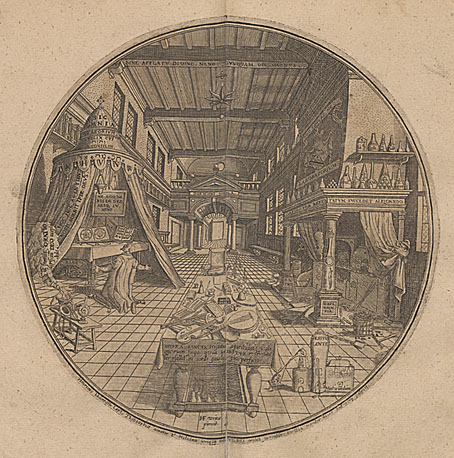
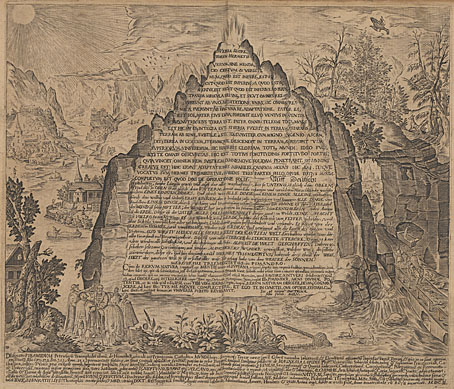
More alchemical business which should be familiar to anyone who’s cracked open an occult history or two. Familiar as these illustrations often are, it’s only recently that we’ve been able to scrutinise their mysteries in detail thanks to the services of various libraries and online archives. These plates are from Amphitheatrum Sapientiae Aeternae (1609) by Heinrich Khunrath, and the Laboratorium is often reproduced as a rather grand example of the alchemist’s workplace. As for the picture below, it’s a shame it didn’t turn up a few years ago when Jay Babcock asked me if I had a decent copy of the illustration for an Arthur magazine article. All I had was a tiny reproduction so I think the piece ran without the picture in the end. The ETH Bibliothek has further illustrations from this volume including a portrait of Meister Khunrath and his pet hound.

Another tip via the BibliOdyssey Twitter feed.

khunrath2.jpg

Designatio Pyramidum.

Elsewhere on { feuilleton }
The etching and engraving archive

Previously on { feuilleton }
Cabala, Speculum Artis Et Naturae In Alchymia
Digital alchemy

Weekend links 48

niteflights.jpg

Nite Flights (1978) by The Walker Brothers. Cover design by Hipgnosis.

something attacked the earth last nite
with a kick that man habit-eye
cut the sleep tight boys who dreamed and dreamed
of a city like the sky

Scott Walker quotes Brion Gysin (and who knows what else) in Shutout (see below), one of the four remarkable songs he wrote for the final Walker Brothers album, Nite Flights. That album cast a shadow over David Bowie’s Lodger a year later, and led Bowie to try his hand at a cover of the title track in 1993.

• Frédéric Chaubin’s photographs of what he calls Cosmic Communist Constructions. Also a new book from Taschen, and an exhibition at the Karlsruhe Museum of Contemporary Art. PingMag interviewed Chaubin back in 2006.

chirnoaga.jpg

From Disparate works by Romanian artist Marcel Chirnoaga (1930–2008). See also the Virtual Museum of Marcel Chirnoaga.

The immense size of modern databases gives us a feeling of meaninglessness. Information in such quantities reminds us of Borges’s library extending infinitely in all directions. It is our task as humans to bring meaning back into this wasteland.

Freeman Dyson on The Information: A History, a Theory, a Flood by James Gleick.

• In the Tumblr labyrinth this week: Mr Rossignol, the Elephant House for Edward Gorey, and Brion Gysin.

• Related to the last, Mutate or Die is “a bioart project being conceived of and executed by Tony Allard and Adam Zaretsky”.

• Barry Miles’s top 10 counterculture books. Related: Rick Poynor on Richard Neville’s Playpower.

“The sooner literary fiction recognises & accepts its generic identity, the sooner it can get help.”

• Is YouTube user “Kosinski” the ever-elusive Chris Marker? “All signs point to yes.”

• The Internet Archive is making its books available to US libraries.

• The Castle of Shadows at BLDGBLOG.

• The Light Painting Pool at Flickr.

• Scott Walker (with the Walker Brothers): Shutout |Nite Flights | The Electrician.