Weekend links 475

brooks.jpg

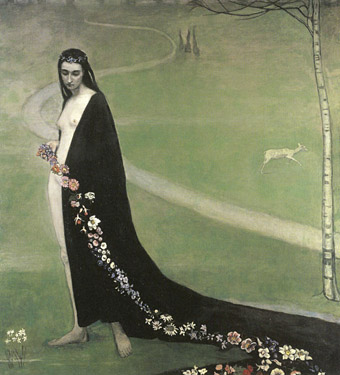
Femme avec des fleurs (c. 1912) by Romaine Brooks.

• “Boring people tend not to exile themselves to rocky islands, but even among the intriguing personalities we encounter in Capri, some individuals prove more extravagantly memorable than others.” Steve Susoyev reviews Pagan Light: Dreams of Freedom and Beauty in Capri by Jamie James.

• “The Mad “idiots” subverted the comic form into a mainstream ideological weapon, aimed at icons of the left and the right—attacking both McCarthyism and the Beat Generation, Nixon and Kennedy, Hollywood and Madison Avenue.” Jordan Orlando on a world without Mad Magazine.

• RIP Sam Gafford, Paul Krassner and Rutger Hauer. Related to the latter: Hauer’s first role as Floris, the hero of a Dutch TV series directed by Paul Verhoeven.

I cannot tell you what it does to me to hear pre-Stonewall. And even in our literature, even in the art, pre-Stonewall, post-Stonewall. I wrote three books pre-Stonewall and a dozen more post-Stonewall. There’s no demarcation. Gay history is centuries and centuries from the Romans to the Greeks to Oscar Wilde to all kinds of outrages. And those seem to be put back and pre-Stonewall is passive. Post-Stonewall is brave and dignified. I actually have heard things like that. I’ve talked, I’ve lectured and I’ve been invited all the way from Harvard to USC. And I talk about what it was like, what we had to survive.

Look, pre-Stonewall produced Allen Ginsberg, William Burroughs, Oscar Wilde, and I could go on. Post-Stonewall produced Bret Easton Ellis, who jumps out of the closet only now and then and then rushes back in, and Queer Eye for the Straight Guy, where we’re reduced to clowns for straight people. The husband of Mr. Buttigieg, he is so darling talking about the silver he’s going to be choosing for the White House. It embarrasses me, it embarrasses me very much because that’s what people expect a gay man to do, to be very precious, and that’s not what we are. A good solid queen I will protect forever, they are heroes.

A lot of people think that everything stopped, everything, all harassment stopped. Look, it’s still going on. It’s still going on, for god’s sake. The same tactics are often used in a different way.

John Rechy talking to Jason McGahan

• The genius of Barry Adamson: An exclusive interview by Paul Gallagher at Dangerous Minds.

Three hours of the Prophecy Theme from Dune (by Brian Eno with Daniel Lanois & Roger Eno).

Ed Sanders on why pop culture still can’t get enough of Charles Manson.

• Havelock Ellis takes a trip: Mike Jay on peyote among the Aesthetes.

Darren Anderson on why little works of architecture deserve respect.

• Mix of the week: Stephen O’Malley presents / Java / Apr 27 2017.

Phil Hine reviews Folk Horror Revival: Urban Wyrd 1 & 2.

John Waters revisits “The Golden Age of Monkey Art”.

I Must Be Mad (1966) by The Craig | The Day My Pad Went Mad (1982) by John Cooper Clarke | Yesterday, When I Was Mad (1993) by Pet Shop Boys
Weekend links 474

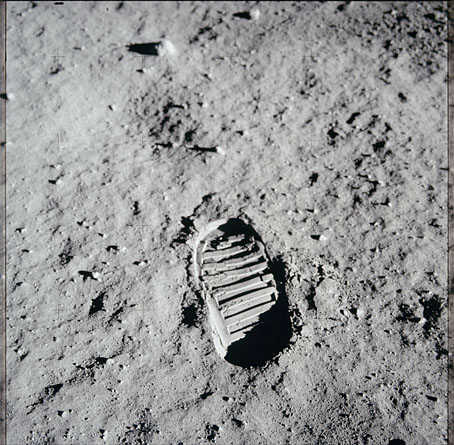
moon.jpg

AS11-40-5877 (1969).

• A minimum of Moon-related links this week because this is a subject I always return to. Previous links to NASA’s photo archives are now redundant after they changed their website but the archive of photos from the Apollo missions are currently hosted on Flickr…while Flickr lasts, anyway. The Albums section features whole film rolls from each of the missions.

• Mixes of the week: Stephen O’Malley presents In Session: Richard Pinhas (a re-posting of a mix from last year), and The Ivy-Strangled Path Vol. XVII by David Colohan.

• Living With The Human Machines: experimental artist Sarah Angliss speaks to Matthew Neale about the cyborgs, dummies and ghosts that populate her work.

• On And On And On: A Guide to Generative Electronic Music. Related: Deconstructing Brian Eno’s Music for Airports.

• At Dennis Cooper’s: Jesse Bransford presents…A List of Grimoires for the Twilight of the Age of the Book.

A Dandy in Aspic exclusive: Paul Gallagher interviewed cult author Derek Marlowe in 1984.

• From Ted Hughes to HG Wells: Jeanette Winterson picks the best books about the Moon.

• Tate acquires vast archive of British surrealist Ithell Colquhoun.

• At Greydogtales: Ten supernatural stories which stay with you.

• Emptyset turn to machine learning on new album Blossoms.

• Paul Grimstad on the absolute originality of Georges Perec.

• Valerie Stivers on cooking with Bruno Schulz.

• Blown out ’77: in the studio with Suicide.

Astronauts on record covers.

Back Side Of The Moon (1991) by The Orb | Moonshot (1999) by Hallucinator | Under The Moon (2019) by Brian Eno with Daniel Lanois & Roger Eno

Weekend links 472

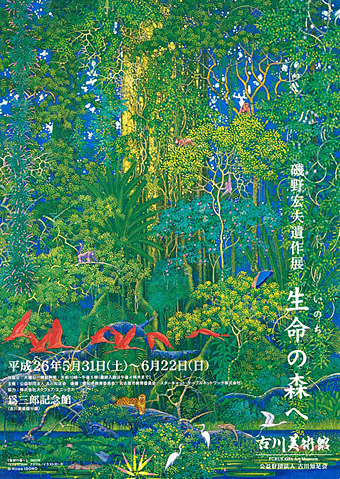
isono.jpg

Poster art by Hiroo Isono.

• “[Divine] didn’t want to pass as a woman; he wanted to pass as a monster. He was thought up to scare hippies. And that’s what he wanted to do. He wanted to be Godzilla. Well, he wanted to be Elizabeth Taylor and Godzilla put together.” I can’t help linking to yet another John Waters interview when he always has things like this to say.

• Fifty shades of grey: great towers of the Eastern bloc photographed by David Navarro & Martyna Sobecka.

• Seeking Beastliness and Defining Beauty: Clive Hicks-Jenkins on visualisations of Beauty and the Beast.

Fire Temple by Bobby Krlic (The Haxan Cloak) from the Midsommar soundtrack.

Brad Jolliff & Mark Robinson on the scientific legacy of the Apollo programme.

John Boardley on Renaissance memes and the chemical pleasure garden.

• “It’s important to go out and feel the so-called reality,” says David Lynch.

Peter Strickland talks to Robert Barry about his new film, In Fabric.

Nico in Manchester: “She loved the architecture—and the heroin”.

• Mix of the week: Secret Thirteen Mix 292 by Paco Sala.

• Andrei Codrescu on the many lives of Lafcadio Hearn.

Hiroo Isono: Into the Depths of the Sacred Forest.

• At Dennis Cooper’s: Queer.

The Beast (1956) by Milt Buckner | The Beast (1989) by Rhythm Devils | Beast (1994) by Brian Eno

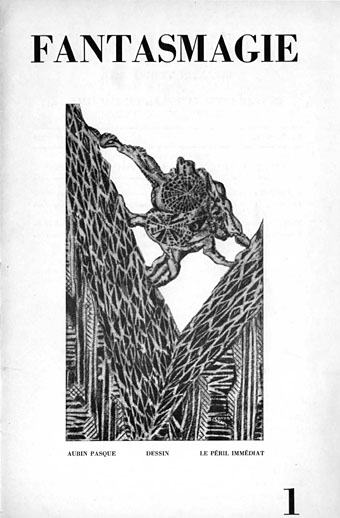
Fantasmagie

fantasmagie01.jpg

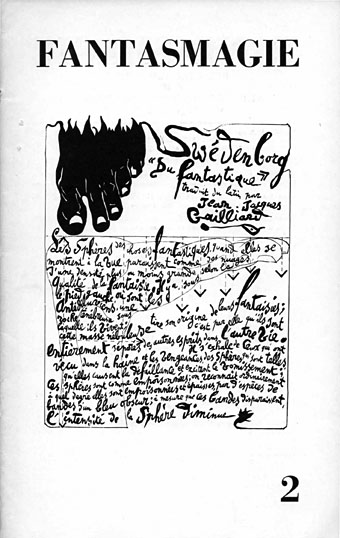
Another post with a Belgian theme (a coincidence despite my present preoccupation with Franco-Belgian culture), and another that has to be filed under “further research required”. The splendidly titled Fantasmagie was founded by author Serge Hutin and artist Aubin Pascale, and was the newsletter/review for the Centre International pour l’étude de l’Art Fantastique et Magique. 52 issues were published from 1959 to 1979 charting the Belgian continuation of the Surrealist project.

fantasmagie02.jpg

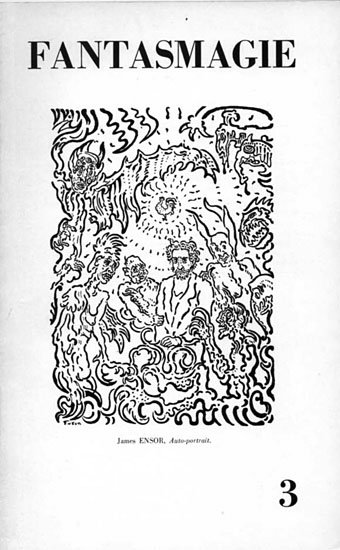
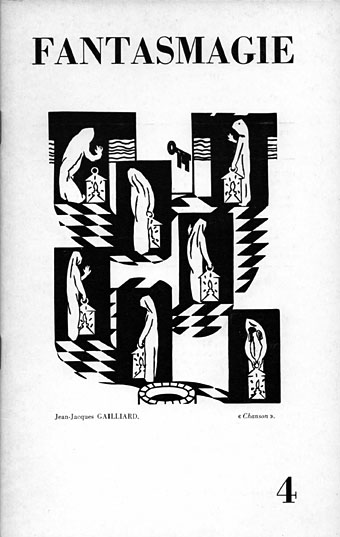
I’d been hoping there might be a collection of all the issues online somewhere but this isn’t the case to date. However, the first 11 issues may be browsed in full at Scribd or downloaded if you use one of the PDF scrapers (search for “Scribd free”). Each issue showcases art by contemporary Surrealists or practitioners of what Ernst Fuchs called Fantastic Realism, all of which was of little interest to the art establishment of the time so from our perspective the artists are fresh discoveries. Issue 8, which is a collage special, is especially good.

fantasmagie03.jpg

fantasmagie04.jpg

Continue reading “Fantasmagie”

The art of Jacob Bendien, 1890–1933

bendien07.jpg

Corner of a Canal (1919–20).

This week’s post is another by Sander Bink about a Dutch artist whose work may be unfamiliar to those outside the Netherlands. Jacob Bendien was certainly new to me. My thanks again to Sander for the post.

* * *

Jacob Bendien, born in Amsterdam in 1890, was one of the pioneers of abstract art (“absolut art” as Bendien and kindred artistic spirits called it) but is nevertheless little known in the Anglophone world. In the Netherlands he is not ignored or forgotten since he is mentioned in most overviews of early Dutch abstract art. Bendien’s work belongs to a somewhat later period than the other Dutch artists in this series but can be related thematically via his roots in the mystical/Symbolist art from around 1900.

Although Bendien was an early admirer of Mondrian’s art, his work differs from Neo-plasticism in its use of lines and round forms instead of bars and straight lines.

bendien01.jpg

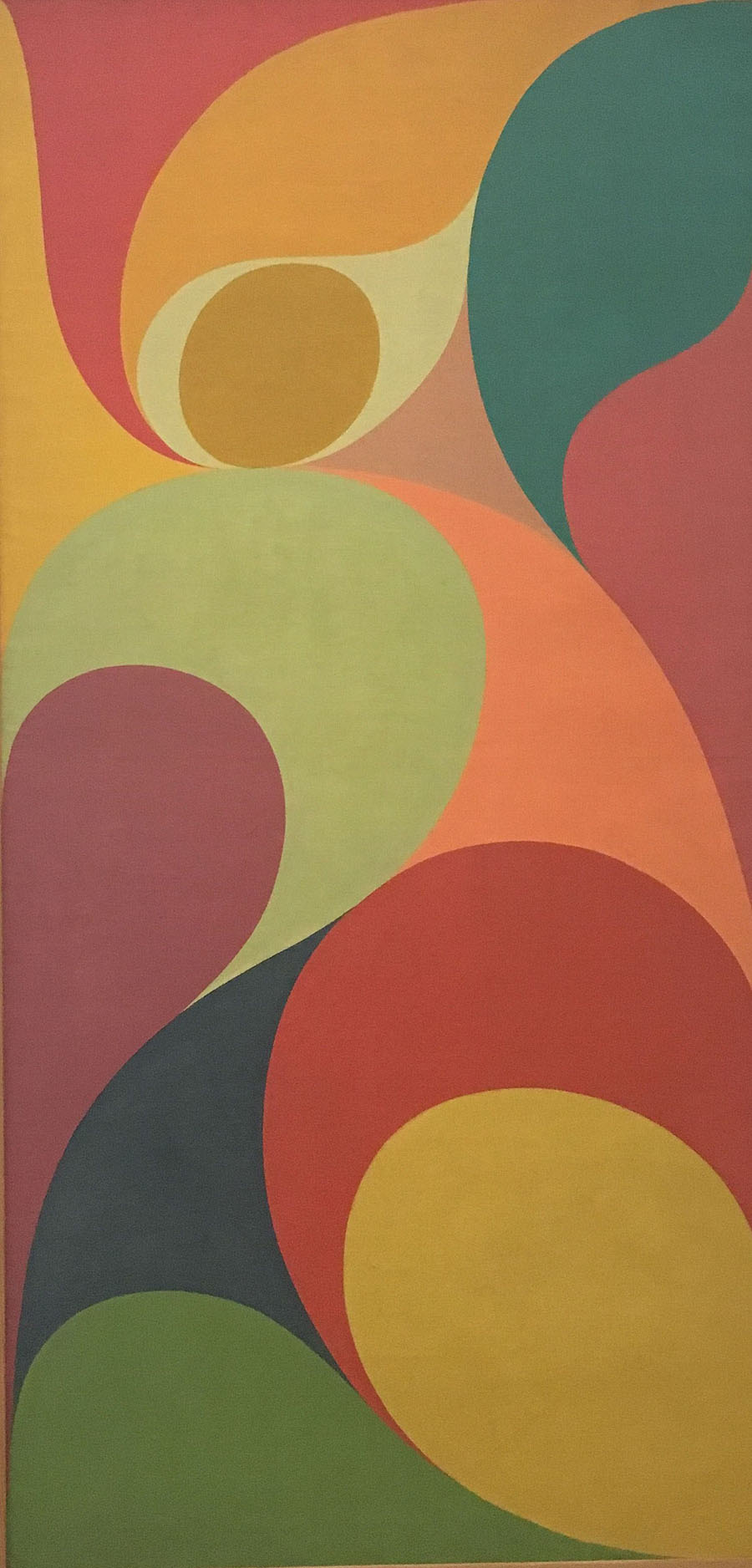
Composition (1912); Stedelijk Museum, Amsterdam.

bendien02.jpg

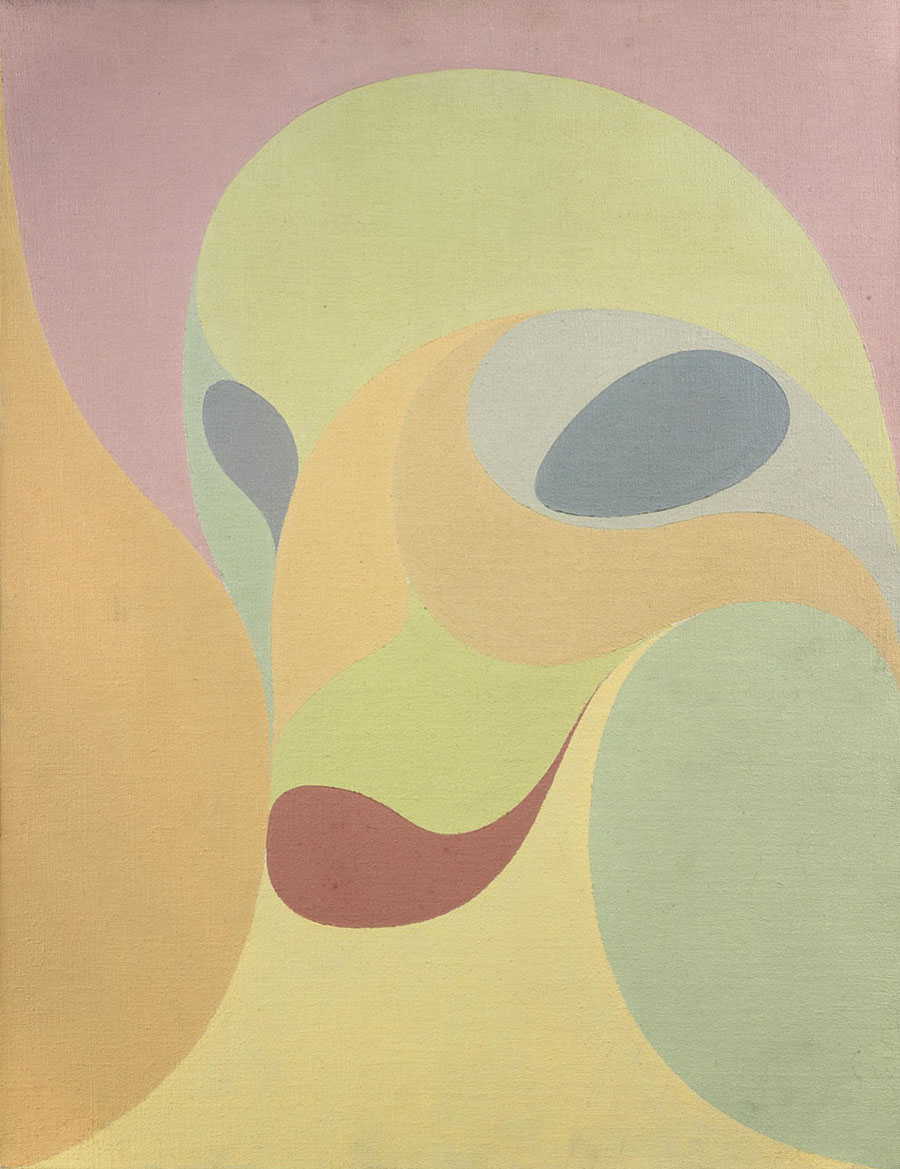
Peinture I (1912); Centraal Museum, Utrecht.

Two examples of Bendien’s early abstractions are the graceful oil-on-canvas Composition from 1912, and the slightly Surrealist portrait Peinture I from the same year.

bendien03.jpg

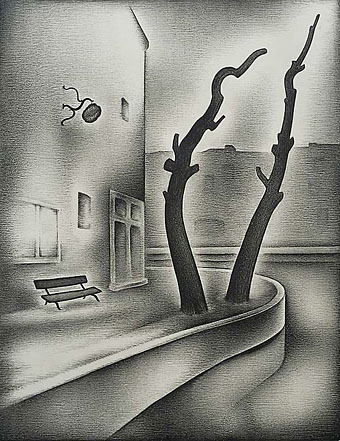
Amsterdam Canal (1916).

Somewhere between Surrealism, Modernism and Symbolism is the lithograph Amsterdam Canal which could just as well be a décor for some German Expressionist movie from the 1920s.

bendien04.jpg

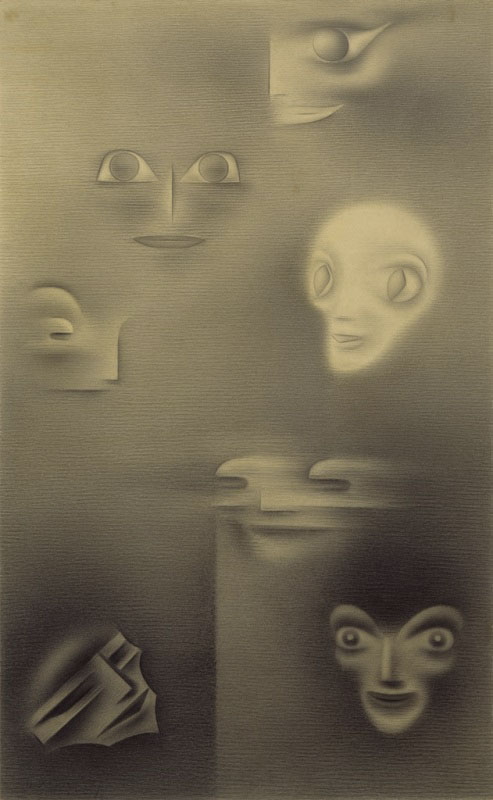
Seven Masks (1917); Museum Belvédère, Heerenveen.

Surreal and Redon-like is his chalk drawing Seven Masks from 1917.

bendien05.jpg

Melancholy (1917).

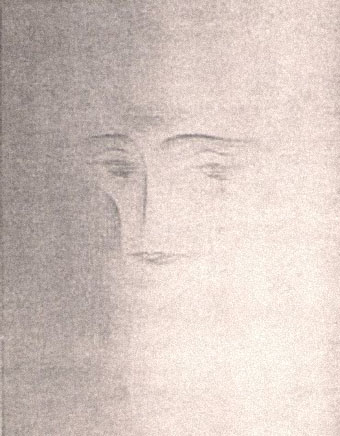
Around 1916 Bendien made some drawings which seem to be directly inspired by Dutch Decadent-Symbolist artist Carel de Nerée (see this Dutch article) of which his self-portrait Melancholy is a fine example.

bendien06.jpg

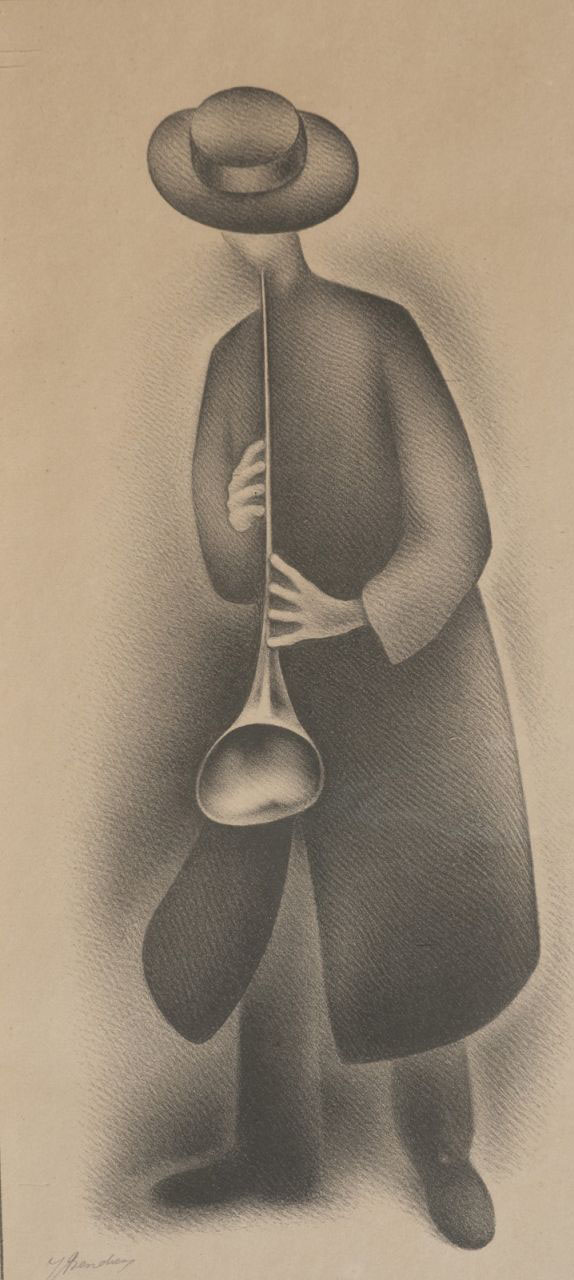
Musician.

More realist but quite endearing is his Musician lithograph from the early 1920s.

As far as I know the last Bendien exhibition was in Utrecht in 1985. His work is hard to find and rarely offered on sale although if one is lucky one can find his lithographs.

Sander Bink

Previously on { feuilleton }
The art of Henricus Jansen, 1867–1921
The art of Antoon van Welie, 1866–1956
The art of Simon Moulijn, 1866–1948
René Gockinga revisited
Gockinga’s Bacchanal and an unknown portrait of Fritz Klein
More from the Decadent Dutch