Lovecraft: Démons et Merveilles

hpl-pd01.jpg

UK publisher Titan Books announced earlier this year that they’d be reprinting the first volume of Glénat’s excellent comic-strip adaptation of Michael Moorcock’s Elric novels in an English edition, a book that should be out in September. This was a surprise to me when I’ve complained for years that Titan seldom showed any interest at all in Continental comics, despite France and Belgium being over-burdened by world-class creators. I’ve been surprised again this week by the news that Titan will also be reprinting the English edition of Philippe Druillet’s The Six Journeys of Lone Sloane in March next year. Druillet’s books have been unavailable in English editions for decades so this is good news indeed, even if the attention is scandalously late.

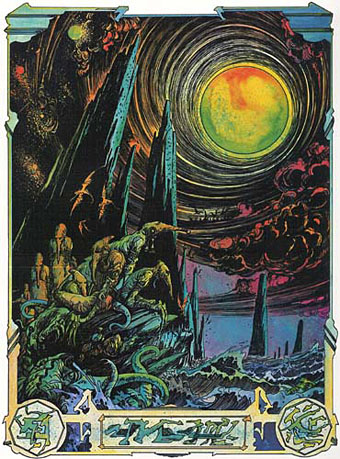
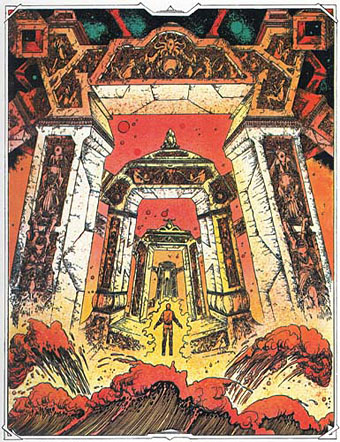
As I noted in the post about Glénat’s Elric, Druillet illustrated Moorcock’s albino anti-hero in 1973. The artist is better known for his Lovecraftian depictions, however, even when—as in the adventures of Lone Sloane—the story could easily sustain itself without all those sinister temples, fish people, Cyclopean architecture and the menace of nameless gods. The Lovecraft influence, which can be found in some of his earliest illustrations, comes to the fore in Lovecraft: Démons et Merveilles, an HP Lovecraft story collection published in an expensive limited edition by Éditions Opta/André Sauret in 1976. Druillet provided ten colour illustrations plus a design for the boards. Some of these illustrations have since been used on paperback editions of Lovecraft in France, although many of them crop the artwork. Tentacles have become a perennial cliché in Lovecraftian art (I should know, I’ve drawn enough of them) so it’s worth noting how few there are in Druillet’s drawings.
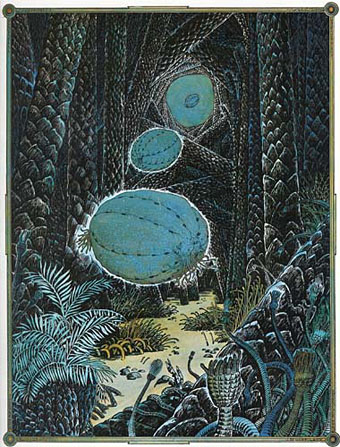
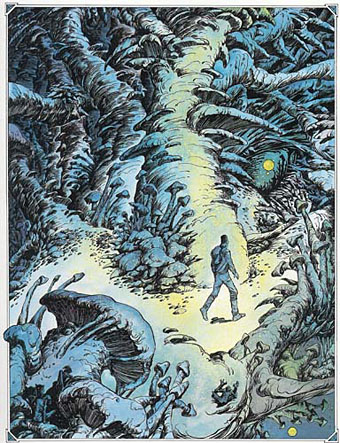
hpl-pd02.jpg

hpl-pd03.jpg

hpl-pd04.jpg

Continue reading “Lovecraft: Démons et Merveilles”

No tears for the creatures of the night

notears1.jpg

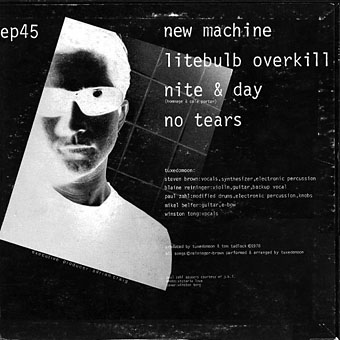
No Tears (1978): A song and 12″ EP by Tuxedomoon. Sleeve design by Winston Tong.


munro.jpg

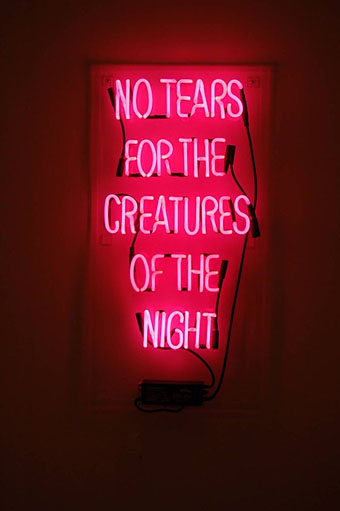
• An artwork from 2005 by Will Munro.


notears5.jpg

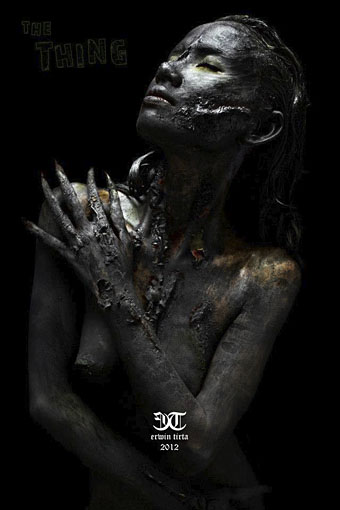
• A make-up portfolio from 2012 by Belinda Betz. Photographer : Erwin Tirta. Model : Jesy Love. Make-Up Artist (Special Effects) : Belinda Betz.


notears3.jpg

• A badge design at Zazzle.


notears2.jpg

A Pinterest page. Tags: dracula, isabelle adjani, vampires, werewolves, witchcraft, francisco goya, edward gorey, joanna lumley.


notears4.jpg

• A club night in St Gallen, Switzerland.

Previously on { feuilleton }
Blaine L. Reininger: An American Friend
Tuxedomoon: some queer connections
Made To Measure
Subterranean Modern: The Residents, Chrome, MX-80 Sound and Tuxedomoon
Tuxedomoon on La Edad de Oro, 1983
Tuxedomoon designs by Patrick Roques
Pink Narcissus: James Bidgood and Tuxedomoon

Weekend links 217

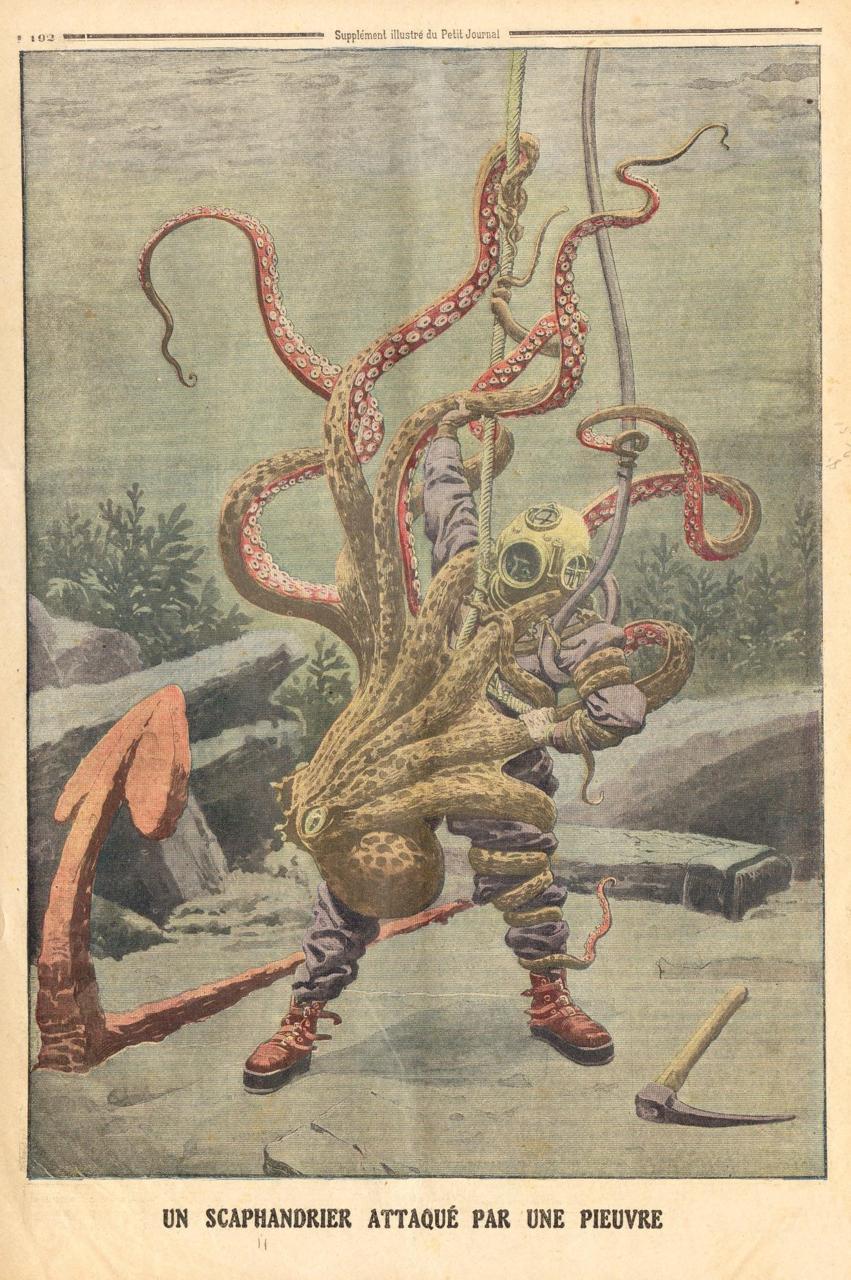
scaphandrier.jpg

Le Petit Journal, June 16, 1912. Via Beautiful Century.

Occult art by Nicomi Nix Turner, Daniel Martin Diaz, Amy Earles and William Crisafi. Related: Illustrations by Ernest M. Jessop for The Witches Frolic by Thomas Ingoldsby.

• “Our definition of ‘Industrial’ then was a very broad one, it’s definitely not so much now.” Chris Carter & Cosi Fanni Tutti on 20 Jazz Funk Greats by Throbbing Gristle.

• At Dangerous Minds: the Amok Assault Video (1988), an hour of the bizarre, the extreme and the outré which will probably get yanked from YouTube before too long.

I’ve always thought the exchange of words for money is no more and no less problematic than any other kind of prostitution—and it’s important that we prostitutes control a certain amount of our production (and reproduction, for that matter). If I’m writing a book and I’m warned, “Oh, this is unsaleable, you need to make it shorter,” or, “It has to be this, or that,” I’m proud to say I don’t pay attention.

Though this is becoming more difficult. As large publishers turn into monopolies, and the MBAs who are running them—maybe editors used to run them before—are steadily tightening the screws, they feel more and more that they get to call the shots.

Writers can do anything, says William T. Vollmann

• Mixes of the week: Over two hours of Coil and other artists sequenced by Surgeon, and Secret Thirteen Mix 122 by DJ Skirt.

Alan Moore calls for a boycott of the “wretched” new Hercules film on behalf of his friend Steve Moore.

Joe Orton‘s first play, Fred and Madge, will receive its world premier in September.

tentacles.jpg

Ned Raggett found the drawing of mine that’s part of the Tentacles exhibition currently showing at the Monterey Aquarium, California. Thanks, Ned! There’s a sepia-toned version of the drawing in my Cthulhu calendar.

• “Weird is a wayward word,” says Erik Davis in an exploration of weirdness old and new.

• More details about the forthcoming Scott Walker + Sunn O))) collaboration.

• A trailer for a reissue of Robert Wiene’s The Cabinet of Dr. Caligari (1920).

A history of sex toys in pictures.

Books on Book Covers

Octopus’s Garden (1969) by The Beatles | The River (1970) by Octopus | Octopus (1970) by Syd Barrett

Young Knight in a Landscape

carpaccio01.jpg

Young Knight in a Landscape (1510).

A painting by Venetian artist Vittore Carpaccio (c. 1460–1525/26) replete with natural detail. Many of these details, the animal ones in particular, are no doubt symbolic, although what they symbolise can change over time, and may also refer to the personal mythology of the family for whom the painting was created. Dogs often represent fidelity but the dog crouching on the path behind the knight wears an expression that may be taken for a snarl. The hawk knocking another bird from the sky is more obviously a symbol of belligerence which suits the action of drawing a sword.

The note for this painting says it was attributed to Albrecht Dürer until 1919, something I find surprising. The vegetation is certainly painted with a Dürer-like precision but Dürer was equally precise with his figures, and would have paid more attention to the modelling of the hands. One detail I don’t recall seeing before is the codpiece pocket. The Scottish sporran often has a pocket in the back, there being no pockets in kilts or, for that matter, in suits of armour.

carpaccio12.jpg

carpaccio02.jpg

Continue reading “Young Knight in a Landscape”

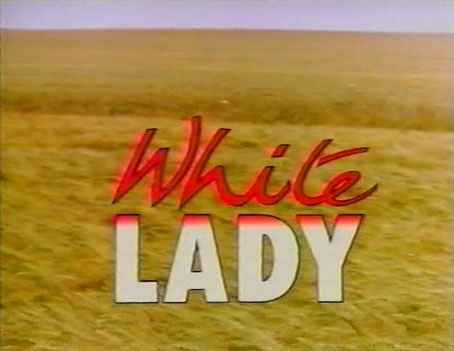
White Lady by David Rudkin

whitelady1.jpg

Amy: Dad? What’s a parable.

Gil: Parable? A sort of story, with something in it…strange. To help you remember it. And think. About something important.

I first heard about David Rudkin’s White Lady (1987) from Grant Morrison during a conversation about Penda’s Fen, Morrison having been a Rudkin-head as far back as the original screening of that TV film in 1974. This was at a time when you couldn’t call up details of somebody’s entire career in a couple of seconds, so all I knew of Rudkin’s television work aside from Penda’s Fen was Artemis 81 (1981) and his adaptation of The Ash Tree (1975) by MR James, one of the BBC’s Christmas ghost stories.

vampyr.jpg

Vampyr (1932).

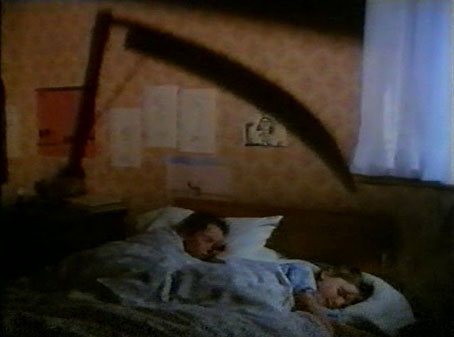
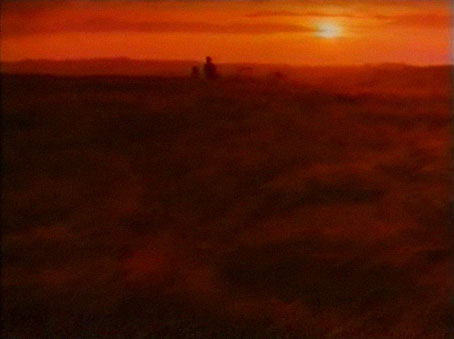
All of those films feature sinister, possibly supernatural events taking place in the English countryside, and this theme is continued in White Lady, a 45-minute drama which Rudkin wrote and also directed. In dramatic terms the film is a minimal piece concerning a divorced father trying to set himself up as a farmer while also taking care of two young daughters. In the fields surrounding the farm pesticides are being used, although we see little direct evidence of this. More overt are the disturbing interjections and animated graphics which show photographs and X-rays of laboratory animals suffering from pesticide exposure. Rudkin’s dialogue tells us at the outset that this is a parable, hence the deadly effects of the pesticide being embodied by the White Lady of the title, a spectral figure who carries a scythe.

whitelady2.jpg

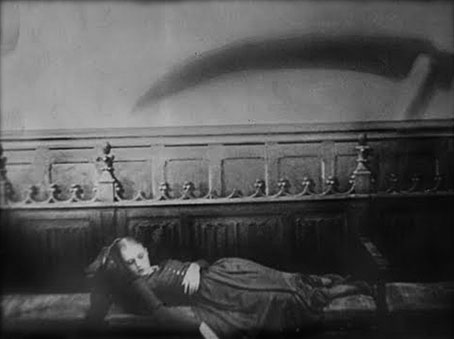
The first time I saw this I thought the scythe was a heavy-handed device, despite its obvious farming connections; watched again I realise that Rudkin would have been alluding (if only for himself) to the scythe-bearing ferryman in Carl Dreyer’s Vampyr (1932), a film Rudkin subjected to very close scrutiny in 2005 for the BFI’s Film Classics series. In his book Rudkin notes a shot in which a sleeping figure is menaced by the shadow of a scythe on a wall; that shot is recapitulated in White Lady.

whitelady3.jpg

It’s unfair to compare this to the eerie, intellectual masterpiece that is Penda’s Fen, but White Lady is still worth a look for anyone interested in Rudkin’s dramas, especially with it being his sole directing credit. If the dire warnings of genetic mutation haven’t come to pass there’s relevance in our present concern about the effects of nicotinoids on bee and bird populations. The White Lady still has plenty of work to do.

White Lady: part one | part two

Previously on { feuilleton }
The Horror Fields
Robin Redbreast by John Bowen
Red Shift by Alan Garner
Children of the Stones
Penda’s Fen by David Rudkin
David Rudkin on Carl Dreyer’s Vampyr