Reworking Kraftwerk (again)

kraftwerk00.jpg

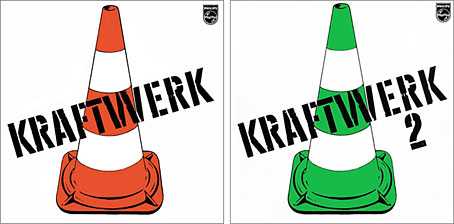
Kraftwerk (1970); Kraftwerk 2 (1972). Design by Ralf Hütter.

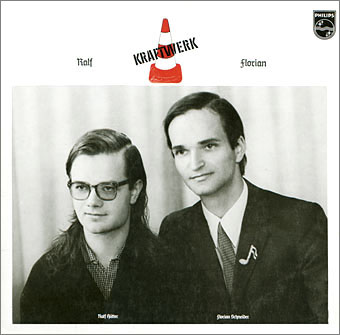
Recent posts about Kraftwerk’s design history had me wondering how the group might present the first three albums if these repudiated works were allowed back into the catalogue. Kraftwerk, Kraftwerk 2, and Ralf and Florian haven’t been officially reissued for decades now, and I remain sceptical that Ralf Hütter (or the recently departed Florian Schneider) are willing to taint their carefully cultivated discography with those awkward, experimental albums. This is highly unusual in the music world where everything by a commercially successful group tends to be reissued on a regular basis.
raf.jpg

Ralf and Florian (1973). Design by Ralf Hütter & Florian Schneider. Photo by Robert Franck.

Kraftwerk are unique in this, and also in subjecting their approved releases to incremental adjustments. This was mostly strikingly seen in 2009 when the 8 albums were reissued in a box as The Catalogue. Not only had further changes been made to the cover art but two of the albums had amended titles: Electric Café was now Techno Pop (as it would have been titled if released earlier in the 1980s), and Tour De France Soundtracks had become Tour De France. The cover art changes had already been previewed in the version of The Catalogue that briefly appeared as a promo set in 2004 only now it was evident that more human traces were being removed from the albums, notably on the cover of The Man-Machine which swapped the band photo for the El Lissitzky-derived graphics. All of this needed to be taken into account when I had the idea last week of roughing out designs for how the first three albums might be reissued in a box set today.
cover1.jpg

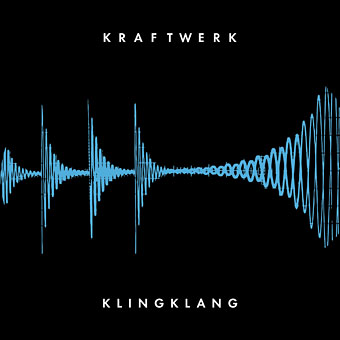
First the title: there’s no way of knowing what Ralf Hütter might call a collected set but mundane choices like Three Albums or Kraftwerk 70–73 seem unlikely. I decided on Klingklang, the name of the first piece of music on the second album, and also the name of Kraftwerk’s studio and publishing company. This would no doubt cause endless (endless) confusion but it still seems apt. The cover design uses Futura, a German typeface that’s been a feature of many Kraftwerk graphics over the years. The oscilloscope wave is taken from the front and back cover of the double-album reissue of Kraftwerk and Kraftwerk 2 on the Vertigo label in 1972. I always liked that cover, and the graphic suits the often raw electronic sound of those albums as well as the minimal nature of the current design.
cover2.jpg

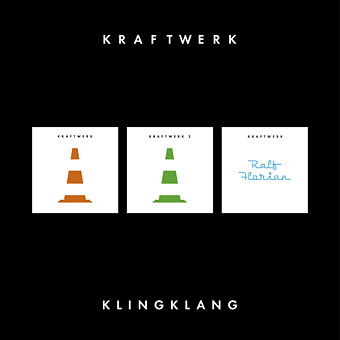
This would be the back of the proposed box, showing the albums within as The Catalogue does.

kw1.jpg

All German traffic cones still follow this standard, apparently, so the design hasn’t dated at all. (See this post for Kraftwerk’s cone obsession.) Using negative space for the white bands works well.
Continue reading “Reworking Kraftwerk (again)”

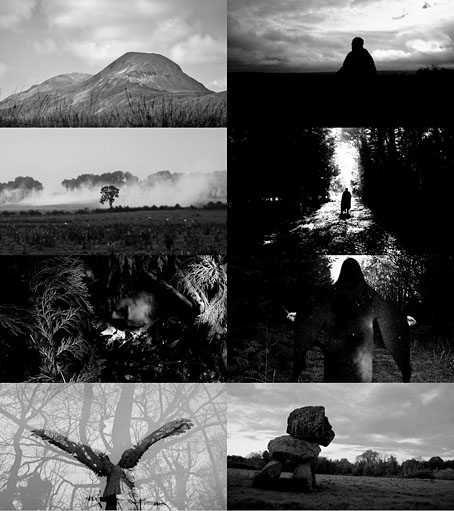
A Darkness Made of Beating Wings, a film by Dave Colohan

darkness.jpg

When Dave Colohan was in touch late last year he mentioned work on a new film which is now available for viewing at Vimeo. A Darkness Made of Beating Wings is another meditation on the sombre beauties of the Irish landscape (with additional shots of the Inner Hebrides) only this time there’s more textual substance in the figure portrayed by Ciarán MacAoidh, a traveller caught between the Celtic past and present, shadowed all the while by a spectral figure. Deliciously atmospheric work once again, with monochrome photography by Mick Carey.

Given all the Celtic business, I thought the hills seen at the beginning might be the Paps of Anu in Kilarney but searching revealed that they’re a different set of breast-shaped hills, the Paps of Jura in the Hebrides, which I’d not heard of before. The isle of Jura produces one of my favourite brands of malt whisky so this adds an additional note of approval.

Previously on { feuilleton }
Newlyborn, a film by Dave Colohan

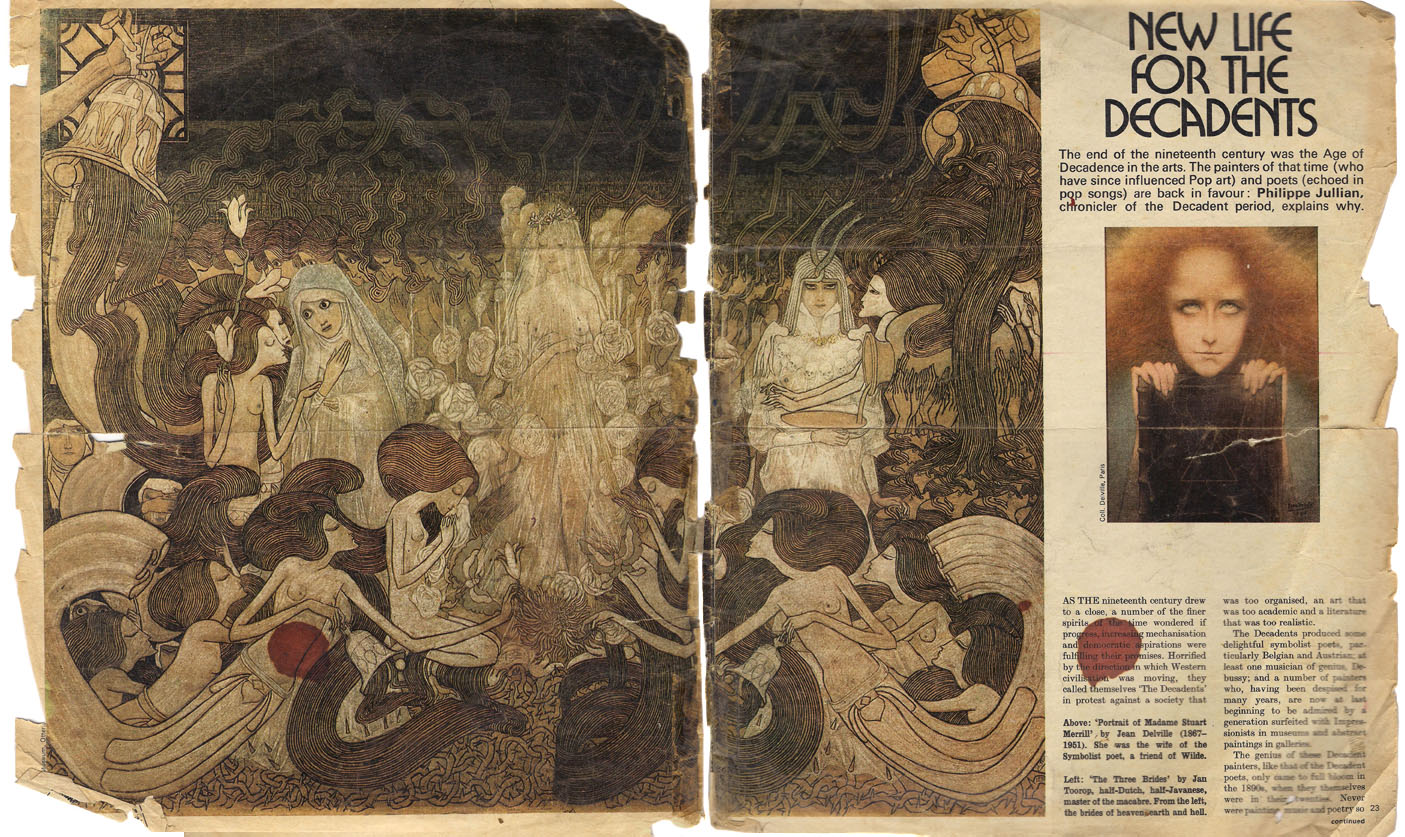
New Life for the Decadents by Philippe Jullian

jullian1.jpg

This essay by cult writer Philippe Jullian appeared in an edition of the Observer colour supplement in 1971, shortly after Jullian’s chef d’oeuvre, Dreamers of Decadence, had been published in Britain. Esthètes et Magiciens (1969), as Jullian’s study was titled in France, was instrumental in raising the profile of the many Symbolist artists whose work had been either disparaged or ignored since the First World War. A year after the Observer piece, the Hayward Gallery in London staged a major exhibition of Symbolist art with an emphasis on the paintings of Gustave Moreau; Jullian alludes to the exhibition in his article, and also wrote the foreword to the catalogue. His Observer article is necessarily shorter and less detailed than his introductory essay, emphasising the reader-friendly “Decadence” over the more evasive “Symbolist”. But as a primer to a mysterious and neglected area of art the piece would have served its purpose for a general reader.

Many thanks to Nick for the recommendation, and to Alistair who went to the trouble of providing high-res scans that I could run through the OCR. The translators of the article, Francis King and John Haylock, had previously translated Jullian’s biography of Robert de Montesquiou.

*

New Life for the Decadents

The end of the nineteenth century was the Age of Decadence in the arts. The painters of that time (who have since influenced Pop art) and poets (echoed in pop songs) are back in favour: Philippe Jullian, chronicler of the Decadent period, explains why.

AS THE nineteenth century drew to a close, a number of the finer spirits of the time wondered if progress, increasing mechanisation and democratic aspirations were fulfilling their promises. Horrified by the direction in which Western civilisation was moving, they called themselves “The Decadents” in protest against a society that was too organised, an art that was too academic and a literature that was too realistic.

The Decadents produced some delightful symbolist poets, particularly Belgian and Austrian; at least one musician of genius, Debussy; and a number of painters who, having been despised for many years, are now at last beginning to be admired by a generation surfeited with Impressionists in museums and abstract paintings in galleries.

The genius of these Decadent painters, like that of the Decadent poets, only came to full bloom in the 1890s, when they themselves were in their twenties. Never were painting, music and poetry so close to one another. The gods of the Decadents were primarily Wagner and Baudelaire, then Swinburne and Poe. The Decadent movement, so active all over Europe, turned towards two great sources of inspiration: the Pre-Raphaelites, and a French painter whose glory was for a while eclipsed by the Impressionists but who is now once again accorded his place among the great—Gustave Moreau.

The women whom the Decadents loved and of whom they dreamt resembled the women created 30 years previously by Rossetti, Burne-Jones and Moreau.

Nothing could be more naturalistic than the artistic style elaborated by the Pre-Raphaelites in the middle of the nineteenth century. Dante Gabriel Rossetti’s model, inspiration, mistress and finally wife was the sweet and sad Elizabeth Siddal, on whom so many fin-de-siècle ladies had to model themselves on the Continent as did all the aesthetic ladies of England in the 1880s. She posed for Rossetti as Beatrix and as the Belle Dame sans Merci.

She was a rare spirit, about whom everything was nebulous and evanescent: the thick, wild hair; the tunic of a simplicity to challenge the elaboration of the crinolines then in vogue; the frail hands burdened with lilies; the gaze turned towards eternity. She also posed, fully dressed and lying in a bath, her hair outspread around her bloodless face, as Ophelia for another Pre-Raphaelite, Millais. Elizabeth died of pulmonary tuberculosis in 1862.

A macabre episode, which might have been imagined by Poe, was the exhumation of a sheaf of Rossetti’s poems that had been buried in Elizabeth Siddal’s coffin. When this symbol of the New Woman died, the grief-stricken poet had insisted on placing the poems inspired by her under her long hair before the coffin was sealed.

jullian4.jpg

Beata Beatrix (1864–1870) by Dante Gabriel Rossetti.

Continue reading “New Life for the Decadents by Philippe Jullian”

The Fantastic World of MC Escher

escher1.jpg

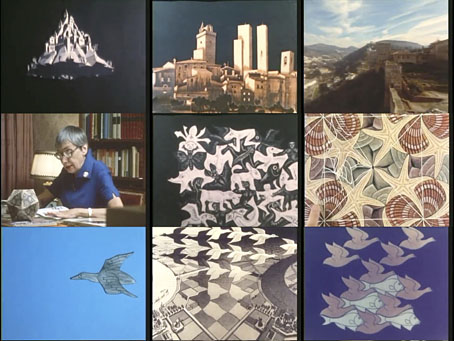
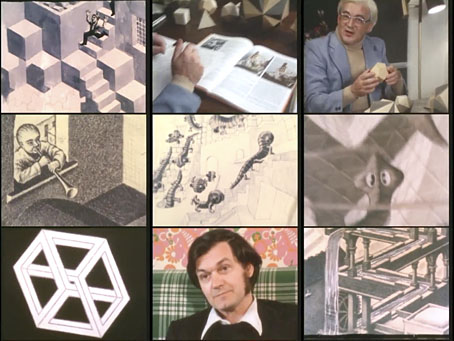
An Italian documentary about the Dutch artist made in 1980 and directed by Michele Emmer. I don’t recall ever seeing a British TV documentary about Escher (although I’d be surprised if there were none) but this resembles the type of thing the BBC used to do so well. Shots of the Italian towns where Escher lived for many years show the influence of the vernacular architecture on Escher’s prints. Elsewhere, animated sequences bring to life his tessellations, while various mathematicians examine some of the structural principles at work in these very familiar images. Of greatest interest for me is mathematician and physicist Roger Penrose discussing his first encounter with Escher’s work, and the development with his father of the Penrose Triangle, an impossible object similar to those that appear in some of Escher’s prints. (I used a Penrose Triangle in my cover art for Zones by Hawkwind.) The Fantastic World of MC Escher runs for 50 minutes, and may be watched here.

escher2.jpg

Previously on { feuilleton }
MC Escher album covers
Escher and Schrofer

Weekend links 246

ngai.jpg

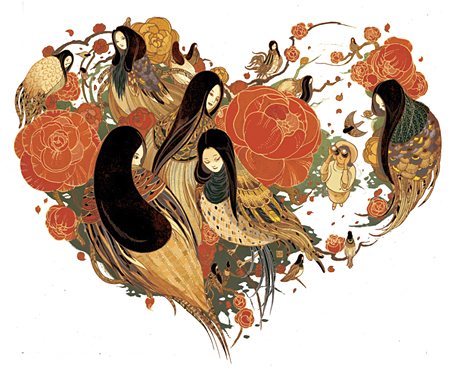
Love Hunter by Victo Ngai.

• “The strangeness of the lyric style, the misuse of words and awkward phraseology that have been criticized even by Poe’s fervent admirers, are here taken as virtues, heightening as they do, a given poem’s conscious and calculated formalism.” Marjorie Perloff reviews The Poet Edgar Allan Poe: Alien Angel by Jerome McGann.

• Mix of the week: Secret Thirteen Mix by Jeremy Kolosine. Starting with Michael Rother is apt when I’ve spent the past week in a Cluster/Harmonia/Kraftwerk/La Düsseldorf/Neu!/Rother loop.

• Court records “suggest that the supposedly prudish Victorians had a far more relaxed attitude to sex between men than their 1960s counterparts”. Historian Jeff Evans has the data.

• “Part of HP Lovecraft’s acknowledged debt to Machen also lies in hearing without seeing.” London Sound Survey on Arthur Machen’s “sounds from beyond the veil”.

• “…pity the designer who has to enact the stage direction that instructs rats to carry away a character’s feet.” Andrew Dickson on the extreme theatre of Sarah Kane.

• Psychedelic collage artist Wilfried Sätty receives a mention in Carey Dunne‘s piece about how LSD helped shape California’s ecstatic design legacy.

• More psychedelia: The Psychedelic Sex Book by Eric Gotland & Paul Krassner, edited by Dian Hanson.

• At Dangerous Minds: Robert Fripp demonstrates Frippertronics on The Midnight Special, 1979.

• Dreams from a Glass House: artist Josiah McElheny on the glass architecture of Paul Scheerbart.

• Director Peter Strickland on six films that fed into The Duke of Burgundy.

Vintage trade card designs

The Zero Of The Signified (1980) by Robert Fripp | Heptaparaparshinokh (1981) by Robert Fripp & The League of Gentlemen | 1984 (1981) by Robert Fripp