Yuggoth details

yuggoth01.jpg

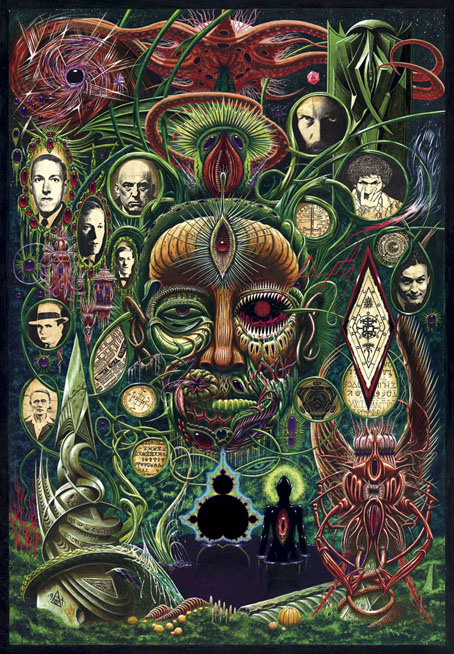
Yuggoth Cultures (1994) by John Coulthart.

Earlier this week I spent a day scanning this painting—which I’m now surprised to find is 21 years old—so I might at last have a good quality digital copy. There’s been a copy on the website for years but that was a print made at a high-street copy shop that did nothing for the detail and range of colour. It’s quite a large piece—49.54 x 71.39 cm (19.5 x 28.1 inches)—done with acrylics on board. Since 2003 the painting has been used (in another poor reproduction) on the cover of The Starry Wisdom, the controversial collection of Lovecraftian fiction from Creation Books. The painting wasn’t originally intended for that collection, however, and doesn’t quite fit since a number of the portraits don’t feature in the book at all.

Yuggoth Cultures would have been an earlier collection of Lovecraftian fiction and non-fiction that Alan Moore had begun writing for Creation in 1993. Alan’s idea was to take Lovecraft’s Fungi from Yuggoth sonnet sequence as the basis for a collection that would explore Lovecraft’s fictional world and also draw together a variety of figures from the same era: fellow writers, occultists like Aleister Crowley and Austin Spare, and Harry Houdini for whom Lovecraft ghost-wrote Imprisoned with the Pharaohs in 1924. Unfortunately the stars were not right on this occasion; Alan took the sole copy of the half-written manuscript to London in order to read selections at an event in Soho but left the papers in a cab. Some pieces survived, having been copied and stored elsewhere—The Courtyard in The Starry Wisdom is one of these—and there was talk for a while of the lost pieces being rewritten but enthusiasm for the project flagged.
yuggoth08.jpg

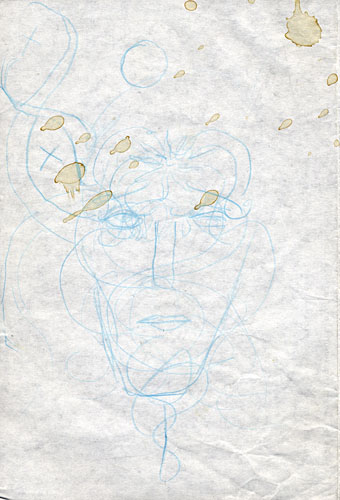
This is Alan’s sketch for the cover, the idea being to have a Lovecraft head made of fungal growths rather like an Arcimboldo painting. The head would be sprouting tendrils whose loops would contain pictures of some of the people featured in the book. Alan’s quick sketch is actually a better approximation of Lovecraft’s strange features than my painted version which isn’t narrow enough. For the record (and because people always ask), the other people on the cover are Alan himself, Austin Osman Spare, Aleister Crowley, Harry Houdini, Robert E Howard (not Al Capone as people often think) and Clark Ashton Smith.
yuggoth09.jpg

yuggoth10.jpg

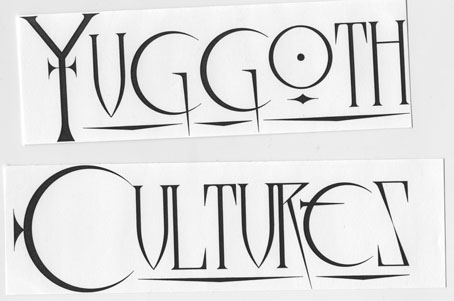
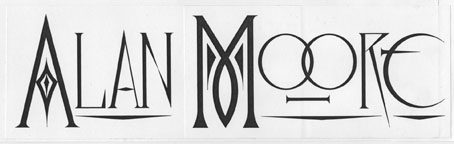
While searching through the archives I discovered these lettering designs although they’re probably not bold enough to read very well on such a busy painting. Before I started using a computer, designs like this had to be drawn at large size then scaled down using a photocopier.
Continue reading “Yuggoth details”

Haunted Corridors: The Temporal Enigmas of Sapphire and Steel

sands01.jpg

All irregularities will be handled by the forces controlling each dimension. Transuranic, heavy elements may not be used where there is life. Medium atomic weights are available: Gold, Lead, Copper, Jet, Diamond, Radium, Sapphire, Silver and Steel.

Sapphire and Steel have been assigned.

Voiceover at the beginning of each episode

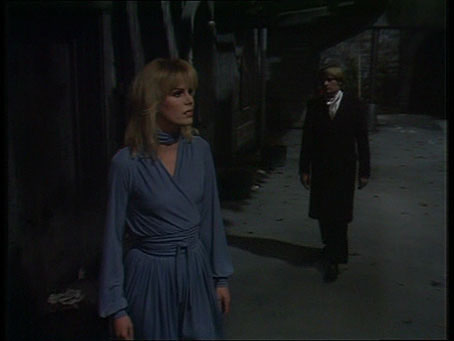
Having revisited a fair amount of old television in the past few years I thought I was past being surprised, but this came as a revelation. Sapphire and Steel appeared at exactly the wrong moment for me to fully appreciate it the first time round. The six storylines ran on the ITV network from 1979 to 1982, a period when my home and personal life was so chaotic that I saw little television at all. At any other time a series featuring a pair of cosmic investigators immersed in mysteries involving haunted railway stations and people escaping from photographs would have been essential viewing. Sapphire and Steel was never repeated after those original screenings so watching the entire run recently has been like seeing it for the first time. In recent years the series has been included in discussion of the weirder British television of past decades; China Miéville in his interview in The Twilight Language of Nigel Kneale describes Sapphire and Steel as the strangest thing ever screened on British TV. After reading that, and a couple of other appraisals, I felt obliged to refresh my vague memories.

sands02.jpg

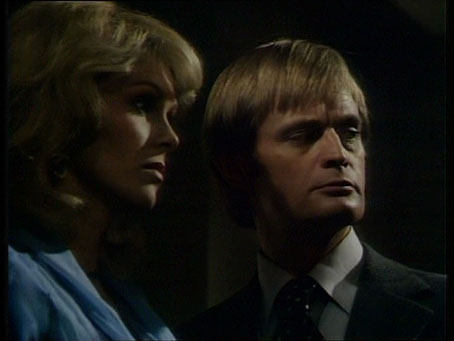
Assignment One: Sapphire (Joanna Lumley) and Steel (David McCallum).

Superficially, Sapphire and Steel belongs to the occult-detective subgenre, a minor category of weird fiction that in its early days included characters such as Sheridan Le Fanu’s Dr Martin Hesselius, Algernon Blackwood’s John Silence, William Hope Hodgson’s Thomas Carnacki and others. But several factors set Sapphire and Steel apart from their more staid predecessors: occult detectives are generally solitary figures whereas Sapphire and Steel operate as a pair; Sapphire is a woman in a field more commonly occupied by middle-aged men; and most striking of all, both Sapphire and Steel are supernatural beings themselves, dispatched to Earth by agencies we never see and learn nothing about, in order to mend ruptures in the flow of Time. Supernatural detectives had appeared in comic books before this but there’s no evidence that series creator PJ Hammond was considering such antecedents when he wrote The Time-Menders (as Sapphire and Steel was originally known). A few years earlier Hammond had been writing for Ace of Wands (1970–72), a mildly hippyish children’s TV series whose hero, Tarot, was a youthful stage magician with genuine occult powers. Between stage shows, Tarot and friends investigated supernatural events. Sapphire and Steel had originally been planned as a series for children but before the first script was finished it was moved to an early evening slot, thus allowing for darker and more adult-oriented material.

sands03.jpg

Assignment Two: the haunted railway station. The clothing worn by the pair changes with each assignment; on this occasion they’re in evening dress.

One of the attractions of Sapphire and Steel in a genre replete with origins and canonical histories is how little is explained about the two main characters, the source of their assignments, or even the true nature of the malevolent forces they have to face. Sapphire (Joanna Lumley) and Steel (David McCallum) embody the materials after which they’re named, the pair being part of a team of elemental operatives some of whose names are listed in the voiceover that introduces each episode. We only encounter two others: Lead (Val Pringle), a huge African-American man with superior strength; and Silver (David Collings), an effete and dandyish Englishman with the ability to mould metals, fix machines and replicate objects. Sapphire’s abilities are mainly psychometric—she reads the history and condition of people and places—but she can also rewind time for short periods; Steel is as cold and unyielding as his name; he’s fiercely analytical, often bad-tempered and also strong enough to tie a knot in a lift cable.

Continue reading “Haunted Corridors: The Temporal Enigmas of Sapphire and Steel”

Jo Daemen’s The Sacred Flame

daemen00.jpg

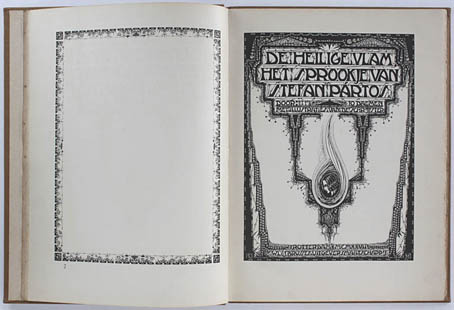
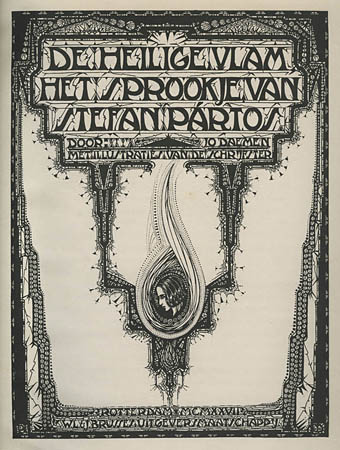
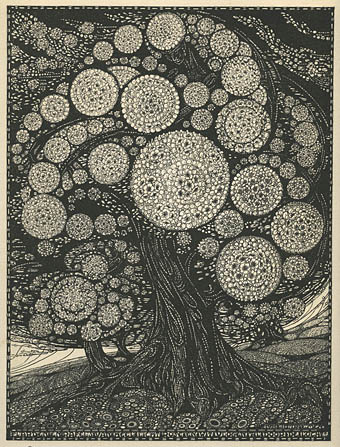
Johanna Maria Hendrika Daemen (1891–1944), credited here as “Jo”, wrote and illustrated The Sacred Flame: The Fairy-Tale of Stefan Pártos (1927), a tribute to a Hungarian violinist who died young. Daemen was a Dutch illustrator, graphic designer and glass artist who one suspects would be better known if she’d been British or American. The detail and composition of these illustrations is exceptional, falling somewhere between Kay Nielsen’s meticulous detailing and Harry Clarke’s stained-glass designs. This is another volume currently for sale at silver-gryph’s eBay pages where larger views of the drawings may be seen. (Thanks again to Nick for the tip!)

daemen12.jpg

daemen01.jpg

daemen02.jpg

Continue reading “Jo Daemen’s The Sacred Flame”

John Yunge-Bateman’s King Lear

yunge01.jpg

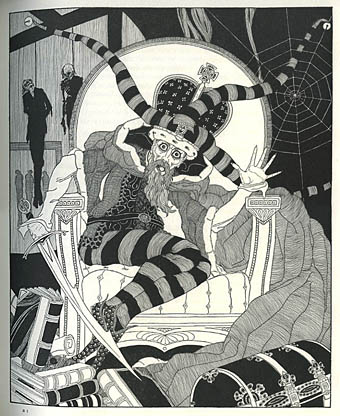
When Majesty turns to folly!

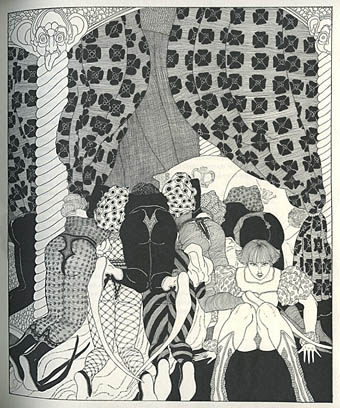
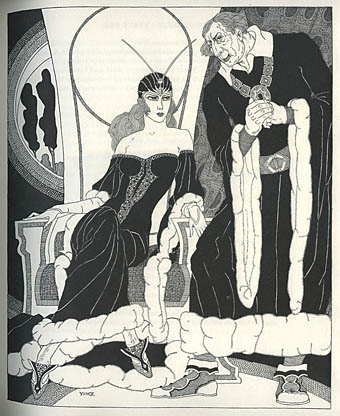
John Yunge-Bateman (1897–1971), aka “Yunge”, is another British illustrator whose work I’d not noticed until now, possibly because this 1930 edition of King Lear is an early creation in a derivative style the artist abandoned. The ten black-and-white drawings are closer to Harry Clarke than Aubrey Beardsley, and a couple of them even try to match Clarke’s more grotesque inventions albeit with variable results. Some of the faces are rather dopey for my taste but I like the use of solid blacks. These samples are taken from a scarce copy currently up for auction at silver-gryph’s eBay pages should anyone be interested. (Thanks again to Nick for the tip!)

yunge02.jpg

Than doth, within a dull, stale, tired bed, go to the creating a whole tribe of fops.

yunge03.jpg

If you come slack of former services you shall do well.

Continue reading “John Yunge-Bateman’s King Lear”

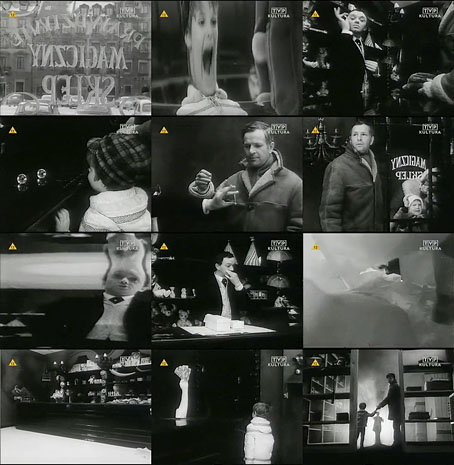
Prawdziwie magiczny sklep, a film by Mieczyslaw Waskowski

magic.jpg

Another short film by Mieczyslaw Waskowski, this is very different to the abstraction of Somnabulists being a remarkably faithful adaptation of HG Wells’ short story, The Magic Shop. Waskowski wrote and directed Prawdziwie magiczny sklep for Polish television in 1969. The title translates as “Truly Magical Shop” although “Genuine Magic Shop” would be more accurate, a description the vaguely sinister (and magical) proprietor in Wells’ story offers to the father and son who pay his establishment a visit.

The Magic Shop had been adapted by US television five years earlier for The Alfred Hitchcock Hour, a version that by coincidence was mentioned in the Guardian‘s print edition this weekend in a list of Reece Shearsmith’s favourite anthology dramas. I’m afraid I can’t share Shearsmith’s enthusiasm on this occasion (see an earlier post); the Wells story has been a favourite for years, and I was unimpressed by the skewing of the Hitchcock Hour version which turned the boy into a much older delinquent-in-the-making. The frisson of the original story comes from the disparity between the young son’s acceptance of the genuinely magical occurrences in the shop, and the growing alarm of the narrator-father when events graduate from the inexplicable to the sinister. Waskowski’s adaptation is more whimsical than Bradbury-dark but it still follows Wells very closely, at least until the end where things are padded out with an extra scene.

The version linked here is without subtitles but the visual storytelling is clear enough. Viewers familiar with The Saragossa Manuscript (1965) may recognise the actors playing the father and shopkeeper from Wojciech Has’s equally adept adaptation. The Wells story may be read here.

Previously on { feuilleton }
Uncharted islands and lost souls
Doctor Moreau book covers
The Island of Doctor Moreau
Harry Willock book covers
The Time Machine
The Magic Shop by HG Wells
HG Wells in Classics Illustrated
The night that panicked America
The Door in the Wall
War of the Worlds book covers