
Weekend links 110

janke.jpg

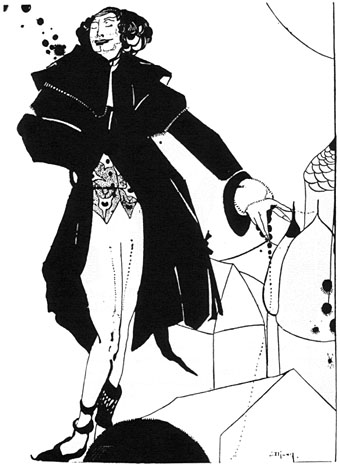
Til Eulenspiegel by Urban Janke. From Twenty Postcards of the Wiener Werkstätte at 50 Watts.

Rorschach Audio by Joe Banks is “essential reading for everyone interested in air-traffic control, anechoic chambers, artificial oxygen carriers, audio art, bell-ringing, cocktail parties, cognitive science, communications interference, compost, the death penalty, Electronic Voice Phenomena, evangelism, evolutionary biology, experimental music, ghosts, the historiography of art, illusions of sound and illusions of language, lip-reading jokes, nuclear blast craters, predictive texting, singing hair, sonic archives, sound design, steam trains, tinnitus, the Turing Test, Victorian blood painting, visual depth and space perception, ultrasonic visual music, ventriloquism, voices and warehouse fires and robberies.”

• “Freud did not understand female sexuality. Klimt did. Klimt’s women please themselves. The realization that women have an independent sexual life was an insight in art.” Eric Kandel discusses his new study The Age of Insight: The Quest to Understand the Unconscious in Art, Mind, and Brain, from Vienna 1900 to the Present.

• Three new books already mentioned here receive further attention: Stan Persky on Christopher Bram’s Eminent Outlaws : The Gay Writers Who Changed America. | Matthew Aquilone on Paul Russell’s The Unreal Life of Sergey Nabokov. | Karin L. Kross on the new translation of the Strugatsky’s Roadside Picnic.

The creative writing moment/movement baffles me and it intrigues me. What does it signify, all this creative longing? And why through language? Specifically fiction, poetry, memoir? […] The crazy part of it is that we are breeding professional, competent, homogenised writers who will go on to teach writing that is professional, competent and homogenised. The intriguing part of it is whether this movement towards creativity and self-expression is really the start of a kind of Occupy – that it could be dangerous and confrontational, not homogenised at all.

Dangerous? But then they won’t get published and win awards and get film deals and… Jeanette Winterson prepares to teach creative writing at Manchester University.

The Underground New York Public Library is a visual library featuring the Reading-Riders of the NYC subways.

Hob by No Man: “Constructed from soundtrack noises from both version of Quatermass and the Pit.”

Stephen Thrower talks about his soundtrack music for The Erotic Films of Peter De Rome.

John Waters surprises everyone by hitchhiking across the US.

• Sounds & the City: An interview with Julia Holter.

The Dead Dream of the Dirigible.

Meditation (1979) by Edward Artemyev.

Heliograms by Jean Piché

piche.jpg

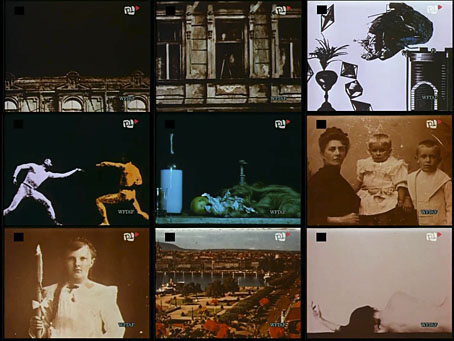
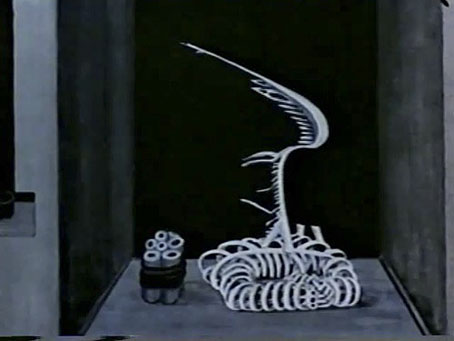
Heliograms (1982), an album of early digital music by Canadian composer Jean Piché has managed to stay resolutely off my electronic music radar until now following news of a reissue from Digitalis Recordings:

Jean Piché recorded “Heliograms” between the years 1977-1980 during his time at Simon Fraser University in Vancouver, BC. The music on the LP consists of works for computer, digital synthesis and acoustic instruments, and most of it was composed using the POD Interactive Compositional System that Barry Truax had developed at SFU. The four compositions that make up “Heliograms” are often dense, harmonically rich pieces that slowly evolve through time. There is a strong use of tonality throughout which characterizes Piché’s work during this period. It echoes a fascination with the music of Terry Riley, Steve Reich, and Lou Harrison, placing it firmly in a minimalist approach to electronic music, alongside the contemporary work of American composer Laurie Spiegel, then working at Bell Labs.

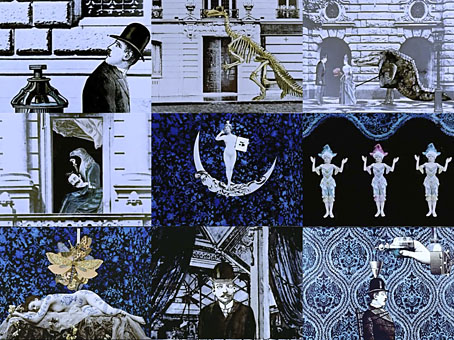
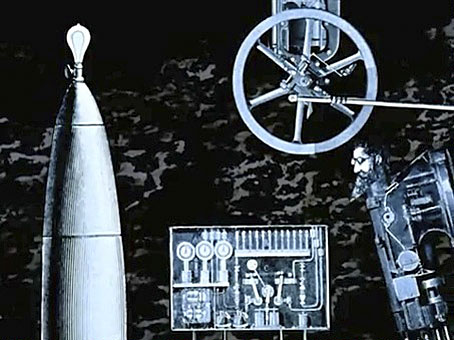
The screen grabs above are from Piché’s 18-minute sample video which gives an impressive taste of two of the tracks. There’s more of Piché’s “videomusic” at his Vimeo channel, ranging from an early Fairlight and video synthesizer piece to more recent work. Via FACT.

Previously on { feuilleton }
Creel Pone
Versum – Fluor by Tarik Barri

Devils debris

devils.jpg

The Devils (1971).

There is only one English feature director whose work is in the first rank. Michael Powell is the only director to make a clear political analysis in his films, his work is unequalled. The Life and Death of Colonel Blimp is the finest English feature, and A Canterbury Tale and A Matter of Life and Death are not far behind. When he made these films he was heavily criticized for his treatment of serious themes. Blimp was banned by Churchill and remained in a savaged version for nearly forty years, a plea for tolerance and regard for the enemy as human made at the height of the war there is no more courageous English film. It is a tragedy he has made so few films in the last twenty years, none in the last ten, and a lasting condemnation of all those who make films. He was a major casualty of the spurious social realism of the sixties, whose practitioners have grown fat and invaded the media with their well-scrubbed minds.

Thus Derek Jarman writing in 1980. Ian Christie quoted Jarman’s sentiments in Arrows of Desire: the films of Michael Powell and Emeric Pressburger (1985), pointing to the shared attitudes of the two directors, especially their outsider stance. There were other correspondences: both maintained an abiding interest in the artistic scope of cinema; both were marginalised by the British film world during their lives then lauded after their deaths. Michael Powell for years attempted to produce a film of The Tempest; Derek Jarman, of course, succeeded.

return1.jpg

Return to the Edge of the World (1978).

Then there’s this odd coincidence from Return to the Edge of the World, a short documentary made in 1978 in which Powell and actor John Laurie returned to the Scottish island of Foula where they’d made Powell’s first feature film, The Edge of the World in 1937. The film opens with shots of Pinewood studios and the very first things we see are this pair of abandoned statues which anyone who’s seen Ken Russell’s The Devils will recognise from an early scene. Derek Jarman was the production designer on The Devils so these would have been created according to his instruction. I only noticed this recently when watching Return to the Edge of the World again as it’s now an extra on the BFI DVD of Edge of the World. No need to dwell on the inadvertent symbolism of abandoned statues and languishing careers.

Powell and Pressburger’s marvellous The Life and Death of Colonel Blimp was reissued recently. John Patterson discussing its writer and director tells us why the most English of movies often benefit from an outsider’s perspective.

return2.jpg

Previously on { feuilleton }
Rex Ingram’s The Magician
The Devils on DVD
Derek Jarman’s music videos
Derek Jarman’s Neutron
Mister Jarman, Mister Moore and Doctor Dee
Powell’s Bluebeard
The Tale of Giulietta
The Tempest illustrated
In the Shadow of the Sun by Derek Jarman
The Angelic Conversation
The life and work of Derek Jarman

Rex Ingram’s The Magician

magician1.jpg

The Magician (1926), Rex Ingram’s curious occult horror film, receives a rare screening with live music accompaniment at the Brighton Fringe Festival on Tuesday, 22nd May. The film is notable for being based on the 1908 Somerset Maugham novel of the same name whose modern-day magus character, Oliver Haddo, was modelled on Aleister Crowley. The screening will feature an introduction by Gary Lachman, and a live soundtrack by the fabulous Ragged Ragtime Band, featuring members of Blondie, Indigo Octagon, Raagnagrok and Time. Booking details and other information here.

magician2.jpg

Maugham’s book has always been easier to find than Ingram’s film, more’s the pity when the film—despite some flaws—is the superior article. Read today, the novel comes across as a template for the standard Dennis Wheatley tale of middle-class innocents imperilled by grandiloquent villainy. A young couple, Arthur Burdon and his fiancée, Margaret, are pitted against Haddo’s extravagant diabolisms; for assistance they have a friend, Dr Porhoët, a Van Helsing type, older than the couple and with a convenient (but purely intellectual) interest in the occult. Haddo kidnaps Margaret and forces her with hypnosis into an unconsummated marriage. Haddo’s goal is to create artificial life—homunculi—and for that he requires a virgin’s blood. Maugham later described his novel as “lush and turgid”, an honest and accurate appraisal. Aleister Crowley was amused at being portrayed as a “Brother of the Shadows” but pretended to be scandalised by Maugham’s alleged plagiarism which he condemned in a Vanity Fair review that he signed “Oliver Haddo”. The best parts of the novel certainly owe something to other authors, usually the scenes concerning the sinister magus and his occult activities; the rest of the characters are lifeless by comparison. Some of the better passages read like HP Lovecraft writing Dorian Gray, and Maugham not only quotes from Walter Pater but also (uncredited) from Wilde’s Salomé.

magician4.jpg

Paul Wegener as Oliver Haddo.

Continue reading “Rex Ingram’s The Magician”

Weekend links 109

magritte.jpg

Dreams before Surrealism: a sheet music cover from 1926 by René Magritte.

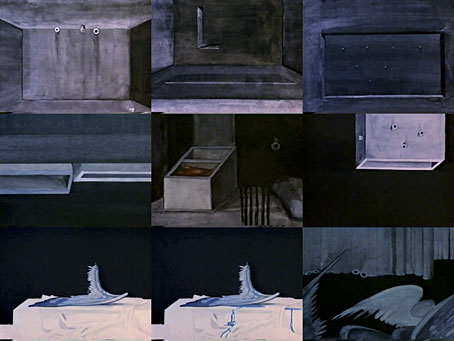
• The week in music: Listen to compositions by Annea Lockwood. | At the Free Music Archive: Uncomfortable Music, a tribute to David Lynch’s Eraserhead (and, it should be said, to Alan Splet’s unique soundtrack). | Alan Licht plays a track from Trout Mask Replica then loops some Donna Summer and improvises guitar noise over it. | Music Experiments with Terror: The Spooky Isles presents Joseph Stannard‘s list of recent eldritch sounds from British musicians.

Great art, or, let’s just say, more modestly, original art is never created in the safe middle ground, but always at the edge. Originality is dangerous. It challenges, questions, overturns assumptions, unsettles moral codes, disrespects sacred cows or other such entities. It can be shocking, or ugly, or, to use the catch-all term so beloved of the tabloid press, controversial. And if we believe in liberty, if we want the air we breathe to remain plentiful and breathable, this is the art whose right to exist we must not only defend, but celebrate. Art is not entertainment. At its very best, it’s a revolution.

Salman Rushdie on the censorship of art

• All Diamond, No Rough” says the School Library Journal about the first volume of The Graphic Canon. Volume two should be out in August.

Scientific American asks: Do Psychedelics Expand the Mind by Reducing Brain Activity?

• From 2010: A Dandy in Aspic – A letter from Derek Marlowe.

Tom Phillips and A Humument: how a novel became an oracle.

Timeline Maps at the David Rumsey Map Collection.

• Happy 50th birthday, A Clockwork Orange.

Jim Dandy (1956) by LaVern Baker | Larks’ Tongues in Aspic, part one (1972) by King Crimson, live on Beat Club.