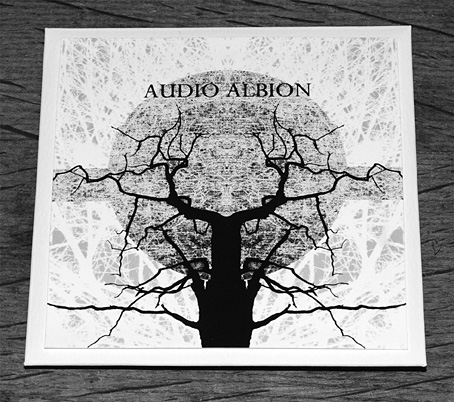
Audio Albion

audioalbion.jpg

Last year saw a series of themed compilation albums from A Year In The Country, each of which was released a few months at a time. This year follows suit with Audio Albion, a collection of 15 new pieces of music from regular contributors such as David Colohan, Howlround, Keith Seatman, Sproatly Smith and others. The theme this time is “the sounds found and heard when wandering down pathways, over fields, through marshes, alongside rivers, down into caves and caverns, climbing hills, along coastlands, through remote mountain forestland, amongst the signs of industry and infrastructure and its discarded debris.”

Track list:
1) Bare Bones—Marshland Improvisation
2) David Colohan—On Stormy Point
3) Grey Frequency—Stapleford Hill
4) Field Lines Cartographer—Coldbarrow
5) Howlround—Cold Kissing
6) A Year In The Country—The Fields of Tumbling Ideas
7) Keith Seatman—Winter Sands
8) Magpahi—Shepsters in the Yessins
9) Sproatly Smith—Ethelbert & Mary
10) Widow’s Weeds—The Unquiet Grave
11) Time Attendant—Holloway
12) Spaceship—The Roding in Spate
13) Pulselovers—Thieves’ Cant
14) The Heartwood Institute—Hvin-lettir
15) Vic Mars—Dinedor Hill

As with previous A Year In The Country collections, the approaches are diverse, ranging here from the banjo-plus-location-recordings of Bare Bones to abstract electronic treatments by Howlround and Time Attendant. The accompanying texts are useful for contextualising the recordings; so David Colohan informs us that his piece, On Stormy Point, contains a whistle recording made in one of the caves at Alderley Edge in Cheshire, an important location in the Rural Wyrd via the popularisation of its myths in the novels of Alan Garner. Not everything here aims for a sinister atmosphere but the The Unquiet Grave by Widow’s Weeds certainly achieves this, a marvellous interpretation of one of the spookiest English folk songs, and the standout piece in an excellent collection.

Audio Albion will be released on 29th May but is available for pre-order now.

Previously on { feuilleton }
A Year In The Country: the book
All The Merry Year Round
The Quietened Cosmologists
Undercurrents
From The Furthest Signals
The Restless Field
The Marks Upon The Land
The Forest / The Wald
The Quietened Bunker
Fractures
Folk Horror Revival: Field Studies

Weekend links 413

bester.jpg

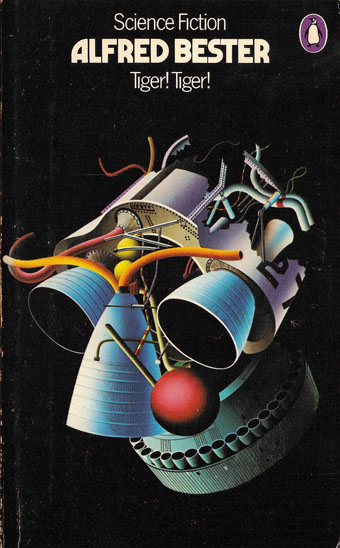
Cover art and design by David Pelham, 1974. The author’s name is set in Marvin (see below).

• Revelation of the week is a lengthy, career-spanning interview with Igor Wakhévitch, the French composer whose extraordinary run of albums from the 1970s are cult items in these parts. (Previously) Wakhévitch isn’t exactly reclusive but he lives in India, and hasn’t recorded anything since the 1980s, so in recent years he wasn’t visible or even known much at all outside France. The release in 1998 of a CD collection, Donc…, and a handful of vinyl reissues, brought him out of obscurity, although all the reissues to date have been in limited quantities. Work of this quality really warrants a wider release.

The Sky Torn Apart is a new album by Paul Schütze, his first for several years. Very good it is too, 56 minutes of growling and glittering atmospherics that could equally suit the enervating heights of summer (as in Wendy Carlos’s drone piece from Sonic Seasonings) as the depths of winter, the inspiration being the apocalyptic cycles of Norse mythology.

• At Lambda Literary: Cathy Camper talks to cartoonist Justin Hall about his planned film, No Straight Lines, about the history of queer comics. There’s a Kickstarter for the project, and more background detail at QueerClick (NSFW).

• Introducing Marvin Visions, a digital revival of Marvin, a photoset typeface first launched in 1969, and very popular during the 1970s on science-fiction cover designs. Marvin Visions is free for personal use.

• The second number of the relaunched Wyrd Daze—”The multimedia zine of speculative fiction + extra-ordinary music, art & writing”—has arrived.

• At New Noise: Dylan Carlson (again) talking about the influences on his solo album, Conquistador.

• Video Drone: Russell Cuzner talks to Rose Kallal about her audio-visual concerts.

• Mix of the week: a Dark Souls-inspired drone mix from Justin C. Meyers.

• RIP Glenn Branca

The Ascension (1981) by Glenn Branca | Ascension (1992) by O Yuki Conjugate | Ascension (2014) by The Bug

Aubrey Beardsley and His World

beardsley.jpg

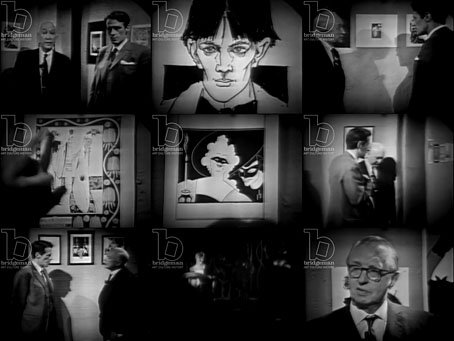
This US TV programme isn’t the greatest quality, and it’s blighted throughout with a large watermark, but it’s a revelatory piece both for Aubrey Beardsley enthusiasts and Oscar Wilde aficionados. Camera Three was a CBS arts show which presented Aubrey Beardsley and His World on 12th March, 1967, as a preview for the Beardsley exhibition which had just opened in New York. This was the same landmark exhibition that made such a splash the year before at the V&A in London, and V&A curator Brian Reade appears in the programme to discuss Beardsley’s importance with host James Macandrew. It’s good to see Reade again (he was also in a later BBC documentary) since his Beardsley monograph is a great favourite of mine; as is typical of the period, he looks and sounds very upper class but his scholarship is always authoritative.

Ordinarily this would be enough to satisfy me, even though the programme only runs for 27 minutes and doesn’t tell me anything about Aubrey that I didn’t know already. The great revelation comes near the end with the appearance of Vyvyan Holland, the younger son of Oscar Wilde. Holland not only admired Beardsley’s work but actually met him in 1895 shortly before the artist’s untimely death. Holland was 9 years old at the time, and was taken to visit Aubrey by his mother; he was 81 in 1967, and died himself later that year so we’re very fortunate that he was captured on tape at all. The programme also includes a short extract from Alla Nazimova’s 1923 film of Salomé, with costumes and decor all based on Beardsley’s drawings. Watch it here.

Elsewhere on { feuilleton }
The Aubrey Beardsley archive

Weekend links 412

maroto.jpg

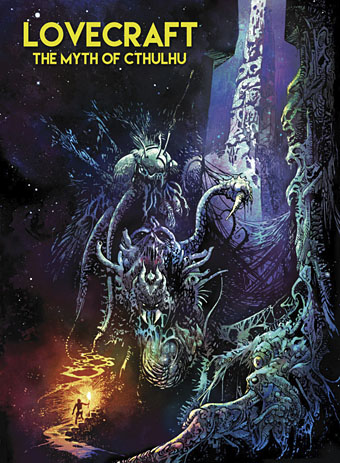
Lovecraft: The Myth of Cthulhu, an English-language edition of three comic-strip adaptations by Esteban Maroto, is now available from IDW.

The Coffin House, a short story by Robert Aickman that’s a taster for the new Aickman collection, Compulsory Games. Anwen Crawford wrote an introduction to Aickman’s world of “strange stories” for The New Yorker. Related: Victoria Nelson, editor of the new collection, chooses ten favourite horror stories.

• German music this week at The Quietus: Sean Kitching talks to Irmin Schmidt about his years with Can; and there’s an extract from Force Majeure, an autobiography by the late Edgar Froese, writing about the early days of Tangerine Dream.

• More German music at Carhartt WIP: a lengthy and revealing interview with guitarist Michael Rother about his time as one half of Neu!. There’s also a bonus Neu!-themed mix (and one of the mixes of the week) by Daniel Miller.

• From October last year, a Stereoklang interview with master synthesist Hideki Matsutake (Logic System, Yellow Magic Orchestra, et al).

• “When did you first get interested in esoteric studies?” Gary Lachman interviewed at The Astral Institute.

• At Sweet Jane: early illustrations by Wojtek Siudmak for Plexus magazine, 1969.

• 87 prints and drawings by MC Escher in zoomable high-resolution.

• Meet the Small Press: James Conway of Rixdorf Editions.

• Mix of the week: Goodbyes & Beginnings by Zach Cowie.

Derek Jarman on the trouble with shopping for clothes.

Person To Person (1981) by Logic System | Plan (1981) by Logic System | Prophet (1981) by Logic System

Daughters of Forgotten Light by Sean Grigsby

grigsby.jpg

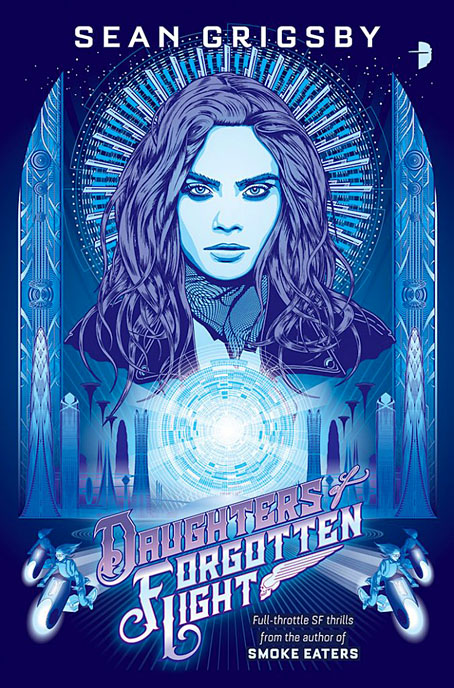
I’ve spent most of the year so far working on more black-and-white illustrations for Editorial Alma—47 full-page pieces to date—so this cover design made a welcome break, especially since all the black-and-white art has a late-Victorian setting. More about that later. Sean Grigsby’s second novel for Angry Robot Books is previewed at the Barnes & Noble SF blog as follows:

A floating prison is home to Earth’s unwanted people, where they are forgotten…but not yet dead, in this wild science fiction adventure.

Deep space penal colony Oubliette, population: scum. Lena “Horror” Horowitz leads the Daughters of Forgotten Light, one of three vicious gangs fighting for survival on Oubliette. Their fragile truce is shaken when a new shipment arrives from Earth carrying a fresh batch of prisoners and supplies to squabble over. But the delivery includes two new surprises: a drone, and a baby. Earth Senator Linda Dolfuse wants evidence of the bloodthirsty gangs to justify the government finally eradicating the wasters dumped on Oubliette. There’s only one problem: the baby in the drone’s video may be hers.

The gangs are biker gangs, riding machines with wheels of light, so the brief was for a design as much reminiscent of a rock poster as a science-fiction cover. I don’t stray very often into the SF world so this again made a refreshing break from the 19th century and its heavy furnishings. There’s a touch of Syd Mead in the background, a reference suggested by the Tron-style bikes, but he’s long been a favourite visual futurist of mine even before Blade Runner (as I noted recently). The side panels and parts of the halo are adapted from Art Deco designs, the panels being based on embellishments for a New York skyscraper. It doesn’t take much to push the aerodynamic qualities of Deco style into the Space Age (the Soviet Monument to the Conquerors of Space could have been designed in 1930), a suggestion that William Gibson explored from a different angle in The Gernsback Continuum.

The Barnes & Noble post linked above also has an extract from the beginning of the novel. The book itself will be out on 4th September, 2018.