Weekend links 430

fiochi.jpg

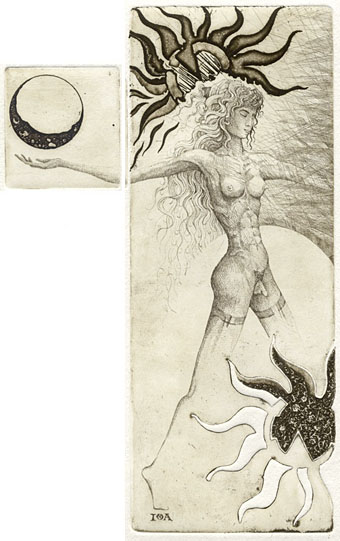
Il Mago from the IONA Tarot by Giona Fiochi.

• “Russia’s answer to James Bond: did he trigger Putin’s rise to power?” Andrew Male on Max Otto von Stierlitz and Seventeen Moments of Spring. The whole series is on YouTube (with subtitles).

Geeta Dayal reviews High Static, Dead Lines: Sonic Spectres and the Object Hereafter by Kristen Gallerneaux, a new book about the eeriness of sound technology.

• Published next month: Strange Frequencies: The Extraordinary Story of the Technological Quest for the Supernatural by Peter Bebergal.

Let me first introduce an aside: I hate the word “queer” and all its new iterations. “Gay” was awful enough. “‘Gays’ makes us sound like bliss ninnies,” Christopher Isherwood said once. “Queer” will always be for men of my generation a word of violence and hatred, and it separates generations. And while I’m digressing, let me commit blasphemy: the over-emphasis on the Stonewall riots depletes and distorts our history of resistance and the art produced, which is determinedly referred to as “pre-Stonewall.” Resistance occurred years before Stonewall (but there were lots of writers in New York at the time to write about those riots), in San Francisco, Los Angeles, other cities, powerful confrontations with the police, powerful demonstrations. “Pre-Stonewall” writers include William Burroughs, Allen Ginsberg, strong radical voices confronting the grave dangers of the time, violence, prison.

John Rechy talking to Eric Newman about his latest novel, Pablo!, written in 1948 but only now seeing publication

Tangerine Dream performing Identity Proven Matrix, one of the standout pieces from recent album Quantum Gate, live in the studio.

Beloved is the debut solo album by Randall Dunn, record producer and member of the masterful Master Musicians of Bukkake.

• “How will police solve murders on Mars?” Geoff Manaugh on the new frontier of interplanetary law enforcement.

Milly Burroughs on how Verner Panton changed the way the world sees furniture design.

Tim Martin on the new science of psychedelics.

Werner’s Nomenclature of Colours

Next Stop Mars (1966) by Sun Ra & His Arkestra | Mars, The Bringer Of War (1976) by Isao Tomita | Mars Garden (2013) by Juan Atkins & Moritz Von Oswald

Saki: The Improper Stories of HH Munro

saki.jpg

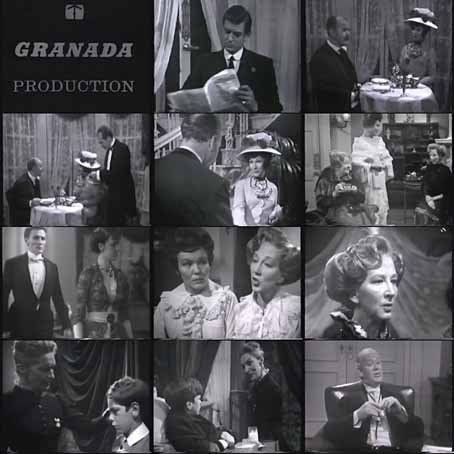
I thought I’d written about this some time ago but it appears not so the present post can serve as a way to honour the talents of the late Fenella Fielding. The obituaries this week have inevitably emphasised her roles in the Carry On films, a series of alleged comedies that I’ve never liked, and which weren’t much liked by several of the actors who appeared in them. Fenella Fielding did much more than this, of course, especially in the theatre, on radio and in television, including appearances such as the one here from a collection of adaptations of the peerless short stories of Hector Hugh Munro, better known as Saki. Granada TV made a whole series of these in 1962, broadcasting this anthology in 1985 following the death of producer Philip Mackie. Fenella appears in the second story, A Holiday Task, as the forgetful Mary Drakmanton, and she fits so well with into Saki’s world that I really wish I’d suggested to my colleagues at Savoy Books a reading or two by Fenella from Saki. She enjoyed reading Colette for Savoy, and chose the selections herself, one of which concerned Colette’s homosexual friends. Given this, I can imagine Fenella teasing out some of the sly gay humour that runs like a scarlet thread through Saki’s Clovis stories.

The other pieces in this Granada collection are The Stampeding of Lady Bastable, The Way to the Dairy, Sredni Vashtar and A Defensive Diamond. The story editor was Gerald Savory who later did such an excellent job adapting Dracula for the BBC.

Previously on { feuilleton }
Fenella Fielding reads Colette

Weekend links 429

holter.jpg

• Julia Holter’s next album, Aviary, will arrive next month with a cover design bearing astrological symbols (a cryptic message?) and what looks like a grimoire page in the background, although I may be reading too much into this. Whatever the esoterics signify, the album is a double, and going by the sound of new song I Shall Love 2 it’s going to be a good one. Aviary will be released on 26th October just in time for the witch season.

Donna Ferguson talks to Oscar Wilde’s grandson, Merlin Holland, about the manuscript for The Picture of Dorian Gray which includes more openly homoerotic sentences than were included in the printed versions. A facsimile of the manuscript is now available in a limited, numbered edition from SP Books.

• The final single in the excellent Other Voices series from the Ghost Box label is released later this month. Something Out Of Nothing is by Sharron Kraus and Belbury Poly.

…we’re still trying to operate this new, paranoid society on what amounts to a psychedelic substrate—with little or no awareness of how our sets and settings are determining our results. The set and setting of the advertiser yield addictive behavioral design and persuasive technologies. The set and setting of the investor lead to algorithmic trading and winner-takes-all, extractive businesses. The set and setting of the military lead to drone warfare. The set and setting of the politician lead to targeted propaganda and digital fascism.

America is unconsciously living in a psychedelic landscape and having a bad trip. We don’t realize that we are living in a media environment that offers us an unprecedented capacity over reality. The world may have always been a consensual hallucination to some extent, but never before have we built our world so completely.

The internet is acid, and America is having a bad trip, says Douglas Rushkoff

Photographia Erotica Historica is a tiny leatherbound collection of antique pornography from Goliath Books.

Why is the Federal Government threatening an indie book publisher with $100,000 in fines?

• Undead, undead: my illustrations for Dracula are featured at Dangerous Minds. Thanks!

• The Vinyl Factory meets Japanese composer and musician Midori Takada.

• Exploring HP Lovecraft’s Gothic roots by Dr Xavier Aldana Reyes.

• From 2013: Dario Argento discussing his films with Alan Jones.

• Aurora Mitchell on Electro pioneer Doris Norton.

• Mix of the week: XLR8R Podcast 558 by DJ T.

Aviator (1970) by Michael Chapman | Aviation (2000) by Fluxion | Aviation (2001) by Monolake

The eyes have it

oeil01.jpg

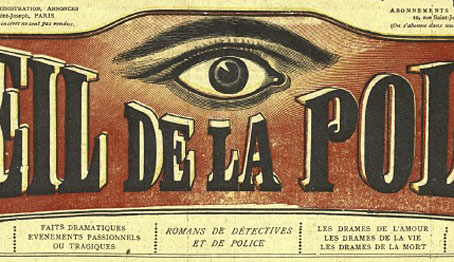
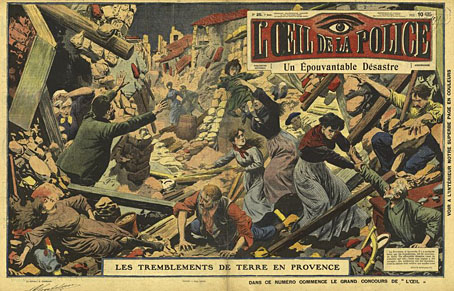
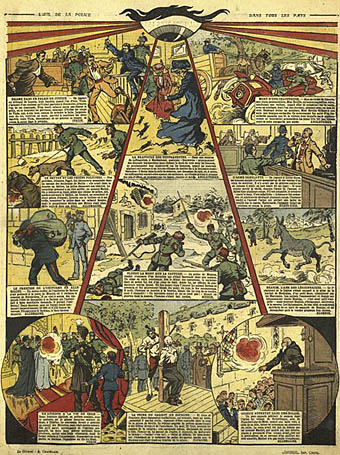
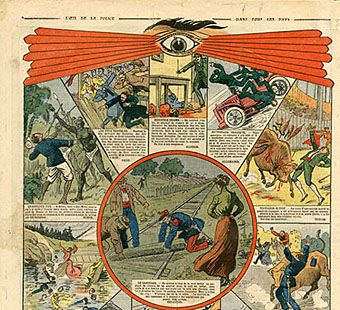
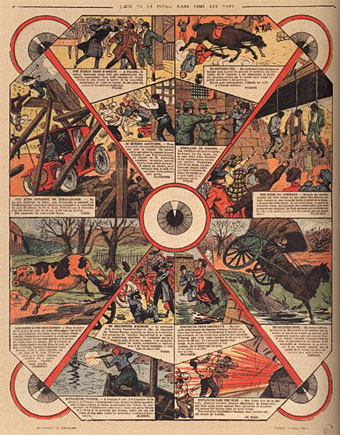
Recent picture research turned up issues of L’Oeil de la Police, a lurid French crime magazine that I hadn’t encountered before. It shouldn’t be too surprising when the nation that gave the world the guillotine and Grand Guignol theatre produces magazines filled with gore, but the amount of red ink in these pages (also applied to gun shots and explosions) is certainly unusual for the time. The covers of Le Petit Journal—which ran concurrently with L’Oeil de la Police—also tended to the lurid and gory but the quality of illustration was better there. L’Oeil de la Police is positively cartoon-like, especially on the back covers of each issue which present their disasters in comic-like pages overseen by the spectral Eye of the Law. This is rather disingenuous when many of the scenes don’t involve law-breaking at all, but are reports of natural disasters and fatal accidents. The samples below show the most bizarre feature of the back pages which is the titular Eye in places becoming anthropomorphised, like an atrocity-viewing precursor of the eyeball heads worn by The Residents.

oeil02.jpg

The L’Oeil de la Police archive at Gallica runs from 1908 to 1914 should you require an antique disaster fix. The archive site has improved in recent years but it can still be awkward (and slow) to use so perseverance is required.

oeil03.jpg

oeil04.jpg

oeil05.jpg

Continue reading “The eyes have it”

Weekend links 428

willink.jpg

Straat met standbeeld (1934) by Carel Willink.

• “[Edward] Gorey, who died in 2000 at 75, was the unequaled master of—of what? Gothic whimsy? The high-camp macabre? Existential black comedy in the Firbankian mode? Essentially unclassifiable, he was, at the end of the day (and it’s always twilight, in Gorey’s stories), simply, inimitably Edwardian.” Mark Dery’s Born to be Posthumous: The Eccentric Life and Mysterious Genius of Edward Gorey, the first full-length biography, will be published in November.

• “In an East Prussian manor house, a Bohemian library, a Bulgarian railway station; in a Venetian citadel, a Breton harbour, a city in the Caucasus, characters encounter not only the vicissitudes of history but also the subtle influences of the uncanny.” Inner Europe by John Howard and Mark Valentine.

• “To the good men I offer the hand of friendship, to the foes of our sex I offer resistance and annihilation!” The next title from Rixdorf Editions (due in November) will be We Women Have no Fatherland (1899), a novel by Ilse Frappan.

• At Dangerous Minds: “The career of Penny Slinger, intrepid surrealist artist of the 1970s, is ripe for rediscovery,” says Martin Schneider.

• Mixes of the week:  FACT mix 668 by Smerz, and XLR8R Podcast 557 by re:ni.

• Dreaming of Walter Benjamin on Walter Benjamin Platz by Roger Gathman.

Alison Kinney on Ludwig II’s obsession with the operas of Richard Wagner.

• A trailer for The Other Side of the Wind, the final film by Orson Welles.

• A happy tenth anniversary to The Quietus.

Wizards (1982) by JD Emmanuel.

The Wizard (1964) by Albert Ayler Trio | The Wizard (1970) by Black Sabbath | Dancin’ Wizard (1973) by Sopwith Camel