Weekend links 589

mackintosh.jpg

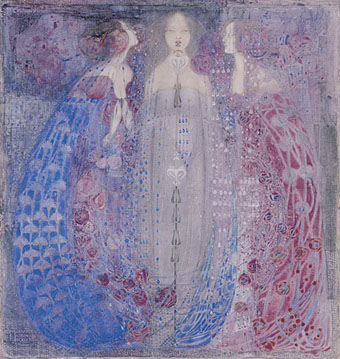
The Three Perfumes (1912) by Margaret Macdonald Mackintosh.

• “…we have empowered this monopoly to strike fear into the hearts of authors. And that may be unprecedented in history. Through our own complicity as consumers, their market share only grows.” Dave Eggers talking to Rachel Krantz about the dominance of Amazon, and his new novel, The Every.

• “People will readily flock to yoga and Pilates classes, but how many show up for soundscape therapy or take a sound-walk?” Bernie Krause on the healing powers of quietude, the Ba’Aka tribe, and Japanese forest bathing.

• “Difficulty is my drug of choice, I guess.” Dennis Cooper (again) talking to Troy James Weaver about his new novel, I Wished.

• At Wormwoodiana: Mark Valentine reviews Shadows of London by Jonathan Wood.

• Robert Fripp’s drive to 1981: Joe Banks on Discipline and the return of King Crimson.

• End times and rapture: Ken Hollings remembers Richard H. Kirk.

• Daniel Spicer on The Strange (Parallel) World of Miles Davis.

• Mix of the week: XLR8R Podcast 715 by Uffe.

• Steven Heller’s font of the month is Oposta.

Perfumed Metal (1981) by Chrome | Ode To Perfume (1982) by Holger Czukay | Perfume (2006) by Sparks

Born for Trouble

trouble.jpg

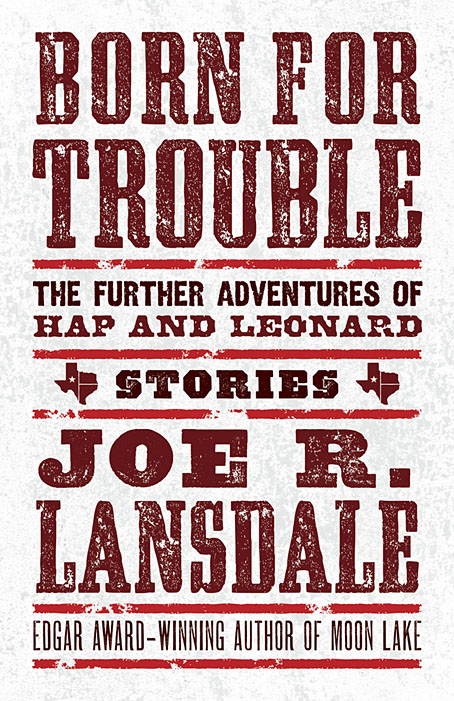
I said at the weekend that I’d recently designed an all-type cover, and here it is. This is my second design for Joe R. Lansdale’s detective duo, and like the earlier Of Mice and Minestrone this one went through more iterations than usual. It’s often the case that the more popular a book is likely to be, the more constraints will be imposed on the cover design. Hap and Leonard are very popular characters so this commission arrived with a number of prerequisites regarding the amount of text, the size of the type and so on. It also required the inclusion of the word “Stories” to emphasise that the book is a story collection rather than a novel. The latter feature is a recent trend in American publishing, one that follows the not-so-recent trend of appending the words “A Novel” to the covers of…novels. As a reader I find these labels to be superfluous and even mildly insulting but as a designer I have to follow the brief, and the brief was to present all of this information in a suitably harmonious manner. Most of the early iterations tried to do this with the addition of some illustrative graphics but the results were persistently unsatisfactory, hence the decision to let the type do the work.

Born for Trouble will be published by Tachyon in March 2022.

Previously on { feuilleton }
Foiled at last
Of Mice and Minestrone

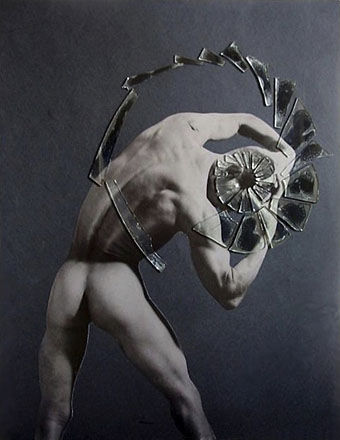
The art of Eduardo Hernández Santos

santos1.jpg

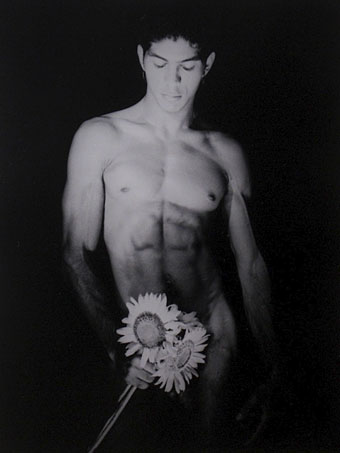
From the series Aproposito los flores.

In 1993 I made Homo-Ludens, which was the first homoerotic exhibition to take place in Cuban photography after the Revolution. This show was committed to a direct, frontal discourse, but very aesthetic. It was not intended to reflect great contradictions, but to propose to society that the male body was also an object to analyze, that it was a source of pleasure, and not only to women.

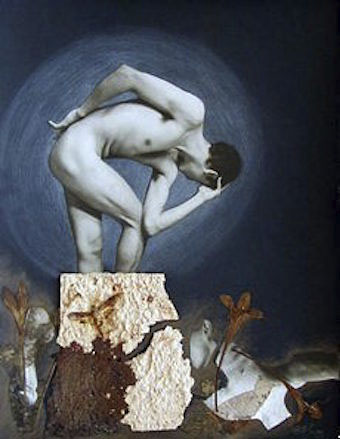
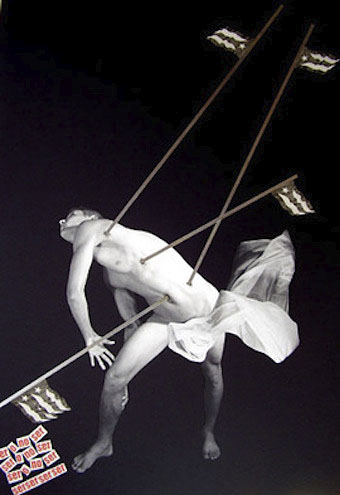
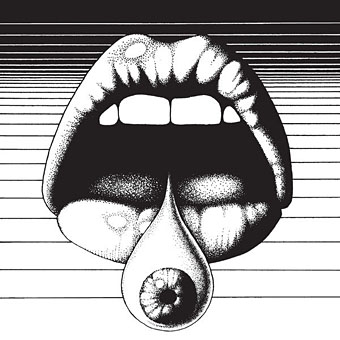
Cuban artist Eduardo Hernández Santos talking in 2016 about his career (here and here). In addition to straightforward photography, Santos favours collage as a technique, combining his own photographs with fragmented slogans and other imagery. The late date of the Homo-Ludens exhibition is a result of the slow evolution of attitudes towards sexuality in Cuban society. Fidel Castro regarded gay men as degenerates, a common sentiment in Communist circles in the 1960s, and one shared by many fascists. A striking thing about homosexuality is the way you can be despised by a wide variety of people who wouldn’t agree with each other about anything else.

santos2.jpg

From the series Corpus Fragiles.

It’s tempting to wonder what Jean Genet would have thought about Santos’s photographs of male nudes with flowers. Genet used flowers for their symbolic qualities almost as much as Oscar Wilde, so even though it’s unwise to try and second-guess him I imagine he’d appreciate their use here.

santos3.jpg

Untitled (2000).

santos4.jpg

From the series Palabras.

Elsewhere on { feuilleton }
The gay artists archive

Previously on { feuilleton }
The art of Gregorio Prieto, 1897–1992
Emil Cadoo

Philippe Caza record covers

caza05.jpg

Bad Taste (2014) by The Datsuns.

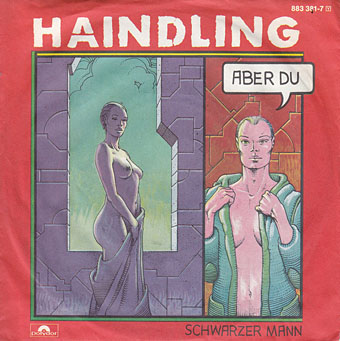
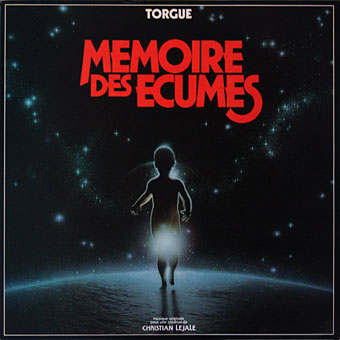
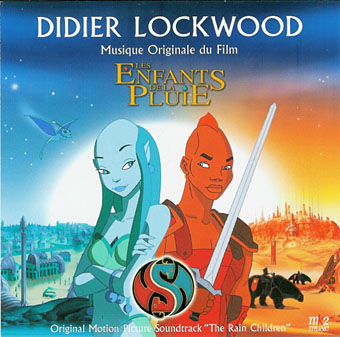
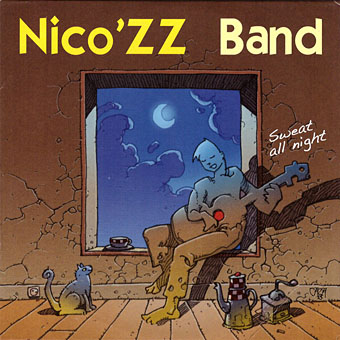
Continuing an occasional series about artists or designers whose work has appeared on record sleeves. Druillet and Moebius have already featured in this series so here’s another French comic artist whose work was popularised in the Anglophone world by Heavy Metal magazine. In addition to comics, Caza has been a prolific cover artist for French fantasy, horror and SF novels, some examples of which are reused here. As with Druillet, many of his record sleeves are reprintings of comics panels, but he’s also created a few pieces specially for vinyl and CD.

caza01.jpg

Aber Du (1985) by Haindling.

caza02.jpg

Mémoire Des Ecumes (1985) by Torgue.

A soundtrack album (?) for the comic book of the same name by Caza and writer Christian Lejalé.

caza03.jpg

Musique Originale Du Film Les Enfants De La Pluie (2003) by Didier Lockwood.

The soundtrack album for an animated feature film co-written and designed by Caza. This follows earlier Caza-derived animations by René Laloux including the feature-length Gandahar (1988).

caza04.jpg

Sweat All Night (2013) by Nico’ZZ Band.

Continue reading “Philippe Caza record covers”

Weekend links 588

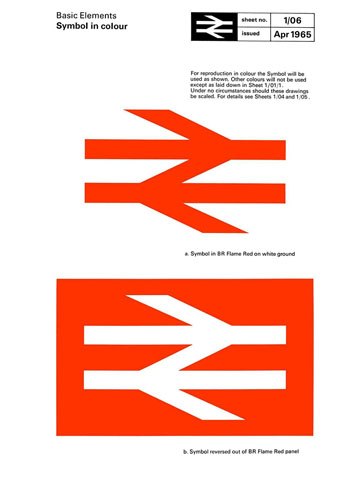
br.jpg

Gerry Barney’s logo for British Rail. A page from the British Rail Corporate Identity Manual (1965).

• RIP Russ Kick, writer, editor, and founder of many websites/blogs such as Rare Erotica, Books Are People Too and (notoriously) the several iterations of The Memory Hole, a space dedicated to keeping visible information that successive US governments would have preferred to remain unseen. I’d known Russ remotely for many years, initially as a reviewer of the Savoy comics in Outposts. Savoy Books later helped find him a publisher for Psychotropedia: A Guide to Publications on the Periphery, a wide-ranging overview of alternative/underground print culture in the late 1990s. In 2004 his information activism gave him a fleeting taste of world-wide attention when he forced the Bush administration to make public the photos of flag-draped coffins returning from Iraq. The scandal put his name on the front pages of newspapers that should have been finding those photos for themselves instead of cheerleading the war. A run of books for Disinformation presented his archival researches for the general reader, then in 2012 he edited The Graphic Canon, a massive three-volume collection of comics and illustrations based on classic works of literature. I was among the many contributors to the latter with an adaptation of The Picture of Dorian Gray, and would have worked on the follow-up collection of crime stories if I hadn’t been busy with other things. I had hoped that we might work together again in the future.

• “‘The new mainstream has attempted to erase the innovations of the avant-garde from jazz history,’ the film declares.” Geeta Dayal reviews Fire Music, a documentary about the jazz innovations of the 1960s.

• I don’t have the hardware to play this but Sable is a new computer game from Raw Fury whose design owes much to the desert landscapes seen in comics by Moebius.

• New/old music: Stealing Sheep and The Radiophonic Workshop reimagine the score for René Laloux’s animated science-fiction film La Planète Sauvage.

• At Spine: Savannah Cordova on how to perfect your book cover’s typography. Having recently designed an all-type cover design this is timely.

• Mixes of the week: Isolatedmix 113 by Sunju Hargun, XLR8R Podcast 714 by Soela, and Holograficzne Widmo ze Bart De Paepe by David Colohan.

• “If it ain’t broke, don’t fix it.” Gerry Barney, designer of the British Rail logo, doesn’t like the green reworking of his design.

• Scottish lord goes blood simple: a teaser for The Tragedy of Macbeth by Joel Cohen and some bloke called William Shakespeare.

• “It’s unmanageable.” Ellen Peirson-Hagger on how the vinyl industry reached breaking point.

Macbeth (1973) by John Cale | Rail (1994) by Main | Logotone (2013) by Steve Moore