This week’s Photoshop researches lead to interesting encounters.
Previously on { feuilleton }
• Fascinating tentacula
• Jewelled butterflies and cephalopods
• Haeckel fractals
• Octopulps
A journal by artist and designer John Coulthart.
Work
This week’s Photoshop researches lead to interesting encounters.
Previously on { feuilleton }
• Fascinating tentacula
• Jewelled butterflies and cephalopods
• Haeckel fractals
• Octopulps

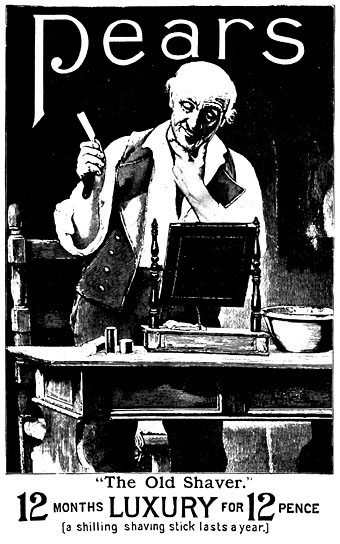
Pears Soap ad, Illustrated London News, March 16, 1895.
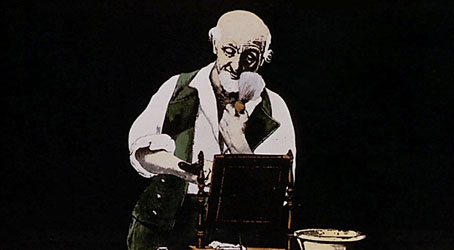
I’ve been working feverishly this week to complete page designs for The Thackery T. Lambshead Cabinet of Curiosities which will be published next year by HarperCollins. This is a sequel of sorts to 2003’s Thackery T. Lambshead Pocket Guide to Eccentric and Discredited Diseases to which I was also a contributor and designer. Ann and Jeff VanderMeer are editing the new collection, and Jeff has posted a couple of teaser introductions to the contents here and here. Gabriel in yesterday’s comments mentioned Terry Gilliam’s animations for the Monty Python TV series, something I was reminded of today while leafing through a 1968 collection of old advertising graphics looking for suitable pictures. Victorian Advertisements was compiled by Leonard de Vries and Ilonka van Amstel, and its Pears Soap ad (above) is obviously the source of Gilliam’s animation (below) showing a man lathering his face then beheading himself with a straight razor, a gag which features in both the TV series and the first Monty Python feature film And Now For Something Completely Different.
And Now For Something Completely Different (1971).
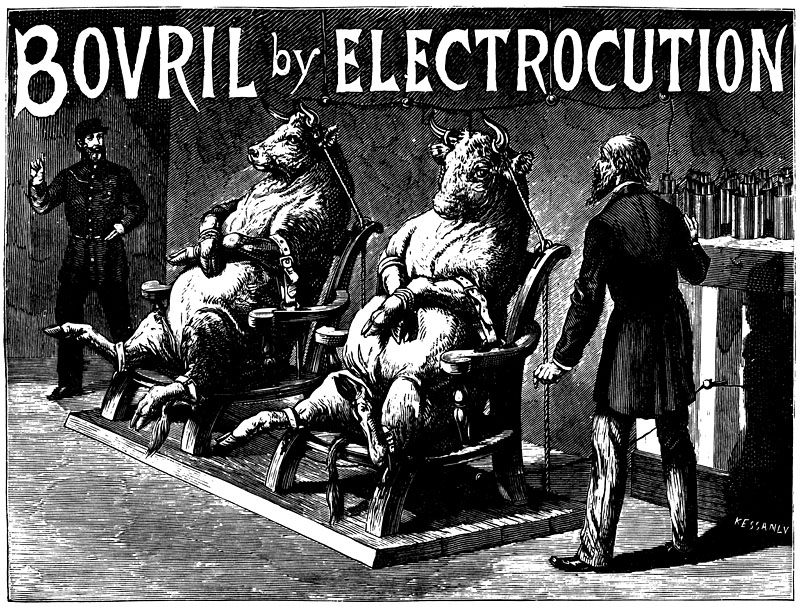
It’s easy to see what would have attracted Gilliam to the De Vries book when it’s filled with bizarre or grotesque ads like the Bovril one below; someone evidently decided that the meaty drink ought to be promoted via the novelty of electricity.
Bovril ad from The Graphic, Christmas number, 1891.
De Vries features many ads for electrical products, not all of them genuine or even likely:
Pseudo-science began to play the part it still plays in therapeutic advertising. Electric light was, by the end of the century, being installed in theatres and restaurants and in some private houses. To what other uses could the magnetic fluid be put? Electricity was the new magic and all kinds of quarters began to exploit its possibilities—and impossibilities. The Medical Battery Company Limited, of Oxford Street, assured the public that its Electropathic Belt had “restored thousands of sufferers to health and vigour”, and had “proved an inestimable blessing to the weak and languid”. It was particularly recommended for “weak men suffering from the effect of youthful errors”. Did the weak men in question wear the contraption in bed? Women also could benefit by it, and one is a little surprised to find this and other remedies for “female irregularities” so frankly discussed. An Electric Corset was the “Very Thing” for ladies. One can only wonder how the batteries if there were any operated. And what could possibly be meant by an “electric” towel, and how could failing sight be cured by an “eye battery”?
There’s also an Electric Hair Brush which gives “hope for the bald” without explaining how it differs from an ordinary brush. Several of the pieces in the new Lambshead volume will be exploring similarly eccentric territory. Watch this space for further details.
Previously on { feuilleton }
• Portuguese Diseases
• Pasticheur’s Addiction
• Short films by Walerian Borowczyk
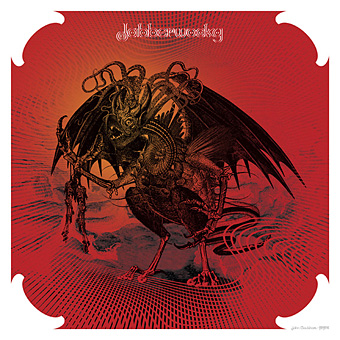
The Jabberwock (2010).
’Twas brillig, and the slithy toves
Did gyre and gimble in the wabe;
All mimsy were the borogoves,
And the mome raths outgrabe.“Beware the Jabberwock, my son!
The jaws that bite, the claws that catch!
Beware the Jubjub bird, and shun
The frumious Bandersnatch!”He took his vorpal sword in hand:
Long time the manxome foe he sought—
So rested he by the Tumtum tree,
And stood awhile in thought.And as in uffish thought he stood,
The Jabberwock, with eyes of flame,
Came whiffling through the tulgey wood,
And burbled as it came!One, two! One, two! And through and through
The vorpal blade went snicker-snack!
He left it dead, and with its head
He went galumphing back.“And hast thou slain the Jabberwock?
Come to my arms, my beamish boy!
O frabjous day! Callooh! Callay!”
He chortled in his joy.’Twas brillig, and the slithy toves
Did gyre and gimble in the wabe;
All mimsy were the borogoves,
And the mome raths outgrabe.
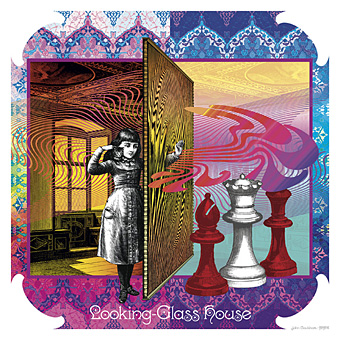
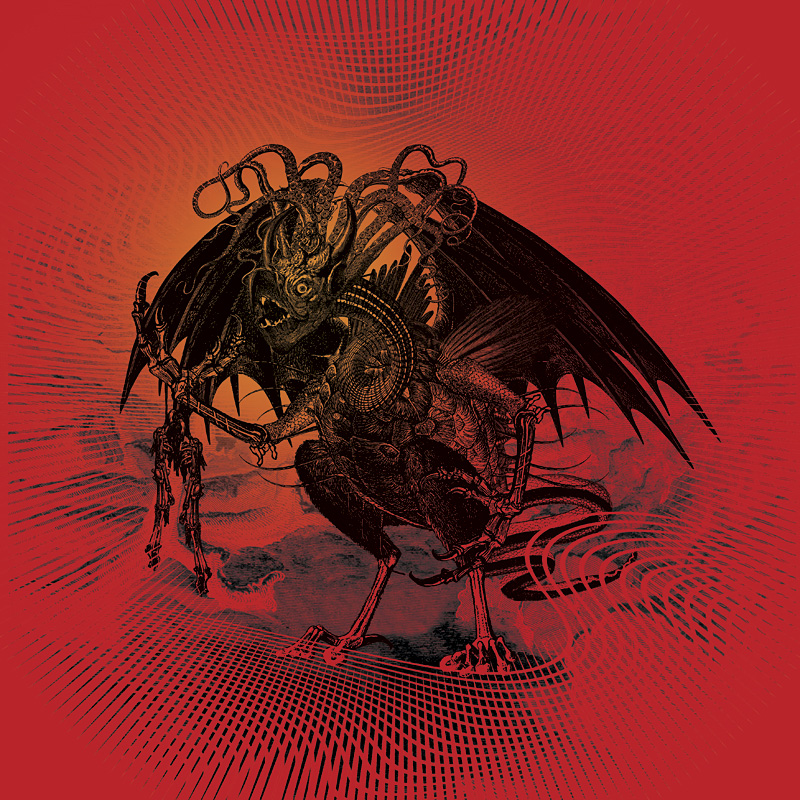
The past month has been inordinately busy which has meant all the fine plans for a 2011 Coulthart calendar have been set back further than intended. No prizes for guessing the theme this year. This picture made its web debut last weekend at Alicenations, a Brazilian site devoted to all things Carrollian. Lots of splendid artwork on the rest of their page, including some of Jan Švankmajer’s Alice collages and some familiar bestiary hybrids. As to the calendar, I’m pleased to say the series of pictures is starting to feel halfway finished so I may have the whole thing completed and uploaded to CafePress sometime next week. Keep your vorpal blades crossed. In the meantime, here’s a picture detail, and while we’re on the subject, let’s not forget Terry Gilliam’s first feature film or the 1968 single from Boeing Duveen & The Beautiful Soup. (Given a choice I prefer the B-side, Which Dreamed It?)

Previously on { feuilleton }
• Alice in Acidland
• Return to Wonderland
• Dalí in Wonderland
• Virtual Alice
• Psychedelic Wonderland: the 2010 calendar
• Charles Robinson’s Alice’s Adventures in Wonderland
• Humpty Dumpty variations
• Alice in Wonderland by Jonathan Miller
• The Illustrators of Alice
Cover design by Ann Monn. Cover image by Dan Jones / Tinkerbots.
Here at last is the steampunk anthology I mentioned back in September and whose interiors I designed. This is another Tachyon publication, and also another anthology edited by Ann & Jeff VanderMeer. I went further with the design for this than I have done for other Tachyon books, partly because if there’s one thing steampunk lends itself to, it’s decoration but also because the book includes illustrations from Ramona Szczerba, Eric Orchard, and others, plus a comic strip by Sydney Padua; adding extra spot illustrations stopped the pictorial material from seeming too isolated.
Title spread. The illustration on the left is one I created last year.
This is a sequel to an earlier steampunk anthology by the same editors but the contents are just as strong as the first collection with excellent stories throughout. (For a review, see here.) By coincidence the book is published in the wake of a recent (and inevitable) backlash against steampunk as science fiction sub-genre and cultural phenomenon. This collection can serve as a repudiation to some of the lazier accusations that writers are ignoring the moral and physical squalor of the Victorian era and the legacies of imperialism; several stories in Steampunk Reloaded address those very issues. For my part I’ve read Friedrich Engels’ Condition of the Working Class in England, Henry Mayhew’s London Labour and the London Poor, and Kellow Chesney’s The Victorian Underworld so I don’t feel in urgent need of a lecture on the iniquities of the 19th century, thank you very much.
While we’re on the subject, the cover of The Steampunk Bible, edited by Jeff VanderMeer and SJ Chambers, has been revealed here. Abrams will be publishing this next year and having seen some of the interior pages it’s going to be a splendid book. More about that later. Further pages from Steampunk Reloaded follow.
Update: A couple more reviews here and here.
Contents spread.

A detail of one of the page footers.
Title page for A Secret History of Steampunk, a self-contained section within the body of the book.
Previously on { feuilleton }
• Steampunk overloaded!
• Skeleton clocks
• Vickers Airship Catalogue
• The Air Ship
• Dirigibles
• More Steampunk and the Crawling Chaos
• The art of François Schuiten
• Steampunk Redux
• Steampunk framed
• Steampunk Horror Shortcuts
• The Airship Destroyer
• Zeppelin vs. Pterodactyls
Goddem with Attendants (1924) by Harry Clarke.
• Some of Harry Clarke’s extraordinary illustrations from Goethe’s Faust can be seen at A Journey Round My Skull. And a reminder for anyone who missed them, Clarke’s Poe illustrations at Golden Age Comic Book Stories.
• HP Lovecraft – Audio Books, Radio Plays, & Audio Documentaries. Out-of-print recordings and (no doubt) pirate copies of more recent things. I found this page by accident so it was a surprise to see my 1999 Lovecraft portrait used there. I used to own the David McCallum Dunwich Horror, an album with a singularly appalling sleeve illustration.
• Better album sleeves can be found here: Prospective 21e Siècle, a collection of foil designs from 1967. Some of the very challenging music within can be downloaded at the Avant Garde Project archive. Related: Have an electroacoustic Halloween with İlhan Mimaroğlu’s Le Tombeau d’Edgar Poe (1964) and Wings of the Delirious Demon (1969).
Star Trails and the Captain’s Ghost, a photo by Chris Kotsiopoulos at Astronomy Picture of the Day.
• “The horror industry is totally male dominated from its directors to its slashers, and even its bloggers…and I think that needs to change.” Day of the Woman, a blog for the feminine side of fear.
• 6 of the Scariest Queer Horror Books Ever. I think I’d agree with the commenter in picking The Haunting of Hill House by Shirley Jackson.
• Designer Jonathan Barnbrook (pictured in a graveyard by the looks of things) is interviewed at MyFonts.
• A Weird and Scratching Beauty: The Art of John Coulthart and Call of Cthulhu.
• Is the Royal Masonic School for Boys the scariest building in Britain?
• 50-million-year-old insect trove found in Indian amber.
• The Café Kaput Samhain 2010 mixtape.
• Monster Mash (1962) by Bobby “Boris” Pickett & The Crypt-Kickers.