Foiled at last

foil.jpg

I’ve already written about the design for this story collection from Swan River Press but the gradient layout does nothing to convey the splendour of the foil-embossed printing. In the past when I’d suggested to publishers that foil printing might be an option the idea was always turned down for reasons of cost. My original intention for The Far Tower was for the design to be printed in a metallic ink so it might resemble the gold-on-green cover of the Yeats book which was the model for this volume. Metallic inks don’t always work too well, however, especially on a darkish background, so I said to Swan River “Or we could do it in gold foil…” To my surprise and delight they said “Why not?” So here’s the result. A great end to the year. The book is available here.

lansdale.jpg

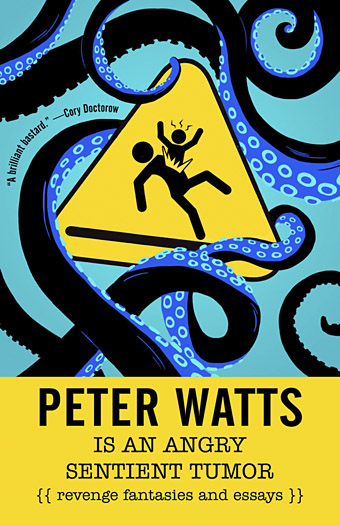
And back in October, I posted what everyone thought at the time was the final design for Of Mice and Minestrone, a new book of Hap and Leonard stories by Joe R Lansdale. The Hap and Leonard books are popular works (there was a TV series based on them a while back) so they’re subject to the demands of the marketplace which in this case required a cover more in line with the red/white/black arrangement of some of Lansdale’s related titles. I’d already done most of this as an additional draft during the work on the first design so the reworking wasn’t too time-consuming. The rodent in the soup is more visible in this version which is another point in its favour. Of Mice and Minestrone will be published by Tachyon in May next year.

Previously on { feuilleton }
The Far Tower: Stories for WB Yeats
Of Mice and Minestrone

The Far Tower: Stories for WB Yeats

tower.jpg

I said a couple of weeks ago that I had more cover designs waiting to be revealed, and this was one of them, arriving two years to the week after my earlier cover for The Scarlet Soul: Stories of Dorian Gray. Both books are collections of original fiction edited by Mark Valentine for Swan River Press, and both offer variations on works by Irish authors prominent during the 1890s:

“All Art that is not mere story-telling,
or mere portraiture, is symbolic…” — WB Yeats

Stories of magic and myth, folklore and fairy traditions, the occult and the outré, inspired by the rich mystical world of Ireland’s greatest poet, WB Yeats. We invited ten contemporary writers to celebrate Yeats’s contributions to the history of the fantastic and supernatural in literature, drawing on his work for their own new and original tales. Each has chosen a phrase from his poems, plays, stories, or essays to herald their own explorations in the esoteric. Alongside their own powerful qualities, the pieces here testify to the continuing resonance of Yeats’s vision in our own time, that deep understanding of the meshing of two worlds and the talismans of old magic.

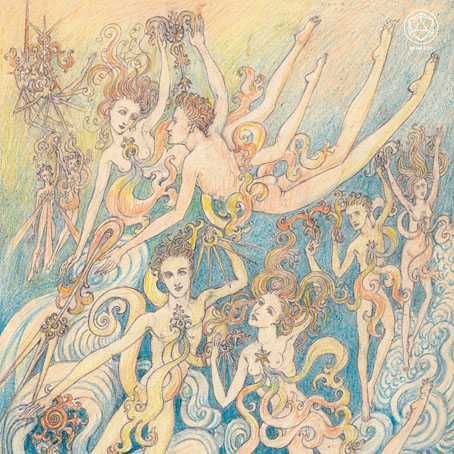
Yeats had a career that extended beyond the fin de siècle, of course, and the title of The Far Tower alludes to The Tower, a collection of poems that Yeats published in 1928. (The first poem in the book, Sailing to Byzantium, is the origin of the phrase/title “no country for old men”.) Yeats’s poetry is very different to the Modernists, however, and remained infused with mystical resonances, something I tried to reflect in the cover design. In addition to the very Yeatsian symbol of the rose there are symbols for the four elements, and a pair of robed figures who can be taken as adepts of one sort or another, either the Golden Dawn (who Yeats was involved with for a time) or the various Theosophists and Rosicrucians of the period who fed his imagination.

The green-and-gold colour scheme matches the gold on green design that Thomas Sturge Moore created for the first edition of The Tower. Sturge Moore produced covers for a number of Yeats’s books but it was his splendid design for Axel by Auguste Villiers de L’Isle-Adam that gave me the nested circles and vertical division of the board. That edition happens to have a preface by Yeats so as an influence it isn’t too remote.

The Far Tower will be published in December but is available for pre-order now.

Previously on { feuilleton }
The Scarlet Soul: Stories for Dorian Gray
Form and Austin Osman Spare
Golden apples and silver apples
A Book of Images by WT Horton
The Savoy magazine

Of Mice and Minestrone

lansdale.jpg

I’ve done a lot of cover work this year, and there are still more designs waiting to be announced. Of Mice and Minestrone isn’t my usual line of work but it’s actually the third cover I’ve done for a Joe R. Lansdale book, although the previous titles were horror and steampunk respectively. The latest volume is a collection of crime stories, and an addition to Lansdale’s Hap and Leonard books, a series about a pair of Texan detectives whose popularity now extends to a TV show.

Crime presents many of the same challenges you find in other genres, all of which come with their own set of clichés which you can either choose to engage with or avoid. In the case of crime there’s a tendency for degraded typefaces to proliferate, along with variations on a red/black/white colour scheme. One of the early drafts of this design did use a red/black/white arrangement but I was told that Joe Lansdale was (unsurprisingly) tired of seeing this scheme applied to his own books. The title of the collection comes from the opening story which concerns the young Hap’s involvement with an older woman and her abusive husband; the marital abuse is resolved via a bowl of soup which has been poisoned with a dead rat, hence the title and the cover image. I like using pareidolia when I can, and the slightly unusual imagery pushed the appearance away from generic clichés (if you discount the bullets) towards the marvellously surreal covers that Tom Adams painted for Agatha Christie’s novels.

The background photo is a rare example of my using a stock image. The soup bowl looked fine from the outset but the background lacked a suitably ominous quality, and was at risk of looking too much like a recipe book. (As it happens there are some recipes by Kasey Lansdale following the fiction although I don’t think any require the use of dead rats.) After trying a number of different table surfaces I decided on a lateral approach so went searching for pictures of Texan storm clouds. The image we eventually used—a tornado over farmland near Patricia, Texas by John Finney at Getty Images—was the second one I tried and it worked so well we decided to keep it.

Of Mice and Minestrone will be published by Tachyon in March 2020 but is available for pre-order now.

Previously on { feuilleton }
The Gods of HP Lovecraft
Lovecraft’s Monsters
Ten titles and a cover
Steampunk overloaded!
New things for April

Weekend links 486

magma.jpg

Magma concert poster, 2017. Art by Jofre Conjota.

The Dream Foundry is a new venture with a mission “to bolster and sustain the nascent careers of professionals working in the field of speculative literature.” This includes artists as well as writers, and to this end I was asked to answer a few questions about my work as a creator of book covers. I also offer some advice about visibility as an artist which I tried not to hedge with too many caveats. Related: my cover for The Resurrectionist of Caligo by Wendy Trimboli & Alicia Zaloga was one of the covers of the month at Muddy Colors.

• “…for a band that were so compositionally advanced, they were adept at producing primordially insistent and hypnotic rhythms.” John Doran on Magma (again), appraising the band’s music and history before presenting Christian and Stella Vander with questions from appreciative musicians.

• Mixes of the week: FACT mix 731 by Meemo Comma, mr.K’s Soundstripe vol 2 by radioShirley, The Ivy-Strangled Path Vol. XIX by David Colohan, and The Pumpkin Tide by Haunted Air.

• At Dangerous Minds: Roddy McDowall reads HP Lovecraft’s The Outsider and The Hound. Related: David McCallum reads HP Lovecraft’s The Dunwich Horror and The Haunter of the Dark.

• “Mathematics is not unique in drawing out charlatans and kooks, of course…” David S. Richeson on cranks, past and present.

• “I plan to take psychedelics again…” Helen Joyce, the finance editor of The Economist, takes a trip.

• The City of Light and its shadows: Brassaï’s Paris.

• At Dennis Cooper’s: Dennis Hopper Day.

Paris (1958) by Perez Prado And His Orchestra | Paris 1919 (1973) by John Cale | Paris 1971 (1971) by Suzanne Ciani

Something from Below

My first encounter with author, editor and Lovecraft biographer ST Joshi was in the form of an artwork request that arrived out of the blue in the late 1980s. My comic-strip adaptation of The Haunter of the Dark had just been published in a large-format edition by Caermaen Press, a small imprint run by Roger Dobson and Mark Valentine, and this prompted a flurry of interest among weird-fiction enthusiasts in Britain and the USA. Joshi was editing Lovecraft Studies for Necronomicon Press at the time, and asked if I’d be willing to contribute illustrations, something I ended up not doing for a variety of reasons. I always felt bad about this, and admitted as much when we eventually met at the Providence NecronomiCon in 2015, so my cover art for his new cosmic-horror novella may be regarded as a kind of recompense.

Something from Below is horror with an industrial setting and a Lovecraftian slant, hence the sinister coal mine dominating the artwork:

When 22-year-old Alison Mannering returns to her home in northeastern Pennsylvania after college, she finds a troubling situation. Her father, Guy Mannering, a longtime coal miner, has died recently under suspicious circumstances, and her mother refuses to provide any details of his passing. Alison feels she has no option but to investigate the matter herself, enlisting her high school sweetheart, Randy Kroeber, as well as Randy’s twin sister, Andrea called Andy, to assist her… (more)

The brief for this one was to create a wraparound cover without showing anything overtly monstrous, something I was happy to do since I dislike horror covers that reveal too much. In addition to the wrap I also produced a black-and-white piece for the inner boards. As is evident from the pictures above, the artwork was flipped around in the design but that’s okay, it works both ways. The coal mine is the central location, however.

Something from Below is published this month by PS Publishing in signed and unsigned hardcovers.

Elsewhere on { feuilleton }
The Lovecraft archive