Weekend links 640

ewers-wunderwald.jpg

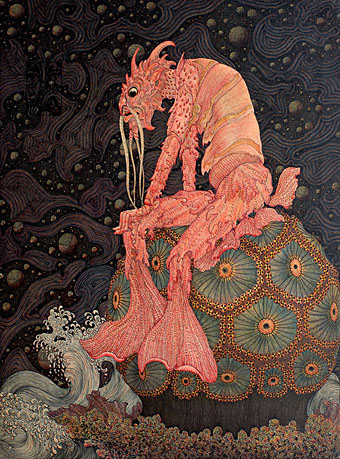
Aquarius (1910–1914) by Ilna Ewers-Wunderwald.

• “…they created a unique Afro-Caribbean soundscape—Battiste’s exceptional skills saw him use the studio as an instrument, voices flutter in and out, instruments shiver and shriek, over which Rebennack mutters and chants, a shaman of sorts.” Garth Cartwright on the life and works of Mac Rebennack, better known to the world as Dr John.

• Issue 3 of Man Is The Animal: A Coil Zine is now available for pre-order. I contributed to this one with a piece entitled “Singularities of Art and Nature”, an examination of the Coil discography via the Wunderkammer concept and the Musaeum Clausum of Thomas Browne.

• Among the recent arrivals at Standard Ebooks, the home of free, high-quality, public-domain texts, is Arthur Machen’s episodic and influential horror novel The Three Imposters (1895).

Media History Digital Library: “A free online resource, featuring millions of pages of books and magazines from the histories of film, broadcasting, and recorded sound.”

• At Dennis Cooper’s: Shall I, Jean Eugène Robert-Houdin, conjurer, introduce myself to you, viewer? And why not?

• At Public Domain Review: The Blood Collages of John Bingley Garland (ca. 1850–60).

• Mix of the week: Endymion, an autumnal ambient mix by The Ephemeral Man.

• “New Webb image captures clearest view of Neptune’s rings in decades.”

• New music: Of Endless Light by Cleared.

• RIP jazz giant Pharoah Sanders.

Conjuration (1977) by Tangerine Dream | Necronomicon—Conjurations (2004) by John Zorn | A Boy Called Conjuror (2020) by Teleplasmiste
Georges Méliès, Mage

melies01.jpg

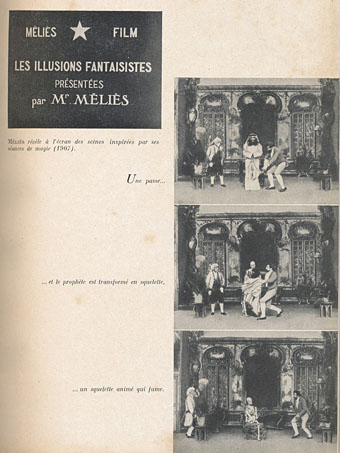
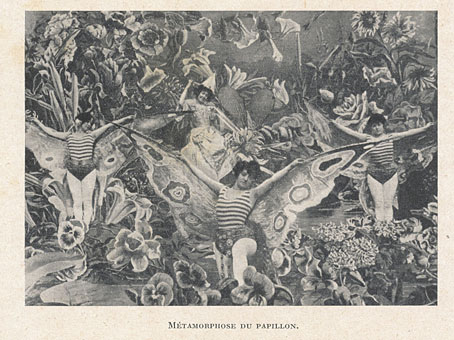
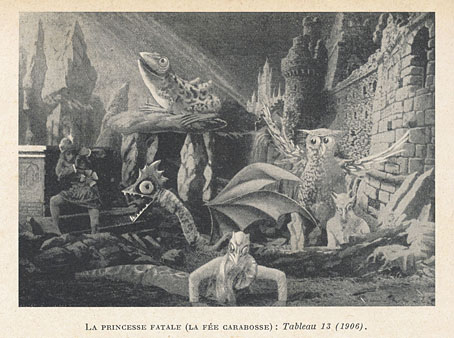
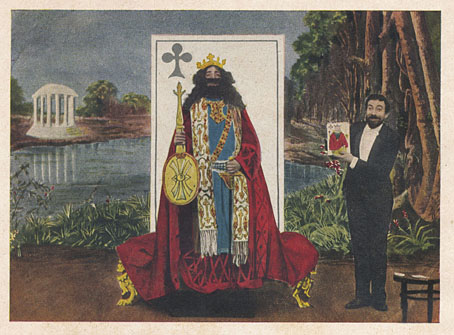
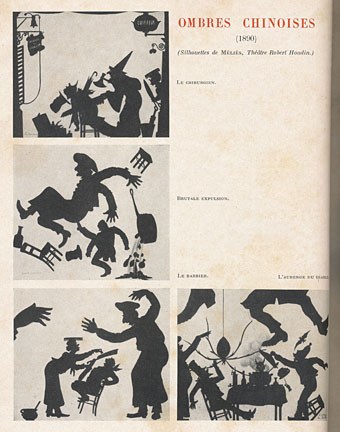
Georges Méliès: magician. Yes, indeed. I was watching Martin Scorsese’s Hugo again recently, a film I found more enjoyable the second time around mostly for the Méliès side of the story. The flashback to the Star Films studio offers in miniature a history that this book delivers in detail. Georges Méliès, Mage (1945) by Maurice Bessy and Joseph-Marie Lo Duca is a copiously illustrated guide to Méliès’ entire career, beginning with his early years as a conjuror and a creator of the kinds of theatrical fantasies that formed the basis for his first films. The text is in French throughout but there’s a wealth of pictorial material, with many production sketches and drawings that show how some of his more complex effects were achieved.

melies02.jpg

One of the things I’ve always found attractive about Méliès’ films is the way they resemble 19th-century illustrations brought to life. The same can be said about some of the later Hollywood productions, especially the Douglas Fairbanks Thief of Bagdad, but they lack the overt theatricality of Méliès. For a taste of those hand-tinted marvels, go here.

melies03.jpg

melies04.jpg

melies05.jpg

Continue reading “Georges Méliès, Mage”

Weekend links 629

vallee.jpg

UFOs: The Psychic Solution (1977) by Jacques Vallée. A retitled reprint of The Invisible College (1975) with cover art by Peter Tybus.

• “In the summer of 1992…a curious experimental interstellar ambient-house album, made it to number one in the UK charts, promoted by a top ten single that was almost forty minutes long.” Darran Anderson navigates the noösphere with my favourite Orb album, U.F.Orb.

• Among the recent arrivals at Standard Ebooks, the home of free, high-quality, public-domain texts: Hope Mirrlees’ strange fantasy novel, Lud-in-the-Mist (1926).

• James Balmont’s guide to the intricate cinema of Hong Kong’s crime auteur, Johnnie To.

Shortlisted photos from the Astronomy Photographer of the Year Contest.

• At Dennis Cooper’s: Spotlight on…Jean Genet Miracle of the Rose.

• Steven Heller’s font of the month is Ambicase.

• New music: Two Sisters by Sarah Davachi.

• RIP Peter Brook and James Caan.

Unidentified Flying Object (1970) by UFO | Psychic And UFO Revelations In The Last Days (1994) by Bill Laswell & Pete Namlook | UFOnic (1995) by Sabalon Glitz

Weekend links 610

durer.jpg

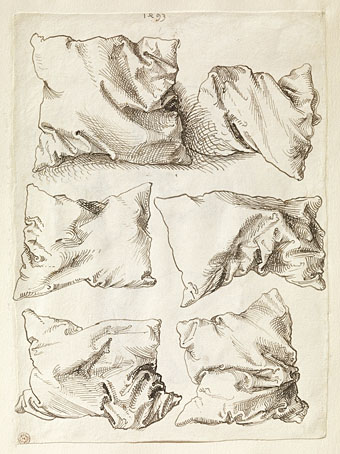
Pillow Studies (1493) by Albrecht Dürer.

• “Without ever writing a song, without ever fronting a group, Khan changed the face of British music.” Michael Hann talks to Morgan Khan about bringing New York Electro to the UK with his Streets Sounds label.

James Balmont offers “an introduction to Japan’s visceral cyberpunk cinema in five cult films”. This reminds me that I’ve not seen Shinya Tsukamoto’s Tetsuo films for years. Time to reacquaint myself.

• At Aquarium Drunkard: 15-minutes of Alice Coltrane from 1970, talking about her music and performing with Pharoah Sanders et al. Amazing.

Clive Hicks-Jenkins presents Beauty & Beast, an animated fairy tale made to showcase his toy theatre design.

• Carl Dreyer’s horror masterpiece, Vampyr (1932), is released on blu-ray by Eureka in May.

• At Wormwoodiana: Mark Valentine explores the mysteries of the Egg Language.

• DJ Food unearths paintings by Syd Mead for a Celcon Steel brochure, 1965.

• Jamie Sutcliffe enters The Strange World of Junji Ito.

• Mix of the week: Isolatedmix 117 by Refracted.

Keeley Forsyth‘s favourite music.

Electrocharge (1980) by Blackbeard | Electrodub1 (1980) by Chris Carter | Ano Electro (Andante) (1993) by The Sabres Of Paradise

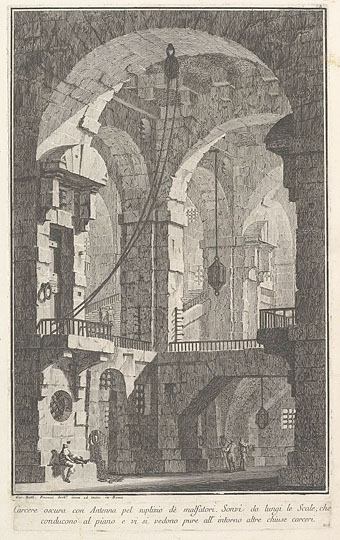
The other Carceri

carceri12.jpg

Dark prison with a courtyard for the punishment of criminals (c.1750) by Giovanni Battista Piranesi. (NB: not one of the Carceri d’Invenzione although it is another imaginary prison.)

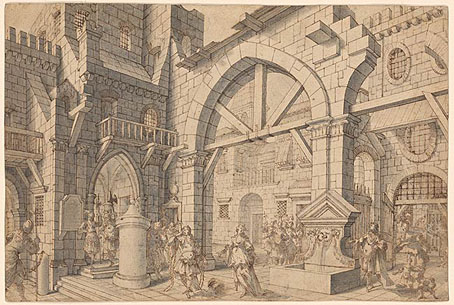
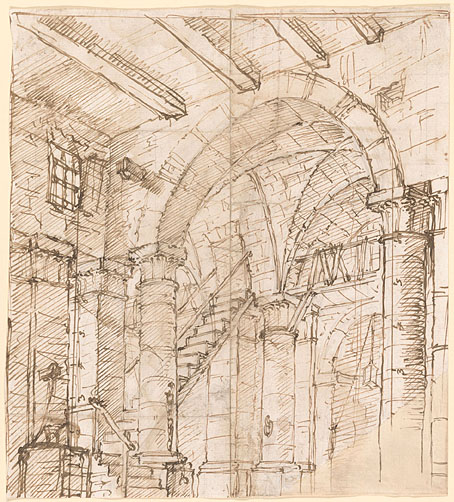
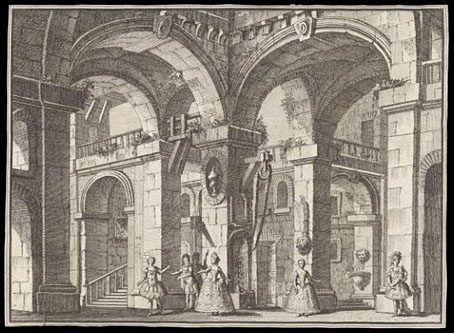
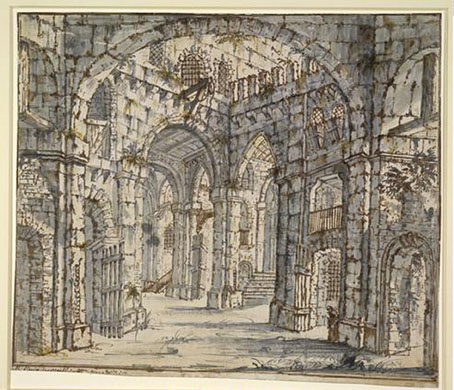
Piranesi’s etchings of imaginary prisons, the Carceri d’Invenzione, are his most celebrated and influential works but they’re not the only such views to be found in 18th-century art. What you see here are some of the prison settings designed for the theatre and opera of the time, where incarceration or unjust imprisonment was a recurrent theme. Beethoven’s only opera, Fidelio, is one of the more famous examples, with all the action taking place inside the walls of a Spanish prison.

carceri08.jpg

Prison Courtyard with Figures (c. 1720). Attributed to Francesco Galli Bibiena.

Many of these designs are by various Galli Bibienas, a multi-generational family of Italian artists and architects who included theatrical designers among their talented number. The Galli Bibienas’ prisons lack the invention and menace of Piranesi’s etchings—many of them look as neat and tidy as their designs for colossal gardens and palaces—but I enjoy the dramatic perspectives all the same.

carceri01.jpg

Prison Interior (c.1725–1730) by Antonio Galli Bibiena.

carceri01.jpg

Print depicting the Prison scene in the opera-ballet Cerere placata at the Royal Palace of Jove (1772). Carlo Bibiena (artist) and Giovanni Battista Nolli (etcher).

carceri03.jpg

Design for a stage set: the interior of a prison. School of Francesco Galli Bibiena.

Continue reading “The other Carceri”