Mister Jarman, Mister Moore and Doctor Dee

tempest.jpg

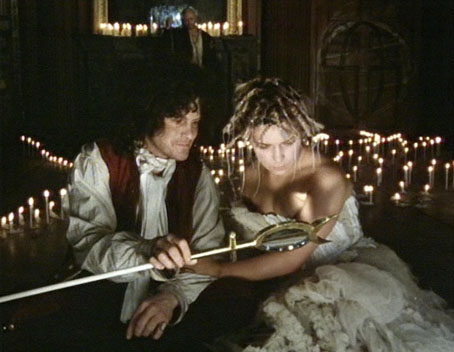
Prospero (Heathcote Williams) and Miranda (Toyah Willcox), The Tempest (1979).

The Shakespeare who spun The Tempest must have known John Dee; and perhaps through Philip Sidney he met Giordano Bruno in the year when he was writing the Cena di Ceneri—the Ash Wednesday supper in the French Ambassador’s house in the Strand. Prospero’s character and predicament certainly reflect these figures, each of whom in his own way fell victim to reaction. John Dee, with the greatest library in England, skrying for the angels Madimi and Uriel (so nearly Ariel)—all of which is recorded in the Angelic Conversations—ended up, in his old age, penniless in Manchester. Bruno was burnt for heresy.

Ten years of reading in these forgotten writers, together with a study of Jung and his disciples proved vital in my approach to both Jubilee and The Tempest. As for the black magic which David Bowie thought I dabbled in like Kenneth Anger, I’ve never been interested in it. I find Crowley’s work dull and rather tedious. Alchemy, the approach of Marcel Duchamp, interests me much more.

Derek Jarman, Dancing Ledge (1991).

Damon Albarn’s opera Doctor Dee has been all over the news this week following its premier as part of the Manchester International Festival. Last weekend one of the press ads was announcing this as an “untold story”, as though no one had given much thought to the Elizabethan magus prior to Mr Albarn’s arrival. Neither the ads nor anyone associated with the production will be in a hurry to tell you that the idea for the opera came from Alan Moore who’s had a fascination with John Dee’s life and work for many years. Albarn and fellow Gorillaz cohort Jamie Hewlett approached Alan about a collaboration a couple of years ago; Alan agreed to write something on the condition that Gorillaz provide a contribution to Alan’s magazine, Dodgem Logic. They agreed, Alan set to work, having suggested John Dee as a good subject then the whole thing fell apart: Gorillaz said they were too busy to accommodate themselves to the magazine’s generous deadlines so Alan told the pair that he was now too busy to have anything further to do with their opera. This is all old news (and being a Dodgem Logic contributor I have a partisan interest in the story) but it’s worth noting since the opera will be playing elsewhere once it’s finished its Manchester run so we’ll continue to hear about it. The point is that the subject matter was Alan Moore’s choice, not Damon Albarn’s; if Alan had decided to write something about Madame Blavatsky (say) we’d now be reading reviews of Blavatsky: The Opera. Albarn can at least be commended for staying with the subject. Despite John Dee’s exile in Manchester being part of the city’s history (among other things he helped organise the first survey of the streets) you can bet the apes from Oasis have never heard of him.
jubilee.jpg

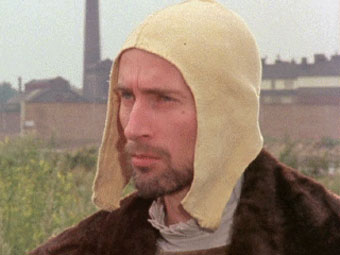
Richard O’Brien as John Dee in Jubilee (1978).

All of which had me thinking how John Dee, a maverick intelligence of the Elizabethan era, has a tendency to attract equally maverick intelligences in later eras. Derek Jarman’s work returns to John Dee often enough to make the magus a recurrent theme in his films, from the scenes in Jubilee (1978) (part of an earlier script) where he’s portrayed by Richard O’Brien showing Elizabeth I the future of her kingdom, to The Tempest (1979) where Prospero’s wand is modelled on Dee’s Monas Hieroglyphica, to The Angelic Conversation (1987) which borrows its title from Dee’s scrying experiments and finds via the sonnets another connection between John Dee and Shakespeare (Ariel being the contrary spirit whose magic allows a vision of the future in Jubilee). By one of those coincidences which make you think there must have been something in the air during the mid-70s, Michael Moorcock’s novel Gloriana, or The Unfulfill’d Queen was published the year Jubilee premiered, a fantasy in which the Elizabethan court is blended with its fictional counterpart from Spenser’s The Faerie Queen, and which features a Doctor John Dee as the queen’s Councillor of Philosophy. (If you want to stretch the connections further, Jenny Runacre who plays Elizabeth in Jubilee had earlier portrayed Miss Brunner in the film of Moorcock’s The Final Programme.)
mindscape_dee.jpg

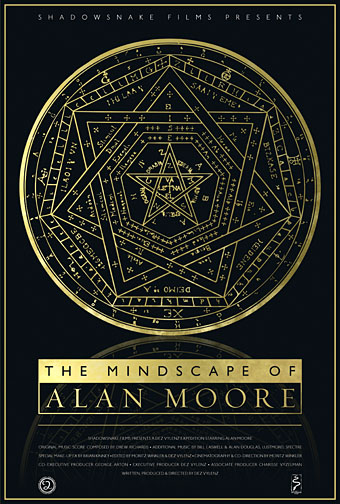
My 2009 poster design for The Mindscape of Alan Moore, a documentary by Dez Vylenz. John Dee’s Sigillum Dei Aemeth appears in the film so I used this as the principal motif for the packaging design and DVD interface.

Reading the reviews it’s impossible to tell how Alan’s libretto might have fared on stage compared to the work which is now showing, the content of which draws on Benjamin Woolley’s excellent biography, The Queen’s Conjuror. Alan and Benjamin Woolley can both be found among the interviewees in a Channel 4 documentary about John Dee broadcast in the Masters of Darkness (sic) series in 2001. For those keen to delve beyond the stage show, Derek Jarman’s films are all on DVD, of course, while fragments of Alan’s libretto can be found in the fourth edition of Strange Attractor along with his notes for the rest of the opera. Charlotte Fell Smith’s life of Dee from 1909, for many years the standard study of the man, can be found online here.

Previously on { feuilleton }
• The Tempest illustrated
• Robert Anning Bell’s Tempest
• In the Shadow of the Sun by Derek Jarman
• Designs on Doctor Dee
• Derek Jarman at the Serpentine
• The Angelic Conversation
• The life and work of Derek Jarman
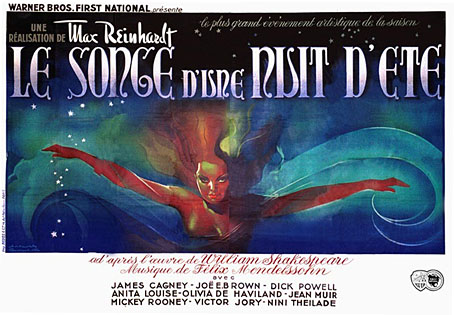
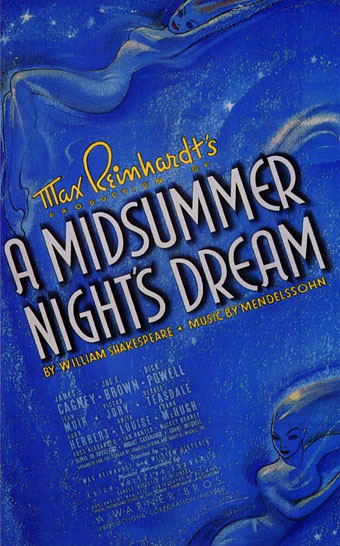
Max Reinhardt’s Dream

mnd1.jpg

In which the great German theatre director goes to Hollywood to show America how to stage Shakespeare. Nearly everyone who was anyone in pre-war German cinema passed through Max Reinhardt’s Deutsches Theater in Berlin so it seemed natural that he’d gravitate eventually to film himself. The 1935 production of A Midsummer Night’s Dream was directed by William Dieterle but it’s very much a Reinhardt production, especially in the fantastic opening of Act II where the fairies dance into the moonlit sky on paths of mist accompanied by Mendelssohn’s music. With its blend of music, dance and lavish production design Dieterle’s film gives us some idea of the harmonising artistry at work in Reinhardt’s stage productions.

mnd2.jpg

There are other reasons to recommend this version over later adaptations, not least James Cagney’s performance as Bottom. A fifteen-year-old Mickey Rooney played Puck although he’s frequently more annoying than mischevious. Then there’s the mystery of whether that’s the young Kenneth Anger uncredited in the role of The Changeling Prince. Anger has always claimed it was him (he was a child actor for a while), Anger biographer Bill Landis agrees but plenty of other people have disputed the claim in recent years. The best viewing I had of the sequence in which the Changeling appears was on a big screen in a season of Kenneth Anger’s films in 1990. Whether Anger played the part or not, the charm of Dieterle’s film subtly invests The Magick Lantern Cycle, from the glittering surfaces in Eaux D’Artifice and the artificial forest in Rabbit’s Moon, to the appearance of Mickey Rooney’s Puck on a TV screen in Scorpio Rising. Anger’s later works were productions of Puck Films, their motto “Lord, what fools these mortals be!”

Ideally the magical opening of Act II would be on YouTube but it seems not. This scene, however, gives an idea of the atmosphere, while Doctor Macro has stills and more information.

Previously on { feuilleton }
• The Midsummer Chronophage
• Another Midsummer Night
• A Midsummer Night’s Dadd
• William Heath Robinson’s Midsummer Night’s Dream

Weekend links 62

pavlishin.jpg

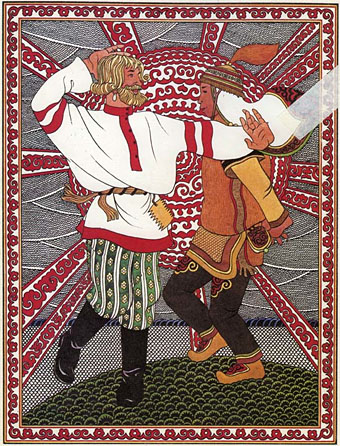
A plate from Tales of the Amur by Dmitry Nagishkin, a 1975 edition illustrated by Gennady Pavlishin.

• The week in Surrealism: Opera of the surreal gives Dalí an encore: Yo, Dalí, a previously unperformed work by Xavier Benguerel, receives its premier in Madrid. Meanwhile Tate Liverpool’s summer exhibition, René Magritte: The Pleasure Principle, is profiled here. “René Magritte has inspired more book covers than any other visual artist,” says James Hall.

If Rimbaud anticipated the Surrealists by decades, Ashbery is said to have gone beyond them and defied even their rules and logic. Yet though nearly 150 years have intervened since Rimbaud’s first declaration of independence, many readers in our own age, too, still prefer a coherence of imagery, a sameness of tone, a readable sequential message, even, ultimately, what amounts to a prose narrative broken into lines.

Lydia Davis on Rimbaud’s Wise Music.

• Umberto Eco’s glimpse into the art of the novel | Return to Wonderland: an essay on Lewis Carroll’s world by Alberto Manguel | Heavy sentences by Joseph Epstein: On How to Write a Sentence and How to Read One, by Stanley Fish.

And then there’s the mystery of what happened to him for those four months in London when we have no trace of him. Rimbaud mentions Scarborough in “Promontory” and talks about “Hotels, the circular façades of the Royal and the Grand in Scarborough or Brooklyn.” Since there’s that missing period in England, people say he must have gone to Scarborough, and have even checked hotel registers for that period, but as far as I know nobody has ever found anything. Someone even checked railway and train schedules in order to pin him to this real place. I seem to remember a French writer admitting that Rimbaud was never in Brooklyn, but kind of wishfully thinking that he might have been. Which is very funny. “Rimbaud in Brooklyn”: there’s a project for someone.

A Refutation of Common Sense, John Ashberry on translating Rimbaud.

• Robert Jeffrey posts a video of his nine-year-old self giving Madge a run for her money in 1991. As Boy Culture puts it: “Anyone who feebly clings to the belief that gay can be prayed away should take a look at this and give up already…” Amen.

• The mathematics of Yog-Sothoth: Richard Elwes on Exotic spheres, or why 4-dimensional space is a crazy place.

• For I Will Consider My Cat Jeoffry by Christopher Smart (1722–1771).

• Lesbian pulp fiction, 1935–1978 and Faber 20th century classics.

• As The Crow Flies, a new album from The Advisory Circle.

• New World Transparent Specimens by Iori Tomita.

• 79 versions of Gershon Kingley’s Popcorn.

• Minor Man (1981) by The League of Gentlemen.

Dalí’s Salomé

dalisalome.jpg

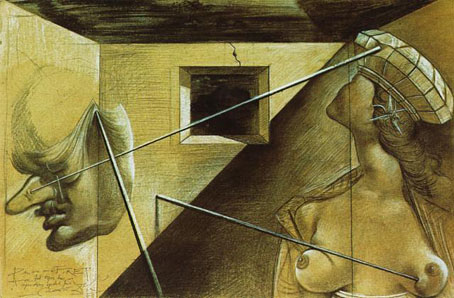
Queen Salomé (1937) by Salvador Dalí.

Of all the Surrealists, Salvador Dalí had his fingers in the most cultural pies—designing for film and theatre, writing books (including a novel, Hidden Faces), even performing occasionally, or at least making a public spectacle of himself—so it’s no surprise to find him adding to the stock of 20th-century Salomé interpretations, first in a drawing then for the stage. The stage work was something I hadn’t run across before (not since this current obsession began, anyway), a 1949 production of the Strauss opera at Covent Garden directed by Peter Brook. The now celebrated theatre director was at the outset of his career when he chose Dalí as his designer but the resultant furore shows that Brook’s ability to challenge an audience (or at least, a gaggle of theatre critics) had an early start. The critics savaged the production and the show closed after only six performances. Brook, who was sacked, had this to say:

The critics all decided that Dali and I were only out to annoy them. There, at least, I might claim that they underestimated us; if that have been our intention I think that between us we might have done much worse… (More)

Getty Images has some tantalising photos here, here and here, but I’ve not seen anything in the way of production sketches. The objections seem to have been the usual tiresomely English revulsion against anything too original, too strange or too imaginative (it’s no wonder Leonora Carrington abandoned Britain for Mexico). An article about the production from the BBC’s Music Magazine includes this detail:

In the last scene for Dali and Brooke, [Salomé] was slowly covered over by a sort of green ooze of bile that came from the head of John the Baptist, an effect of luxuriant disgust which we can imagine without too much difficulty, bearing in mind others of Dali’s images.

That piece also mentions a proposed restaging of the opera with Dalí’s designs but I’ve been unable to discover whether this took place. If anyone knows better, please leave a comment.

Elsewhere on { feuilleton }
• The Salomé archive

Wild Salomés

wildesalome.jpg

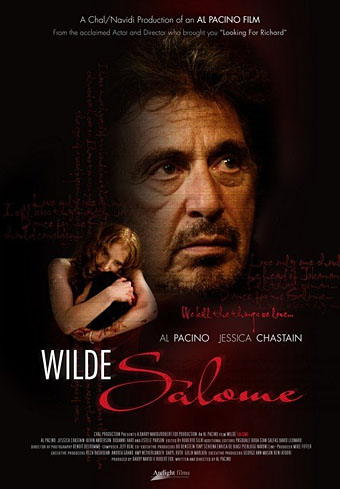
So there’s a poster for Al Pacino’s forthcoming drama-documentary about the Oscar Wilde play but I’ve yet to see any release details. The tagline connects Salomé with The Ballad of Reading Gaol: “We kill the thing we love.”

salome1986.jpg

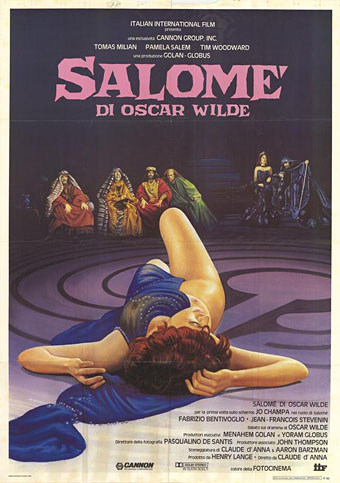
Searching around for posters turned up this item for an Italian-French co-production of the Wilde play directed by Claude d’Anna. I’ve not seen this but it can’t be any worse than Ken Russell’s version so it may be worth seeking out.

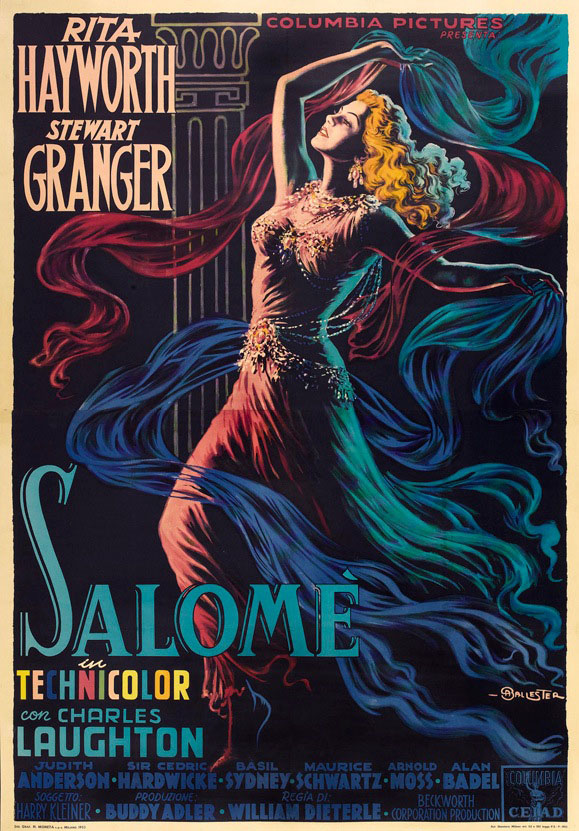
salome1953.jpg

Far better poster-wise is this splendid creation by Anselmo Ballester for the Italian release of the 1953 Hollywood film (which isn’t based on the play). Rita Hayworth was too old for the role, and the film is simultaneously lavish and dull in the way that so many sword-and-sandal epics manage to be, but the poster is a gem. This site has many more examples of Ballester’s poster art.

Elsewhere on { feuilleton }
• The Oscar Wilde archive
• The Salomé archive