Michael Powell’s Bluebeard revisited

powell1.jpg

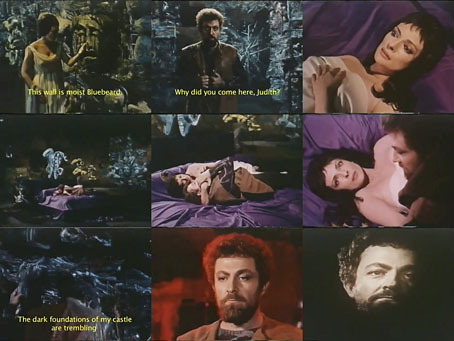
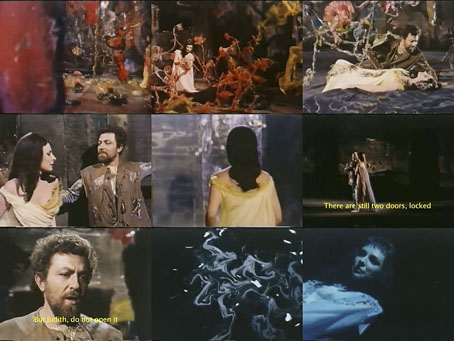
Yesterday’s post prompted me to look again for one of Michael Powell’s scarcest films, his television version of Bartók’s Bluebeard’s Castle made for  Süddeutscher Rundfunk in 1963. Sure enough, it’s now on YouTube in a watchable copy taken from VHS tape. Herzog Blaubarts Burg (to use its German title) was made post-Peeping Tom when the director’s career was at its lowest ebb, and while the production values don’t match those he’d been used to in the 1940s he was no doubt happy to be working at all after being vilified by the UK press. Norman Foster is Bluebeard and Ana Raquel Satre plays Judith, with the libretto being a German translation with English subtitles. I ought to note here that I’ve not read the second volume of Powell’s biography (mea culpa) so the only information I have about this comes from Ian Christie’s Arrows of Desire: The Films of Michael Powell and Emeric Pressburger (1985). Christie doesn’t have much to say about it other than pointing out that Norman Foster financed the film, and that it’s seldom been screened in Britain: IMDB has the first UK screening as 1978, just prior to the time when Powell and Pressburger began to receive to some belated recognition.
powell2.jpg

The YouTube copy suffers in the sound department by being a muffled mono transmission but it’s the visuals which will be of most interest to Powell aficionados. Powell & Pressburger’s regular production designer Hein Heckroth created the multi-coloured labyrinth which serves as the castle. The overall effect is stagey but contains some unique details, such as the rune-etched standing stones shown at the opening and close, and also some painted moments similar to those seen during the celebrated dance sequence in The Red Shoes (1948). Powell’s staging is much more vivid and artificial than Leslie Megahey’s 1988 adaptation whose Gothic gloom remains a personal favourite. Despite its shortcomings, when compared to the other Powell films that came after—the two Australian features, the Children’s Film Foundation commission which reunited him with Pressburger—this is far closer to the greatest works of the Archers era, and provides a more satisfying career coda for the man who directed The Red Shoes and The Tales of Hoffmann.

Previously on { feuilleton }
• Joseph Southall’s Bluebeard
• Leslie Megahey’s Bluebeard
• Powell’s Bluebeard
• The Tale of Giulietta
Julius Klinger’s Sodom

klinger1.jpg

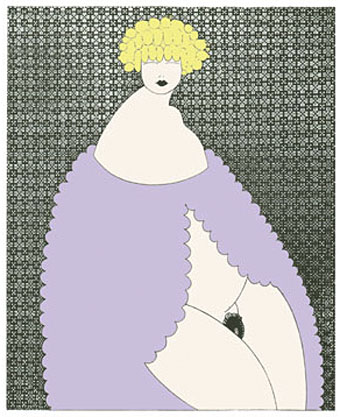
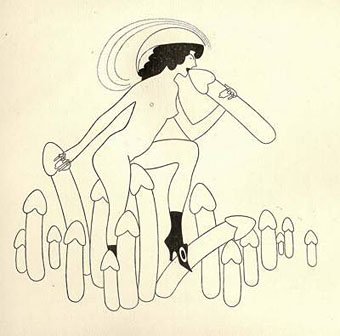
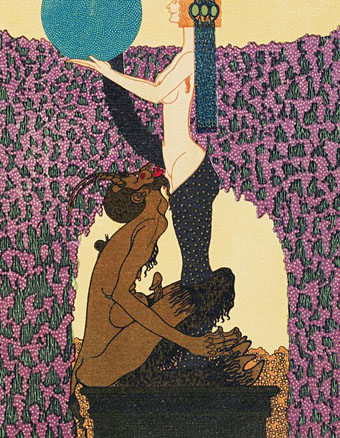
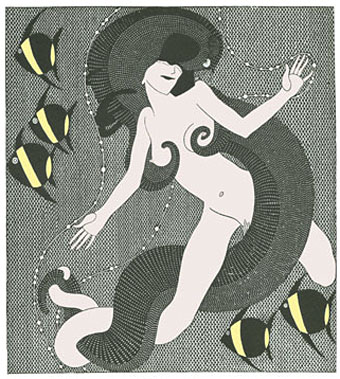
The more I look at the work of Austrian artist Julius Klinger (1876–1942), the more I like what I see. This Pinterest sample shows his versatility, equally at home with detailed illustration, often with a Beardsley-like quality, as he was with more Modernist design. Sodom (1689) (aka The Farce of Sodom, or The Quintessence of Debauchery) is the notorious Restoration drama attributed to John Wilmot, the second Earl of Rochester, which is here illustrated by Klinger for an edition privately published in Leipzig in 1909. The play is one of the most flagrantly outrageous works in the English language, with a cast of characters that includes Bolloxinion, the King of Sodom, Cuntigratia, his Queen, and so on; you can see parts of it performed in The Libertine (2004) with Johnny Depp playing Rochester, and taking the role of Bolloxinion.

Klinger produced 16 illustrations in all. His picture of Salomé gets linked to this series on a number of websites but I’ve seen other sites that list it as a separate piece. Since Salomé isn’t mentioned anywhere in Sodom I’d also be inclined to keep them separate.

klinger2.jpg

klinger3.jpg

klinger4.jpg

Elsewhere on { feuilleton }
• The illustrators archive

Previously on { feuilleton }
• Deutsche Kunst und Dekoration #21
• Julius Klinger’s Salomé

Weekend links 155

austin.jpg

Poster design by Mishka Westell for this month’s Austin Psych Fest. Billy Gibbons’ pre-ZZ Top psychedelic outfit, The Moving Sidewalks, surprised everyone by reforming for a New York gig last month, their first performance together in 44 years.

• Pye Corner Audio played the Boiler Room, London, last week, and remixed a track from FC Judd’s Electronics Without Tears. Also on the latter is Chris Carter who talks about his own remix (and the “Radiophonic” Mr Judd) here.

• Tom Bianchi’s Fire Island Pines, Polaroids of New York’s gay enclave from 1975–1983. Related: In Conversation with the Violet Quill: Andrew Holleran, Felice Picano, and Edmund White.

• From 2011: Sex, prison and lost ligatures: The story of Herb Lubalin’s Avant Garde typeface. Related: The ITC Avant Garde Gothic group at Flickr.

• Music reissues: Tape Works 1981–1982 by Laughing Hands is out now, and Scott Walker’s early solo albums will be reissued in the summer.

fraser.jpg

Drugs and the Mind (ii), a cover design from 1957 by Eric Fraser (1902–1983) whose illustrations and designs are in exhibition at the Chris Beetles gallery, London.

• At Ubuweb: William S. Burroughs + Brion Gysin + Genesis P-Orridge – Cold Spring Tape (1989).

• The World According to John Coltrane, an hour-long documentary.

• Neko Font: for when you need a word made of cats.

• Fuck yeah, Sarah Bernhardt

• Sordid Spheres!

• 99th Floor (1967) by The Moving Sidewalks | Over Fire Island (1975) by Brian Eno | Ledge (1980) by Laughing Hands

Le Cantique des Cantiques

kupka1.jpg

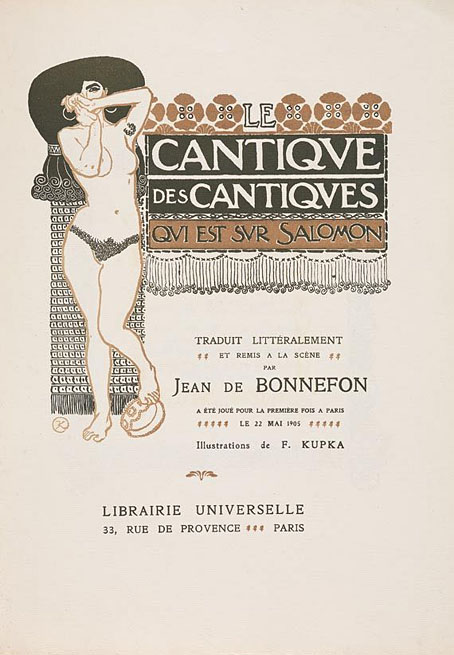
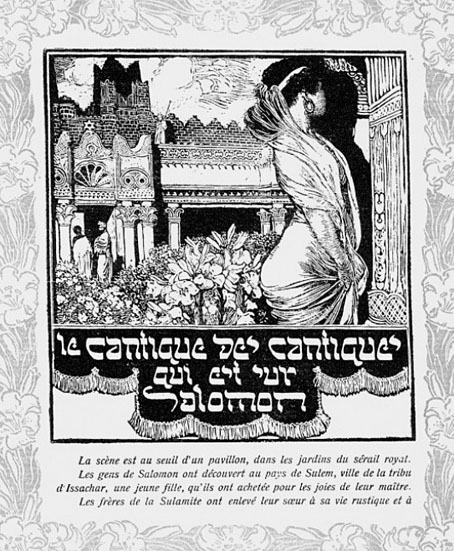
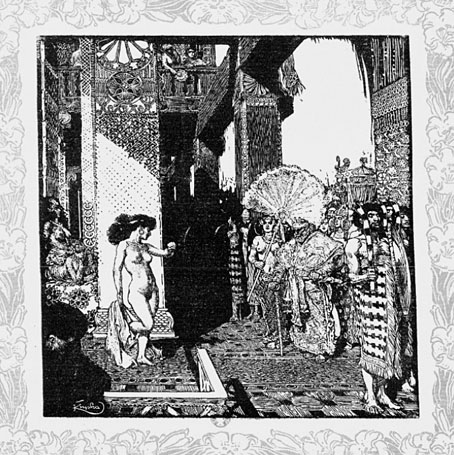
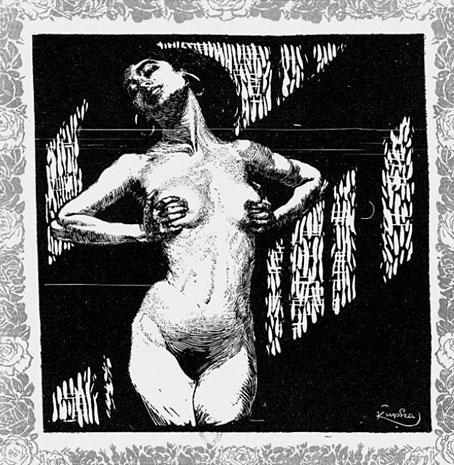
An oddity from the career of František Kupka, Le Cantique des Cantiques (1905) in this version is a stage presentation of the Song of Solomon by Jean de Bonnefon. Kupka provided a series of illustrations in a style similar to his Symbolist paintings which in the original printing are decorated with coloured borders. The copies here are from a bad scan at Gallica whose page I’ve been unable to find again. For the moment there are better copies to be seen at eBay. The drama is very much oriented towards the sexual exotica which Oscar Wilde had rendered notorious in Salomé, and which underpins so many of the obsessions of the period. A few years after this Kupka was in a different world entirely, following new directions into abstract art.

kupka6.jpg

kupka5.jpg

kupka3.jpg

Continue reading “Le Cantique des Cantiques”

Brecht and Bowie

baal2.jpg

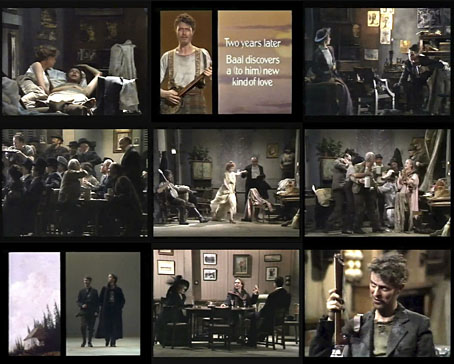
While David Bowie is still making the news it’s worth revisiting Baal, an hour-long BBC TV adaptation of the Bertolt Brecht play broadcast in 1981. Bowie stars as the title character, a thoroughly disagreeable poet and café singer who ruins the lives of those around him. This caused a stir at the time more for Bowie’s presence than for the content although Brecht wasn’t exactly a popular choice for evening entertainment. Prior to this most of Bowie’s acting had been in films, with his television appearances being limited to song performances or chat show discussions. The Man Who Fell to Earth aside, I’ve been somewhat dismissive of Bowie’s acting at times, his accent and the sheer weight of his musical persona overwhelm whatever role he’s given, but he’s good in this. He throws himself into the role, and is more convincing than I remember him being a couple of years later in Merry Christmas Mr Lawrence.

baal.jpg

For many people Bowie will be the sole attraction in Baal but for me there’s also the presence of the great Alan Clarke as director and co-adaptor (with John Willett). Clarke directed the cult TV play Penda’s Fen in 1974, and was later responsible for a handful of other notable TV films including Scum, Made in Britain, Road, Elephant (1989), and The Firm, all of which are distinguished by a singular intensity and dramatic power the likes of which is usually only found in the best feature films. Compared to those plays Baal is a minor piece, filmed entirely in the studio, and made deliberately stagey to honour Brecht’s Verfremdungseffekt. The cameras keep their distance from the performers, and Brechtian distance is also achieved by the use of split-screen, title cards, and Bowie’s direct addresses to the viewer. If this seems like challenging material for a general audience (never mind the singer’s fans) consider that Baal was broadcast in primetime on BBC 1 when there were only three television channels in the UK. This would not happen today.

Previously on { feuilleton }
• Penda’s Fen by David Rudkin